
Compare Device as a Service / Hardware Leasing Providers UK (2026)
Compare Devices, Lifecycle Services, Contract Flexibility And End-of-Term Control
Compare Device as a Service and hardware leasing for UK businesses by device choice, contract term, deployment, asset records, support, repairs, replacements, refresh cycles, secure returns, residual value, sustainability evidence and total cost. Evaluate suppliers against the same employee-device and lifecycle requirements before committing laptops, desktops, workstations, tablets, smartphones or accessories to a multi-year agreement.
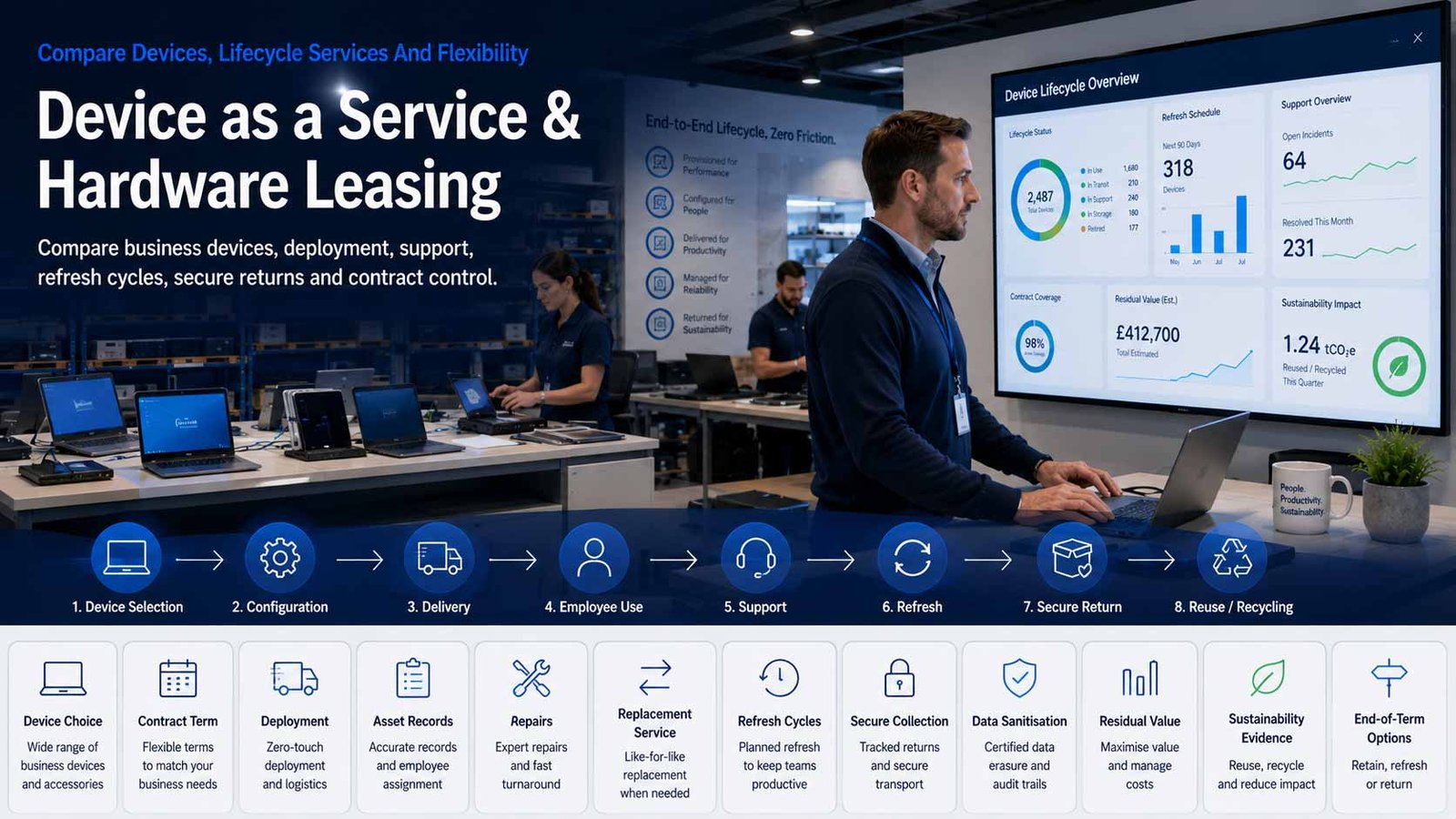
DaaS Is A Lifecycle Service, Not Only Monthly Hardware
The value comes from standardising, deploying, supporting, refreshing and recovering devices reliably—not simply spreading an invoice over several years.
- Define role-based device standards and expected service life
- Separate hardware, lifecycle services, support and contract charges
- Track every device, user, location, warranty and return obligation
- Plan secure sanitisation, reuse, resale and recycling before deployment
Device as a Service combines business hardware with selected lifecycle services under a recurring commercial model. Depending on the provider, the service may cover sourcing, configuration, zero-touch enrolment, delivery, user assignment, asset tracking, support, repairs, swaps, refresh, collection, data sanitisation, reuse, remarketing and recycling.
Hardware leasing can be narrower. It may provide a defined set of devices over a fixed term while the customer remains responsible for configuration, management, support, asset records and return. Buyers should not assume every lease is a managed device service or that every DaaS proposal transfers the same operational responsibilities.
This page does not compare consumer finance, personal credit, general business loans or unrestricted working-capital products. It also does not replace the dedicated IT Asset Management / MDM comparison. Device inventory, endpoint policy and mobile-device management may support a DaaS arrangement, but the commercial decision here remains focused on acquiring and operating business hardware through a structured lifecycle agreement.
Separate Hardware Funding From Lifecycle Responsibility
Providers use Device as a Service, leasing and lifecycle terminology differently. Compare the delivered operating model rather than the label.
| Service Model | What It Usually Provides | Best-Fit Question |
|---|---|---|
| Hardware lease only | Specified devices supplied for a fixed term with regular payments; lifecycle services may be minimal or separately contracted | Who owns configuration, repair, asset tracking, insurance, end-of-term return and data sanitisation? |
| Bundled Device as a Service | Hardware combined with deployment, support and end-of-term lifecycle services under one recurring charge | Which services are genuinely included for every user and which remain dependent on a separate managed-services contract? |
| Managed device lifecycle | Provider manages joiner, mover and leaver workflows, stock, configuration, repair, refresh, collection and retirement | Can the provider integrate with the customer’s identity, IT service management and asset systems without losing ownership or audit evidence? |
| Manufacturer-led DaaS | OEM devices and support combined with the manufacturer’s financing, analytics and lifecycle capabilities | Does the manufacturer support the required multi-vendor estate, accessories and operating systems, or will the device standard become unnecessarily narrow? |
| Multi-vendor lifecycle service | A reseller or integrator sources and manages devices from several manufacturers under one operating model | How are equivalent models, warranties, spares, refresh standards and manufacturer escalations governed across brands? |
| Apple-focused lifecycle service | Mac, iPad or iPhone procurement, automated enrolment, support, accessories and residual-value management | Are Apple Business Manager, MDM, support, repairs, ownership, return and residual-value assumptions clearly separated? |
| Short-term project or contractor fleet | Devices supplied for seasonal staff, contractors, projects or temporary sites over a shorter or variable period | What are the minimum term, early-return conditions, damage rules, user reissue process and rapid scale-up or scale-down limits? |
| Circular refresh and residual-value model | Devices are returned, sanitised, graded, reused, redeployed, remarketed or recycled with value potentially reflected in pricing | Who receives residual value, which condition standards apply and what evidence proves secure treatment and final destination? |
Eight Areas That Determine Device as a Service Fit
Use the same lifecycle criteria for every provider so a low monthly device figure does not hide support, return or flexibility gaps.
Comparison Criterion
Device Catalogue And Role Standards
Compare manufacturers, business ranges, operating systems, processors, memory, storage, displays, workstations, mobile devices, accessories, docks, monitors and accessibility. Create approved role profiles so selection remains consistent while allowing justified exceptions for specialist users.
Comparison Criterion
Commercial Term And Ownership
Review contract length, payment structure, ownership, title, residual value, purchase or extension options, early termination, additions, reductions, loss, damage and insurance. Obtain accounting and tax advice for the organisation’s circumstances rather than relying on sales descriptions of capital or operating treatment.
Comparison Criterion
Configuration, Enrolment And Deployment
Assess imaging, firmware, BIOS settings, asset tags, encryption readiness, Autopilot, Apple automated enrolment, Android enrolment, accessories, direct-to-user delivery, desk-side setup and user communication. Confirm how failed or delayed enrolments are handled.
Comparison Criterion
Asset Records And Lifecycle Visibility
Compare serial, asset, user, location, warranty, configuration, contract, support, repair, refresh and return records. Require data access, APIs, exports and reconciliation so the business retains an authoritative inventory even if the provider portal changes.
Comparison Criterion
Support, Repair And Replacement
Review service hours, remote diagnosis, vendor warranty, on-site repair, accidental damage, loan devices, whole-unit exchange, courier arrangements, user data handling, service targets and support exclusions. Match replacement speed to the employee and business impact.
Comparison Criterion
Flexibility, Refresh And Estate Change
Assess refresh windows, model substitution, role changes, new starters, leavers, temporary users, volume changes, contract co-termination, early upgrades and extension. A predictable monthly price is not useful if the estate cannot change with the workforce.
Comparison Criterion
Return, Sanitisation And Circularity
Compare collection, chain of custody, device condition, accessories, data erasure, certificates, repair, redeployment, reuse, remarketing and recycling. Confirm approved processes, subcontractors, residual value, environmental evidence and customer liability for missing or damaged equipment.
Comparison Criterion
Service Integration, Governance And Exit
Review identity, MDM, endpoint management, ITSM, procurement, asset, finance and HR integrations. Define service reporting, contract ownership, audit, supplier change, data export, final returns, outstanding devices and transition assistance.
Measures To Define Before A Device Contract Is Signed
Translate simple, flexible and fully managed into measurable deployment, support, inventory and return outcomes.
| Measure | What It Should Define | Evidence To Request | Common Weakness |
|---|---|---|---|
| Deployment lead time | Time from approved request to a correctly configured, enrolled and delivered device | Request date, stock status, build, dispatch, delivery, enrolment, exception and acceptance | The target starts only after stock allocation and excludes user-ready validation |
| First-time-ready rate | The proportion of devices that arrive with the right hardware, accessories, policies and applications | Build checklist, enrolment result, missing items, user acceptance and corrective action | Delivery is counted as successful even when the user cannot start work |
| Device availability and failure | Whether approved device models are available and how often hardware causes lost productivity | Stock coverage, substitution, failure rate, warranty events, battery health and model trend | Cheaper devices create higher support and replacement demand |
| Repair and replacement time | How quickly a failed device returns to productive use or is replaced | Diagnosis time, courier or engineer attendance, loan stock, swap, data handling and completion | The SLA covers dispatch but not user setup or restoration of access |
| Asset-record accuracy | Whether device, user, location, contract, warranty and return records match the live estate | Inventory reconciliation, unmatched devices, stale assignments, duplicate records and owner | Provider and customer portals show different owners and contract dates |
| Joiner, mover and leaver completion | Whether device delivery, reassignment and collection happen within the required business timetable | Workflow timestamps, approvals, shipping, return, access removal, exceptions and ageing | Leaver devices remain unreturned because HR, IT and supplier processes are not integrated |
| Refresh compliance | Whether devices are replaced or extended according to approved role, age, condition and support policy | Age profile, warranty end, operating-system support, performance, refresh forecast and exceptions | The estate is refreshed by contract date rather than actual user and technical need |
| Return and sanitisation completion | Whether every returned device is collected, tracked, sanitised and closed with appropriate evidence | Chain of custody, serial match, erasure method, certificate, condition, destination and exception | A collection confirmation is treated as proof that data has been sanitised |
| Residual value and circular outcome | How returned devices are redeployed, reused, remarketed or recycled and how value is allocated | Grade, sale or reuse route, residual credit, recycling evidence, WEEE treatment and reporting | Sustainability claims are made without device-level destination evidence |
| Total cost per productive device | The complete recurring and operational cost for a device that remains usable throughout the term | Hardware, services, support, damage, replacements, stock, management, returns and internal effort | A low rental figure excludes user downtime and lifecycle administration |
Device as a Service And Hardware Lifecycle Providers UK Businesses Can Consider
Shortlist providers whose device range, commercial structure, lifecycle operations and return controls match the workforce. Confirm current availability, minimum scale and contract terms directly before award.
Provider Profile
Dell Managed Workplace Services
Dell’s workplace-services portfolio covers device deployment, lifecycle operations, support, repairs, refresh, returns and end-of-life disposition through managed workflows. Include Dell where a business wants an OEM-led lifecycle around Dell devices and direct support integration. Confirm financing separately from managed services, device ownership, available models, support level, multi-vendor coverage, asset data, refresh flexibility and the treatment of returned equipment.
Review official managed workplace servicesProvider Profile
HP Managed Device Services
HP’s current managed-device offering, previously known in many markets as Device as a Service, combines device lifecycle services, analytics, support and flexible workplace-computing options. Include HP where proactive fleet insights, OEM support and an HP-centred device standard fit the requirement. Confirm UK commercial availability, supported third-party devices, deployment scope, analytics, replacement, contract flexibility and end-of-term services.
Review official workforce-computing servicesProvider Profile
Lenovo TruScale Device as a Service
Lenovo TruScale DaaS combines configurable devices, services and lifecycle support through an as-a-service model, with newer sustainability modules focused on device life, recovery and circularity. Include Lenovo where a Lenovo device standard, global deployment or flexible lifecycle design matters. Confirm UK offer structure, minimum scale, service modules, ownership, support, refresh, data sanitisation, residual value and contract-change rights.
Review official TruScale informationProvider Profile
CHG-MERIDIAN
Technology lifecycle and financing specialist offering Device-as-a-Service, flexible rental, asset management and end-of-use services across device estates. Include CHG-MERIDIAN where multi-vendor hardware, customised commercial structures, international coverage and asset recovery are important. Confirm nominated suppliers, ownership, payment profile, asset portal, additions, early changes, condition rules, data erasure, remarketing and residual-value treatment.
Review official lifecycle servicesProvider Profile
Econocom
Econocom offers IT-as-a-service and end-user-computing solutions that combine technology sourcing, flexible commercial models and lifecycle services. Include Econocom where a business wants multi-vendor devices, recurring payments and managed disposal or refresh. Confirm which services are part of the subscription, supplier choice, contract structure, maintenance, device management, support, end-of-term return, data sanitisation and any residual-value assumptions.
Review official IT-as-a-service informationProvider Profile
Computacenter Device Lifecycle Management
Computacenter manages enterprise device fleets across sourcing, configuration, deployment, stock, support, tracking, refresh and recovery. Include it where a larger or distributed organisation needs integration with workplace operations and global logistics. Confirm commercial ownership separately from lifecycle management, supported manufacturers, minimum scale, user fulfilment, ITSM integration, asset data, regional coverage, support model and end-of-life process.
Review official device lifecycle managementProvider Profile
Softcat Managed Device Lifecycle
Softcat’s managed device lifecycle service supports joiner, mover and leaver processes, configuration, helpdesk, logistics and lifecycle control, with access to manufacturer and financing options through its partner ecosystem. Include Softcat where a UK organisation wants consultative sourcing and managed operational delivery. Confirm the funding provider, included service desk, device scope, stock, repair, MDM boundary, service levels, asset records and return process.
Review official managed lifecycle serviceProvider Profile
XMA Device Management as a Service
XMA’s DMaaS covers procurement, secure storage, pre-delivery configuration, deployment, joiner-mover-leaver workflows, break-fix, asset records, refresh and secure retirement. Include XMA where end-to-end UK device operations, public-sector experience or Apple and multi-vendor services are relevant. Confirm the financing or DaaS component, supported devices, ITSM and MDM integration, service coverage, collection, sanitisation, upcycling and commercial flexibility.
Review official device-management serviceWhat Changes Device as a Service And Hardware Leasing Cost
The monthly device payment is only one component. Deployment, support, stock, workforce change, returns, damage and lifecycle services can materially change the total.
| Cost Driver | Why It Changes Spend | What A Comparable Proposal Should Show |
|---|---|---|
| Device specification and accessories | Processor, memory, storage, display, graphics, ruggedisation, monitors, docks, cases and peripherals alter device and support cost | Role profile, approved models, accessory bundle, substitution rule, warranty, compatibility and refresh assumption |
| Contract length and residual value | Longer terms can lower monthly payments while increasing exposure to obsolete devices, workforce change and return conditions | Term, ownership, residual assumption, extension, purchase, early termination, refresh date and end-of-term options |
| Deployment and configuration | Imaging, enrolment, asset tags, firmware, accessories, direct delivery, desk setup and data migration may be included or charged per event | Per-device tasks, volume, locations, exception rates, tooling, acceptance and failed-deployment handling |
| Stock and fulfilment | Reserved buffer stock, secure storage, urgent joiners, international delivery and model availability create recurring or event charges | Stock ownership, minimums, replenishment, ageing, loss, same-day or next-day options and unused inventory |
| Support, repair and accidental damage | Warranty upgrades, on-site repair, courier collection, whole-unit swap, loan stock and damage protection materially affect recurring cost | Service target, covered faults, exclusions, excess, battery, user damage, data handling and replacement device |
| Management and service integration | Asset portals, monitoring, ITSM workflows, device analytics, reporting and dedicated service management may sit above the hardware payment | Included platform, integrations, API, service manager, reports, improvement activity and internal responsibilities |
| Estate flexibility | New starters, leavers, seasonal demand, mergers, role changes and early refresh can trigger additions, reductions or termination charges | Volume bands, co-termination, substitution, early return, reassignment, temporary users and maximum change allowance |
| Collection and end-of-term condition | Courier collection, missing accessories, cosmetic damage, failed returns and late devices can create significant charges | Condition guide, packaging, collection attempts, missing-item rates, dispute process, grace period and charge schedule |
| Data sanitisation and circular services | Certified erasure, physical destruction, repair, reuse, resale, recycling and reporting can be included or separately priced | Method, standard, chain of custody, certificate, subcontractors, residual credit, WEEE route and evidence |
| Tax, accounting, insurance and contract advice | Commercial treatment depends on contract substance and the organisation’s circumstances rather than the service label | Supplier terms, ownership, risk, insurance, damage, taxes and professional accounting or legal review before signature |
How The Workforce Changes The Provider Shortlist
The right provider depends on device diversity, employee locations, refresh policy, internal operational capacity and how often the workforce changes.
Small Business With Predictable Growth
Prioritise a limited set of business devices, straightforward recurring cost, rapid deployment, reliable warranty support, clear ownership, simple refresh and return terms that do not require a large internal device team.
Distributed Or Hybrid Workforce
Prioritise direct-to-user delivery, zero-touch enrolment, courier repair, replacement stock, remote support, joiner-mover-leaver integration, location tracking and secure collection from home workers.
Large Multi-Vendor Estate
Prioritise device standards, global or national logistics, manufacturer independence, asset data, stock forecasting, ITSM integration, service management, repair analytics and controlled refresh across business units.
Apple Or Specialist Device Environment
Prioritise automated enrolment, MDM compatibility, approved accessories, Apple or specialist repair capability, residual-value management, secure returns and role-based exceptions without fragmenting lifecycle records.
How To Compare Device Proposals
Give every provider the same user roles, approved hardware, accessories, locations, joiner volumes, support needs, failure scenarios, refresh rules, return conditions, asset-data requirements and workforce-change assumptions. Require the response to separate device funding from every lifecycle service.
- Each role maps to named hardware and accessory standards
- Contract ownership, residual value and end-of-term options are explicit
- Deployment, support, repairs and replacements are demonstrated
- Asset records integrate with customer systems and remain exportable
- Leavers, early returns, missing devices and damage are costed
- Sanitisation, reuse, resale and recycling evidence is included
Make Every Provider Run The Same Device Lifecycle
Ask each finalist to process the same new starter, urgent replacement, role change, leaver, damaged device, early return and end-of-term refresh.
Compare elapsed time, user effort, asset evidence and charges across the full lifecycle before comparing the monthly hardware figure.
Six Questions To Put To Every Device Provider
The answers expose hidden service gaps, inflexible contract terms, weak asset evidence and expensive return conditions before the agreement starts.
What Is Included Beyond The Hardware?
Request a line-by-line schedule for sourcing, configuration, storage, deployment, support, repair, replacement, asset records, refresh, collection, sanitisation, reuse and recycling.
Who Owns The Device And Residual Value?
Confirm legal ownership, risk, insurance, loss, damage, purchase or extension options, residual-value assumptions, return condition and who receives remarketing proceeds.
How Will Joiners, Movers And Leavers Work?
Ask for request channels, approvals, stock, build, enrolment, direct delivery, reassignment, collection, access removal, ageing exceptions and integration with HR or ITSM.
What Happens When A Device Fails?
Test diagnosis, service hours, courier or engineer response, loan stock, replacement, accessories, user data, MDM enrolment, warranty escalation and completion evidence.
How Flexible Is The Contract When Headcount Changes?
Confirm additions, reductions, temporary users, early returns, early upgrades, co-termination, substitutions, mergers, international moves and charges outside forecast volumes.
How Are Devices Sanitised And Accounted For At Exit?
Request serial-level chain of custody, erasure method, certificates, missing-device reconciliation, condition grading, reuse or resale route, WEEE evidence and final data export.
A Seven-Stage Device as a Service Evaluation
Move from workforce and lifecycle evidence to controlled rollout rather than selecting a monthly device package before understanding operational demand.
- Inventory users, roles, current devices, age, condition, operating systems, accessories, locations, failures, support costs, refresh dates and unreturned assets.
- Define role-based device standards, support impact, deployment, stock, asset-record, security, refresh, return and sustainability requirements.
- Choose the commercial and operating model: purchase, lease-only, bundled DaaS, managed lifecycle or a combination for different user groups.
- Issue one written brief and obtain comparable hardware, service, contract, deployment, support, return and three-year commercial responses.
- Run a configured pilot covering new starters, remote delivery, enrolment, support, replacement, asset reconciliation and a representative device return.
- Roll out in controlled waves with stock planning, user communication, acceptance, legacy-device collection, reconciliation and removal of old data and access.
- Operate with licence and device reviews, stock forecasts, SLA reporting, asset reconciliation, refresh governance, leaver controls and regular return evidence.
Device as a Service / Hardware Leasing Comparison Checklist
Use this table before approving a device subscription, lease, lifecycle service or workforce rollout.
| No. | Requirement | Evidence To Obtain Before Award | Confirmed |
|---|---|---|---|
| 01 | User roles, device standards and accountable owner agreed | Role profiles, approved models, accessories, locations, exceptions and named service owner | |
| 02 | Current estate and refresh demand inventoried | Serials, users, age, warranty, condition, support incidents, operating systems and planned refresh | |
| 03 | Commercial model and ownership confirmed | Lease or DaaS structure, owner, term, residual value, purchase, extension, insurance and early termination | |
| 04 | All included lifecycle services documented | Sourcing, storage, configuration, deployment, support, repair, replacement, refresh, collection and retirement | |
| 05 | Configuration and enrolment tested | Build standard, firmware, asset tag, encryption, Autopilot or automated enrolment, apps and acceptance | |
| 06 | Joiner, mover and leaver workflow accepted | Requests, approvals, stock, direct delivery, reassignment, collection, ageing and escalation | |
| 07 | Support and replacement targets demonstrated | Service hours, diagnosis, repair, swap, loan stock, accidental damage, courier and user-ready completion | |
| 08 | Asset data and integrations approved | Serial, asset, user, location, contract, warranty, status, API, exports, ITSM, HR and MDM links | |
| 09 | Workforce-change flexibility agreed | Additions, reductions, seasonal users, substitutions, co-termination, early upgrades and maximum variance | |
| 10 | Return condition and missing-device rules accepted | Condition guide, packaging, accessories, collection, grace period, dispute, damage and charge schedule | |
| 11 | Secure sanitisation and chain of custody verified | Collection tracking, approved method, certificates, exceptions, subcontractors and customer evidence | |
| 12 | Reuse, resale and WEEE route confirmed | Grading, redeployment, residual credit, remarketing, approved treatment, recycling and destination reporting | |
| 13 | Pilot and rollout plan priced | Stock, build, pilot, waves, communication, old-device recovery, reconciliation, support and rollback | |
| 14 | Three-year total cost compared | Hardware, services, stock, support, failures, damage, internal effort, returns, residual value and growth | |
| 15 | Exit, data export and final reconciliation agreed | Outstanding devices, final collection, asset records, certificates, residual settlement, transition and closure |
Common Device as a Service Buying Mistakes To Avoid
Most avoidable problems begin with a price-led decision, unclear service scope or end-of-term conditions that were never tested operationally.
| Mistake | Why It Creates Risk | Better Control |
|---|---|---|
| Comparing monthly device prices only | A low hardware figure can exclude deployment, support, returns, damage and internal administration | Compare total cost per productive device |
| Using one specification for every employee | Some users are over-equipped while specialist roles remain underpowered | Create role standards and controlled exceptions |
| Assuming DaaS means fully managed | Providers include different combinations of lifecycle and support services | Require a line-by-line responsibility schedule |
| Choosing a term longer than the useful device life | Performance, operating-system support and workforce needs can change before contract end | Align term, warranty, refresh and role demand |
| Ignoring joiner and leaver logistics | New starters wait for equipment while former employees retain devices and data | Integrate HR, ITSM, stock, delivery and collection workflows |
| Leaving asset records in the provider portal only | The business loses visibility or evidence when services, portals or suppliers change | Maintain an exportable authoritative inventory |
| Treating collection as proof of data erasure | Returned devices can still contain recoverable personal or business information | Require chain of custody and serial-level sanitisation evidence |
| Failing to price damaged or missing devices | End-of-term charges become material and difficult to dispute | Agree condition standards, grace periods and charge schedules |
| Assuming residual value automatically reduces cost | The provider may retain all remarketing value or apply strict grading deductions | Document ownership, grading, proceeds and settlement |
| Treating DaaS as a general borrowing decision | The page’s purpose and contract risks become confused with unrelated credit or working-capital products | Compare only device and lifecycle agreements and obtain professional advice where needed |
Frequently Asked Questions
Answers to common questions from UK businesses comparing device subscriptions, hardware leases and managed lifecycle services.
What Is Device as a Service?
Device as a Service is a recurring business service that combines laptops, desktops, tablets, smartphones or related hardware with selected lifecycle services. Depending on the agreement, it may include configuration, deployment, asset tracking, support, repairs, refresh, collection, secure sanitisation, reuse and recycling.
How Is Device as a Service Different From Hardware Leasing?
A hardware lease may mainly fund specified equipment over a fixed term while the customer manages the devices. DaaS normally adds lifecycle services around the hardware. Provider definitions vary, so buyers should compare ownership, service responsibility, refresh, return and end-of-term evidence rather than relying on the label.
Is Device as a Service The Same As Desktop as a Service?
No. Device as a Service concerns physical endpoint hardware and its lifecycle. Desktop as a Service usually provides a cloud-hosted virtual desktop that users access from a device. A business may use both, but they solve different procurement and operating requirements.
Which Devices Can Be Included In DaaS?
Services may cover business laptops, desktops, workstations, tablets, smartphones, monitors, docks, accessories and selected specialist devices. Catalogue breadth varies by manufacturer and provider. Confirm approved models, substitutions, warranties, peripherals, accessibility and support for mixed operating systems.
How Long Are Device Contracts?
Business device agreements commonly use multi-year terms aligned to expected hardware life and warranty, but available periods and flexibility vary. Compare early termination, workforce reductions, additions, co-termination, early refresh, extensions, purchase options, return conditions and the risk of keeping unsuitable devices too long.
Who Owns Devices Under A DaaS Agreement?
Ownership depends on the contract. The supplier, manufacturer, funder or customer may hold title at different stages. Confirm ownership, risk, insurance, loss, damage, residual value, purchase or extension options and the customer's obligations when the device is returned.
What Happens When A Leased Device Breaks?
The response depends on the selected support service. Options may include manufacturer warranty, courier repair, on-site service, loan devices or whole-unit replacement. Confirm service hours, diagnosis, response, accidental-damage exclusions, user data, accessories and when the employee is considered productive again.
How Are Returned Devices Wiped And Recycled?
A responsible provider should track the device by serial number, maintain chain of custody, use a documented sanitisation or destruction method and provide evidence. It should also explain whether devices are redeployed, reused, remarketed or treated through an appropriate WEEE route and how residual value is handled.
How Much Does Device as a Service Cost?
Cost depends on hardware, accessories, term, residual value, deployment, stock, support, repairs, accidental damage, management, flexibility, returns, sanitisation and internal effort. Compare a three-year or full-term total cost per productive device rather than only the advertised monthly hardware payment.
How Should A UK Business Compare DaaS Providers?
Give every provider the same user roles, hardware standards, locations, deployment volumes, support scenarios, refresh rules, workforce changes, return conditions and asset-data requirements. Compare full lifecycle evidence, contract flexibility, total cost and exit—not only device brand or monthly price.
Provider Information And UK Device-Lifecycle Resources
Reviewed by Bhav Giva, Founder & Lead Analyst at CompareServices.co.uk, on 16 July 2026.
Use official provider documentation to confirm current device catalogues, service scope, commercial terms, support, returns and end-of-life processes. Device availability and as-a-service packaging can change during a procurement cycle.
- NCSC — Secure Sanitisation And Disposal Of Storage Media
- NCSC — Erasing Devices
- ICO — Disposal And Deletion
- GOV.UK — Waste Electrical And Electronic Equipment Regulations
- Dell — Managed Workplace Services
- HP — Workforce Computing And Managed Device Services
- Lenovo — TruScale
- CHG-MERIDIAN — Technology Lifecycle Services
- Econocom — IT-As-A-Service
- Computacenter — Device Lifecycle Management
- Softcat — Managed Device Lifecycle
- XMA — Device Management As A Service