
Compare Accounting Software Providers UK (2026)
Compare Bookkeeping, Invoicing, VAT, MTD, Reporting, Controls And Cost
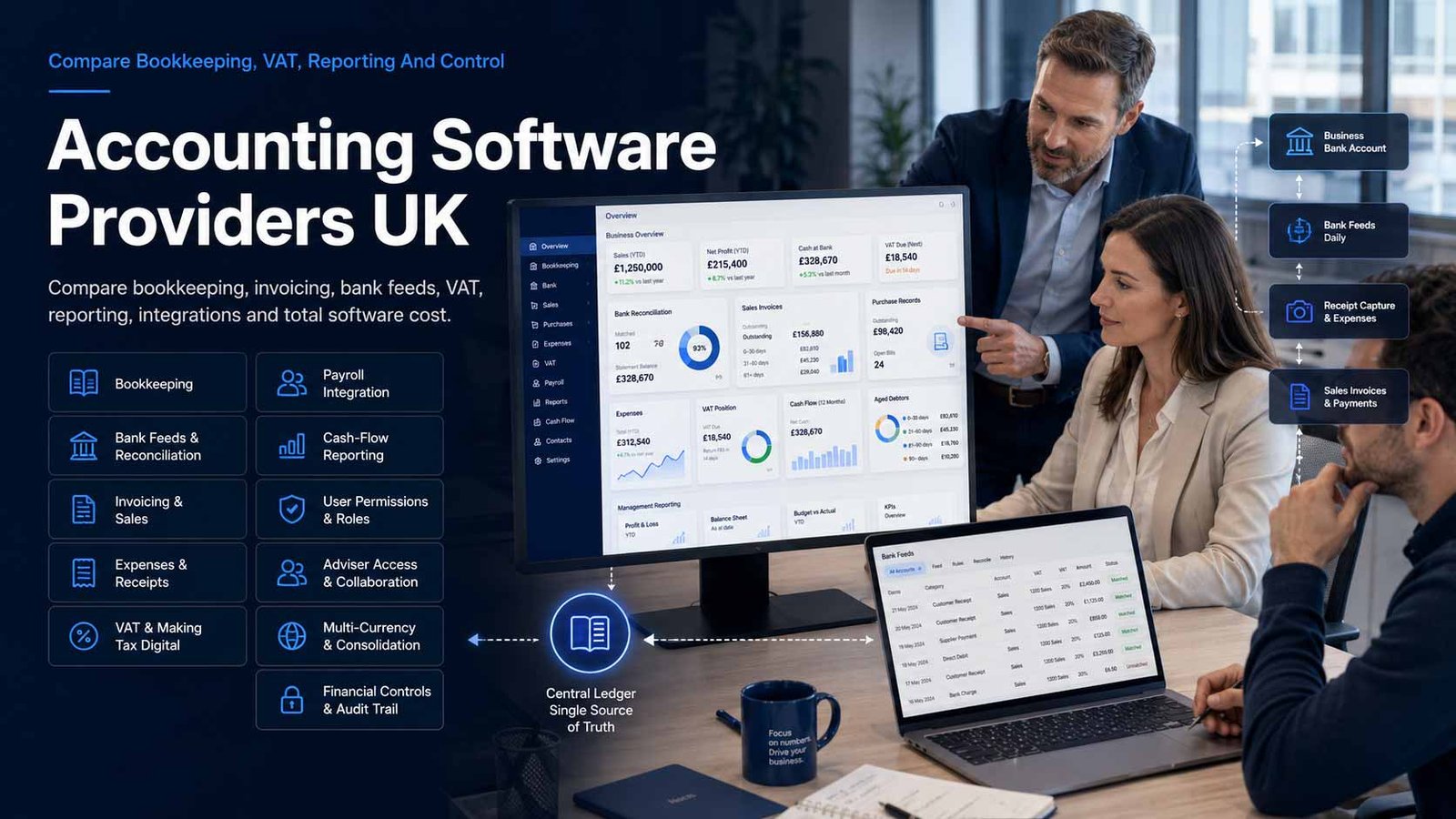
Compare accounting software for small businesses in the UK by bookkeeping, bank feeds, invoicing, expenses, VAT, Making Tax Digital for Income Tax, payroll links, projects, stock, multi-currency, reporting, permissions, integrations, migration, support and total cost. Evaluate providers against the same business structure, transaction volumes and compliance requirements before moving financial records.
Choose For The Finance Process, Not Only Tax Filing
HMRC compatibility matters, but the software must also support accurate daily records, controlled month-end work and useful management information.
- Map sales, purchasing, expenses, banking and period-close workflows
- Define VAT, Income Tax, payroll, CIS and statutory-reporting boundaries
- Separate user convenience from approval and audit requirements
- Test migration, opening balances and historical reporting before cutover
Accounting software records and organises financial transactions, including sales, purchases, bank activity, expenses, assets, liabilities and tax information. It can automate recurring invoices, bank matching, payment reminders, expense capture, VAT calculations and financial reporting while giving owners, finance teams and authorised advisers access to one controlled set of records.
The right product depends on the business structure and complexity. A sole trader may prioritise simple records, Self Assessment estimates and Making Tax Digital for Income Tax. A limited company may need purchase controls, accruals, budgets and accountant collaboration. A growing group may require multiple entities, consolidation, currencies, departments and stronger approval workflows.
This page does not compare outsourced accountancy or bookkeeping firms. Professional advisers may operate the software or support tax and statutory work, but selecting an accountant is a different service decision. It also does not compare full ERP suites: manufacturing planning, warehouse operations, broad procurement, CRM and end-to-end enterprise resource planning belong on the ERP Systems page.
Match The Accounting Platform To The Legal Entity And Workflow
Accounting needs change materially between a sole trader, a limited company and a growing multi-entity finance team.
| Business Profile | Typical Accounting Need | Best-Fit Question |
|---|---|---|
| Sole trader or freelancer | Income, expenses, invoicing, bank feeds, mileage, tax estimates and digital records | Does the plan support the correct MTD for Income Tax journey, VAT status and Self Assessment workflow without unnecessary company-accounting features? |
| Landlord or property business | Property income and expenses, digital records, separate properties, tax estimates and quarterly updates | Can the software represent the required property businesses and records, and is the exact landlord product recognised for the intended HMRC submission? |
| Micro limited company | Sales and purchases, bank reconciliation, VAT, expenses, payroll connection, corporation-tax preparation and accountant access | Can the business maintain accurate statutory records while giving directors simple operational visibility? |
| Service business | Quotes, recurring invoices, time, projects, expenses, online payment and profitability | Does project and time information flow into invoices and useful margin reporting without requiring a separate operational suite? |
| Retail or stock-holding business | Products, purchase orders, stock quantities, sales channels, VAT and payment reconciliation | Is the included stock capability sufficient, or does the business require a dedicated inventory or ERP system? |
| Construction or subcontracting business | Quotes, jobs, purchase costs, CIS, retention, VAT and project reporting | Which CIS and job-costing functions are native, which are add-ons and which require adviser or third-party workflows? |
| Growing multi-department company | Budgets, approvals, departments, projects, currencies, advanced reporting and audit | Can the platform strengthen finance control without pushing the business into a full ERP implementation? |
| Multi-entity organisation | Separate ledgers, intercompany transactions, consolidation, multi-currency and group reporting | Is multi-entity accounting native and controlled, or dependent on exports and spreadsheet consolidation? |
Eight Areas That Determine Accounting Software Fit
Use the same finance and compliance criteria for every provider so introductory prices and feature counts do not hide control or migration gaps.
Comparison Criterion
Core Ledger, Banking And Reconciliation
Compare chart of accounts, journals, opening balances, bank feeds, import methods, matching rules, reconciliation, cash coding, currencies, period locks and corrections. Confirm bank coverage, feed ownership, duplicate prevention and how unreconciled or amended transactions remain visible.
Comparison Criterion
Sales, Invoicing And Receivables
Review quotes, estimates, recurring invoices, deposits, credit notes, statements, payment links, reminders, direct debit, multi-currency, CIS and debtor reporting. Test the complete path from approved sale to payment allocation and overdue follow-up.
Comparison Criterion
Purchases, Expenses And Payables
Assess supplier bills, purchase orders, receipt capture, expenses, approvals, duplicate detection, payment runs, scheduled payments and supplier statements. Require clear separation between entering a cost, approving it and releasing payment.
Comparison Criterion
VAT, MTD And Tax Workflows
Confirm HMRC recognition for the exact product and submission type. Compare MTD for VAT, MTD for Income Tax, quarterly updates, digital records, tax estimates, Self Assessment, CIS, payroll and corporation-tax preparation boundaries. Do not assume one product supports every tax obligation.
Comparison Criterion
Reporting, Budgets And Management Insight
Compare profit and loss, balance sheet, cash flow, aged debt, budgets, departments, projects, custom reports, consolidation, forecasting and drill-down. Reports should reconcile to the ledger and preserve the period, dimensions and assumptions used.
Comparison Criterion
Users, Permissions And Audit Trail
Review owners, employees, finance users, advisers and approvers separately. Compare role design, approval limits, audit history, record locking, bank access, payment rights, user activity and strong authentication. Avoid giving convenience users unrestricted finance control.
Comparison Criterion
Integrations, Payroll And Business Applications
Assess payment services, payroll, expense, ecommerce, CRM, inventory, time, project, banking and reporting connections. Confirm data direction, duplicate handling, failure alerts, supported versions, ownership and whether the integration adds another subscription.
Comparison Criterion
Migration, Support And Platform Administration
Review opening balances, contacts, unpaid invoices, VAT history, bank reconciliation, attachments, detailed transactions, audit evidence and report comparability. Compare migration tools, partner support, service hours, backups, data export, release management and exit.
Check The Exact HMRC Submission Requirement
MTD compatibility is product- and obligation-specific. Verify the current HMRC software listing and the business’s start date before relying on a provider claim.
| Requirement | Current UK Context | Evidence To Confirm |
|---|---|---|
| MTD for VAT | VAT-registered businesses generally keep digital VAT records and submit returns using compatible software | Exact product recognition, digital links, VAT schemes, adjustments, return submission, agent access and audit evidence |
| MTD for Income Tax from 6 April 2026 | Sole traders and landlords with qualifying income above £50,000 for the relevant test year entered the mandatory regime | Digital records, each business source, quarterly updates, tax-return completion, authorisation, adviser workflow and missed-update handling |
| MTD for Income Tax from 6 April 2027 | The qualifying-income threshold moves to above £30,000 for the relevant test year | Product roadmap, HMRC recognition, onboarding lead time, existing VAT integration and whether several software products are needed |
| MTD for Income Tax from 6 April 2028 | The qualifying-income threshold moves to above £20,000 for the relevant test year | Suitability for smaller businesses, free or low-cost options, mobile records, support, migration and digital-exclusion considerations |
| Bridging or combined software | A business may use spreadsheets or more than one compatible product where digital-link and submission requirements are satisfied | Source records, permitted transfers, digital links, correction process, responsibility, evidence and long-term support |
| Agent collaboration | An authorised accountant or bookkeeper may maintain records or send updates through compatible software | Client access, agent permissions, approval, responsibility, deadlines, changes, records ownership and service boundaries |
Accounting Software Providers UK Businesses Can Consider
Shortlist products whose tax scope, transaction workflow, controls and commercial model fit the organisation. Confirm current plans, HMRC recognition and pricing directly before award.
Provider Profile
Xero
Cloud accounting platform for small businesses and advisers, with bank feeds and reconciliation, invoicing, bills, expenses, reporting, projects and a broad application marketplace. Xero also positions its UK software for MTD for VAT and MTD for Income Tax. Include it where collaboration, integrations and a cloud-first finance workflow matter. Confirm the current plan limits, users, payroll or expense add-ons, projects, multi-currency, MTD obligation, support route and migration scope.
Review official Xero informationProvider Profile
QuickBooks Online
Cloud accounting platform for self-employed people and small companies, covering bank transactions, invoicing, expenses, VAT, reports and plan-dependent features such as bills, projects, stock or enhanced controls. Include QuickBooks where a business wants broad small-business functionality and Intuit’s UK tax workflows. Confirm the correct sole-trader or company plan, MTD submission type, user limits, payroll, payments, inventory, support and discounted-to-standard pricing.
Review official QuickBooks informationProvider Profile
Sage Accounting And Sage 50
Sage provides cloud accounting for smaller businesses and Sage 50 Accounts for organisations needing deeper stock, departments, budgets, orders or established desktop-connected finance workflows. Include Sage where UK familiarity, a choice of product depth and adviser availability matter. Confirm which Sage product is proposed, cloud and desktop dependencies, users, companies, payroll, CIS, inventory, reporting, MTD for VAT or Income Tax, support and migration.
Review official Sage accounting productsProvider Profile
FreeAgent
UK-focused cloud accounting software for sole traders, landlords, micro-businesses and small limited companies, with invoicing, expenses, bank feeds, cash-flow views, payroll, VAT, Self Assessment and tax timelines. FreeAgent states support for MTD for VAT and MTD for Income Tax. Include it where owner-friendly tax visibility and simple collaboration matter. Confirm business type, transaction complexity, stock, multi-entity, user needs, bank-linked eligibility, payroll, accountant access and migration.
Review official FreeAgent informationProvider Profile
Zoho Books
Cloud accounting platform covering invoicing, expenses, banking, reconciliation, purchases, stock, projects, reporting, user roles and connections to the wider Zoho ecosystem. Its UK offer includes a free sole-trader route and MTD capabilities for VAT and Income Tax. Include it where value, automation and Zoho integration matter. Confirm plan limits, users, branches, stock, payroll connection, direct tax submission, multi-currency, support and whether wider Zoho products create useful integration or added complexity.
Review official Zoho Books informationProvider Profile
FreshBooks
Cloud invoicing and accounting platform aimed strongly at freelancers, service businesses and client-based work, with invoicing, payments, expenses, time, projects, proposals and reports. Its UK plans include MTD-compliant VAT submission capability. Include it where billing, time and client experience are more important than complex stock or multi-entity finance. Confirm client and team limits, VAT and Income Tax scope, bank feeds, payroll, accountant workflow, reporting, payment charges and migration.
Review official FreshBooks informationProvider Profile
iplicit
UK cloud accounting platform positioned for growing and mid-market organisations that have outgrown entry-level systems, with core financials, approvals, automation, reporting, group accounting, integrations and multi-entity capability. Include iplicit where finance teams need stronger control and consolidation without selecting a broad operational ERP suite. Confirm implementation partner, entities, users, dimensions, consolidation, stock scope, tax functions, integrations, support, migration and commercial minimums.
Review official iplicit informationProvider Profile
AccountsIQ
Cloud accounting and financial-management platform for mid-market and multi-entity finance teams, with automation, consolidation, intercompany, multi-currency and reporting. Include AccountsIQ where group finance, structured controls and real-time consolidated visibility are priorities. Keep the comparison within accounting and financial management rather than full ERP. Confirm entity count, consolidation, approvals, transaction volume, local tax requirements, integrations, implementation, support, user model and data export.
Review official AccountsIQ informationMeasures To Define Before An Accounting Contract Is Signed
Translate simple, automated and compliant into measurable finance accuracy, timeliness and control outcomes.
| Measure | What It Should Define | Evidence To Request | Common Weakness |
|---|---|---|---|
| Bank reconciliation completion | Whether all expected bank accounts and transactions are imported, matched and reconciled for the period | Feed status, statement balance, book balance, unreconciled items, duplicates, age and owner | The bank feed is connected but unmatched transactions accumulate for months |
| Sales ledger accuracy | Whether invoices, credit notes, receipts and outstanding customer balances are complete and correctly allocated | Invoice sequence, aged debt, unapplied cash, credits, write-offs and reconciliation to control accounts | Revenue reports look correct while customer accounts contain unallocated receipts |
| Purchase and expense completeness | Whether supplier bills, expenses, approvals and liabilities are recorded in the correct period | Unapproved bills, receipt exceptions, supplier statements, accruals and duplicate checks | Cash payments are recorded while unpaid obligations and missing receipts are excluded |
| VAT return readiness | Whether digital records, tax codes, adjustments and reconciliations support an accurate return | VAT control reconciliation, exception report, scheme, adjustments, digital links, approval and submission record | The software calculates a return but incorrect tax codes and unreconciled accounts remain |
| MTD update readiness | Whether qualifying Income Tax records can produce the required quarterly and year-end submissions | Business sources, digital records, authorisation, update status, corrections, adviser approval and deadline | A product is described as MTD-ready without supporting the user’s exact business type or obligation |
| Month-end close duration | How quickly finance can complete reconciliation, accruals, review, lock and management reporting | Close calendar, task owner, late inputs, exceptions, adjustments, review and final lock | Automation saves entry time but the close remains delayed by unowned approvals |
| Aged debt and collection | Whether overdue invoices are visible, followed up and resolved consistently | Age bands, disputed invoices, reminder status, promise date, owner and collection outcome | Automated reminders are sent without handling disputes or incorrect invoices |
| User and approval compliance | Whether transactions and changes follow authorised roles and thresholds | User roles, approval evidence, overrides, deleted records, bank rights and access review | All finance users receive administrator access to avoid configuration work |
| Integration reliability | Whether connected payroll, payment, ecommerce and operational systems transfer complete and non-duplicated data | Run status, source totals, target totals, failures, duplicates, delay, retry and owner | An integration silently stops and finance corrects differences manually |
| Total cost per active finance user | The complete subscription, add-on, implementation, support and administration cost for users who rely on the system | Plans, users, entities, transactions, add-ons, support, internal effort and growth | Promotional subscription pricing hides standard renewals and required modules |
What Changes Accounting Software Cost
The introductory subscription is only one component. Users, payroll, payments, stock, tax modules, migration and support can materially change the budget.
| Cost Driver | Why It Changes Spend | What A Comparable Proposal Should Show |
|---|---|---|
| Business type and core plan | Sole-trader, landlord, limited-company and mid-market products use different plan structures and tax features | Legal entities, business sources, VAT status, transaction needs, plan, standard price and renewal basis |
| Users, roles and adviser access | Owners, employees, finance staff, approvers and advisers may be included, limited or charged separately | Named roles, quantities, permissions, included users, extra-user cost and inactive-user process |
| Transactions, invoices or clients | Some products cap invoices, bills, clients, bank rules, records or usage at lower tiers | Current and forecast volume, limits, overage, plan upgrade trigger and seasonal peak |
| Payroll, expenses and payments | Payroll, employee expenses, payment collection, direct debit and supplier payments often use separate subscriptions or fees | Employees, submissions, users, transactions, payment charges, minimums and support |
| Stock, projects and advanced reporting | Inventory, project profitability, departments, budgets, multi-currency and custom reporting may require higher plans | Required functions, eligible plans, users, locations, currencies, add-ons and integration |
| MTD and tax submissions | VAT, Income Tax, Self Assessment, CIS and corporation-tax functions may be product- or plan-specific | Exact HMRC obligation, recognised product, submission scope, adviser workflow and extra software |
| Bank feeds and data capture | Bank connections, receipt scanning, document extraction and transaction automation can have provider, bank or usage limits | Accounts, banks, refresh, documents, extraction allowance, retention and exception process |
| Migration and historical data | Opening balances, contacts, unpaid items, detailed history, attachments and custom reports require different migration effort | Years of data, detail, documents, VAT history, reconciliation, testing and rollback |
| Implementation, training and support | Mid-market platforms and complex migrations may require partner implementation and ongoing service | Discovery, configuration, training, service hours, support level, change allowance and customer tasks |
| Contract, price changes and exit | Promotional offers, annual commitments, entity reductions, exports and archive access affect lifetime cost | Standard price, discount end, uplift, term, reduction rights, export, archive, assistance and deletion |
How The Finance Environment Changes The Shortlist
The right product depends on legal structure, tax obligations, transaction complexity, reporting needs and the organisation’s finance capability.
Sole Trader Or Landlord
Prioritise easy digital records, bank feeds, invoices, expenses, mileage, tax estimates, mobile capture and confirmed MTD for Income Tax support for the correct business sources.
Small Limited Company
Prioritise VAT, bills, expenses, cash flow, accountant collaboration, payroll connection, role-based access, reliable reports and a controlled route from owner bookkeeping to finance-team operation.
Service And Project Business
Prioritise time, projects, quotes, recurring invoices, expenses, online payments, debtor follow-up and project or customer profitability without buying a broad ERP suite.
Growing Multi-Entity Finance Team
Prioritise entities, consolidation, intercompany, currencies, dimensions, approvals, audit, integrations, structured implementation and reporting that reduces spreadsheet group accounts.
How To Compare Accounting Software Proposals
Give every provider the same entity structure, users, transaction volumes, banks, sales, purchases, VAT schemes, MTD obligations, payroll, stock, projects, currencies, reports, integrations and migration requirements. Require the response to identify the exact product, edition and standard price after any introductory discount.
- Every tax obligation maps to an exact recognised product and workflow
- Users, entities, transactions and add-ons are normalised
- Opening balances and historical-data migration are demonstrated
- Bank, sales, purchases and VAT controls are tested
- Month-end reports reconcile to the ledger
- Complete data export and archive access are covered at exit
Make Every Provider Close The Same Accounting Period
Give each finalist the same bank transactions, duplicate supplier bill, customer credit, employee expense, VAT adjustment, unpaid invoice and month-end accrual.
Compare the controls, audit evidence, reconciliation and final reports before comparing the dashboard design.
Six Questions To Put To Every Accounting Software Provider
The answers expose unsupported tax workflows, hidden add-ons, incomplete migration and difficult data exit before the agreement starts.
Which Exact Product And Plan Meets Our Tax Obligations?
Request confirmation for VAT, MTD for Income Tax, Self Assessment, CIS, payroll and company reporting, including features requiring another product.
How Will Our Existing Records Be Migrated?
Confirm opening balances, contacts, unpaid invoices, bills, bank reconciliation, VAT history, detailed transactions, attachments, custom fields, testing and rollback.
Which Users And Controls Are Included?
Map owners, finance users, employees, advisers and approvers to named roles, limits, audit history, payment rights, period locks and extra-user cost.
Which Add-Ons And Transaction Charges Apply?
Confirm payroll, expenses, payments, receipt capture, stock, projects, currencies, reports, bank feeds, entities, integrations and standard renewal pricing.
How Will Integrations Be Reconciled?
Request data ownership, direction, schedule, duplicate prevention, failure alerts, control totals, correction, support and responsibility for each connection.
What Data And Evidence Can We Export At Exit?
Confirm transaction detail, attachments, reports, audit logs, VAT submissions, configuration, user history, format, archive access, assistance and deletion.
A Seven-Stage Accounting Software Evaluation
Move from legal, tax and finance evidence to a reconciled migration rather than selecting a familiar brand before mapping the complete accounting process.
- Inventory entities, users, banks, transactions, invoices, bills, VAT, payroll, CIS, stock, projects, currencies, reports, integrations and current pain points.
- Define legal, tax, digital-record, approval, reporting, close, adviser-access, retention and audit requirements with accountable finance owners.
- Create a role-based shortlist separating simple owner-managed accounting from multi-entity financial management and full ERP requirements.
- Issue one written brief and obtain comparable plan, standard-price, migration, implementation, support and three-year commercial responses.
- Run a configured pilot covering bank feeds, invoicing, bills, expenses, VAT, MTD where applicable, reporting, permissions and representative integrations.
- Migrate at an agreed accounting boundary with reconciled opening balances, unpaid items, VAT position, historical evidence, user acceptance and rollback.
- Operate through monthly reconciliations, access review, tax calendars, integration monitoring, close controls, licence optimisation and annual exit-readiness checks.
Accounting Software Comparison Checklist
Use this table before approving an accounting subscription, migration or implementation agreement.
| No. | Requirement | Evidence To Obtain Before Award | Confirmed |
|---|---|---|---|
| 01 | Legal entities, business sources and finance owner agreed | Sole trade, property, companies, groups, VAT registrations, currencies and accountable owner | |
| 02 | Tax and MTD obligations confirmed | VAT, Income Tax start date, Self Assessment, CIS, payroll, company tax boundary and adviser role | |
| 03 | Current records and transaction volumes inventoried | Banks, sales, purchases, expenses, invoices, bills, payroll, stock, projects and history | |
| 04 | Exact product and plan identified | Product name, edition, limits, users, entities, tax functions, add-ons and standard price | |
| 05 | Banking and reconciliation tested | Bank coverage, import, rules, matching, duplicates, statement reconciliation and exception handling | |
| 06 | Sales and purchase workflows accepted | Quotes, invoices, bills, credit notes, approvals, payments, overdue debt and supplier statements | |
| 07 | VAT and MTD workflow demonstrated | Digital records, codes, adjustments, reconciliation, authorisation, submission, correction and evidence | |
| 08 | Permissions and audit controls approved | Roles, approval thresholds, payment rights, period locks, audit history and access review | |
| 09 | Reports and close requirements reconciled | Profit and loss, balance sheet, cash flow, aged debt, budgets, departments and control accounts | |
| 10 | Integrations and add-ons validated | Payroll, payments, ecommerce, CRM, inventory, projects, expenses, APIs, owners and control totals | |
| 11 | Migration and cutover plan accepted | Opening balances, unpaid items, VAT, bank, history, attachments, testing, acceptance and rollback | |
| 12 | Support and operational ownership agreed | Service hours, administrator, accountant, month-end tasks, release review, training and escalation | |
| 13 | Data protection and retention assessed | Personal data, access, purpose, locations, subprocessors, retention, export and deletion | |
| 14 | Three-year standard-price cost compared | Subscription, users, entities, add-ons, payments, migration, support, internal effort and growth | |
| 15 | Exit and archive access agreed | Transactions, documents, reports, audit, VAT evidence, formats, assistance, read-only access and deletion |
Common Accounting Software Buying Mistakes
Most avoidable problems begin with promotional pricing, assumed tax compatibility or a migration plan that does not reconcile the finance records.
| Mistake | Why It Creates Risk | Better Control |
|---|---|---|
| Choosing only from an introductory price | Promotions expire and required users, payroll, payments or stock increase the real cost | Compare the three-year standard-price total |
| Assuming every MTD claim covers every obligation | VAT and Income Tax recognition can differ by product and business type | Check the exact HMRC listing and workflow |
| Comparing outsourced accountants with software | Professional service quality and software capability are different buying decisions | Keep adviser selection outside this page |
| Buying a full ERP for simple bookkeeping | Implementation, licensing and process complexity exceed the finance requirement | Escalate to ERP only when wider operations require it |
| Migrating only opening balances without deciding history | Users lose transaction evidence and comparative reporting unexpectedly | Agree detailed history, attachments and archive access |
| Giving every user administrator access | Payment, deletion and configuration risks increase while audit becomes weak | Use role-based permissions and approvals |
| Treating bank feeds as completed bookkeeping | Imported transactions still require coding, matching and reconciliation | Measure reconciliation and exception completion |
| Ignoring the month-end close | The software records daily work but fails to improve accurate reporting | Test reconciliations, accruals, locks and reports |
| Adding integrations without control totals | Failures and duplicate records remain undetected | Reconcile each connected system and assign ownership |
| Deferring data export and exit | Transactions, attachments and tax evidence become difficult to retain | Test export and archive access before award |
Frequently Asked Questions
Answers to common questions from UK businesses comparing bookkeeping, cloud accounting and financial-management software.
What Is Accounting Software?
Accounting software records, organises and reports a business's financial transactions. It can cover invoices, purchases, expenses, bank feeds, reconciliation, VAT, tax records, cash flow, reports and collaboration with employees or advisers. Capability varies from sole-trader bookkeeping to multi-entity financial management.
Which Accounting Software Is Best For A Small UK Business?
There is no universal best product. A sole trader may prioritise tax estimates and MTD for Income Tax, while a limited company may need VAT, purchase controls and accountant access. Compare legal structure, transactions, users, reporting, integrations, migration, standard pricing and support.
Does Accounting Software Replace An Accountant?
No. Software records transactions and automates finance tasks, while an accountant or tax adviser may provide professional judgement, statutory accounts, tax planning, assurance and representation. A business can operate software itself or collaborate with an adviser, but outsourced accountancy is a separate service decision.
What Is Making Tax Digital For Income Tax?
Making Tax Digital for Income Tax requires qualifying sole traders and landlords to keep digital records and use compatible software for quarterly updates and their tax-return process. Mandatory entry began on 6 April 2026 for qualifying income above £50,000, followed by lower thresholds in later tax years.
Do All Accounting Products Support MTD For VAT And Income Tax?
No. HMRC recognition applies to specific products and functions. A product may support MTD for VAT but not the complete MTD for Income Tax journey, or may support only certain business types. Check the current HMRC software listings and obtain written provider confirmation.
Can A Business Keep Using Spreadsheets?
Spreadsheets can remain part of a compliant process where the required digital records and digital links are maintained and compatible software sends information to HMRC. Bridging or combined software may be needed. The business should document transfers, corrections, ownership and long-term support.
How Much Does Accounting Software Cost?
Cost may include the core plan, users, entities, payroll, expenses, payments, receipt capture, stock, projects, currencies, tax modules, migration and support. Compare the standard price after promotions and calculate a three-year total using expected growth and transaction volumes.
How Long Does Accounting Software Migration Take?
Timing depends on entities, records, transaction history, bank reconciliation, VAT position, unpaid invoices, attachments, integrations and reporting. A safe migration includes discovery, data cleanup, trial conversion, reconciliation, user testing, an agreed cutover boundary and rollback.
When Does A Business Need More Than Entry-Level Accounting Software?
A business may need a stronger mid-market platform when it has multiple entities, currencies, departments, approval requirements, consolidation, high transaction volume or complex reporting. It needs a full ERP only when wider operational processes such as manufacturing, warehousing or broad procurement must be integrated.
How Should A UK Business Compare Accounting Software Providers?
Give every provider the same legal entities, tax obligations, users, volumes, banks, invoices, bills, reports, integrations and migration requirements. Compare the exact recognised product, configured finance workflow, standard-price total, controls, support and exit—not only promotional pricing.
Provider Information And UK Accounting-Software Resources
Reviewed by Bhav Giva, Founder & Lead Analyst at CompareServices.co.uk, on 16 July 2026.
Use HMRC and official provider documentation to confirm current MTD recognition, plans, limits, tax workflows, integrations, support and pricing. Accounting products and tax requirements can change during a buying cycle.
- HMRC — Check When MTD For Income Tax Applies
- HMRC — Choose MTD For Income Tax Software
- HMRC — Find MTD For Income Tax Software
- HMRC — Find MTD For VAT Software
- Xero — UK Accounting Software
- QuickBooks — UK Accounting Software
- Sage — Accounting Software
- FreeAgent — Small-Business Accounting
- Zoho — Books
- FreshBooks — UK Accounting And Invoicing
- iplicit — Cloud Accounting
- AccountsIQ — Cloud Accounting And Financial Management