
Compare Website Design & Development Providers UK (2026)
Compare Discovery, UX, Visual Design, Development, CMS, Accessibility, Security, Testing, Handover And Complete Project Cost
Compare web design services business providers by discovery depth, user research, information architecture, responsive design, accessibility, content-management approach, front-end and back-end development, integrations, performance budgets, security practices, browser and device testing, content migration, project governance, intellectual-property terms, hosting readiness, handover, support and complete ownership cost. Give every provider the same brief, user journeys, integrations, content volume and acceptance criteria before comparing proposals.
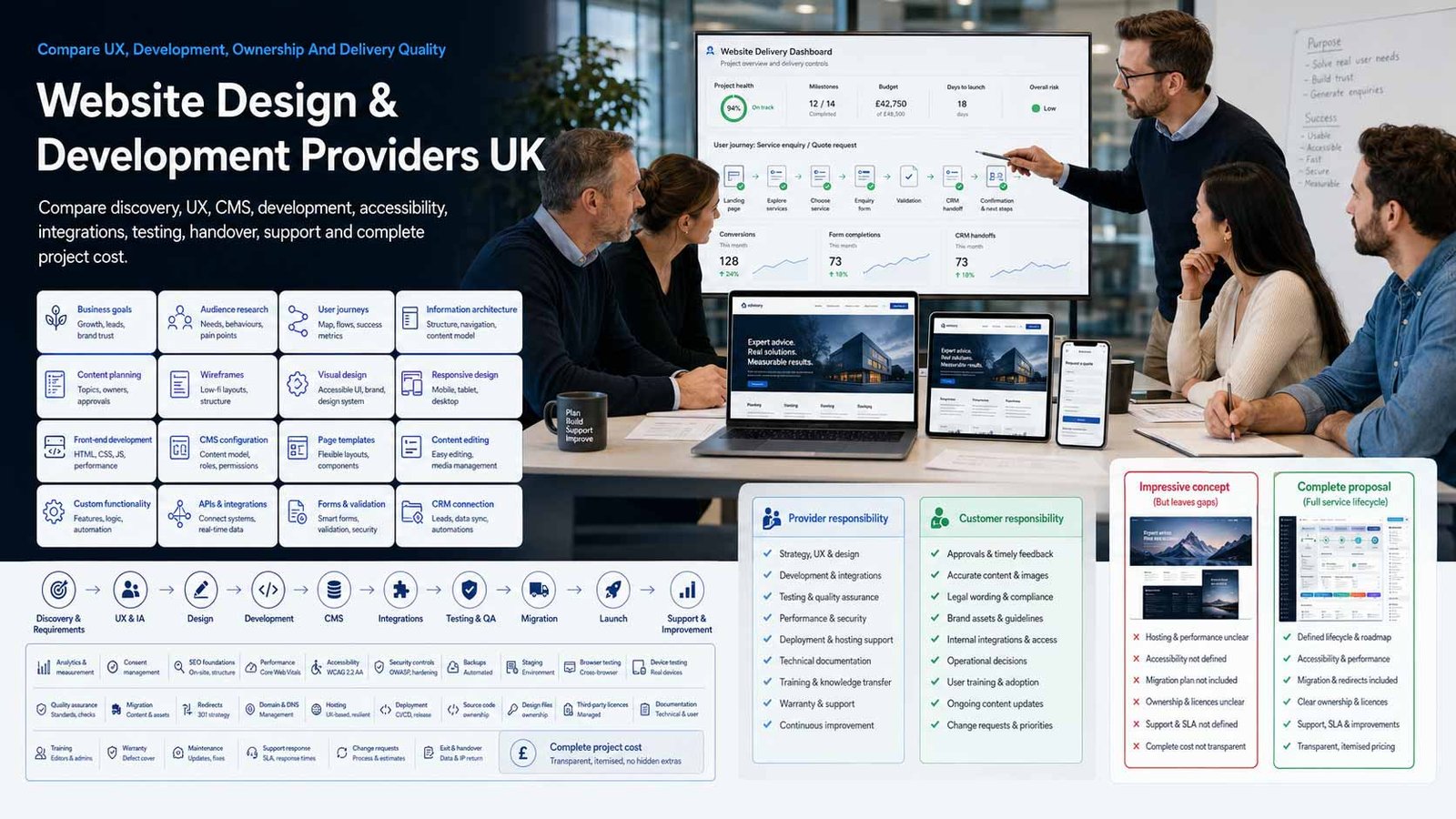
Buy A Working Digital Service, Not A Collection Of Pages
A business website has to support real users, staff workflows, content governance, enquiries, transactions, integrations and future changes. Visual presentation matters, but it is only one part of the project.
- Define measurable user journeys and business outcomes
- Separate discovery, design, development and ongoing support
- Use explicit accessibility, performance and security acceptance criteria
- Confirm content, data, domain, code and intellectual-property ownership
Website design and development combines the planning, experience design, visual design, technical build, testing and launch work needed to create or replace a business website. A robust project normally begins with discovery and requirements, moves through architecture and prototype approval, then enters content, development, integration, quality assurance, launch and handover.
The provider may use a content-management system, a headless architecture, a commerce framework or bespoke components. The correct approach depends on user journeys, editing needs, content volume, integrations, risk, accessibility, internal capability and expected change. The proposal should explain why the chosen architecture is proportionate rather than simply naming a preferred platform.
This page compares professional website design and development services. It does not compare search-engine optimisation, paid advertising management or do-it-yourself website builders as standalone products. Those adjacent services have different commercial intent, deliverables and evidence requirements.
Choose The Right Website Delivery Model
The design and build model changes discovery, governance, technical architecture, testing, internal workload and the amount of change the organisation can manage after launch.
| Project Model | What It Usually Includes | Best-Fit Question |
|---|---|---|
| Discovery-Led SME Website | Research, stakeholder workshops, audience definition, information architecture, content planning, prototypes, responsive design and a manageable CMS for a professional business site. | Does the provider turn business needs into an approved scope before design begins? |
| Bespoke Lead-Generation Website | Custom page templates, journeys, forms, CRM routing, consent handling, analytics-ready events and reusable content components designed around enquiry and qualification processes. | Are form behaviour, routing, validation, notifications and failure handling documented and tested? |
| Corporate CMS Website | Structured content, governance, permissions, approval workflows, component libraries, integrations and scalable page management for teams with frequent publishing requirements. | Can internal editors maintain the site safely without breaking design or accessibility? |
| Commerce Website Build | Product, basket, checkout, customer-account and operational integrations delivered as a website project without turning the comparison into a platform-only exercise. | Are catalogue, payment, fulfilment, tax, returns and customer-service responsibilities mapped end to end? |
| Membership, Portal Or Service Website | Authenticated journeys, role-based content, forms, documents, account functions or secure integrations for users who do more than browse public pages. | Which functions are standard, configured or custom, and how will identity and data be protected? |
| Multilingual Or Multi-Site Estate | Shared design systems, reusable components, translation workflows, regional governance, domain structures and central technical control across several sites or markets. | Can the operating model prevent duplicated effort and uncontrolled local variants? |
| Migration And Replatform Project | Content, media, forms, integrations, domains, redirects, analytics configuration and operational ownership moved from a legacy estate into a maintainable new build. | Is there a complete inventory, migration rule set, reconciliation method and rollback plan? |
| Accessible And High-Assurance Website | Inclusive research, keyboard and assistive-technology testing, secure development, privacy controls, documented acceptance evidence and controlled release for higher-risk organisations. | Are accessibility and security requirements contractual, testable and owned by named specialists? |
Eight Areas That Determine Website Project Fit
Use the same brief, user journeys, content volume, integrations, technical constraints, launch date and acceptance standards for every provider.
Comparison Criterion
Discovery, Outcomes And Scope Control
Compare stakeholder research, audience definition, current-site evidence, user needs, content inventory, competitor context, business processes, risks, integrations, project assumptions and measurable acceptance criteria. A credible provider should expose uncertainty early, separate mandatory from optional scope and show how changes will be estimated and approved.
Comparison Criterion
Information Architecture, UX And Prototyping
Review navigation design, content hierarchy, user journeys, wireframes, interactive prototypes, usability testing and mobile-first decisions. Require evidence for priority tasks such as finding a service, submitting an enquiry, completing a transaction or accessing support. Approving visual concepts without testing structure can embed expensive problems before development.
Comparison Criterion
Visual Design, Design Systems And Accessibility
Compare brand interpretation, typography, colour, contrast, responsive behaviour, component states, interaction patterns, error messages and accessibility. Ask whether WCAG 2.2 success criteria are used as a benchmark, which conformance level is targeted, what will be manually tested and how design decisions will be documented for future editors and developers.
Comparison Criterion
CMS, Content Model And Editorial Governance
Assess page templates, reusable blocks, structured fields, preview, revisions, roles, approvals, media handling, localisation, accessibility safeguards and editor training. The CMS should support real publishing workflows without forcing staff to rebuild layouts. Confirm licences, upgrade path, vendor dependence and who owns custom themes, modules and configuration.
Comparison Criterion
Front-End, Back-End And Integration Quality
Review coding standards, browser support, responsive implementation, APIs, forms, CRM or booking connections, authentication, error handling, logging and maintainability. Require an integration inventory with owners, test environments, rate limits, data fields, failure scenarios and support responsibilities. A successful visual build can still fail operationally if integrations are fragile.
Comparison Criterion
Performance, Resilience And Secure Development
Compare performance budgets, image and font handling, caching, hosting compatibility, dependency management, secure coding, backups, monitoring and release controls. Ask how the provider follows secure-development principles, manages secrets, patches dependencies, restricts administrator access and recovers from failed deployment. Performance and security must be engineered, not added after sign-off.
Comparison Criterion
Quality Assurance, Accessibility Testing And Acceptance
Require browser, device, keyboard, screen-reader, form, integration, content, regression, security and performance testing proportionate to risk. Define who supplies test data, how defects are prioritised, which tools and manual methods are used, what evidence is delivered and which defects can remain at launch. Acceptance should be based on recorded criteria rather than subjective approval.
Comparison Criterion
Ownership, Handover, Support And Exit
Confirm ownership of domains, hosting accounts, source code, design files, licences, repositories, content, data and credentials. Compare documentation, training, warranty, support hours, service levels, maintenance responsibilities, backup ownership and exit assistance. The business should be able to operate, audit and transfer the website without dependence on one individual or inaccessible account.
Measures To Define Before Development Starts
Translate attractive portfolios and broad promises into auditable scope, quality, ownership and launch evidence.
| Measure | What It Should Define | Evidence To Request | Common Weakness |
|---|---|---|---|
| Scope completeness | Whether every required journey, template, feature, integration, content task and responsibility is included | Requirements matrix, assumptions, exclusions, dependency log, deliverables, acceptance criteria and change process | The proposal uses broad phrases such as “custom website” without a testable definition |
| Prototype readiness | Whether structure and interaction are understood before build | Sitemap, user flows, annotated wireframes, responsive prototype, test findings and approval record | Visual homepage approval is treated as approval of every journey and screen state |
| Accessibility evidence | Whether agreed accessibility requirements are designed, built and tested | Target standard, component checks, keyboard test, assistive-technology test, issue log and statement | An automated score is presented as complete accessibility assurance |
| Performance budget | Whether pages stay within agreed loading and interaction limits | Asset budgets, test environment, device and network assumptions, measurements and remediation | Fast demonstration pages hide unoptimised production content and third-party scripts |
| Functional test coverage | Whether forms, search, accounts, transactions and integrations behave in normal and failure conditions | Test cases, data, expected results, defect severity, retest record and acceptance owner | Only successful desktop journeys are tested |
| Security controls | Whether the development and operating model reduces foreseeable website risk | Threats, access roles, MFA, dependency checks, secrets handling, patching, backups, logging and incident route | Security is reduced to an SSL certificate and a generic plugin list |
| Migration accuracy | Whether approved content, files, forms, routes and metadata move completely | Inventory, mapping rules, sample migration, reconciliation counts, exceptions and redirect list | The provider estimates migration by page count without reviewing content types or quality |
| Integration reliability | Whether connected systems can be monitored and recovered | Interface owner, fields, authentication, retry, timeout, alerting, logs, fallback and support boundary | The website and third party each assume the other will diagnose failures |
| Editor usability | Whether authorised staff can complete routine publishing safely | Role tests, common tasks, training, documentation, guardrails, revision and rollback evidence | A flexible page builder transfers design and compliance risk to untrained editors |
| Launch and support readiness | Whether deployment, ownership and early-life support are controlled | Cutover plan, freeze, backups, rollback, DNS, monitoring, warranty, contacts, support hours and exit pack | Launch is scheduled without a tested rollback route or named decision authority |
Website Design And Development Providers UK Businesses Can Consider
Shortlist providers whose discovery approach, design capability, technical stack, governance and support model fit the project. Confirm the live proposal, team and complete terms before award.
Provider Profile
Cyber-Duck
Cyber-Duck, part of CACI, combines digital strategy, user-centred design, web application development, CMS and platform engineering. Include it where an organisation needs structured discovery, accessible service design, complex stakeholder engagement or a higher-assurance website and application estate. Confirm the delivery entity, team composition, discovery output, technology recommendation, accessibility scope, security controls, hosting boundary, subcontractors, acceptance evidence, support model, intellectual-property terms and how a website project is separated from broader transformation work.
Review official Cyber-Duck servicesProvider Profile
Wholegrain Digital
Wholegrain Digital is a London WordPress design and development agency with a strong focus on digital sustainability, efficient websites and responsible delivery. Include it where a business values WordPress expertise, performance, accessibility and a lower-impact operating approach. Confirm project fit, discovery, custom-design scope, editor experience, plugin policy, hosting requirements, carbon and performance measurement, accessibility testing, migration, maintenance, ownership, warranty and the degree to which sustainability objectives are contractual rather than advisory.
Review official Wholegrain web developmentProvider Profile
MadeByShape
MadeByShape is an independent Manchester agency providing web design, web development, branding and e-commerce work, with published experience in Craft CMS. Include it where a business wants a design-led regional agency, bespoke front-end work and a structured content-management build. Confirm the proposed CMS, discovery process, templates and components, responsive prototype, content responsibilities, integration scope, quality assurance, hosting, support, licences, source-code access, training and whether any adjacent marketing services are outside the website contract.
Review official MadeByShape developmentProvider Profile
KOTA
KOTA is a creative digital agency in London offering brand-led web design, web development and WordPress delivery, alongside ongoing site-care services. Include it where visual identity, motion, storytelling and a distinctive responsive experience are central to the brief. Confirm how creative ambition is balanced with accessibility, performance and editor usability; which animations are optional; what CMS components are reusable; how content is supplied; the browser and device scope; SiteCare terms; hosting ownership; code and design-file handover; and the process for approving changes after launch.
Review official KOTA web design and developmentProvider Profile
Propeller
Propeller provides bespoke website design and development, replatforming and commerce delivery, with experience across consumer, hospitality and growth-focused brands. Include it where the website needs strong experience design, transactional journeys, integrations or ongoing digital evolution. Confirm the exact project team, platform rationale, discovery and research, analytics and personalisation dependencies, commerce responsibilities, content migration, quality assurance, hosting, third-party licences, support retainers, release governance, intellectual property and whether services outside design and development are optional or bundled.
Review official Propeller web developmentProvider Profile
Fhoke
Fhoke is a UK web design agency based in London and Salisbury, offering bespoke website design, WordPress development and web application services. Include it where a business wants a specialist creative and development team with direct access to project decision-makers. Confirm minimum project fit, discovery, UX research, WordPress architecture, custom functionality, accessibility, content and migration scope, hosting, plugin and licence ownership, security, testing, training, warranty, ongoing support, response times and how future supplier transfer would work.
Review official Fhoke website designProvider Profile
Blue Frontier
Blue Frontier is a UK digital agency offering web design and development, WordPress, Joomla, commerce and software capabilities. Include it where an organisation needs a broader technical team, integration experience or support across a complex web estate. Confirm which specialists are assigned, whether development is bespoke or configured, platform and hosting rationale, content ownership, accessibility and security testing, migration, API responsibilities, support service levels, subcontracting, repositories, licences, acceptance, change control and separation from any optional marketing or IT services.
Review official Blue Frontier web designProvider Profile
SOZO
SOZO combines web design and development with a stated focus on purpose-led brands, e-commerce and lower-carbon websites. Include it where brand experience, sustainable design decisions and ongoing website development are important. Confirm the discovery and strategy deliverables, design-system depth, platform recommendation, carbon and performance methodology, accessibility, content preparation, commerce integrations, hosting, maintenance, warranty, technical ownership, data and privacy responsibilities and whether broader growth services are separately scoped from the website build.
Review official SOZO capabilitiesWhat Changes Website Design And Development Cost
Website prices vary because providers include different discovery, design, content, technical, assurance and support work. Compare the complete project and operating cost rather than a page count.
| Cost Driver | Why It Changes Spend | What A Comparable Quote Should Show |
|---|---|---|
| Discovery and requirements | Workshops, research, audits, content inventory, user journeys, technical discovery and an approved requirements baseline | Days, participants, outputs, revisions, assumptions, decision gates and whether discovery is credited against build |
| Information architecture and UX | More audiences, content types, journeys, languages and usability testing increase design and validation effort | Sitemap, flows, wireframes, prototype depth, research participants, rounds and accessibility input |
| Visual design and component system | Custom art direction, animation, illustration and many states require more design and development than adapting a small component set | Page concepts, components, states, breakpoints, motion, design files, revisions and design-system documentation |
| CMS and content model | Structured content, roles, workflows, localisation, preview and custom editorial tools add configuration and testing | Platform, licences, content types, fields, components, permissions, workflow, training and upgrade responsibilities |
| Custom development and integrations | APIs, portals, booking, CRM, search, calculators, accounts and third-party services create technical and support dependencies | Each integration, data fields, authentication, environments, limits, failure handling, testing and owner |
| Content creation and migration | Auditing, rewriting, photography, video, accessibility remediation and structured migration can exceed the build effort | Content owner, volumes, formats, quality rules, mapping, entry, migration, review and approval |
| Accessibility, security and assurance | Manual accessibility testing, penetration testing, privacy review and formal evidence add specialist effort but reduce operational risk | Target criteria, test methods, specialists, environments, remediation rounds, evidence and residual issues |
| Testing and launch | Browser, device, regression, content, integration, performance and launch rehearsals expand with complexity and risk | Test matrix, test data, defects, retest, deployment, DNS, rollback, monitoring and launch support |
| Hosting, licences and third parties | Hosting, CDN, fonts, stock assets, plugins, consent tools, search and external services create recurring cost | Supplier, account owner, term, limits, renewal, price change, data location, support and exit |
| Warranty, maintenance and change | Post-launch fixes, updates, backups, monitoring, support and enhancement capacity should be priced separately from the build | Warranty, exclusions, hours, SLA, security updates, release process, rate card, minimum term and exit assistance |
| Indicative Project Band | Typical Scope | What Must Be Confirmed |
|---|---|---|
| £3,000–£10,000 | A smaller professional website with limited templates, supplied content and modest custom functionality | Whether discovery, copy, migration, accessibility testing, hosting, licences and support are included |
| £10,000–£30,000 | A bespoke SME or lead-generation site with custom UX, component design, CMS configuration and selected integrations | Number of templates, prototype depth, form or CRM workflows, content workload, test coverage and handover |
| £30,000–£75,000 | A larger corporate, commerce, multilingual or replatform project with significant migration and integrations | Architecture, environments, integration owners, security, accessibility, operational readiness and ongoing support |
| £75,000+ | A complex multi-site, transactional, portal or high-assurance digital service with specialist teams and governance | Programme scope, supplier boundaries, assurance, hosting, data, support, ownership, change control and total lifecycle cost |
Match The Provider To The Website Operating Model
The right shortlist depends on internal capability, risk, user journeys, content governance, integrations, assurance and the pace of future change.
Small Professional Services Business
Prioritise a clear proposition, credible responsive design, manageable CMS, reliable forms, privacy controls, straightforward content ownership and a support route that does not require a large retainer. Avoid paying for complex architecture that the team cannot operate.
Growing B2B Or Multi-Service Company
Prioritise information architecture, reusable service and sector components, lead-routing integrations, case-study governance, structured content, analytics-ready events, editor permissions and a roadmap that supports new offers without rebuilding the site.
Retail, Hospitality Or Transactional Brand
Prioritise mobile journeys, product or booking operations, speed, availability, integrations, fraud and privacy controls, accessibility, content production, peak-event resilience and clear ownership across the website, commerce and operational systems.
Corporate, Regulated Or Multi-Site Organisation
Prioritise discovery governance, stakeholder alignment, accessibility assurance, secure development, roles, auditability, multiple environments, migration reconciliation, integration ownership, formal acceptance, documentation, service management and supplier exit.
How To Compare Website Proposals
Issue one brief containing the current-site position, business outcomes, priority audiences, user journeys, content volume, integrations, compliance expectations, internal responsibilities, launch constraints and support needs. Require a response matrix rather than accepting a presentation that cannot be compared line by line.
- Discovery outputs and decision gates are specified
- Templates, components, features and integrations are counted
- Content creation and migration responsibilities are explicit
- Accessibility, security, performance and testing are measurable
- Hosting, licences, warranty and support are separated
- Code, design, data, accounts and exit rights are documented
Compare The Same Acceptance Standard
Ask every provider to price the same prototype depth, responsive states, CMS roles, integrations, content workload, test matrix and launch support.
A lower quote is not comparable when it excludes discovery, content migration, accessibility, assurance, licences or post-launch ownership.
Six Questions To Put To Every Website Provider
The answers expose incomplete scope, platform dependence, weak assurance and handover arrangements that create future cost.
What Exactly Will Be Delivered?
Request the sitemap, templates, components, features, integrations, content tasks, environments, documentation, training, warranty and support items that form the contractual scope.
Which Team Will Actually Do The Work?
Confirm named roles, seniority, availability, location, subcontractors, specialist accessibility or security input, account management and who can approve technical decisions.
How Will The Architecture Be Chosen?
Ask for the CMS and hosting rationale, custom-code boundary, licence dependencies, upgrade path, integration method, content model and reasons rejected alternatives are unsuitable.
How Will Quality Be Proven?
Require the browser and device matrix, accessibility methods, functional and integration tests, performance budgets, security checks, defect process, evidence pack and acceptance owner.
Who Owns Every Asset And Account?
Confirm domain, hosting, repository, source code, themes, modules, design files, fonts, stock media, content, data, analytics, consent tools, credentials and administrator access.
What Happens After Launch Or Supplier Exit?
Review warranty, maintenance, backups, monitoring, updates, support hours, service levels, change rates, documentation, data export, account transfer and reasonable transition assistance.
A Seven-Stage Website Provider Evaluation
Move from current-state evidence and user needs to a controlled website service rather than selecting an agency from visual portfolios alone.
- Create a current-state inventory covering domains, hosting, pages, content types, forms, integrations, analytics, cookies, accounts, licences, traffic-critical journeys, known defects and accountable owners.
- Define business outcomes, priority users, measurable journeys, content governance, accessibility, privacy, security, performance, integration, launch, support and ownership requirements.
- Prepare one supplier brief with mandatory, optional and future scope; decision criteria; response format; budget context; timetable; dependencies; and evidence required from each provider.
- Shortlist providers by relevant project type, delivery capability, technical fit, accessible and secure-development evidence, team availability, support model, financial stability and referenceable work.
- Run structured discovery or proposal clarification, then normalise cost across research, design, build, content, migration, testing, hosting, licences, warranty, maintenance and internal effort.
- Contract only after scope, acceptance, change control, payment milestones, intellectual property, confidentiality, data protection, subcontracting, security, access, termination and transition are clear.
- Deliver through controlled research, prototype, content, development, integration, test, migration and launch gates, followed by monitoring, defect resolution, training, documentation and a prioritised improvement backlog.
Website Design And Development Comparison Checklist
Use this table before approving a new website, rebuild, migration, transactional site, portal or multi-site programme.
| No. | Requirement | Evidence To Obtain Before Award | Confirmed |
|---|---|---|---|
| 01 | Website purpose and accountable owner agreed | Business outcomes, decision-maker, product owner, content owner, technical owner, approver and support contacts | |
| 02 | Current estate inventoried | Domains, hosting, pages, content, forms, integrations, data, licences, accounts, defects and dependencies | |
| 03 | Users and priority journeys defined | Audience needs, tasks, mobile context, accessibility needs, service journeys and measurable completion criteria | |
| 04 | Scope and exclusions documented | Templates, components, features, integrations, languages, content, migration, environments and future items | |
| 05 | Architecture and CMS rationale accepted | Platform, hosting, content model, custom code, licences, upgrades, permissions and technical dependencies | |
| 06 | Prototype and design-system scope agreed | Sitemap, flows, wireframes, responsive prototype, components, states, motion, revisions and design files | |
| 07 | Content and migration plan approved | Inventory, rewrite, media, accessibility, ownership, mapping, entry, migration, review and reconciliation | |
| 08 | Accessibility requirements contractual | Target standard, design reviews, manual tests, assistive technology, defects, evidence and residual issues | |
| 09 | Security and privacy controls accepted | Secure development, access, MFA, secrets, dependencies, forms, cookies, data, backups, logs and incident route | |
| 10 | Performance and resilience budget agreed | Page weight, images, fonts, scripts, caching, environments, availability, monitoring and recovery | |
| 11 | Integration ownership confirmed | Systems, fields, authentication, test data, limits, errors, logs, retries, support and change notification | |
| 12 | Quality and acceptance plan completed | Browsers, devices, functional, regression, content, accessibility, security, performance, evidence and sign-off | |
| 13 | Commercial and IP terms approved | Price, milestones, changes, expenses, licences, code, design, content, data, repositories and subcontractors | |
| 14 | Launch, warranty and support ready | Freeze, backups, DNS, deployment, rollback, monitoring, warranty, SLA, updates, contacts and escalation | |
| 15 | Handover and supplier exit tested | Administrator access, documentation, training, credentials, exports, accounts, source files, transition and closure |
Common Website Design And Development Buying Mistakes
Most avoidable failures begin with visual-led selection, incomplete scope, unclear ownership or assurance that cannot be evidenced.
| Mistake | Why It Creates Risk | Better Control |
|---|---|---|
| Choosing from the homepage visual alone | A polished concept does not prove usable journeys, maintainable content, integrations, accessibility or reliable forms | Score the complete delivery method |
| Using page count as the main scope | Templates, components, states, content types and integrations drive effort more than the number of published URLs | Use a requirements matrix |
| Starting design before discovery | Unresolved audiences, content and processes become expensive design changes later | Approve outcomes and architecture first |
| Leaving content until the end | Missing copy, media and approvals delay build and weaken the designed journeys | Run content as a managed workstream |
| Treating automated accessibility checks as complete | Automated tools cannot validate every keyboard, screen-reader, language or interaction issue | Include manual specialist testing |
| Assuming a familiar CMS removes risk | Poor architecture, uncontrolled plugins, weak permissions and no update process can make any platform fragile | Assess the implementation and operating model |
| Not testing form failure and routing | A visually correct form can lose enquiries through validation, spam, integration or email-delivery failures | Test end-to-end with monitoring |
| Accepting supplier-owned accounts | Domains, hosting, repositories, analytics and licences can become inaccessible during dispute or exit | Keep business-controlled ownership |
| Combining build and indefinite support terms | The organisation cannot see the real project price or exit from an unsuitable retainer | Separate project, warranty and support agreements |
| Launching without rollback and early-life support | DNS, integrations, content or performance failures can affect users immediately | Rehearse cutover and recovery |
Frequently Asked Questions
Answers to common questions from UK businesses comparing website design agencies, development teams and digital-delivery partners.
What Does Website Design And Development Include?
It normally includes discovery, requirements, information architecture, user experience, visual design, responsive components, content-management configuration, front-end and back-end development, integrations, testing, migration, launch and handover. The exact scope varies, so every deliverable, responsibility and acceptance criterion should be written into the proposal.
How Much Does A Business Website Cost In The UK?
A smaller professional site can sit in the low thousands, while bespoke corporate, commerce, portal, multi-site or high-assurance projects can cost tens of thousands or more. Cost depends on discovery, design, templates, custom development, integrations, content, migration, accessibility, security, testing, licences and support—not only page count.
How Long Does A Website Project Take?
A smaller controlled project may take several weeks, while a bespoke corporate, commerce or integration-heavy programme can take several months. Timing depends on decision-making, content readiness, research, prototype approval, technical dependencies, testing, migration and launch constraints. Ask for stage gates and client responsibilities rather than one unqualified launch date.
Should A Business Use WordPress Or A Bespoke CMS?
The decision should follow the content model, editor needs, integrations, security, scale, available skills, support and cost. WordPress can be suitable when implemented and governed well. A different CMS or bespoke architecture may be justified for complex workflows. Require the provider to explain the recommendation and long-term operating implications.
What Is Responsive Web Design?
Responsive design adapts layout, navigation, content and interactions to different screen sizes and input methods. A responsive project should cover more than a desktop and mobile mock-up: components, forms, tables, menus, media, error states, keyboard use and real content must be tested across the agreed browser and device matrix.
How Should Accessibility Be Included In A Website Brief?
Define the intended WCAG version and conformance target as a procurement benchmark, include accessibility in research and design, require semantic and keyboard-friendly development, specify manual and assistive-technology testing, and agree how issues will be evidenced and remediated. Automated tools are useful but are not complete assurance.
Who Should Own The Website Source Code And Accounts?
The contract should identify ownership or licence rights for source code, custom themes, modules, design files, content, data, domains, hosting, repositories, fonts, stock assets and third-party services. The business should hold appropriate administrator access and be able to transfer the service without losing critical assets or credentials.
What Testing Should A Website Provider Complete?
Testing should be proportionate to the service and cover agreed browsers and devices, responsive behaviour, keyboard and accessibility, forms, integrations, content, links, performance, security, roles, error handling, backups, deployment and rollback. Require test evidence, defect severity, retesting and named acceptance authority.
What Ongoing Website Support Is Needed?
Most websites need security and dependency updates, backups, monitoring, hosting management, content support, licence renewals and controlled enhancements. Separate the build warranty from maintenance and change work. Compare service hours, response targets, exclusions, update policy, release process, account ownership and exit assistance.
How Should UK Businesses Compare Website Providers?
Give every provider the same brief and response template. Compare relevant experience, discovery, UX, architecture, CMS, development, accessibility, security, testing, content and migration, project governance, team, ownership, support and complete lifecycle cost. Do not rank providers on portfolio appearance or headline project price alone.
Official Guidance And Provider Resources
Reviewed by Bhav Giva, Founder & Lead Analyst at CompareServices.co.uk, on 30 July 2026.
Use official company, privacy, security, accessibility and provider documentation to verify current requirements, delivery capability and commercial terms. Provider teams, platforms, services, ownership and offers can change. Accessibility and regulatory duties depend on the organisation and website, so obtain specialist advice where required.
- GOV.UK — Company Information Required On Websites
- ICO — Cookies And Similar Technologies
- NCSC — Building And Operating A Secure Online Service
- NCSC — Secure Development Principles
- W3C — Web Content Accessibility Guidelines 2.2
- Cyber-Duck — Digital Design And Development
- Wholegrain Digital — Web Development
- MadeByShape — Web Development
- KOTA — Web Design And Development
- Propeller — Web Development
- Fhoke — Website Design
- Blue Frontier — Web Design
- SOZO — Design And Development