
Compare SEO Services Providers UK (2026)
Compare Technical SEO, Organic Strategy, Content Optimisation, Authority, Search Visibility, Reporting, Governance And Complete Retainer Cost
Compare SEO services UK business providers by baseline diagnosis, technical audit depth, crawling and indexation controls, organic-search strategy, keyword and intent research, on-page optimisation, content quality, internal linking, authority development, migration support, Search Console and analytics governance, AI-search visibility measurement, implementation ownership, reporting, contract terms and complete annual cost. Give every provider the same website data, commercial priorities, target markets, implementation capacity and measurement framework before comparing proposals.
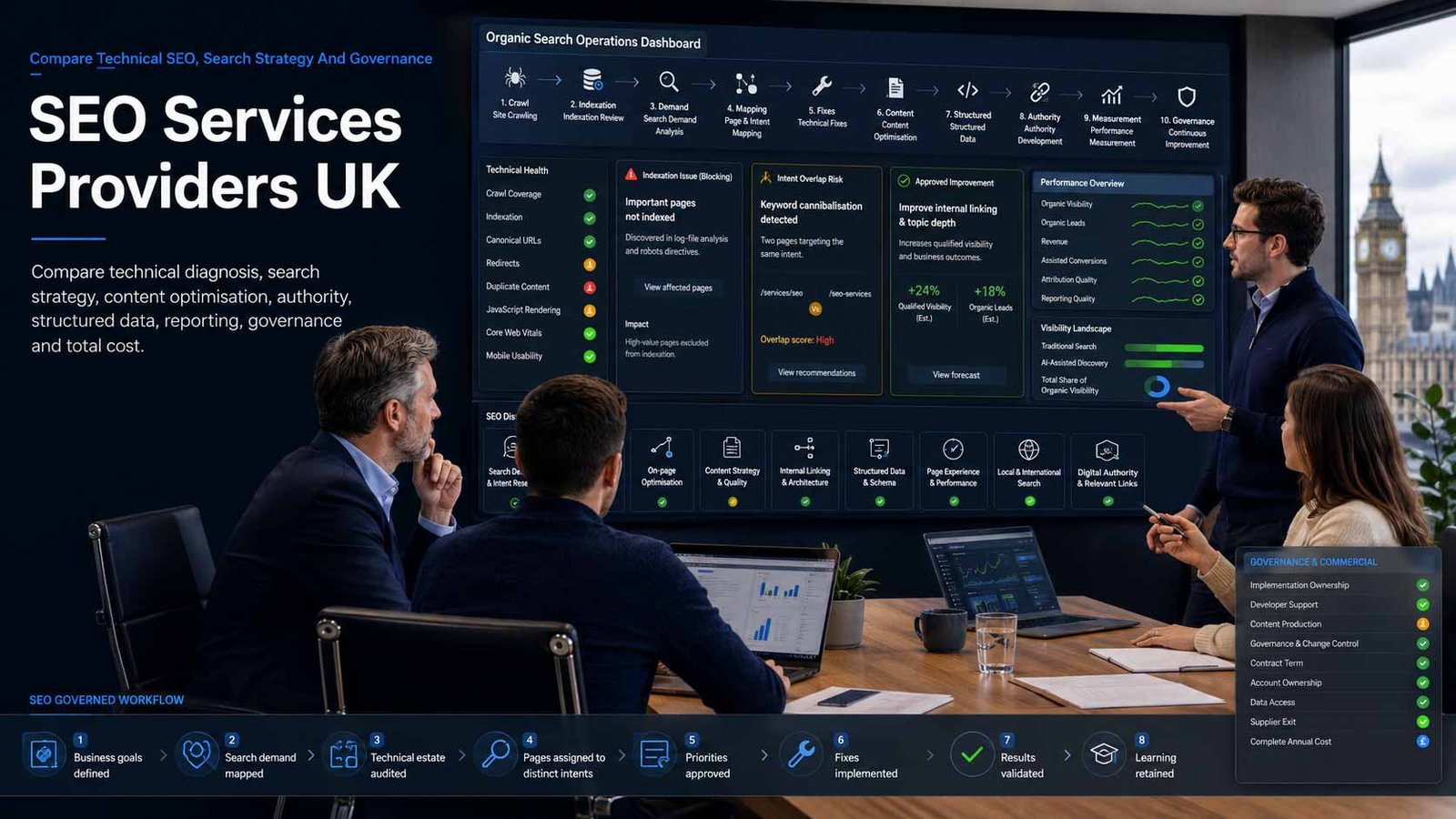
Define The Organic Search Mandate Before Comparing Agencies
SEO can describe an audit, a monthly managed service, embedded consultancy or a large programme spanning technical, content and authority work. Quotes are not comparable until the buyer defines the same commercial objectives, markets, implementation capacity and measurement rules.
- Separate organic-search work from PPC and social media
- Keep website design and redevelopment in its own procurement scope
- Define who implements technical and content recommendations
- Require evidence, access controls and a documented exit position
SEO services help a business improve how its website is discovered, understood and selected through unpaid search results. A managed programme can include technical diagnosis, crawling and indexation improvements, search-demand research, page optimisation, content-quality work, internal linking, authority development, digital PR support, migration assurance, structured data, Search Console governance and performance reporting.
Search engines do not sell guaranteed organic positions. Google states that meeting its technical requirements and Search Essentials does not guarantee crawling, indexation or ranking. A credible provider should therefore define hypotheses, priorities, implementation responsibilities and measurable commercial outcomes rather than promise a fixed position or immediate traffic gain.
This page compares national and broader organic SEO services. It does not compare website design, paid search management or social media marketing. Local listings and Google Business Profile management also have a dedicated service page, so local-presence administration should not dominate this scope.
Choose The Right SEO Delivery Structure
The operating model changes team access, implementation speed, accountability, knowledge transfer and the way results should be assessed.
| SEO Service Model | What It Usually Provides | Best-Fit Question |
|---|---|---|
| Managed SEO retainer | An ongoing programme covering prioritisation, technical work, on-page optimisation, content recommendations, authority activity and reporting | Does the business need continuous specialist capacity and a structured monthly roadmap? |
| SEO audit and remediation project | A defined technical, content or strategic review followed by a prioritised implementation plan | Can the internal team implement recommendations after the diagnostic phase? |
| Technical SEO consultancy | Specialist support for crawling, rendering, indexation, JavaScript, faceted navigation, migrations, internationalisation and complex architecture | Is the principal risk technical complexity rather than ongoing content production? |
| E-commerce SEO programme | Category, product, faceted-navigation, stock, duplicate-content, internal-linking and organic-revenue optimisation | Can the provider work with merchandising, development, analytics and trading teams? |
| B2B and lead-generation SEO | Search-demand mapping, service and sector architecture, decision-stage content, lead-quality measurement and pipeline attribution | Are objectives tied to qualified enquiries and revenue rather than traffic volume alone? |
| Enterprise or international SEO | Multi-market governance, hreflang, templates, large-scale quality control, stakeholder coordination and platform constraints | Can the provider operate across countries, teams, release cycles and approval structures? |
| Co-managed SEO and enablement | An external team supplies strategy, specialist analysis, reviews, training and quality assurance while internal teams implement | Does the organisation want capability transfer and retained ownership of execution? |
| Migration and change assurance | Organic-risk planning for redesigns, replatforming, domain changes, acquisitions, consolidations and large content moves | Is there a time-limited change event where traffic, URLs and evidence must be protected? |
Eight Areas That Determine SEO Provider Fit
Use the same website data, commercial priorities, markets, internal resources and measurement requirements for every proposal.
Comparison Criterion
Baseline, Objectives And Commercial Priorities
A credible proposal should establish current organic performance, brand and non-brand demand, priority products or services, target markets, seasonality, margin, sales cycle and implementation constraints. Require a written baseline and agreed outcome hierarchy before activity begins.
Comparison Criterion
Technical SEO And Indexation Control
Compare crawl diagnostics, robots and noindex management, XML sitemaps, canonicalisation, redirects, rendering, JavaScript, status codes, duplicate URLs, faceted navigation, pagination, international targeting and release testing. Recommendations must be prioritised by likely impact, risk and delivery effort.
Comparison Criterion
Search Demand, Intent And Page Architecture
Review how the provider identifies commercial search demand, separates distinct intents, maps topics to existing or required pages, prevents cannibalisation and recommends internal linking. The method should connect search behaviour to buyer journeys rather than rely on keyword volume alone.
Comparison Criterion
On-Page Quality And Content Optimisation
Compare briefs, page reviews, titles, headings, entity coverage, evidence, usefulness, originality, structured content, internal links and maintenance. Keep full editorial production and broader content-marketing campaigns outside this service unless explicitly scoped and priced.
Comparison Criterion
Authority, Digital PR And Link Risk
Assess how the provider earns relevant third-party references, evaluates link quality, handles digital PR collaboration and avoids paid-link, site-reputation or scaled-content tactics that can breach search-engine spam policies. Require approval rules and a record of all externally placed activity.
Comparison Criterion
Search Experience, Structured Data And AI Visibility
Review structured data governance, SERP appearance, featured answers, image and video eligibility, brand/entity consistency and measured visibility in AI-assisted search. Providers should treat AI-search reporting as an evolving evidence layer, not promise guaranteed citations or special optimisation shortcuts.
Comparison Criterion
Measurement, Attribution And Reporting
Compare Search Console, analytics, CRM and revenue measurement; consent-aware tracking; brand versus non-brand segmentation; landing-page and query analysis; lead quality; forecast assumptions; annotations and reporting access. Require raw-data ownership and definitions for every KPI.
Comparison Criterion
Team, Implementation, Governance And Exit
Confirm named specialists, seniority, delivery location, subcontractors, communication cadence, ticketing, approvals, access, change control, implementation ownership, contract term, notice, data export and handover. Strategy without delivery capacity often creates a growing recommendation backlog.
Measures To Define Before An SEO Contract Is Signed
Translate rankings and visibility claims into auditable technical, commercial and operational evidence.
| Measure | What It Should Define | Evidence To Request | Common Weakness |
|---|---|---|---|
| Index coverage and eligibility | Whether important URLs are crawlable, indexable and represented correctly in search | Valid indexed pages, excluded URLs, canonical targets, sitemap status, robots directives and reason codes | A provider reports total indexed URLs without checking whether priority pages are eligible or duplicated |
| Organic search demand captured | Visibility and clicks from relevant non-brand searches across priority topics | Search Console queries, pages, countries, devices, impressions, clicks, position distributions and seasonality | Growth is attributed to branded demand or one volatile query |
| Qualified organic outcomes | Leads, applications, revenue or other valuable actions attributable to organic landing sessions | Analytics events, CRM source, landing page, consent coverage, lead quality, revenue, margin and attribution assumptions | Traffic growth is reported without proving business value |
| Technical issue reduction | Whether high-impact crawl, indexation, rendering and template problems are resolved | Issue, affected URLs, severity, owner, release, validation date, before-and-after evidence and residual risk | Audit scores improve while commercial templates remain unchanged |
| Content and page performance | Whether priority pages better satisfy demand and generate useful outcomes | Baseline query set, page changes, index date, impressions, clicks, conversions, assisted value and cannibalisation checks | New word count is treated as success without quality or outcome evidence |
| Core Web Vitals and experience | Real-world loading, responsiveness and visual stability for material page groups | CrUX or Search Console field data, LCP, INP, CLS, page templates, percentile, device and release annotations | Laboratory scores are presented as if they are field performance |
| Authority and reference quality | Whether relevant, editorially credible third-party references and mentions support visibility | Referring page, relevance, placement, destination, acquisition method, status, traffic context and risk review | Success is measured only by link count or a third-party authority score |
| Implementation velocity | How quickly approved recommendations reach production and are validated | Recommendation, owner, dependency, priority, approval, release date, test result and blocked days | The agency produces recommendations faster than the organisation can implement them |
| AI-assisted search visibility | Observed brand or page inclusion in selected AI-search and answer surfaces | Prompt set, market, date, platform, cited source, landing page, volatility and methodology limitations | A single screenshot or proprietary score is treated as a guaranteed market measure |
| Retention and knowledge transfer | Whether data, decisions and capability remain usable after the engagement | Shared documentation, dashboards, change log, training, account ownership, exports, final roadmap and access removal | The buyer loses reporting history, tools or context when the supplier changes |
SEO Providers UK Businesses Can Consider
Shortlist providers whose specialism, team, operating model and evidence fit the website and commercial requirement. These profiles are comparison positions, not a universal ranking.
Provider Profile
Impression
Impression is a performance marketing agency with a dedicated SEO practice covering organic strategy, technical SEO, content, digital PR and international requirements. Include it where a business wants an evidence-led programme connected to broader commercial measurement and has the internal capacity to work through an active roadmap. Confirm the named delivery team, organic-only scope, technical implementation ownership, content and digital PR boundaries, reporting definitions, AI-search measurement, tool access, retainer allocation, minimum term, notice and treatment of any services supplied outside SEO.
Review official Impression SEO servicesProvider Profile
Builtvisible
Builtvisible is a specialist organic-search agency combining SEO, data and content around search-led customer journeys. Include it where a business wants strategic organic growth, complex technical analysis or a connected programme across search demand and content performance. Confirm the contracting entity, team composition, ownership following its wider group integration, technical and content workstreams, implementation model, digital PR responsibilities, forecasting method, data access, reporting, meeting cadence, contract term and the extent to which recommendations depend on other group services.
Review official Builtvisible servicesProvider Profile
Blue Array
Blue Array is a UK specialist organic-search agency offering SEO, digital PR and generative-search visibility services through its consulgency model. Include it where a buyer values a search-specialist team, senior strategic input and scalable delivery for an established or enterprise website. Confirm which services sit inside the SEO retainer, team seniority, technical implementation support, content ownership, digital PR approval, AI-search methodology, reporting access, training, minimum commitment, notice and how recommendations are prioritised against commercial value.
Review official Blue Array organic search servicesProvider Profile
Re:signal
Re:signal is an organic growth consultancy focused primarily on e-commerce brands, integrating technical SEO, content strategy, digital PR and AI-search visibility. Include it where organic revenue, product and category architecture, international markets and merchandising coordination are central to the brief. Confirm sector fit, forecast assumptions, revenue attribution, technical ownership, category and product-page scope, content-production boundaries, digital PR delivery, international support, tools, reporting, internal stakeholder requirements, contract term and handover.
Review official Re:signal SEO servicesProvider Profile
Hallam
Hallam provides SEO services with a current emphasis on B2B search, technical SEO, content strategy, authority and visibility across traditional and AI-assisted discovery. Include it where a B2B organisation wants organic activity aligned with long buying cycles, pipeline and broader brand-search behaviour. Confirm the organic-only workstream, buying-stage methodology, technical implementation, content and digital PR division, attribution to qualified pipeline, AI-search reporting limits, named team, meeting and reporting cadence, retainer allocation, contract term and termination.
Review official Hallam SEO servicesProvider Profile
SALT.agency
SALT.agency is a specialist technical SEO and organic-visibility agency working with complex, international and enterprise websites. Include it where crawl, rendering, architecture, platform change, internationalisation or high-risk search issues require deep technical capability and senior consultancy. Confirm whether implementation is included, developer collaboration, migration and release support, tool and log-file requirements, international scope, AI-visibility work, content or authority dependencies, response times, documentation, retainer or project structure, notice and knowledge transfer.
Review official SALT.agency servicesProvider Profile
Aira
Aira is a UK digital agency offering SEO alongside digital PR, link building, paid media and wider marketing support. Include it where a growing business wants a coordinated organic programme and may benefit from specialist authority work while retaining a clear SEO mandate. Confirm which services are included, whether paid media is excluded from the comparison, technical and on-page delivery, implementation responsibility, digital PR and link approval, content production, reporting and attribution, dedicated team, minimum retainer, contract term, notice and account ownership.
Review official Aira SEO servicesProvider Profile
Screaming Frog
Screaming Frog provides agency SEO services in addition to its widely used crawling software, combining technical and creative expertise for competitive sectors. Include it where a business wants a specialist team with strong technical diagnosis, content and link-earning capability and can support implementation through internal or external developers. Confirm the service team rather than software licence, project or retainer scope, crawl and log analysis, content and digital PR responsibilities, implementation support, reporting, tool access, named contacts, contract term, notice and final data transfer.
Review official Screaming Frog SEO servicesWhat Changes SEO Services Cost
SEO pricing depends on site complexity, market scope, implementation support, content workload, authority activity, data requirements and team seniority. Compare annual scope and capacity rather than one monthly figure.
| Cost Driver | Why It Changes Spend | What A Comparable Quote Should Show |
|---|---|---|
| Website scale and technical complexity | Large, JavaScript-heavy, faceted, multilingual or multi-domain sites require more crawling, analysis, stakeholder work and release testing | URL and template counts, platforms, markets, rendering, log access, release cadence, known risks and implementation owners |
| Baseline condition and penalty risk | Indexation failures, migrations, manual actions, hacked content, link risk or historic duplication increase diagnostic and remediation effort | Search Console access, history, migrations, manual actions, security events, link profile, previous suppliers and unresolved issues |
| Markets, products and search scope | More countries, languages, services, categories and audience segments expand research, mapping, governance and reporting | Priority markets, language ownership, products, margin, locations, seasonality, intent groups and exclusions |
| Technical implementation support | Recommendations that require tickets, developer workshops, QA and release validation use more specialist time than advisory-only work | Monthly implementation hours, ticketing, code or configuration access, environments, acceptance tests and response times |
| Content optimisation workload | Page briefs, rewrites, reviews, consolidation, internal linking and maintenance vary with page count and internal writing capability | Pages per month, research depth, drafting owner, subject-matter review, approvals, publishing, update cadence and quality standard |
| Authority and digital PR activity | Research, campaigns, outreach and reactive work add specialist creative and media-relations capacity | Campaign count, assets, outreach markets, approval rules, target publications, link policy, reporting and reuse rights |
| Data, tooling and reporting | Enterprise crawlers, rank tracking, log analysis, dashboards, AI-search monitoring and data warehouses can add licence or engineering cost | Tools, licences, limits, ownership, exports, APIs, retention, dashboard access and post-contract continuity |
| Meetings, training and governance | Senior consultancy, workshops, international coordination, board reporting and capability transfer increase planned service time | Named roles, senior hours, meeting cadence, training sessions, stakeholder groups, documentation and escalation |
| Contract term and retainer allocation | Lower monthly pricing may depend on a longer term, pooled hours, strict scope or separately charged projects | Minimum term, renewal, notice, hours, rollover, overage rates, project fees, annual increases, pauses and termination |
| Internal implementation capacity | A low agency fee can deliver poor value when recommendations wait months for development, content or approval | Named internal owners, available hours, release windows, editorial capacity, dependencies and service-level expectations |
| Indicative Planning Band | Typical Scope | What Must Be Confirmed |
|---|---|---|
| £750–£2,000 per month | A focused small-business or limited-site engagement with constrained technical complexity and a narrow priority set | Included hours, audit depth, implementation, content workload, reporting, authority activity and contract term |
| £2,000–£5,000 per month | A structured SME or mid-market programme covering technical, on-page, content guidance and ongoing measurement | Named team, monthly outputs, implementation support, page volume, digital PR, tools and commercial KPI ownership |
| £5,000–£12,000 per month | A larger e-commerce, B2B, multi-market or technically complex programme with several workstreams and stakeholders | Specialist allocation, markets, technical delivery, content production, authority activity, data engineering and governance |
| £12,000+ per month | An enterprise, international or high-change organic programme with complex platforms, assurance and cross-functional delivery | Scope by market and workstream, senior capacity, implementation model, reporting infrastructure, service levels and exit |
| £1,500–£15,000+ one-off | A technical audit, migration review, strategy project, due diligence exercise or defined remediation programme | Exact deliverables, data access, affected templates, workshops, implementation, validation, documentation and follow-up |
Match The Provider To The Organic Search Operating Model
The right shortlist depends on website complexity, commercial goals, internal implementation capacity, market scope, evidence requirements and risk.
Small Professional Or Local Service Business
Prioritise a clear technical baseline, service-page quality, sensible internal linking, transparent reporting and a manageable implementation plan. Keep Google Business Profile and local-listing management in its dedicated service scope where that is the principal requirement.
Growing B2B Or Multi-Service Company
Prioritise search-demand architecture, service and sector intent separation, technical governance, expert content input, qualified-lead measurement, CRM attribution and a provider able to work with long buying cycles and internal subject-matter experts.
E-commerce Or High-Volume Transactional Site
Prioritise category and product architecture, faceted navigation, crawl efficiency, stock and duplication rules, internal linking, international requirements, organic-revenue measurement, release QA and close coordination with merchandising and development teams.
Enterprise, International Or Regulated Organisation
Prioritise technical depth, multi-market governance, stakeholder management, documented risk, controlled releases, compliance-aware analytics, authority standards, board reporting, training, data ownership and a robust supplier transition plan.
How To Compare SEO Proposals
Issue one brief containing the current website position, target markets, priority services or categories, commercial objectives, analytics and Search Console access, known technical issues, previous migrations, internal development and editorial capacity, governance needs and contract constraints. Require a response matrix rather than a sales presentation that cannot be compared line by line.
- The baseline and commercial outcome hierarchy are explicit
- Technical, content, authority and reporting workstreams are separated
- Monthly capacity and named roles are quantified
- Implementation ownership and dependencies are documented
- Measurement definitions, tools and data access are agreed
- Contract, handover and supplier-exit requirements are clear
Make Every Provider Price The Same Implementation Model
Ask each provider to assume the same developer availability, editorial capacity, stakeholder approvals, market scope, content volume and authority work.
A cheaper retainer is not comparable when it excludes implementation, content review, digital PR, migration assurance, tools or senior consultancy.
Six Questions To Put To Every SEO Provider
The answers expose vague retainers, unsafe tactics, weak implementation and reporting arrangements that create cost without durable value.
What Baseline And Outcome Will You Contract Against?
Request current performance, known limitations, commercial priorities, assumptions, target markets, leading indicators and the exact results that will be reported without promising guaranteed rankings.
Who Will Actually Deliver The Work?
Confirm named strategists, technical specialists, content and authority roles, seniority, location, subcontractors, availability, meeting cadence and the hours allocated to each workstream.
Who Implements Every Recommendation?
Ask who writes tickets, changes templates, publishes page updates, tests releases, fixes defects, coordinates developers and validates that recommendations reached production correctly.
How Will You Avoid Spam And Reputation Risk?
Require the provider to explain link acquisition, digital PR, AI-assisted content, scaled page creation, third-party publishing, approvals and how activity is checked against current search-engine spam policies.
How Will Business Value Be Measured?
Confirm Search Console, analytics and CRM access; consent limitations; brand versus non-brand reporting; qualified lead or revenue attribution; forecast assumptions; dashboard ownership and data export.
What Happens If Priorities Change Or The Contract Ends?
Review reprioritisation, unused capacity, project fees, minimum term, renewal, notice, tool access, documentation, dashboards, final roadmap, account transfer and removal of supplier permissions.
A Seven-Stage SEO Provider Evaluation
Move from verified baseline evidence to a controlled organic-search programme rather than selecting a supplier from rankings, awards or a generic traffic forecast.
- Collect Search Console, analytics, CRM, crawl, rank, backlink and technical-change evidence; map current suppliers, tools, previous migrations, manual actions, constraints and accountable internal owners.
- Define the commercial outcome hierarchy, target markets, priority products or services, audiences, organic-search boundary, exclusions, implementation capacity, risk tolerance and reporting requirements.
- Prepare one provider brief covering site scale, platforms, templates, markets, data access, content operations, development releases, authority activity, analytics consent and supplier-governance expectations.
- Obtain comparable proposals identifying named roles, monthly hours, service model, deliverables, technical and content responsibilities, digital PR, tools, reporting, meetings, fees, contract and exit.
- Normalise proposals by annual cost, senior capacity, implementation support, workstream volume, third-party costs, internal effort, dependencies, evidence quality and the time required to reach production.
- Complete reference checks and risk review covering relevant site types, team continuity, spam-policy controls, data access, account ownership, security, conflicts, subcontractors and case-study evidence.
- Operate through a prioritised roadmap, change log, implementation validation, monthly evidence, quarterly strategy, consent-aware measurement, access review, knowledge transfer and a maintained exit pack.
SEO Services Comparison Checklist
Use this table before approving a monthly retainer, specialist project, migration engagement or co-managed organic-search programme.
| No. | Requirement | Evidence To Obtain Before Award | Confirmed |
|---|---|---|---|
| 01 | Organic-search scope and owner agreed | Business owner, marketing owner, technical owner, editorial owner, approver, data owner and escalation route | |
| 02 | Current performance baseline validated | Search Console, analytics, CRM, brand and non-brand demand, priority pages, conversions, revenue, seasonality and limitations | |
| 03 | Technical estate mapped | Domains, subdomains, platforms, templates, rendering, robots, sitemaps, canonicals, migrations, internationalisation and release process | |
| 04 | Search intent and page ownership defined | Priority topics, existing pages, required pages, cannibalisation rules, internal links, local boundary and exclusions | |
| 05 | Provider team and capacity confirmed | Named roles, seniority, location, subcontractors, monthly hours, availability, meeting cadence and backup cover | |
| 06 | Implementation model accepted | Tickets, code or configuration changes, content publishing, developer support, QA, release validation, defect handling and owners | |
| 07 | Content optimisation boundary agreed | Briefs, reviews, rewrites, evidence, subject-matter approval, publishing, maintenance and separation from broad content marketing | |
| 08 | Authority and link controls approved | Digital PR scope, outreach, placement approval, paid-link prohibition, third-party publishing, records, risk review and remediation | |
| 09 | Measurement framework signed off | KPIs, definitions, sources, consent coverage, attribution, brand split, page and query reporting, forecasts, annotations and dashboard | |
| 10 | Tools and data ownership verified | Search Console, analytics, tag manager, CRM, crawler, rank tracker, log data, dashboards, licences, exports and retention | |
| 11 | Search and AI policy controls documented | Search Essentials, spam policies, AI-content review, structured data, AI-visibility methodology, approvals and incident response | |
| 12 | Pricing and annual capacity compared | Retainer, projects, licences, digital PR, content, travel, overages, annual increases, internal effort and complete twelve-month cost | |
| 13 | Contract and change terms accepted | Minimum term, renewal, notice, reprioritisation, pauses, scope changes, overages, conflicts, liability and termination assistance | |
| 14 | Access and security governance approved | Least privilege, individual accounts, MFA, credential handling, data protection, subcontractors, access reviews and removal | |
| 15 | Handover and exit pack agreed | Roadmap, issue log, dashboards, exports, documentation, change history, content assets, link records, training and final access removal |
Common SEO Services Buying Mistakes
Most avoidable failures begin with vague outcomes, incomplete implementation responsibility, unsafe authority tactics or data that the buyer does not control.
| Mistake | Why It Creates Risk | Better Control |
|---|---|---|
| Buying a ranking guarantee | No provider controls search-engine rankings, and a guarantee can encourage narrow or unsafe tactics | Contract measurable work, evidence and commercial outcomes |
| Choosing on traffic forecasts alone | Forecasts depend on rankings, click behaviour, implementation and market conditions that can change | Compare assumptions and scenario ranges |
| Ignoring brand versus non-brand demand | Growing branded searches can make SEO performance appear stronger than new demand capture | Segment queries and landing pages |
| Commissioning audits without implementation | Repeated diagnostics create a backlog while the underlying website remains unchanged | Fund delivery and validation capacity |
| Paying for bulk content production | Large volumes of low-value or repetitive pages can create quality, duplication and spam-policy risk | Use intent, evidence and editorial review |
| Buying links by quantity or score | Irrelevant, paid or manipulated links can create reputational and search risk | Require editorial relevance and acquisition records |
| Allowing the agency to own core accounts | Loss of Search Console, analytics, dashboards or tools weakens control and makes switching difficult | Keep business-owned administrator access |
| Mixing SEO with PPC and social scope | Bundled reporting can obscure which channel created cost and value | Separate workstreams, budgets and KPIs |
| Treating AI visibility as guaranteed | AI-assisted results are dynamic and measurement remains immature | Use repeatable prompt sets and disclose limitations |
| Ending access before handover is complete | The business can lose evidence, documentation, history and unresolved priorities | Complete export, training and access removal in sequence |
Frequently Asked Questions
Answers to common questions from UK businesses comparing managed SEO agencies, specialist consultants and project-based providers.
What Do SEO Services Usually Include?
SEO services can include technical auditing, crawling and indexation work, search-demand research, intent mapping, on-page optimisation, content recommendations, internal linking, structured data, authority development, migration support, Search Console governance and reporting. The exact deliverables, implementation responsibilities and monthly capacity should be written into the contract.
How Much Do SEO Services Cost In The UK?
Pricing varies with website size, technical complexity, market scope, competition, content workload, implementation support, authority activity, data requirements and team seniority. Small focused retainers may start below larger multi-workstream programmes, but buyers should compare annual scope, hours, licences, project fees and internal effort rather than one monthly amount.
How Long Does SEO Take To Produce Results?
There is no universal timetable. Technical corrections can be discovered and implemented quickly, but crawling, indexation, search demand, competition, content quality, authority and sales cycles affect when measurable outcomes appear. A provider should define leading indicators, dependencies and review points without guaranteeing a ranking date.
Can An SEO Agency Guarantee First-Page Rankings?
No credible agency controls a search engine and should not guarantee a specific organic position. Google also states that following its requirements does not guarantee crawling, indexing or serving. Compare providers by method, evidence, implementation and commercial outcomes rather than ranking promises.
What Is The Difference Between SEO And PPC?
SEO focuses on unpaid search visibility and the technical, content and authority signals that help pages become eligible and useful in organic results. PPC purchases advertising placements through a paid-media platform. The channels can share research and measurement, but budgets, delivery and attribution should remain distinct.
Should SEO Include Website Development?
SEO providers may identify technical changes and support developers, but a full website design or development project is a separate procurement scope. The SEO agreement should state whether the provider only recommends changes, writes implementation tickets, edits the CMS or supplies development and release testing.
What Access Should An SEO Provider Need?
Common access includes Google Search Console, analytics, tag management, the CMS, crawling tools, rank tracking, log files and sometimes CRM or revenue data. Use business-owned accounts, least-privilege permissions, individual users, MFA, access reviews and a documented removal process.
How Should SEO Performance Be Measured?
Use a balanced framework covering indexability, relevant non-brand demand, priority landing pages, qualified conversions or revenue, technical issue resolution, content performance, authority quality and implementation velocity. Record attribution and consent limitations and avoid relying on one rank or third-party score.
Does AI-Generated Content Harm SEO?
The tool used to create content is not the only issue. Google warns that generating many pages primarily to manipulate rankings can violate its scaled-content-abuse policy. Businesses should require original value, accurate evidence, expert review, clear purpose, quality control and maintenance for any AI-assisted content.
Can A Business Change SEO Provider?
Yes, subject to the contract and notice terms. A controlled switch should transfer the roadmap, issue backlog, dashboards, exports, content briefs, link and digital PR records, technical documentation, tool ownership and account access before the previous supplier is removed.
Official Search Guidance And Provider Resources
Reviewed by Bhav Giva, Founder & Lead Analyst at CompareServices.co.uk, on 30 July 2026.
Use Google Search Central, Search Console, ICO guidance and official provider documentation to verify current search requirements, measurement practices, provider scope and contractual claims. Search features, spam policies, agency teams and service offers can change.
- Google Search Central — Search Essentials
- Google Search Central — Spam Policies
- Google Search Central — SEO Starter Guide
- Google Search Central — Helpful, Reliable, People-First Content
- Google Search Central — Do You Need An SEO?
- Google Search Console — Performance And Indexing Tools
- Google Search Central — Core Web Vitals And Search
- Google Search Central — Structured Data Guidelines
- Google Search Central — Generative AI Content Guidance
- ICO — Cookies And Similar Technologies
- Impression — SEO Services
- Builtvisible — Organic Search Services
- Blue Array — Organic Search Services
- Re:signal — E-commerce SEO
- Hallam — SEO Services
- SALT.agency — Technical SEO And AI Visibility
- Aira — SEO Services
- Screaming Frog — SEO Services