
Compare PPC / Google Ads Management Providers UK (2026)
Compare Paid Search Strategy, Account Ownership, Tracking, Bidding, Performance Max, Shopping, Reporting, Governance And Complete Management Cost
Compare PPC management UK business providers by Google Ads account ownership, commercial objectives, campaign structure, keyword and search-term control, conversion measurement, consent implementation, offline sales imports, Smart Bidding, Performance Max, Shopping feeds, creative assets, budget pacing, policy compliance, reporting, testing, management capacity, contract terms and complete annual cost. Give every provider the same advertising history, margins, lead-quality definitions, target markets, landing-page constraints and measurement rules before comparing proposals.
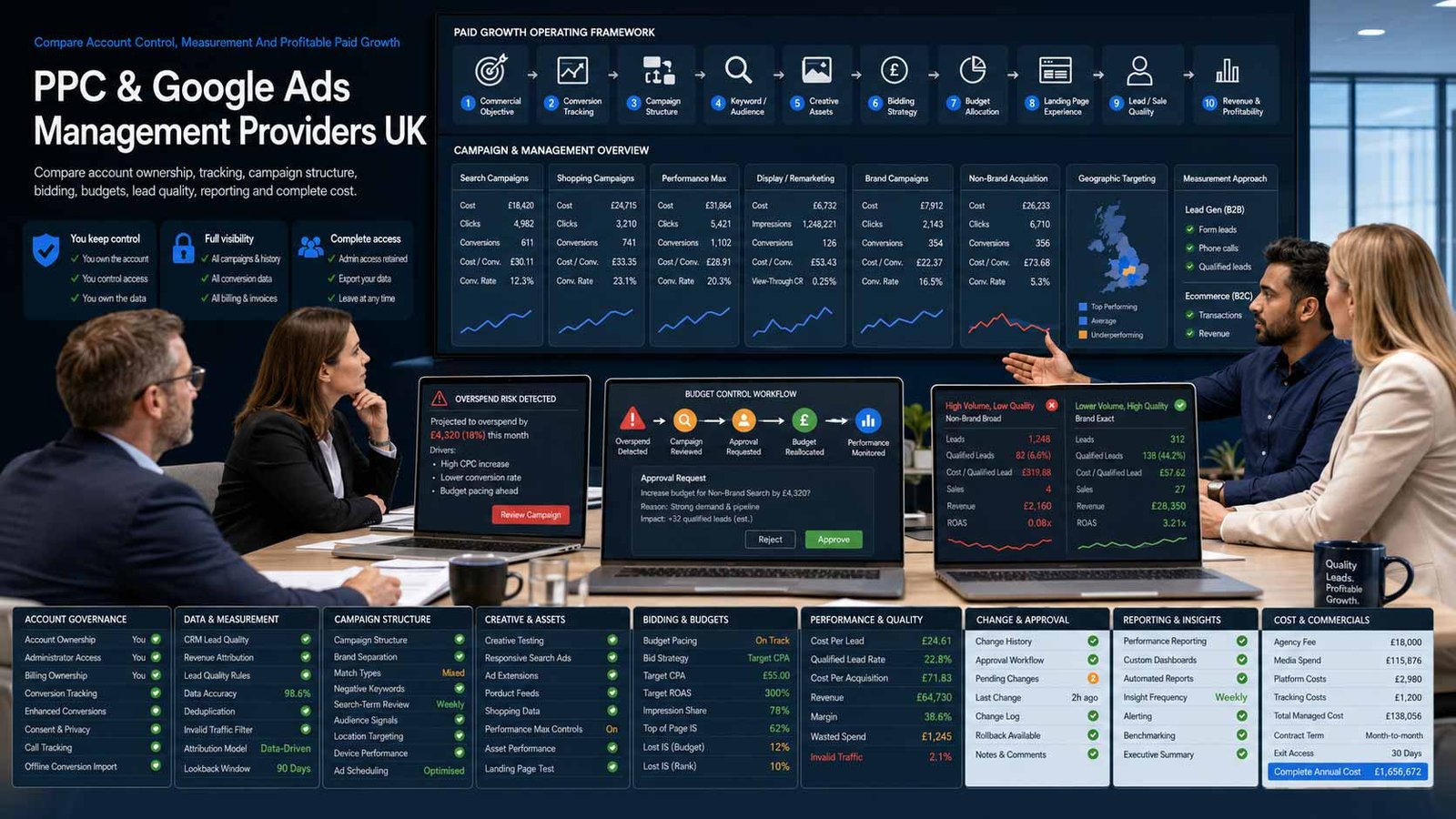
Keep The Google Ads Account Under Business Control
The business should retain administrative access, billing visibility, conversion data and the ability to remove an agency manager. Google explains that a client account still owns its data and can unlink manager ownership.
- Use a business-owned Google Ads account and payment profile
- Link the agency through a manager account rather than surrendering ownership
- Separate advertising spend from agency management fees
- Document conversion actions, data sources and the exit process
PPC and Google Ads management is the professional planning, operation and improvement of paid advertising campaigns within Google Ads and closely related paid-search environments. The service can include Search, Shopping, Performance Max, Display, YouTube, remarketing, audience use, Merchant Center feeds, conversion tracking, offline sales imports, bidding, budget pacing, experiments, reporting and account governance.
Google Ads is an auction platform, so an agency cannot guarantee a fixed cost per click, number-one ad position, exact lead volume or return. A credible provider should explain the assumptions behind forecasts, distinguish platform-reported conversions from verified commercial outcomes and show how it will control wasted spend, low-quality leads, policy risk and automation.
This page compares paid-search and Google Ads management only. It does not compare SEO services, social media marketing or website design and development. Landing-page recommendations can form part of PPC optimisation, but a full redesign or conversion-rate-optimisation programme should be separately scoped and priced.
Choose The Right PPC Management Structure
The delivery model changes management capacity, account control, reporting depth, implementation speed and the way fees should be assessed.
| PPC Service Model | What It Usually Provides | Best-Fit Question |
|---|---|---|
| Managed Google Ads retainer | Ongoing strategy, campaign management, optimisation, reporting and account governance for a defined monthly fee or percentage of spend | Does the business need continuous specialist ownership and a monthly testing roadmap? |
| Account audit and recovery project | A time-limited review of tracking, structure, search terms, bidding, policy issues, budgets and historical changes, followed by corrective actions | Is the current account underperforming, difficult to understand or dependent on inherited settings? |
| Lead-generation paid search | Search and related campaigns designed to produce qualified enquiries, calls, bookings or applications | Can the agency connect advertising interactions to accepted leads, opportunities and sales? |
| E-commerce and Shopping management | Merchant Center feeds, Shopping, Performance Max, product segmentation, promotions, profitability and stock-aware optimisation | Can product economics and feed quality be measured at category, brand and item level? |
| Performance Max and cross-channel management | Goal-based campaigns across Google inventory using audience signals, creative assets, feeds, bidding and channel reporting | Will the provider maintain enough visibility, exclusions, asset quality and experiment control? |
| B2B pipeline-focused PPC | Paid search connected to CRM stages, offline conversions, revenue values, account targeting and longer sales cycles | Can the provider optimise beyond form fills and report pipeline quality? |
| Enterprise or multi-market paid search | Large accounts, multiple countries, currencies, brands, teams, governance layers and potentially Search Ads 360 | Can the agency manage permissions, localisation, budgets and consistent controls across markets? |
| Co-managed PPC consultancy | An external specialist supplies strategy, audits, training, reviews and quality assurance while an internal team operates the account | Does the business want capability transfer and retained day-to-day control? |
Eight Areas That Determine PPC Provider Fit
Use the same account history, budgets, commercial targets, conversion definitions, geographic scope and internal resources for every proposal.
Comparison Criterion
Commercial Objectives, Unit Economics And Forecast Assumptions
Require the provider to understand gross margin, average order value, repeat revenue, lead-to-sale rate, sales capacity, target markets, seasonality and acceptable acquisition cost. Forecasts should identify assumptions, confidence limits and the difference between platform conversions and realised revenue.
Comparison Criterion
Account Ownership, Access, Billing And Change Authority
The advertiser should retain administrator access, billing records and ownership of its client account. Compare manager-account linking, individual user permissions, MFA, payment responsibility, change approval, scripts, API connections, third-party tools and the process for removing access.
Comparison Criterion
Conversion Measurement, Consent And First-Party Data
Review primary and secondary conversions, Google tag or Tag Manager implementation, consent mode, enhanced conversions, call tracking, CRM integration, offline conversion imports, deduplication, conversion windows, values and data-quality monitoring. Measurement must respect UK privacy and cookie requirements.
Comparison Criterion
Campaign Architecture, Keywords And Search-Term Control
Compare brand and non-brand separation, campaign objectives, match types, negative keywords, geographic settings, languages, devices, schedules, audience observation, search partners and query-review cadence. The structure should support business decisions rather than merely mirror the website menu.
Comparison Criterion
Bidding, Budgets, Pacing And Automation Governance
Assess Smart Bidding readiness, conversion volume, target CPA or ROAS logic, learning periods, portfolio strategies, seasonality, budget allocation, overspend controls, limited-by-budget decisions and human review. Automation requires accurate goals and guardrails rather than passive acceptance of recommendations.
Comparison Criterion
Ads, Assets, Offers And Landing-Page Coordination
Review responsive search ad quality, sitelinks, callouts, images, price or promotion assets, legal qualifications, message consistency, offer approval, brand controls, landing-page relevance, mobile experience and testing. Clarify whether copy, design and page implementation are included or only recommended.
Comparison Criterion
Shopping Feeds, Performance Max And Inventory Visibility
For retailers, compare Merchant Center diagnostics, product titles, attributes, identifiers, promotions, exclusions, margin data and stock logic. For Performance Max, require asset-group design, audience signals, brand controls, URL expansion decisions, search themes, channel reporting and a written test plan.
Comparison Criterion
Reporting, Experiments, Policy Control And Handover
Require raw-account access, dashboards, change history, search-term evidence, experiment logs, attribution assumptions, policy and disapproval handling, meeting cadence, forecast updates and a documented handover. Reporting should distinguish ad spend, Google fees, agency fees and internal conversion economics.
Measures To Define Before PPC Management Begins
Translate clicks, automated recommendations and platform conversions into auditable commercial evidence.
| Measure | What It Should Define | Evidence To Request | Common Weakness |
|---|---|---|---|
| Qualified cost per acquisition | Advertising and management cost divided by leads or customers that meet the agreed qualification definition | Ad cost, agency fee, valid leads, duplicates, spam, rejected leads, accepted leads and time period | A low platform CPA hides poor lead quality or unworked enquiries |
| Return on ad spend and gross-profit return | Revenue or gross profit attributed to advertising relative to advertising cost | Order values, cancellations, refunds, margin, repeat revenue, ad spend, agency fee and attribution model | Revenue ROAS rewards low-margin or returned orders |
| Lead-to-sale and pipeline value | How paid leads progress through accepted lead, opportunity, proposal and closed-sale stages | CRM stage dates, values, source identifiers, lost reasons, duplicates and offline conversion uploads | The account optimises to form submissions rather than commercial outcomes |
| Conversion measurement integrity | Whether primary conversion actions fire once, carry appropriate values and remain observable under consent choices | Tag diagnostics, consent states, enhanced conversions, import logs, deduplication, test transactions and variance | Duplicate or soft conversions train bidding towards the wrong behaviour |
| Search-term relevance | The proportion of spend and conversions associated with queries aligned to the intended product, service and audience | Search terms, match type, campaign, spend, conversion quality, negatives and reviewer decision | Broad reach expands without timely query governance |
| Budget pacing and allocation | Whether spend follows approved monthly and campaign limits while moving toward higher-value demand | Daily budgets, spend, forecasts, campaign caps, seasonality, change dates and approvals | Strong campaigns are constrained while weak campaigns consume budget |
| Competitive visibility | How often eligible ads show and whether budget or rank limits the chosen priority areas | Search impression share, top share, lost to budget, lost to rank, auction insights and priority keywords | The provider chases impression share without considering profitability |
| Creative and asset learning | Whether new ads, assets, offers and landing-page messages are tested with adequate evidence | Asset versions, approval dates, impressions, conversions, experiments, statistical limits and decisions | Automated combinations are treated as proof without a controlled hypothesis |
| Performance Max contribution | How Performance Max delivers across channels and whether incremental value can be separated from brand or existing demand | Channel performance, asset groups, search terms or insights, brand controls, feed products, experiments and conversion quality | A blended campaign report masks where spend and outcomes occurred |
| Change and governance quality | Whether material changes are approved, documented, monitored and reversible | Change history, tickets, rationale, owner, expected effect, review date, outcome and rollback | Many simultaneous edits make performance movement impossible to diagnose |
PPC And Google Ads Management Providers UK Businesses Can Consider
Shortlist providers whose team, account model, measurement capability and fee structure match the business. Profiles describe relevant positions, not a universal ranking.
Provider Profile
Impression
Impression provides Google Ads management within a broader paid-media, analytics and experimentation capability. Include it where a growing or established advertiser wants specialist paid search, Shopping, Performance Max and measurement support connected to commercial objectives. Confirm the named team, senior oversight, Google Ads and Merchant Center ownership, account audit, conversion plan, offline data, creative scope, landing-page responsibilities, experiment cadence, reporting, fee model, minimum spend, third-party technology, notice and handover. Do not treat Google Partner status or awards as a substitute for account-specific evidence.
Review official Impression Google Ads servicesProvider Profile
Found
Found offers Google Ads management covering Search, Shopping and Display within a London-based performance agency proposition. Include it where the business wants a strategic paid-media team able to combine audience, data and campaign management. Confirm the exact platforms and campaign types, who performs day-to-day changes, business-owned account access, billing, tracking implementation, lead-quality or revenue imports, creative production, search-term reviews, Performance Max controls, meeting cadence, fee basis, contract length and exit deliverables. Verify current Google Partner claims directly through Google rather than relying only on agency wording.
Review official Found Google Ads managementProvider Profile
Hallam
Hallam provides paid-media services with a strong B2B positioning and Google advertising capability across Search, Shopping, Display and YouTube. Include it where longer sales cycles, narrow audiences and pipeline measurement require closer integration with CRM and revenue evidence. Confirm whether the scope is paid search only or full-funnel paid media, conversion-value design, offline imports, account-based inputs, landing-page support, creative, budget governance, platform fees, team seniority, reporting against pipeline, data access and handover. Keep paid social and broader media activity separately priced when comparing a PPC-only brief.
Review official Hallam paid media servicesProvider Profile
ROAST
ROAST provides KPI-focused PPC management, regular account audits, keyword and budget optimisation and paid-search support across Google and Microsoft. Include it where the advertiser values structured optimisation, technology-assisted quality control and larger-account experience. Confirm baseline audit depth, account architecture, search-term governance, scripts or proprietary tools, conversion and attribution approach, Performance Max visibility, brand versus non-brand reporting, creative scope, international support, meeting cadence, management fee, account access and the ownership or export of any agency-created dashboards and automation.
Review official ROAST PPC servicesProvider Profile
Croud
Croud provides global paid-search execution supported by proprietary technology, distributed specialist resources and multi-market media capability. Include it where an enterprise or international advertiser needs scale, localisation, governance and potential Search Ads 360 expertise. Confirm the UK contracting entity, named leadership, delivery locations, platform and technology fees, manager hierarchy, currency and market controls, data processing, brand governance, translation approval, conversion architecture, budget allocation, change authority, reporting, service levels, business continuity and exit. Ensure the operating model is proportionate for the account size and internal team.
Review official Croud paid search capabilityProvider Profile
Push
Push provides paid-search management across Google and Microsoft with AI, data and creative positioning, including Performance Max and value-based measurement. Include it where an SME or scale-up wants active campaign management and broader performance-marketing support. Confirm which proprietary platforms or dashboards are mandatory, their cost and data portability; account ownership; campaign scope; conversion-quality evidence; use of customer data; creative production; landing-page support; automated recommendations; budget controls; reporting; contract term and exit. Separate any paid social, SEO, CRO or pay-per-lead work from the Google Ads management fee.
Review official Push PPC agency servicesProvider Profile
Circus PPC
Circus PPC is an independent specialist agency focused on PPC and paid advertising, including Google Ads and Microsoft Advertising. Include it where the buyer wants a hands-on specialist team rather than a broad integrated agency. Confirm the assigned account team, sector experience, Search and Shopping coverage, Merchant Center feeds, Performance Max governance, keyword and search-term review, creative, reporting, contract term, stated minimum commitment, management fee, third-party tools, access levels and handover. Verify current partner status and require proposal evidence based on the advertiser’s own economics and account history.
Review official Circus PPC servicesProvider Profile
Precis
Precis combines paid search with media strategy, creative, technology and data services. Include it where a retailer, app business or international organisation wants integrated media, measurement and creative capability around Google Ads. Confirm the exact paid-search scope, office and delivery team, platform and consultancy fees, campaign ownership, Merchant Center and feed responsibilities, analytics engineering, first-party data use, consent controls, creative production, experimentation, market localisation, reporting, account access, intellectual property and exit. A broad integrated proposition should still provide a transparent paid-search work plan and fee schedule.
Review official Precis paid search capabilityWhat Changes PPC And Google Ads Management Cost
Separate Google advertising spend from management, data, creative and internal operating costs. Compare the complete annual programme, not one fee percentage.
| Cost Component | Why It Changes Spend | What A Comparable Proposal Should Show |
|---|---|---|
| Google advertising spend | The media budget paid to Google for clicks, views or other chargeable interactions | Monthly and campaign budgets, currency, billing profile, taxes or jurisdiction-specific fees, credits and who controls changes |
| Fixed monthly management fee | The agency charges an agreed retainer for a defined service capacity | Named team, hours or activity, meetings, campaigns, markets, reporting, minimum spend, review and out-of-scope rates |
| Percentage-of-spend fee | The management fee rises with platform spend | Percentage bands, minimum fee, included channels, whether Google surcharges are included, upper cap and incentive effects |
| Hybrid retainer and percentage | A base fee provides coverage and an additional percentage applies above a threshold | Base scope, spend threshold, marginal rate, cap, annual forecast and change process |
| Setup, audit or rebuild fee | A one-off charge covers discovery, tracking review, restructuring, feed work or migration | Deliverables, access required, implementation, testing, documentation, completion criteria and ownership |
| Performance-linked fee | Part of the fee depends on leads, revenue, ROAS, CPA or another outcome | Baseline, attribution, lead acceptance, cancellations, margin, caps, disputes, data source and audit rights |
| Tracking and data costs | Call tracking, CRM connectors, server-side tagging, data warehousing or enhanced measurement can add cost | Licences, implementation, maintenance, consent, data processing, business ownership, export and termination |
| Creative and landing-page costs | Images, video, copy, feed assets or landing-page changes may sit outside campaign management | Quantity, format, approvals, production rounds, accessibility, hosting, testing, source files and reuse rights |
| Merchant Center and feed technology | E-commerce accounts may need feed tools, supplemental feeds, promotions and diagnostics | Products, countries, languages, feed rules, licences, implementation, ownership and support |
| Internal operating cost | Sales follow-up, offer approval, stock, margin data, compliance, page changes and CRM hygiene affect real performance | Named owners, response targets, data preparation, approval time, developer support and opportunity cost |
How Business Model And Conversion Journey Change The Shortlist
The appropriate provider depends on transaction economics, sales cycle, account scale, market coverage, data quality and the organisation’s ability to act on demand.
Local Or National SME Lead Generation
Prioritise accurate call and form tracking, search-term control, geographic settings, response-time evidence, qualified lead definitions, manageable budget pacing and a team that can explain changes without hiding behind automation.
E-commerce Retailer
Prioritise Merchant Center health, product economics, Shopping and Performance Max structure, feed optimisation, stock and promotion rules, new-customer value, returns, gross-profit reporting, creative assets and category-level budget decisions.
B2B Or High-Value Sales Organisation
Prioritise CRM integration, enhanced conversions for leads, offline stage imports, account and sector value, long conversion windows, pipeline quality, sales capacity, brand and non-brand separation and reporting that follows opportunities to revenue.
Enterprise Or Multi-Market Advertiser
Prioritise manager hierarchy, governance, Search Ads 360 where justified, market localisation, currency and budget controls, data warehousing, brand safety, compliance, large-scale creative, service levels and a documented global-to-local operating model.
How To Compare PPC Management Proposals
Provide the same twelve-month Google Ads exports, budgets, campaign objectives, products or services, margins, target regions, conversion definitions, lead-quality data, CRM stages, seasonality, compliance constraints, landing-page capacity and internal approval process. Require each agency to respond in the same format.
- The business owns the advertiser account, billing and conversion data
- Primary conversions and commercial values are defined before bidding changes
- Brand, non-brand, Shopping and Performance Max results are separated
- Included management, data, creative and landing-page work is itemised
- Forecasts show assumptions and do not promise guaranteed outcomes
- Notice, account unlinking, exports and final handover are documented
Do Not Let A Low Platform CPA Decide The Award
A cheap form submission can still be spam, duplicate, out of area, unqualified or commercially unworkable.
Score providers on verified lead or customer value, data integrity, account control and the complete cost of management.
Six Questions To Put To Every PPC Provider
The answers expose weak ownership, wrong conversion goals, hidden work exclusions and reporting that cannot survive an agency change.
Who Owns The Google Ads Account?
Request the client account ID, administrator users, manager link, billing owner, payment profile, Merchant Center ownership, scripts, API connections and the exact unlinking process.
Which Conversion Actions Will Control Bidding?
Define primary versus secondary actions, values, duplicates, calls, offline stages, cancellations, returns, consent effects and the evidence required before a goal is used for Smart Bidding.
How Will Brand And Existing Demand Be Reported?
Require separate brand, non-brand, Shopping, remarketing and Performance Max views so efficient branded demand does not conceal weak acquisition activity.
What Work Is Included In The Management Fee?
Ask for named people, capacity, campaign types, markets, meetings, reporting, copy, assets, feeds, tracking, landing-page support, experiments and out-of-scope rates.
How Will Automation Be Governed?
Confirm who approves broad match, Smart Bidding targets, Performance Max, automatically created assets, recommendations, URL expansion, audience data and major budget movements.
What Happens When The Contract Ends?
Confirm notice, final optimisation, manager unlinking, access removal, dashboards, scripts, feed rules, conversion documentation, creative files, experiment history, invoices and knowledge transfer.
A Seven-Stage PPC Provider Evaluation
Move from verified account and sales evidence to a controlled paid-search operating model rather than buying a forecast based on incomplete conversion data.
- Collect account access, change history, billing, twelve months of campaign and search-term data, conversion actions, analytics, call tracking, Merchant Center, CRM outcomes, margins, sales capacity and current contracts.
- Define the paid-search mandate: markets, products, brand rules, budgets, commercial outcomes, acceptable acquisition cost, lead-quality criteria, landing-page capacity, policy constraints and approval owners.
- Validate measurement before major bidding changes: consent signals, tags, enhanced conversions, calls, offline stages, values, deduplication, attribution, refunds, cancellations and test evidence.
- Issue one written brief and obtain proposals covering account ownership, team, campaigns, audit findings, roadmap, automation, creative, feeds, reporting, fees, contract, data processing and handover.
- Normalise each proposal using the same media budget, management period, conversion definitions, creative needs, tools, internal effort and forecast assumptions. Separate platform spend from total service cost.
- Contract only after manager access, payment responsibility, change authority, data use, policy handling, service levels, reporting, security, intellectual property, notice and exit deliverables are agreed.
- Operate through weekly pacing, search-term reviews, conversion-quality feedback, experiments, monthly commercial reporting, quarterly strategy, access reviews, policy monitoring and an always-current account document.
PPC And Google Ads Management Comparison Checklist
Use this table before appointing an agency, specialist consultant, co-managed partner or replacement provider.
| No. | Requirement | Evidence To Obtain Before Award | Confirmed |
|---|---|---|---|
| 01 | Paid-search scope and accountable owners agreed | Objectives, markets, products, budgets, PPC owner, sales owner, data owner, approvers and escalation | |
| 02 | Business ownership of accounts confirmed | Google Ads, payment profile, Merchant Center, analytics, Tag Manager, call tracking, CRM and administrator users | |
| 03 | Historical baseline validated | Spend, conversions, values, search terms, brand split, lead quality, revenue, margin, seasonality and change history | |
| 04 | Conversion framework approved | Primary and secondary actions, values, calls, offline stages, refunds, duplicates, consent, windows and tests | |
| 05 | Campaign architecture documented | Search, Shopping, Performance Max, Display or YouTube scope, brand, non-brand, markets, match types and negatives | |
| 06 | Budget and bidding controls accepted | Monthly budget, campaign allocation, Smart Bidding, targets, pacing, approvals, learning periods and emergency limits | |
| 07 | Search-term and audience governance agreed | Review frequency, negative process, broad match, locations, languages, audiences, Customer Match and exclusions | |
| 08 | Creative and landing-page ownership defined | Ad copy, assets, offers, qualifications, approvals, page recommendations, production, testing and source files | |
| 09 | Shopping and feed responsibilities confirmed | Merchant Center, feeds, titles, identifiers, promotions, diagnostics, stock, margin data and account ownership | |
| 10 | Performance Max controls documented | Goals, asset groups, audience signals, search themes, brand settings, URL expansion, channel reporting and experiments | |
| 11 | Reporting and attribution framework accepted | CPA, ROAS, gross profit, pipeline, brand split, attribution, consent limits, dashboards, exports and meeting cadence | |
| 12 | Policy, privacy and security controls approved | Google policies, ASA claims, cookies, consent mode, data processing, MFA, least privilege, incident and disapproval handling | |
| 13 | Complete cost normalised | Ad spend, Google surcharges, agency fee, setup, tools, call tracking, feeds, creative, landing pages, VAT and internal effort | |
| 14 | Contract and service capacity accepted | Named team, senior oversight, work capacity, response times, term, renewal, notice, fee changes and subcontractors | |
| 15 | Handover and continuity plan agreed | Manager unlinking, users, dashboards, scripts, feed rules, conversion map, creative, experiments, invoices, exports and final review |
Common PPC Management Buying Mistakes
Most avoidable failures begin with weak account ownership, unreliable conversion data, incomplete fees or automation without business guardrails.
| Mistake | Why It Creates Risk | Better Control |
|---|---|---|
| Letting the agency own the advertiser account | The business can lose access, history, billing visibility and continuity when the relationship ends | Use a business-owned client account and manager linking |
| Optimising to the wrong conversion | Soft actions, duplicates or low-quality leads can train automated bidding away from revenue | Validate primary goals and import qualified outcomes |
| Comparing only the management percentage | A low percentage can hide limited capacity, setup, tools, creative and internal work | Compare the complete annual programme |
| Using broad match without search-term governance | Budget can expand into irrelevant or low-value demand | Set query reviews, negatives and commercial guardrails |
| Allowing brand demand to mask acquisition | Cheap branded conversions can make the whole account appear stronger than non-brand growth | Report brand and non-brand separately |
| Ignoring lead response and sales capacity | Advertising can create demand that the business cannot contact, qualify or fulfil | Connect media plans to operational capacity |
| Launching Performance Max without inputs | Weak goals, assets, feeds and exclusions reduce control and make learning difficult | Prepare conversion value, creative, feed and test controls |
| Treating consent and privacy as a tag-setting task | Invalid consent or unclear data use creates legal, measurement and trust risk | Align CMP, consent mode, privacy notices and data contracts |
| Assuming landing-page work is included | The agency may identify page problems but have no authority or budget to fix them | Define implementation ownership and separate cost |
| Ending the contract without a handover | Scripts, dashboards, feeds, conversion knowledge and open tests can be lost | Run a documented transition before unlinking access |
Frequently Asked Questions
Answers to common questions from UK businesses comparing paid-search agencies, specialist consultants and co-managed Google Ads providers.
What Does PPC Management Usually Include?
PPC management can include account auditing, campaign strategy, Search, Shopping, Performance Max, Display or YouTube management, keyword and search-term control, bidding, budgets, ad assets, Merchant Center, tracking, offline conversions, reporting and experiments. The agreement should state exactly which channels, markets, creative, data and landing-page work are included.
How Much Does Google Ads Management Cost In The UK?
Cost normally combines the media budget paid to Google with an agency fee, which may be a fixed retainer, percentage of spend, hybrid or project charge. Tracking tools, call recording, feed technology, creative and landing-page work may be extra. Compare the complete annual cost and included management capacity rather than one percentage.
Is There A Minimum Google Ads Budget?
Google does not impose one universal business budget, but an agency may set a minimum spend or fee. The practical budget should be large enough to reach relevant auctions, generate meaningful conversion evidence and support testing without exceeding the business’s acceptable acquisition cost and fulfilment capacity.
How Quickly Can PPC Produce Results?
Ads can begin receiving impressions and clicks after approval and launch, but reliable commercial learning takes longer. Conversion volume, sales cycle, tracking quality, competition, budgets, policy review, landing pages and automated-bidding learning periods affect the timetable. Providers should define early checks and decision points without guaranteeing outcomes.
Does Google Partner Status Guarantee Better Results?
No. Partner status can indicate that an agency meets current programme requirements, but it does not prove that the proposed team, method or fee is right for a specific business. Verify status directly and compare account ownership, named specialists, conversion quality, case evidence, governance and contract terms.
What Access Should A PPC Agency Receive?
An agency commonly receives access through a Google Ads manager account, plus appropriate permissions for analytics, Tag Manager, Merchant Center, call tracking and CRM data. Use business-owned accounts, named users, least privilege, MFA, access reviews and an agreed removal process. Avoid sharing passwords.
What Is The Difference Between PPC And SEO?
PPC purchases advertising visibility through platforms such as Google Ads, with spend controlled by bids, budgets and campaign settings. SEO focuses on unpaid organic search visibility. The channels can share search-demand and landing-page insight, but media budgets, management, measurement and contractual scopes should remain separate.
Should Every Business Use Performance Max?
No single campaign type is right for every advertiser. Performance Max uses Google AI across multiple channels and can be valuable when goals, conversion values, creative assets, feeds and audience inputs are strong. Buyers should require a written role for the campaign, brand controls, channel reporting, tests and comparison against other campaign structures.
How Should Google Ads Performance Be Measured?
Use measures aligned to the business model: qualified cost per acquisition, revenue or gross-profit return, lead-to-sale rate, pipeline value, new-customer value, search-term relevance, budget pacing and conversion integrity. Separate brand and non-brand performance and document attribution, consent and offline-data limitations.
Can A Business Change PPC Agency?
Yes, subject to the contract and notice terms. A controlled switch should preserve the business-owned advertiser account, billing, Merchant Center, conversion actions, scripts, dashboards, feed rules, creative assets, experiment history and documentation. Link the new manager and complete knowledge transfer before removing the previous agency.
Official Google Ads Guidance, UK Advertising Rules And Provider Resources
Reviewed by Bhav Giva, Founder & Lead Analyst at CompareServices.co.uk, on 30 July 2026.
Use Google Ads Help, Google advertising policies, ICO online-advertising guidance, ASA/CAP rules and official provider documentation to confirm current features, access models, data use, policy requirements and service scope. Platform features, partner status, agency teams, fees and offers can change.
- Google Ads — Manager Accounts
- Google Ads — Ownership Of Client Accounts
- Google Ads — Manage Account Access
- Google Ads — Smart Bidding
- Google Ads — Performance Max Campaigns
- Google Ads — Performance Max Channel Reporting
- Google Ads — Enhanced Conversions
- Google Ads — Consent Mode
- Google Ads — Offline Conversion Imports
- Google Ads — Jurisdiction-Specific Surcharges
- Google Ads — Advertising Policies
- Google Ads — Misrepresentation Policy
- ICO — Online Advertising And Consent
- ASA/CAP — Misleading Advertising
- Impression — Google Ads Management
- Found — Google Ads Management
- Hallam — Paid Media Services
- ROAST — PPC Services
- Croud — Paid Search Capability
- Push — PPC Agency Services
- Circus PPC — PPC Services
- Precis — Paid Search And Media Services