
Compare Reputation Management / Review Management Providers UK
Compare Authentic Review Collection, Monitoring, Responses, Insights, Integrations, Compliance, Pricing And Exit
Compare review management software UK business providers by customer eligibility, invitation methods, verified-review evidence, supported public sources, response workflows, complaint escalation, moderation, fraud controls, sentiment and topic analysis, website displays, product reviews, multi-location governance, integrations, user permissions, privacy, implementation, complete cost and supplier exit. Give every provider the same locations, products, review volumes, systems, workflow scenarios and acceptance standards.
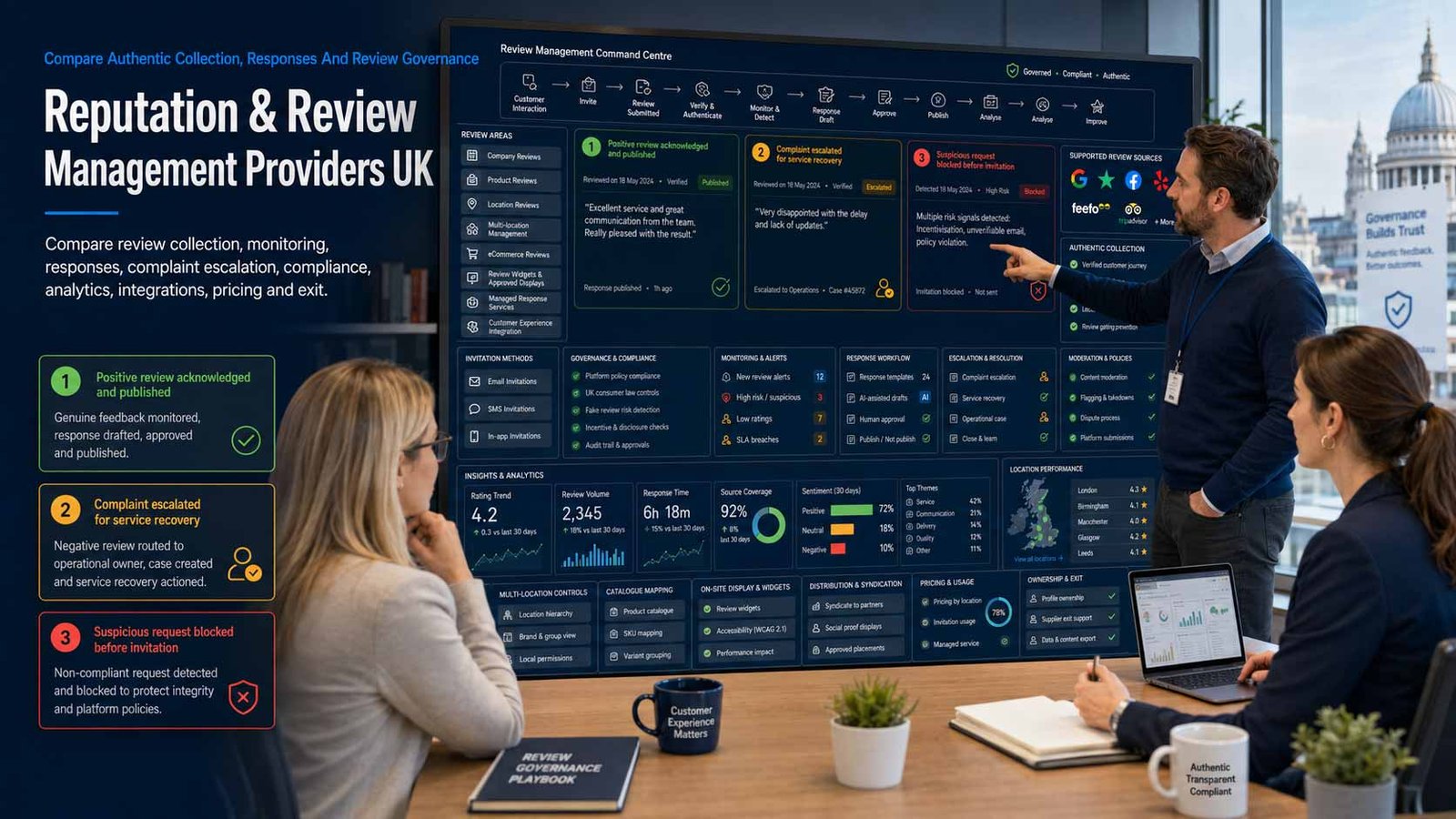
Buy A Controlled Review Operation, Not A Five-Star Promise
A credible platform should help a business invite genuine customers, monitor relevant sources, respond consistently, escalate risk and learn from feedback. It should not manufacture praise or hide legitimate criticism.
- Invite customers using fair, documented and repeatable eligibility rules
- Preserve evidence linking invitations to genuine transactions or service experiences
- Route critical reviews into customer-service, complaint and safeguarding workflows
- Keep review profiles, source accounts, data and administrator access under business control
Reputation and review management software coordinates the collection, monitoring, response, analysis and governed use of customer reviews across selected public and owned channels. The service may include company reviews, product reviews, location-level reviews, automated invitations, shared response queues, approval controls, website widgets, sentiment analysis and integrations with commerce, CRM, booking or support systems.
The buying decision is not simply which platform can generate more reviews. A suitable system must support authentic review evidence, platform-policy compliance, negative-review handling, complaint escalation, accurate reporting, user permissions, privacy controls and a practical exit route. The business remains responsible for its invitation policy, customer treatment, public responses and the accuracy of any claims made from review data.
This page compares reputation management and review management platforms and managed operational support. It does not compare local listing distribution as a standalone service or public-relations agencies that manage media relations, search-result suppression or crisis communications. Those services have different deliverables, risks and commercial intent.
Choose The Right Review Management Model
The correct model depends on where reviews appear, how customers are invited, whether products or locations are involved, the risk of complaints and the amount of internal operational capacity.
| Service Model | What It Usually Includes | Best-Fit Question |
|---|---|---|
| Invitation-Led Service Reviews | Automated post-transaction invitations, company-level reviews, response tools and website displays for businesses selling services or mixed offers. | Can the provider prove which customer event triggered each invitation and how exclusions are applied? |
| Product Reviews And Visual UGC | SKU-level reviews, ratings, attributes, photos, video, Q&A, widgets and syndication for ecommerce and product-led brands. | Can reviews, media rights and product mappings move cleanly if the commerce platform changes? |
| Multi-Source Review Monitoring | Central monitoring and response across Google and other relevant public review sources, subject to each source connection and permission. | Which sources support full response and reporting, and which are monitoring-only? |
| Multi-Location Reputation Management | Location hierarchies, central policies, local users, assignments, approvals, benchmarks and performance reporting across branches or franchisees. | Can headquarters retain control while local teams respond with the correct context and service level? |
| Enterprise Reputation And CX Suite | Reviews combined with surveys, social signals, customer-experience analytics, role governance and operational action across a large estate. | Is the broader suite necessary, or will it add cost and implementation work beyond the review requirement? |
| Customer Messaging And Review Requests | Review invitations combined with SMS, webchat, inbox or lead-conversion tools for location-based and service businesses. | Are messaging consent, usage charges and customer-service workflows fully separated from review collection? |
| Managed Review Response Service | Software combined with human monitoring, drafted responses, escalation and reporting delivered under an agreed policy and service level. | Who approves sensitive responses, and how is quality, confidentiality and accountability evidenced? |
| Co-Managed Review Operations | Internal teams own policy, high-risk decisions and improvement actions while a provider supplies technology, setup, reporting and selected administration. | Are responsibilities, response thresholds, escalation and knowledge transfer explicit? |
Eight Areas That Determine Review Management Fit
Use the same review sources, customer journeys, locations, products, monthly volumes, user roles, integrations, escalation scenarios and ownership requirements for every provider.
Comparison Criterion
Authentic Review Collection And Eligibility
Compare the customer event that makes a person eligible, transaction or service evidence, timing, invitation channels, reminders, exclusions, duplicate prevention, language support and opt-out handling. The platform should support a documented process that treats eligible customers consistently rather than asking only customers predicted to leave positive feedback.
Comparison Criterion
Review Sources, Coverage And Account Ownership
List every required company, product, location, marketplace, app-store and sector review source. For each one, confirm whether the provider can request, monitor, import, respond, report and retain history. Keep source profiles and administrator access under the business name, using named users rather than shared credentials.
Comparison Criterion
Response Workflow, Approval And Service Levels
Review central inboxes, assignments, templates, tone guidance, translation, approvals, response deadlines, private follow-up, attachments, audit history and closure. High-volume teams need clear ownership by brand, product or location. Sensitive responses should never be published automatically without the agreed human control.
Comparison Criterion
Negative Reviews, Complaints And High-Risk Escalation
Require workflows for allegations involving safety, discrimination, fraud, vulnerable customers, professional conduct, data protection or regulated complaints. Staff should acknowledge concerns without disclosing personal data, move resolution into the correct private process, preserve evidence and avoid using the public response as a substitute for formal complaint handling.
Comparison Criterion
Moderation, Fraud And Incentive Controls
Compare reviewer verification, anomaly detection, duplicate and suspicious-pattern controls, moderation policies, dispute routes, audit evidence and handling of incentivised content. Ask how the provider supports compliance with UK fake-review rules and source policies without promising removal of legitimate criticism merely because it is negative.
Comparison Criterion
Insights, Sentiment And Operational Action
Assess topic classification, sentiment, product and location comparisons, emerging-issue detection, competitor benchmarks, trends, dashboards and exports. Require links between recurring feedback and accountable actions in customer service, operations, product, training or quality. An insight feature has limited value if teams cannot verify the underlying reviews.
Comparison Criterion
Website Displays, Syndication And Content Rights
Review widgets, product ratings, visual UGC, filtering, accessibility, loading performance, freshness, moderation status, attribution, SEO settings and syndication. Confirm what remains visible if the contract ends, whether the business can export review content, and what permissions cover customer photos, videos and quoted comments.
Comparison Criterion
Integrations, Security, Privacy And Exit
Compare ecommerce, CRM, booking, helpdesk, messaging, analytics and API connections; role-based access; MFA; audit logs; retention; sub-processors; international transfers; deletion; and incident handling. Require exports for reviews, responses, tags, cases, users, templates, reports and integration documentation before award.
Measures To Define Before Selecting A Review Platform
Replace broad promises about trust, ratings or visibility with auditable measures covering authenticity, customer handling, operations and supplier independence.
| Measure | What It Should Define | Evidence To Request | Common Weakness |
|---|---|---|---|
| Invitation coverage | The share of eligible completed transactions or service events that enter the approved invitation process | Eligible-event count, exclusions, send logs, bounces, opt-outs and duplicate prevention | The platform reports invitations sent without showing who should have been invited |
| Review authenticity | Whether reviews are linked to genuine experiences and suspicious activity is controlled | Transaction reference, verification label definition, anomaly process, moderation record and dispute route | A “verified” badge is used without a clear evidential standard |
| Source completeness | Whether required public and owned review channels are covered | Source-by-source capability matrix for collection, monitoring, response, reporting and history | A long source list hides that some connections are read-only or delayed |
| Response service level | How quickly reviews are assigned, approved and answered according to severity | Timestamped queue, owner, escalation, approval, publication and closure records | Average response time hides unassigned critical reviews |
| Complaint conversion | Whether serious reviews become controlled private cases | Escalation rules, case reference, responsible team, acknowledgement, evidence, outcome and closure | Public replies are treated as complaint resolution |
| Moderation and removal | How policy-violating content is challenged without suppressing genuine criticism | Platform policy, evidence pack, flagging status, decision history and appeal route | The supplier promises guaranteed removal of negative reviews |
| Insight accuracy | Whether automated themes and sentiment can be checked against the underlying feedback | Review samples, model definitions, confidence, correction workflow, human validation and export | An attractive dashboard cannot reproduce the source review set |
| Location or product action | Whether feedback can be assigned to the unit able to improve the experience | Location, SKU, journey or topic mapping, owner, action, due date and follow-up measure | Reports rank locations but do not create accountable improvement work |
| Website display integrity | Whether published ratings and review selections remain accurate and transparent | Widget rules, source, freshness, filters, moderation state, accessibility, performance and rights | Only favourable extracts are displayed without clear context |
| Exit readiness | Whether the organisation can continue operations or migrate supplier | Export test, data dictionary, response history, users, templates, connections, media and access-removal plan | Critical history or widgets disappear when the subscription ends |
Reputation And Review Management Providers UK Businesses Can Consider
Shortlist providers whose review model, source coverage, governance, integrations, operating approach and commercial terms fit the requirement. Confirm every live proposal and contract before award.
Provider Profile
Feefo
Feefo is a customer and product review platform focused on gathering, managing, displaying and analysing feedback from verified customer interactions. Include it where a UK business wants transaction-linked service or product reviews, invitation workflows, website displays and customer insight. Confirm the exact verification method, eligible transaction feed, invitation allowance, product mapping, visual-content rights, moderation, Google-related syndication, widgets, integrations, analytics, support, contract term, data export and what remains available after cancellation.
Review official Feefo business platformProvider Profile
REVIEWS.io
REVIEWS.io provides company and product review collection, website widgets, ecommerce integrations and tools for using authentic customer feedback across sales channels. Include it where an ecommerce or service business wants flexible subscription options, UK support and product, company or visual-review capabilities. Confirm plan limits, invitations, SMS, domains, stores, products, integrations, Google-related features, review verification, moderation, widgets, source ownership, API access, data portability and renewal terms.
Review official REVIEWS.io platformProvider Profile
Trustpilot Business
Trustpilot Business combines an open public company profile with automated review invitations, responses, analytics, integrations, product-review options and website TrustBox displays. Include it where market recognition and an independently visible review profile are important. Confirm the plan, invitation volume, domains, locations, product-review add-ons, user limits, widgets, API, verification labels, flagging and dispute process, analytics, initial term, renewal, price changes, profile access and which data can be exported.
Review official Trustpilot Business platformProvider Profile
Birdeye
Birdeye offers review generation, monitoring, response, analytics and wider reputation capabilities, with a strong emphasis on multi-location organisations. Include it where a business needs central oversight across many branches, shared workflows and broader customer-interaction tools. Confirm the UK contracting entity, supported sources, locations, automated requests, AI response controls, assignments, listings or messaging modules, implementation, integrations, user roles, managed services, data protection, usage charges, reporting, contract and export.
Review official Birdeye UK review managementProvider Profile
Reputation
Reputation provides enterprise review management alongside surveys, listings, social and location-level experience signals. Include it where a multi-location brand needs central governance, local action, AI-assisted response and operational insight across a large estate. Confirm the exact modules in scope, review sources, response automation, location hierarchy, managed services, integrations, benchmarks, implementation, data model, security, sub-processors, service levels, user licensing, renewal, exit assistance and whether broader suite functions create unnecessary cost.
Review official Reputation review managementProvider Profile
InMoment
InMoment combines reputation management with broader customer-experience and feedback capabilities, including review monitoring, response and analysis. Include it where an enterprise wants public review operations connected to voice-of-customer programmes and closed-loop action. Confirm which sources and countries are supported, invitation and response capability, location model, text analytics, case management, integrations, implementation partners, model governance, privacy, security, reporting, licence basis, managed support and data extraction.
Review official InMoment reputation managementProvider Profile
Yotpo Reviews
Yotpo Reviews focuses on ecommerce product and site reviews, ratings, visual user-generated content, Q&A, widgets and channel syndication. Include it where product-level feedback and on-site conversion evidence are central to the requirement. Confirm supported commerce platform, product catalogue mapping, invitation volumes, site versus product reviews, media rights, moderation, widget performance, accessibility, Google and marketplace connections, localisation, migration, add-ons, pricing, contract and export of reviews and assets.
Review official Yotpo Reviews platformProvider Profile
Podium
Podium combines review requests and management with customer messaging and a shared interaction inbox, primarily for location-based businesses. Include it where review collection is closely connected to SMS conversations, enquiries and frontline customer service. Confirm UK availability and support, messaging numbers, consent responsibilities, review sources, AI functions, user and location limits, message usage, integrations, mobile workflow, response approvals, retention, security, contract, implementation and whether non-review modules are required.
Review official Podium reviews platformWhat Changes Reputation And Review Management Cost
Quotes differ because providers count locations, invitations, domains, users, review types, messaging, integrations, analytics and support differently. Compare the complete three-year operating cost.
| Cost Driver | Why It Changes Spend | What A Comparable Quote Should Show |
|---|---|---|
| Locations, profiles and domains | Many providers price by location, public profile, brand, domain or store, which can increase cost as the estate grows | List every current and planned location, profile, domain, storefront and brand included in the quote |
| Invitation and message volume | Email invitations, SMS requests, reminders and in-app collection may have monthly limits or usage charges | Show eligible transactions, sends, reminders, channels, included allowance, overage and growth assumptions |
| Review type and source coverage | Company, product, location and visual reviews may sit in different plans or add-on modules | Price each required review type and each source capability rather than accepting a generic “reviews” line |
| Users, teams and approvals | More users, local teams, permission levels and approval workflows can require a higher edition | State named users, roles, locations, approvers, external agencies and administrator accounts |
| Widgets, UGC and syndication | Website displays, visual content, product feeds, APIs and syndication can be plan-limited or separately charged | List widgets, pages, domains, product count, media volume, feeds, API and performance responsibilities |
| Analytics and AI | Advanced text analytics, competitor benchmarks, AI responses and automated insights may be premium modules | Specify included models, usage, approval controls, reports, data access, limitations and recurring fees |
| Integrations and implementation | Commerce, CRM, booking, helpdesk and data-warehouse connections require setup, mapping, testing and maintenance | Price discovery, configuration, migration, development, test environments, training and acceptance separately |
| Managed responses and support | Human response services, strategic reviews, dedicated success management and extended support add recurring cost | Show response volume, hours, languages, approval, escalation, exclusions, service levels and named roles |
| Contract, renewal and uplift | Annual prepayment, auto-renewal, module changes, usage growth and price uplift can dominate later cost | Show initial term, renewal notice, uplift basis, plan-change rights, minimum commitment and termination charges |
| Exit and transition | Exports, widget replacement, profile transfer, documentation and integration closure can require paid assistance | Include standard exports, format, timing, API access, transition days, access removal and final reconciliation |
| Indicative Monthly Band | Typical Scope | What Must Be Confirmed |
|---|---|---|
| £0–£150 per month | Basic or entry review collection for one small business, brand or domain with limited invitations, users and integrations | Check public-profile terms, invitation allowance, verification, widgets, exports, renewal and whether operational support is excluded |
| £150–£600 per month | Growing service or ecommerce business needing automation, company or product reviews, displays and selected integrations | Confirm domains, products, invitations, users, SMS, integrations, analytics, implementation and support |
| £600–£2,000 per month | Multi-location, higher-volume or co-managed operation requiring workflow, source monitoring, approvals and deeper reporting | Confirm location count, response coverage, AI controls, managed services, API, implementation and contract term |
| £2,000+ per month | Enterprise or complex multi-brand estate with many locations, customer-experience modules, custom integration and governance | Require a complete scope, licence metric, implementation plan, service levels, security review, growth model and exit price |
Match The Platform To The Review Operating Model
The right shortlist depends on customer volume, products, locations, public sources, complaint risk, integrations and the team available to act on feedback.
Single-Location Service Business
Prioritise simple post-service invitations, Google and relevant sector-source monitoring, mobile response, clear ownership, affordable administration and reliable export. Avoid an enterprise suite that the team cannot operate.
Ecommerce Or Product Brand
Prioritise transaction-linked product and company reviews, catalogue mapping, visual UGC, widgets, syndication, media rights, moderation, commerce integrations, page performance and portable review data.
Multi-Location Or Franchise Operation
Prioritise location hierarchy, central policy, local assignments, approvals, source coverage, service levels, anomaly detection, branch comparisons and consolidated reporting with business-owned source accounts.
Regulated Or High-Risk Organisation
Prioritise complaint and safeguarding escalation, controlled templates, legal or compliance approval, audit history, permissions, retention, AI governance, privacy and integration with formal case-management processes.
How To Compare Review Management Proposals
Issue one brief containing customer journeys, invitation eligibility, required review sources, locations, products, monthly volumes, response policy, complaint escalation, users, integrations, data-protection requirements, implementation and exit. Require a response matrix instead of accepting a generic demonstration.
- Every required source is marked collect, monitor, respond, report or unsupported
- Invitation evidence, exclusions and anti-manipulation controls are documented
- Negative-review and complaint workflows are demonstrated end to end
- Locations, products, users, messages, modules and growth assumptions are priced
- AI drafting and analysis functions include approval, correction and audit controls
- Reviews, responses, media, reports, configurations and connections can be exported
Compare The Same Proof Scenario
Ask every provider to receive a genuine completed transaction, apply the eligibility rule, send an invitation, ingest a positive review and a critical review, assign and approve responses, escalate the critical case, report the result and export the complete audit history.
A lower quote is not comparable when it omits required sources, product reviews, SMS, implementation, users, integrations, analytics, managed responses or exit assistance.
Six Questions To Put To Every Review Management Provider
Written answers expose authenticity, workflow, cost and ownership differences more effectively than a prepared dashboard tour.
How Do You Prove Review Authenticity?
Explain invitation eligibility, transaction evidence, reviewer verification, duplicate detection, suspicious-pattern controls, moderation and exactly what each verified or invited label means.
Which Sources Support The Full Workflow?
For every required source, state whether the platform can request, monitor, import, respond, report and retain history. Identify read-only connections, delays and permissions controlled by the source owner.
How Are Negative Reviews And Complaints Escalated?
Demonstrate assignment, acknowledgement, private follow-up, response approval, regulated complaint or safeguarding routes, evidence retention, publication control and closure reporting.
What Can AI Do And Who Approves It?
Document sentiment models, topic summaries, response drafting, automated publication, confidence, prohibited use cases, human approval, correction and the audit record for each output.
Which Costs Increase As We Grow?
Identify charges for locations, profiles, invitations, SMS, users, domains, products, widgets, sources, API usage, analytics, implementation, support, renewal and transition.
What Can We Take At Exit?
Demonstrate exports for reviews, responses, tags, cases, media, reports, users, permissions, templates, source connections and integration documentation, plus the process for removing supplier access.
A Seven-Stage Review Management Provider Evaluation
Move from current-state evidence and customer-policy decisions to a controlled review operation rather than selecting software from star-rating promises.
- Create a current-state inventory covering review profiles, products, locations, source ownership, invitations, website displays, response accounts, complaints, integrations, users, historic data and known policy issues.
- Define the business outcomes, customer eligibility, required review sources, response service levels, escalation, moderation, insight, privacy, security, ownership and exit requirements.
- Prepare one supplier brief with review volumes, locations, products, user roles, channels, languages, systems, proof scenarios, decision criteria, response format, timetable and evidence requirements.
- Shortlist providers by exact service model, required source coverage, authentic-review controls, relevant integrations, multi-location or product capability, support and referenceable customer fit.
- Run structured proof scenarios using representative data, then normalise cost across licences, invitations, SMS, modules, implementation, integrations, managed responses, support, internal effort and exit.
- Contract only after account ownership, review policy, acceptance, data protection, security, subcontracting, service levels, AI use, price changes, termination, exports and transition assistance are clear.
- Launch through controlled sources or locations, monitor invitation coverage and complaints, review response quality, validate insights, test permissions and exports, and assign recurring themes to operational owners.
Reputation And Review Management Comparison Checklist
Use this table before approving a review platform, managed response service, multi-location programme or ecommerce review migration.
| No. | Requirement | Evidence To Obtain Before Award | Confirmed |
|---|---|---|---|
| 01 | Business objective and accountable owner agreed | Collection, response, recovery, product, location, operational and commercial outcomes with baselines and named owners | |
| 02 | Review source inventory completed | Company, product, location, marketplace, app-store and sector sources, including profile ownership and administrator access | |
| 03 | Eligibility and invitation rules documented | Completed event, exclusions, timing, channels, reminders, language, opt-outs, duplicate prevention and fair-treatment approach | |
| 04 | Authenticity and moderation evidence accepted | Transaction evidence, verification definition, anomaly detection, incentive policy, disputes, moderation and audit trail | |
| 05 | Response workflow approved | Queues, assignments, service levels, templates, tone, approvals, translation, private follow-up, escalation and closure | |
| 06 | Complaint and high-risk handling connected | Formal routes for regulated complaints, safety, discrimination, fraud, vulnerable customers, legal issues and safeguarding | |
| 07 | AI governance defined | Allowed drafting and analysis, approval, prohibited automation, confidence, correction, monitoring and evidence retention | |
| 08 | Insight and action model agreed | Topic, sentiment, product, journey, branch and trend analysis linked to owners, corrective actions and follow-up measures | |
| 09 | Widgets and content rights checked | Display rules, source, freshness, accessibility, page speed, media permissions, attribution, syndication and cancellation behaviour | |
| 10 | Integration architecture documented | Commerce, CRM, booking, helpdesk, messaging, analytics and warehouse connections, including limits, failures and ownership | |
| 11 | Privacy and security reviewed | Lawful basis, transparency, minimisation, processor terms, sub-processors, transfers, retention, deletion, MFA, roles and logs | |
| 12 | Volume and licence model normalised | Locations, profiles, contacts, transactions, invitations, messages, users, domains, products, widgets, API and growth | |
| 13 | Implementation and support scope agreed | Setup, data mapping, source connection, templates, migration, training, launch, service hours and incident handling | |
| 14 | Contract and renewal terms approved | Initial term, auto-renewal, uplift, plan changes, overage, policy changes, liability, service levels and termination rights | |
| 15 | Ownership and exit tested | Business-owned profiles, administrator access, exports, media, templates, reports, integrations, documentation and access removal |
Common Reputation And Review Management Buying Mistakes
Most avoidable failures begin with manipulated collection, incomplete source coverage, weak complaint handling, unclear ownership or a contract that cannot be exited cleanly.
| Mistake | Why It Creates Risk | Better Control |
|---|---|---|
| Buying a promise to “remove negative reviews” | Legitimate criticism usually cannot be removed simply because it is damaging, and guaranteed removal claims can encourage poor or non-compliant practice | Assess policy-based flagging, evidence and customer resolution |
| Inviting only satisfied customers | Selective solicitation distorts the review picture and can breach source policies or consumer-protection expectations | Use documented, consistently applied eligibility rules |
| Offering undisclosed incentives | Paid or rewarded reviews that conceal the incentive can be unlawful, while some review sources prohibit incentives entirely | Check UK law and each source policy before any campaign |
| Treating every poor review as a marketing problem | A serious review may be a complaint, safety issue, fraud allegation or safeguarding concern requiring a formal private process | Create risk-based escalation and evidence handling |
| Publishing AI responses without approval | Automated replies can disclose information, invent facts, use the wrong tone or mishandle regulated complaints | Require human approval for sensitive and high-risk cases |
| Comparing by number of review sites alone | A long source list can hide read-only, delayed or unsupported response connections | Use a source-by-source capability matrix |
| Ignoring website widget performance and rights | Review widgets and visual UGC can affect accessibility, loading, privacy and content ownership | Test real pages and verify display permissions |
| Bundling listings, messaging and reviews without need | Broader suites can add cost, complexity and duplicated tools that do not improve review operations | Buy only the modules supported by the business case |
| Allowing supplier-owned profiles or shared credentials | The business can lose access, auditability and control during staff change or supplier exit | Use business-owned profiles and named role-based access |
| Failing to test export before contract | Review history, responses, media, tags and configurations may be difficult to move after notice is served | Make a representative export an acceptance requirement |
Frequently Asked Questions
Answers to common questions from UK businesses comparing review platforms, reputation-management software and managed review operations.
What Is Reputation Management And Review Management Software?
It is software used to invite genuine customers to leave feedback, monitor selected review sources, organise and approve responses, escalate complaints, analyse themes and display permitted review content. Some platforms specialise in company or product reviews, while others support multi-location monitoring or broader customer-experience programmes.
How Much Does Review Management Software Cost In The UK?
Basic single-business tools may start with free or lower-cost plans, while growing-business platforms can cost hundreds of pounds per month and enterprise or multi-location programmes can cost thousands. Price depends on locations, domains, invitations, SMS, review types, users, sources, widgets, analytics, integrations, implementation and managed support.
Is It Legal To Pay Customers For Reviews In The UK?
UK law prohibits fake reviews and consumer reviews that conceal the fact they were incentivised. A review source may impose stricter rules and prohibit incentives entirely. Businesses should check current CMA guidance and each platform policy, disclose any permitted incentive clearly, avoid conditioning it on positivity and retain evidence of the process.
Can A Business Ask Only Happy Customers For Reviews?
That approach can create a misleading picture and is prohibited by important review-source policies such as Google’s rules against selectively soliciting positive reviews or discouraging negative reviews. A safer process applies documented eligibility rules consistently to genuine customers and routes private service recovery separately from the public review request.
Can Review Management Software Remove Negative Reviews?
Software can help identify, document and report reviews that breach a source policy, but it cannot guarantee removal of genuine negative feedback. The source decides whether content violates its rules. The business should respond appropriately, investigate the underlying experience and use a formal complaint or safeguarding process where necessary.
What Is A Verified Customer Review?
The meaning varies by provider. It usually indicates that the platform received evidence connecting the reviewer to a transaction, booking, order or service interaction. Buyers should ask exactly what evidence is used, whether the label applies to every invitation route, how duplicates and suspicious patterns are controlled and what happens when evidence is disputed.
Should A Business Respond To Every Review?
The response policy should reflect review source, volume, severity, customer expectation and operational capacity. Many businesses prioritise critical reviews, questions, factual corrections and high-value praise while maintaining reasonable response targets. Sensitive cases require private escalation, and public replies should not disclose personal or confidential information.
What Is The Difference Between Review Management And Local Listings?
Review management focuses on authentic feedback collection, monitoring, responses, complaint escalation, analysis and controlled use of review content. Local listings services focus on distributing and correcting business names, addresses, phone numbers, categories, hours and location attributes. Some suites include both, but the requirements should be assessed separately.
Which Integrations Matter For Review Management?
Common integrations include ecommerce platforms, CRM systems, booking or practice software, helpdesks, customer-data platforms, messaging services, analytics and data warehouses. The important point is not the logo list: confirm trigger events, fields, authentication, retries, failures, consent, retention, test environments, support ownership and export.
How Should UK Businesses Compare Review Management Providers?
Give every provider the same sources, locations, products, customer journeys, invitation volumes, user roles, response and escalation scenarios, integrations, privacy controls, pricing assumptions and exit test. Score authenticity, workflow, source coverage, insight, security, implementation, support, contract and complete lifecycle cost rather than choosing on star-rating promises alone.
Official Guidance And Provider Resources
Reviewed by Bhav Giva, Founder & Lead Analyst at CompareServices.co.uk, on 30 July 2026.
Use current consumer-protection, review-source, data-protection and provider documentation to verify obligations, functionality, source coverage and commercial terms. Review policies, platform features, prices, integrations, contracting entities and offers can change. Obtain legal or regulatory advice where the review programme involves higher-risk consumer claims, regulated complaints, health information, safeguarding or other sensitive data.
- GOV.UK — CMA Fake Reviews Guidance
- GOV.UK — Unfair Commercial Practices Guidance
- GOV.UK — Online Consumer Reviews Enforcement Work
- Google Business Profile — Prohibited And Restricted Content
- Google Business Profile — Tips To Get More Reviews
- ICO — Data Protection By Design And By Default
- ICO — The Right To Be Informed
- Feefo — Customer Review Platform
- REVIEWS.io — Review Collection Platform
- Trustpilot Business — Review Platform
- Birdeye UK — Review Management
- Reputation — Review Management
- InMoment — Reputation Management Software
- Yotpo — Reviews And UGC
- Podium — Reviews