
Compare Local Listings / Google Business Providers UK (2026)
Compare Profile Ownership, Verification, Listing Accuracy, Categories, Locations, Directory Coverage, Change Control, Reporting, Support And Total Cost
Compare local SEO services UK providers by Google Business Profile ownership, verification support, business eligibility, category selection, address and service-area rules, opening hours, products and services, photos, posts, booking links, duplicate suppression, citation accuracy, Apple and Bing listings, multi-location governance, change monitoring, performance reporting, support, pricing, data ownership and supplier exit. Give every provider the same locations, legal entities, trading names, service areas, categories, opening hours, existing access, directory footprint and operational change requirements.
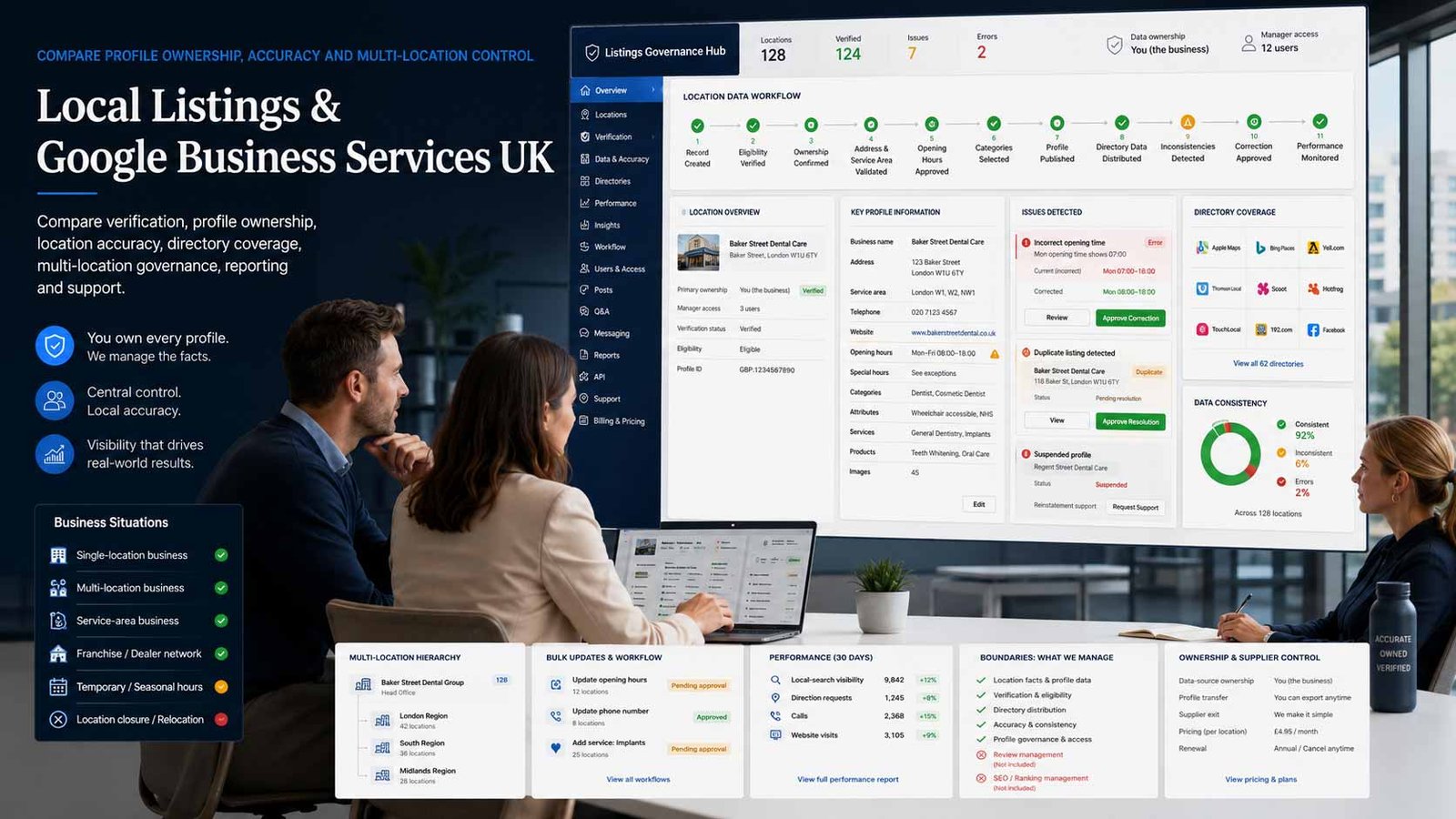
Keep The Business As Primary Owner
A provider should be added through Google Business Profile owner or manager permissions, not by sharing the owner’s password or allowing the agency to create a profile that it controls.
- Confirm the operating business is eligible for each profile and location
- Keep primary ownership in a company-controlled Google Account
- Use named user access rather than shared credentials
- Record every location, category, service area, URL and phone number
- Document how listings, data and access will be returned at exit
Local listings and Google Business Profile services manage how an eligible business location or service-area business appears in map, directory and local-search experiences. The work can include claiming and verifying profiles, correcting location data, selecting appropriate categories, maintaining opening hours, adding services and imagery, suppressing duplicates, distributing consistent business data to relevant directories and monitoring unauthorised changes.
Google states that a Business Profile can be managed on Search and Maps at no charge. The commercial decision is therefore not whether to buy a Google listing, but whether to use internal staff, specialist software, a managed listings provider or a local-search agency to operate the profile accurately and consistently. Paid support should be judged by governance, workload reduction, listing coverage, issue resolution and evidence—not by claims that a supplier has bought privileged ranking access.
This page compares local listings and Google Business Profile services only. It does not compare national SEO campaigns or paid search advertising. It also does not assess standalone review-management platforms; review responses may form part of profile operations, but wider review collection, monitoring and reputation workflows belong to a separate comparison.
Choose The Right Local Listings Delivery Structure
The delivery model changes ownership, workload, directory coverage, support, pricing, data control and the evidence required before appointment.
| Service Model | What It Usually Provides | Best-Fit Question |
|---|---|---|
| In-house profile management | Internal staff claim, verify and maintain Google, Apple, Bing and priority directory listings without a paid management platform | Does the business have clear ownership, time, policy knowledge and a controlled process for every change? |
| One-off profile setup or recovery | A specialist claims or creates a profile, corrects core data, supports verification and hands control back after completion | Is the requirement a defined setup, ownership recovery or data-repair project rather than ongoing management? |
| Managed single-location service | A provider maintains one or a small number of profiles, updates hours and content, monitors edits and reports performance | Does the business need regular operational help without buying enterprise software? |
| Listings-management software | A central platform distributes and synchronises business information across selected maps, directories, navigation systems and discovery services | Will internal teams use the software actively, and what happens to listings when the subscription ends? |
| Multi-location managed platform | Technology and managed operations support dozens, hundreds or thousands of locations with templates, permissions and bulk updates | Can the service protect local accuracy while enforcing brand and data governance at scale? |
| Citation audit and cleanup | The provider identifies duplicates, inconsistent name-address-phone data and outdated directory entries, then corrects or suppresses them | Is historical listing inconsistency the main problem, and which directories are actually relevant to the sector and location? |
| Local visibility agency retainer | An agency manages profiles and citations while coordinating limited local-search analysis and location-page requirements | Is the scope genuinely local and listing-led, without drifting into an undefined national SEO retainer? |
| Franchise or distributed-location programme | Head office controls standards while franchisees or local managers supply approved changes, photos and operational information | Are roles, approval rights, local exceptions and ownership responsibilities documented for every location? |
Eight Areas That Determine Local Listings Fit
Give every provider the same locations, current access, operating data, change frequency and governance requirements so proposals are genuinely comparable.
Comparison Criterion
Business Eligibility, Ownership And Verification
Confirm that each profile represents an eligible operating business, not a virtual office, lead-generation shell or invented location. Compare verification preparation, evidence requirements, ownership recovery and escalation support. The business should remain primary owner and add the provider through named owner or manager permissions.
Comparison Criterion
Location Data, Categories And Service Areas
Review the source of truth for business name, address, phone, website, opening hours, special hours, primary and secondary categories, attributes, services and service areas. Providers should explain how they avoid keyword-stuffed names, inaccurate addresses, overlapping service areas and other policy risks.
Comparison Criterion
Google Business Profile Operations
Compare profile completion, products and services, descriptions, photos, videos, posts, booking or ordering links, questions and answers, holiday hours and temporary changes. Require a clear publishing calendar and approval process rather than indiscriminate activity intended only to look busy.
Comparison Criterion
Listings Coverage And Data Distribution
Assess which maps, directories, navigation systems, voice assistants and AI-discovery services receive data. Coverage counts alone are weak evidence: request the UK publisher list, update method, direct versus aggregator relationships, field support, update times and limitations for each location type.
Comparison Criterion
Duplicate, Conflict And Suggested-Edit Control
Compare duplicate discovery, merge or suppression support, third-party edits, unauthorised changes, closed-location handling, moved premises, departmental listings and practitioner profiles. The provider should identify who approves changes and how damaging edits are detected and reversed.
Comparison Criterion
Multi-Location Governance And Permissions
For groups and franchises, review business groups, location codes, bulk uploads, templates, local-manager rights, approval queues, audit trails and head-office standards. A scalable system must allow genuine local differences without letting users overwrite legal names, ownership or critical contact data.
Comparison Criterion
Performance Measurement And Lead Evidence
Require location-level reporting for profile visibility, searches and available interactions such as website visits, calls, directions or bookings. Separate branded discovery from relevant local demand where the data allows, define call-tracking implications and avoid presenting map rankings from one fixed postcode as universal performance.
Comparison Criterion
Support, Pricing, Portability And Exit
Compare implementation, recurring fees, per-location charges, support channels, platform dependency, data export, publisher relationships and post-cancellation behaviour. Confirm that the business retains primary ownership, original images, location data, history and the ability to continue management without the supplier.
Measures To Define Before A Listings Provider Is Appointed
Translate profile optimisation and directory coverage into auditable ownership, accuracy, update and performance evidence.
| Measure | What It Should Define | Evidence To Request | Common Weakness |
|---|---|---|---|
| Primary ownership | The operating business controls the profile and can add or remove suppliers | Owner account, primary owner, managers, recovery details and access register | The agency creates the profile in its own account and treats access as its asset |
| Eligibility and verification | Each listed location or service-area profile satisfies current platform rules | Trading evidence, signage or service-area evidence, verification status and escalation history | A provider promises approval without checking whether the business is eligible |
| Core data accuracy | Name, address, phone, URL, hours, categories and attributes match the real operation | Approved location record, website, signage, telephone routing, category decision and change log | Keyword additions or copied data create policy and customer-experience problems |
| Listings consistency | Priority publishers display current and materially consistent business data | Publisher list, live URL, field-level status, last update and unresolved conflict | The report counts submissions rather than confirming published and accurate records |
| Duplicate control | Duplicate, closed, moved and unauthorised profiles are identified and handled safely | Duplicate register, ownership, evidence, action, outcome and remaining risk | Profiles are deleted or merged without protecting reviews, history or the live location |
| Update timeliness | Operational changes reach priority profiles within an agreed timeframe | Change request, approval, submission, publisher confirmation and exception | Holiday hours or closures remain wrong because updates depend on ad hoc emails |
| Profile completeness | Relevant profile fields, images, services and action links are maintained | Field inventory, asset register, quality checks, approval and publication date | Completion is reported as a score without checking accuracy or customer usefulness |
| Local visibility | The business is visible for relevant local demand across realistic search areas | Search themes, grid methodology, device, date, location, local-pack presence and competitor context | One favourable map screenshot is presented as proof of market-wide ranking |
| Customer interactions | Profile actions are tracked without overstating attribution | Available calls, website clicks, directions, bookings, source tagging and CRM outcome | Every interaction is treated as a unique lead or sale |
| Exit readiness | The business can remove the supplier and continue management without data loss | Ownership, user removal, exports, publisher list, subscription effects, documentation and handover | Listings revert, become locked or lose updates because dependency was never disclosed |
Local Listings And Google Business Providers UK Businesses Can Consider
Shortlist software and managed-service providers whose location coverage, access model, governance and support match the business. Confirm current features, live publisher coverage and complete terms before award.
Provider Profile
BrightLocal
BrightLocal provides local-search software, citation building, listings management, rank tracking and managed local SEO services. Include it where an SME or agency wants a flexible platform with optional expert delivery rather than a large enterprise contract. Confirm UK directory coverage, direct or one-time citation products, ongoing monitoring, review features excluded from this comparison, location limits, managed-service scope, account ownership, cancellation effects, exports and how existing citations are treated.
Review official BrightLocal servicesProvider Profile
Yext
Yext provides enterprise listings management and distributes structured business information across a broad publisher network, including major search, map and discovery services. Include it where a multi-location organisation needs central governance, APIs, workflows and large-scale updates. Confirm the exact UK publisher network, supported fields, direct integrations, location and module pricing, implementation, approvals, data ownership, API access, duplicate handling, support, contract term and what changes after subscription cancellation.
Review official Yext ListingsProvider Profile
Uberall
Uberall provides listings management for multi-location brands, with centralised location data, publisher distribution, local content and performance tools. Include it where head office needs to control many branches, dealerships, stores or service locations. Confirm the UK directories, bulk-update method, local-manager permissions, duplicate control, Google and Apple connections, data ingestion, reporting, reviews excluded from this comparison, implementation, support, contract term, exports and post-exit publisher behaviour.
Review official Uberall ListingsProvider Profile
Semrush Local
Semrush Local combines listing distribution, local business tools, Google Business Profile connections and local visibility features within the broader Semrush ecosystem. Include it where an internal marketing team already uses Semrush and wants a connected location workflow. Confirm UK availability and directories, per-location pricing, underlying distribution relationships, fields supported, duplicate suppression, update frequency, local-rank methods, review modules excluded here, permissions, cancellation effects and whether the service remains appropriate as location count grows.
Review official Semrush LocalProvider Profile
LocalClarity
LocalClarity provides enterprise local-search operations for organisations and agencies managing large location estates. Its platform focuses on listings, workflows, analytics and centralised control across major local platforms. Include it where complex permissions, bulk changes, data ingestion and reporting are more important than a basic SME dashboard. Confirm publisher coverage, minimum location requirements, managed versus software scope, Google and Apple connections, workflow configuration, API and export access, implementation, support, security, contract terms and handover.
Review official LocalClarity ListingsProvider Profile
LOCALiQ UK
LOCALiQ UK offers managed local SEO and local business listings services for UK organisations. Include it where a small or regional business wants an agency-led service covering Google Business Profile optimisation, directory accuracy and practical support rather than operating software alone. Confirm the exact listing and local-search deliverables, account ownership, categories, citation work, content updates, reporting, call tracking, minimum term, fees, responsibilities for website changes, review services excluded from this page and the evidence returned at exit.
Review official LOCALiQ local SEOProvider Profile
Hallam
Hallam provides local SEO consultancy and managed services for businesses that need regional visibility, Google Business Profile work and location-focused search support. Include it where the business wants strategic agency input and coordination with its internal website team. Confirm that the quoted scope remains local-listings-led, which profile and citation tasks are included, ownership, location-page responsibilities, reporting, implementation authority, review-management boundaries, monthly fee, term, staff access and handover.
Review official Hallam local SEOProvider Profile
Add People
Add People provides local SEO services for SMEs, including Google Business Profile, maps visibility and directory citation work. Include it where a smaller business wants a managed campaign and direct support rather than a multi-location enterprise platform. Confirm exact profile and citation deliverables, whether website changes are separately scoped, ownership, verification support, category decisions, reporting, contract length, fees, account access, review work excluded from this comparison, claims and guarantees, data export and cancellation process.
Review official Add People local SEOWhat Changes Local Listings And Google Business Cost
Compare the complete first-year and recurring cost. A free Google profile does not make verification, cleanup, multi-location operations, monitoring or supplier support free.
| Cost Driver | Why It Changes Spend | What A Comparable Quote Should Show |
|---|---|---|
| Google Business Profile fee | Google allows eligible businesses to add or claim a Business Profile at no charge | Separate the free platform from paid setup, optimisation, monitoring and support |
| Initial audit and ownership recovery | Unclaimed, duplicate, suspended, moved or agency-controlled profiles require more investigation and evidence | Locations, owners, verification state, duplicates, issues, actions, assumptions and fixed project price |
| Number of locations | Most software and managed services charge by location, with minimum commitments for enterprise platforms | Active, planned, seasonal and closed locations; volume tiers; minimums and additions |
| Publisher and directory coverage | Broader networks and direct integrations may cost more, but raw directory counts do not equal business value | Named UK publishers, supported fields, direct or aggregator method, update speed and exclusions |
| Managed content and updates | Hours, services, images, posts, links and local information create recurring operational workload | Monthly update allowance, approval process, assets, special hours, emergency changes and excess fees |
| Duplicate and citation cleanup | Historical inconsistencies, moves and duplicate listings can make onboarding labour-intensive | Audit depth, number of fixes, evidence, publisher support, rechecks and unresolved items |
| Multi-location governance | Templates, permissions, workflows, APIs, bulk updates and data integrations increase implementation effort | Configuration, location hierarchy, roles, systems integration, training, security and support |
| Reporting and tracking | Local grids, call tracking, dashboards and CRM attribution may be separate modules or tools | Metrics, methodology, licences, tracked numbers, recording, data retention and privacy responsibility |
| Agency strategy and website coordination | Some managed services add local research and location-page recommendations | Listings-only fee, optional website work, separate SEO scope, approval rights and deliverables |
| Contract and exit dependency | Subscription distribution or platform-maintained data may change after cancellation | Minimum term, notice, export, ownership, publisher behaviour, handover, support and final audit |
How Location Estate And Operating Model Change The Shortlist
The correct provider depends on eligibility, number of locations, change frequency, internal resources, data quality and the commercial value of local discovery.
Single-Location Local Business
Prioritise company-owned profile access, correct eligibility, a one-off setup or light monthly service, accurate hours, relevant categories, useful photos, practical reporting and a contract that does not create permanent dependence.
Service-Area Business
Prioritise address and service-area compliance, truthful coverage, category selection, telephone routing, verification evidence and protection against invented offices or city listings that could create suspension risk.
Multi-Site Retail, Hospitality Or Healthcare
Prioritise bulk location data, holiday-hour workflows, local-manager permissions, duplicate control, central reporting, structured location identifiers, data integrations and fast escalation when profiles or high-value locations are disrupted.
Franchise Or Distributed Brand
Prioritise a documented ownership model, head-office standards, franchisee permissions, local content approvals, opening and closing processes, data feeds, audit trails and a handover plan that survives franchise or supplier changes.
How To Compare Local Listings Proposals
Give every provider one location register containing legal entity, trading name, approved address or service area, telephone, website, categories, opening hours, special hours, existing profile URLs, ownership, managers, duplicate history, change frequency and current issues. Require a standardised implementation and recurring-service schedule.
- The business remains primary owner of every eligible profile
- Google, Apple, Bing and directory coverage is named rather than summarised as a count
- Verification, duplicates, suspensions and moved locations have clear responsibilities
- Content, special hours and operational updates use an approval workflow
- Reporting methods, tracked interactions and attribution limits are documented
- Cancellation, data export and post-subscription listing behaviour are disclosed
Compare Accuracy And Control Before Visibility Claims
Local visibility depends partly on factors a provider cannot buy or guarantee, including relevance, distance and prominence.
Choose the service that keeps business information accurate, eligible, well governed and measurable across the locations and platforms that matter.
Six Questions To Put To Every Local Listings Provider
The answers expose ownership risk, vague directory networks, unsupported ranking promises, weak change control and services that are difficult to exit.
Who Owns Every Business Profile?
Request the primary owner, all owners and managers, company recovery process, business groups, platform accounts and the exact access the provider requires.
Which Locations Are Eligible And Verified?
Confirm physical presence or service-area operation, signage or trading evidence, verification state, duplicates, suspensions and any location that should not be published.
Which Publishers And Fields Are Included?
Ask for the named UK network, direct integrations, address, hours, services, photos, links, attributes, menus, products and fields not supported.
How Are Changes Approved And Monitored?
Confirm who requests, approves, submits and verifies normal updates, holiday hours, closures, moves, phone changes and third-party edits.
How Will Performance Be Measured?
Define profile views or searches where available, interactions, calls, website visits, directions, bookings, local-grid method, CRM outcomes and attribution limits.
What Happens When The Contract Ends?
Confirm ownership, user removal, data export, profile history, citations, publisher behaviour, image rights, final audit, documentation and handover support.
A Seven-Stage Local Listings Evaluation
Move from a verified location register and ownership audit to controlled implementation, evidence-led reporting and an exit-ready operating model.
- Create a verified location register covering legal entity, trading name, address or service area, telephone, URL, categories, hours, ownership, managers and location status.
- Audit Google Business Profile, Apple Business, Bing Places and priority UK directories for unclaimed records, duplicates, inconsistent data, moved locations and unauthorised profiles.
- Define the source of truth, profile ownership, approval rights, urgent-change process, local-manager permissions, evidence retention and suspension escalation.
- Issue one written request with the same location count, required publishers, content workload, reporting, support, integrations, implementation deadline and exit conditions.
- Score providers on accuracy, ownership, UK publisher coverage, workflow, duplicate control, issue resolution, reporting, security, pricing and portability—not directory count alone.
- Implement through controlled claiming, verification, ownership transfer, data correction, duplicate handling, field completion, testing and documented sign-off for each location.
- Operate through scheduled data reviews, holiday-hour planning, change monitoring, access reviews, performance analysis, closed-location governance and an annual supplier-exit test.
Local Listings And Google Business Comparison Checklist
Use this table before approving a setup project, managed local-search service, listings platform, agency retainer or multi-location programme.
| No. | Requirement | Evidence To Obtain Before Award | Confirmed |
|---|---|---|---|
| 01 | Location scope and accountable owner agreed | Legal entities, trading names, operating locations, service areas, head-office owner, local contacts and approvers | |
| 02 | Google profile ownership verified | Primary owner, owners, managers, company accounts, recovery, business groups and unauthorised access | |
| 03 | Eligibility and verification evidence complete | Trading evidence, signage or service-area operation, verification state, suspensions and escalation history | |
| 04 | Core location data approved | Name, address, phone, URL, categories, hours, special hours, attributes, services and action links | |
| 05 | Existing listings and duplicates audited | Google, Apple, Bing, priority directories, duplicate URLs, moved locations, closed records and conflicts | |
| 06 | Publisher network and field coverage accepted | Named UK publishers, direct or aggregator method, supported fields, update times and exclusions | |
| 07 | Change workflow documented | Requester, approver, submitter, verification, urgent changes, holiday hours, closures, moves and audit trail | |
| 08 | Content and media controls agreed | Descriptions, services, products, images, videos, posts, rights, brand rules, local input and approvals | |
| 09 | Multi-location permissions approved | Head office, regional users, franchisees, local managers, templates, location codes, bulk uploads and exceptions | |
| 10 | Duplicate and policy-risk controls accepted | Naming, virtual offices, service areas, departments, practitioners, duplicates, edits, suspensions and appeals | |
| 11 | Performance framework defined | Available searches, views, interactions, calls, directions, website visits, bookings, grids, CRM outcomes and caveats | |
| 12 | Pricing and commercial terms normalised | Setup, per-location fee, modules, managed updates, cleanup, tracking, minimum term, notice and excess charges | |
| 13 | Security and data governance approved | Named accounts, MFA, least privilege, API connections, personal data, call tracking, retention and incident response | |
| 14 | Related-service boundaries recorded | Listings work, local website changes, national SEO, paid media and standalone review management separated | |
| 15 | Exit and continuity plan agreed | Ownership, user removal, exports, publisher behaviour, images, documentation, final audit, support and handover |
Common Local Listings And Google Business Buying Mistakes
Most avoidable failures begin with weak ownership, ineligible locations, inconsistent data, vague networks or a contract that creates dependency.
| Mistake | Why It Creates Risk | Better Control |
|---|---|---|
| Letting the supplier own the profile | The business can lose control when staff or agencies change | Keep company primary ownership |
| Creating ineligible or invented locations | Virtual offices, lead-generation profiles and false premises can create suspension risk | Verify eligibility before publishing |
| Adding keywords to the business name | The listing no longer represents the real-world name and may breach platform rules | Use the genuine trading name |
| Comparing directory count alone | Many low-value submissions do not equal accurate priority listings | Review named UK publishers |
| Using inconsistent source data | Different addresses, phones and hours create customer confusion and repeated corrections | Maintain one approved location register |
| Ignoring holiday and temporary hours | Customers travel to closed premises or miss available services | Run a scheduled hours workflow |
| Treating map rankings as fixed | Results vary by location, device, relevance, distance and competition | Use transparent grid methodology |
| Mixing listings with undefined SEO work | The business cannot tell which deliverables, fees or outcomes belong to which service | Separate the scopes and measures |
| Failing to monitor third-party changes | Incorrect edits, duplicates or closures can remain live | Use alerts and regular audits |
| Cancelling without an exit test | Data, updates or access can change after the subscription ends | Document portability and final checks |
Frequently Asked Questions
Answers to common questions from UK businesses comparing Google Business Profile services, listings software, local citation support and multi-location management.
What Is Google Business Profile?
Google Business Profile is Google’s free service for eligible businesses to manage how their information appears on Google Search and Maps. A profile can contain contact details, hours, categories, services, images, updates and customer interaction features. Eligibility and content must follow Google’s policies.
Is Google Business Profile Free?
Yes. Google states that eligible businesses can add or claim a Business Profile at no charge. Businesses may still pay an agency, consultant or software provider for setup, verification support, optimisation, updates, directory management, monitoring, reporting and issue resolution.
Who Should Own A Google Business Profile?
The operating business should retain primary ownership through a company-controlled Google Account. Agencies and other suppliers can be invited as owners or managers using their own accounts. This avoids password sharing and allows access to be removed without losing the profile.
Can An Online-Only Business Have A Google Business Profile?
A business must meet Google’s current eligibility rules. Businesses that meet customers in person at a location or travel to customers may qualify, including some service-area businesses. Online-only businesses without in-person customer contact are generally outside the normal Business Profile eligibility model.
What Information Should Be Consistent Across Local Listings?
The approved business name, address where publicly displayed, telephone number, website, opening hours, location status and other core details should be accurate and materially consistent. Differences may be legitimate where publishers support different fields, but they should reflect the real operation rather than marketing variations.
What Are Local Citations?
Local citations are online references to a business and its location information, often in directories, maps, navigation services and sector platforms. Citation work should focus on accurate, relevant and maintainable listings. A high submission count is not useful when records are duplicated, low quality or wrong.
Can A Provider Guarantee A Top Google Maps Ranking?
No credible provider can guarantee a permanent top position. Google explains that local results are mainly based on relevance, distance and prominence. Results also vary by the searcher’s location, query and competition. Providers should explain methods and evidence without claiming privileged control.
How Should Multi-Location Businesses Manage Profiles?
Use a central location register, company ownership, business groups where appropriate, unique location identifiers, role-based permissions, standard templates, local approval rules and controlled bulk changes. Each location must still represent a genuine eligible operation with accurate local information.
What Happens To Listings When Software Is Cancelled?
The effect depends on the provider, publisher relationship and service model. Some data may remain, some publisher links may stop being actively managed and some enhancements may change. Ask for written cancellation behaviour, exports, ownership confirmation, final audit and handover before signing.
How Should A UK Business Compare Local Listings Providers?
Give each provider the same location register, current ownership, directory footprint, update workload and support requirements. Compare eligibility knowledge, business-owned access, UK publisher coverage, duplicate control, workflow, reporting, security, complete cost and exit—not only ranking claims or directory count.
Official Guidance And Provider Resources
Reviewed by Bhav Giva, Founder & Lead Analyst at CompareServices.co.uk, on 30 July 2026.
Use official Google, Apple and Microsoft guidance to verify current eligibility, ownership, policies, features and reporting. Provider networks, product modules, publisher relationships and contract terms can change, so confirm live scope before appointment.
- Google Business Profile — Get Started
- Google — Guidelines For Representing Your Business
- Google — Business Eligibility And Ownership Guidelines
- Google — Tips To Improve Local Ranking
- Google — Manage Owners And Managers
- Google — Business Profile Third-Party Policies
- Google — Business Profile Performance
- Apple Business — Manage Locations On Apple Maps
- Microsoft — Bing Places For Business
- BrightLocal — Local SEO Platform And Services
- Yext — Listings Management
- Uberall — Listings Management
- Semrush — Local Business Tools
- LocalClarity — Local Listings
- LOCALiQ UK — Local SEO Services
- Hallam — Local SEO Services
- Add People — Local SEO Services