
Compare Email Marketing Platforms Providers UK (2026)
Compare Consent Controls, Deliverability, Segmentation, Campaign Creation, Automation, Testing, Reporting, Integrations, Pricing And Data Portability
Compare email marketing platforms UK providers by subscriber and contact pricing, email-send allowances, consent and preference evidence, list management, segmentation, templates, responsive editing, personalisation, campaign approval, automated journeys, A/B testing, deliverability controls, SPF, DKIM and DMARC support, unsubscribe handling, analytics, ecommerce and website integrations, user permissions, data export, support and complete annual cost. Give every provider the same contact volume, sending pattern, data sources, campaign types, compliance requirements and growth assumptions.
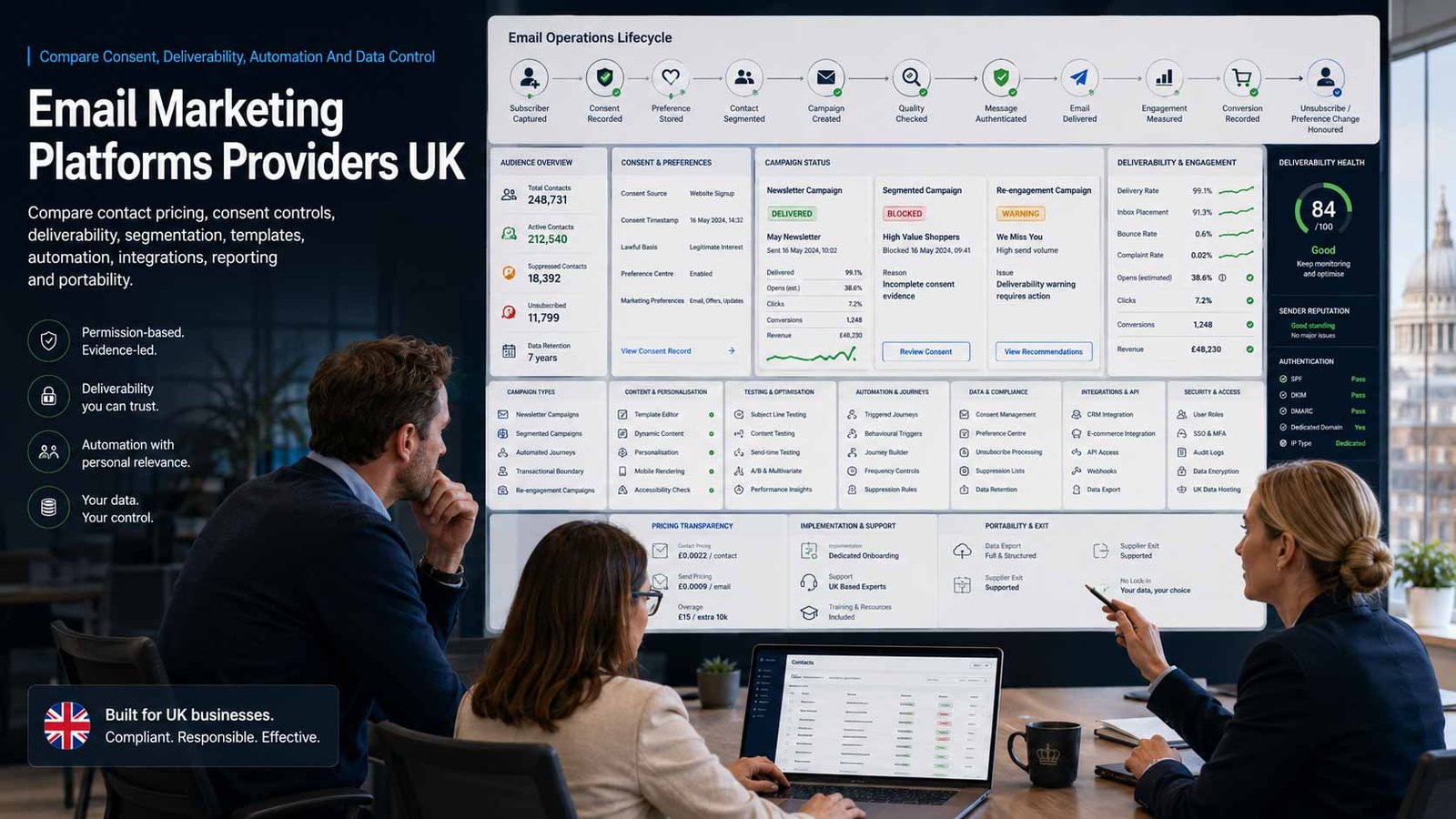
Own The Audience, Consent Evidence And Sending Domain
The business should retain administrator control of its account, subscriber records, consent and preference evidence, suppression lists, sending domains, authentication records, templates, automations, integrations and reporting history.
- Use company-controlled administrator and recovery accounts
- Preserve the source, date, wording and method behind every marketing permission
- Configure SPF, DKIM and DMARC for every authorised sending domain
- Document full contact, suppression, template, journey and report export before appointment
An email marketing platform is software used to collect and manage marketing contacts, create campaigns, send bulk or automated emails, process preferences and unsubscribes, test content and report delivery and engagement. Platforms range from straightforward newsletter tools to sophisticated lifecycle systems using behavioural, purchase and website data to trigger personalised messages.
The platform does not make a mailing list lawful, accurate or commercially useful by itself. The business remains responsible for deciding who can be contacted, preserving consent or other relevant evidence, acting on objections, protecting personal data, maintaining suppression records and ensuring the content and promotions comply with UK rules.
This page compares email marketing platforms only. It does not compare CRM systems or social media marketing services. A platform may include adjacent customer-management, SMS, landing-page or social features, but those capabilities must be separately evaluated where they create a different business process, legal basis, ownership model or supplier decision.
Choose The Right Email Marketing Platform Structure
The platform model changes pricing, automation depth, operational ownership, deliverability support, integration effort and the evidence required before purchase.
| Platform Model | What It Usually Provides | Best-Fit Question |
|---|---|---|
| Newsletter and campaign platform | Template-led campaign creation, lists or audiences, scheduling, basic segmentation, testing and reporting | Does the business mainly need reliable newsletters and promotional campaigns without complex journeys? |
| Subscriber-priced email platform | Pricing scales primarily with subscribed, marketable or stored contacts | Does the contact-count definition match the way duplicates, unsubscribed people and archived records are billed? |
| Send-volume-priced platform | Pricing is driven mainly by monthly email volume, sometimes with separate contact limits | Is the audience large but contacted selectively, making send-based pricing more efficient? |
| Lifecycle automation platform | Visual journeys, event triggers, branching, scoring, dynamic content and automation reporting | Does the business need behaviour-led welcome, nurture, renewal, re-engagement or post-purchase sequences? |
| Ecommerce email platform | Store, catalogue, order and behavioural data power abandonment, product, replenishment and loyalty messages | Are ecommerce data quality, real-time integrations and attributable revenue central to the decision? |
| B2B email and nurture platform | Segmentation by organisation, role, interest or lifecycle stage, with lead and event nurturing | Can the platform support long buying cycles without replacing the separately governed CRM? |
| Multi-brand or multi-account platform | Separate brands, teams, permissions, domains, templates and reporting under central governance | Does the organisation need local independence with shared compliance and technical control? |
| Enterprise or high-volume sending platform | Higher throughput, dedicated infrastructure options, advanced permissions, APIs, deliverability support and service commitments | Are scale, uptime, security review, data residency, support and procurement obligations decisive? |
Eight Areas That Determine Email Platform Fit
Use the same contact volume, send frequency, data sources, campaign types, automation requirements, compliance rules and internal skills for every platform evaluation.
Comparison Criterion
Audience, Consent And Preference Management
Compare sign-up forms, imports, permission fields, consent timestamps, source records, preference centres, double opt-in, suppression handling, deletion and subject-right workflows. The platform should preserve evidence without automatically treating every imported address as marketable.
Comparison Criterion
Contact Model, Segmentation And Data Quality
Review lists, tags, groups, custom fields, deduplication, active-contact definitions, dynamic segments, exclusions and data hygiene. Confirm whether one person held in several audiences is billed once or several times and how bounced, unsubscribed and inactive records affect price.
Comparison Criterion
Campaign Builder, Templates And Approval
Compare responsive drag-and-drop editing, reusable modules, brand controls, HTML access, previews, test sends, accessibility, conditional content, link checking, spelling, approval and version history. Confirm whether non-technical users can create safe campaigns without damaging the template system.
Comparison Criterion
Automation, Triggers And Journey Control
Review triggers, delays, branches, goals, frequency rules, re-entry, testing, exceptions, error handling, pause controls and journey reporting. Require a clear inventory of live automations so customers are not sent conflicting, outdated or excessive messages.
Comparison Criterion
Deliverability, Authentication And Reputation
Compare domain verification, SPF, DKIM and DMARC guidance, bounce processing, complaint monitoring, suppression, warming, dedicated-IP options, sending-rate controls and deliverability support. No provider can guarantee inbox placement, so require evidence, diagnostics and operational responsibilities.
Comparison Criterion
Testing, Personalisation And Content Safety
Review subject-line and content testing, send-time experiments, holdout groups, dynamic fields, fallback values, product recommendations and preview data. Personalisation should fail safely and avoid exposing sensitive or incorrect customer information.
Comparison Criterion
Integrations, APIs And Transactional Boundaries
Compare website forms, ecommerce, analytics, events, data warehouse, helpdesk and API connections. Keep marketing email separate from essential transactional messages where outages, permissions, unsubscribe rules or service ownership require independent infrastructure.
Comparison Criterion
Reporting, Permissions, Security And Exit
Assess delivery, bounce, complaint, unsubscribe, click, conversion and revenue reporting alongside user roles, MFA, audit logs, data processing terms, sub-processors, backup, incident response and export. Require usable data and asset portability before signing.
Measures To Define Before An Email Platform Is Selected
Translate simple claims about ease of use, automation and deliverability into auditable compliance, sending, operational and commercial evidence.
| Measure | What It Should Define | Evidence To Request | Common Weakness |
|---|---|---|---|
| Permission evidence | Whether the organisation can demonstrate the source, date, wording, method and scope of permission or other applicable basis | Contact ID, sign-up source, form version, timestamp, privacy wording, preference and later changes | A generic “subscribed” status exists without evidence of how or why the address was collected |
| Suppression integrity | Whether opt-outs, complaints, hard bounces and objections remain excluded across imports, lists and integrations | Global suppression file, reason, date, source, sync logs and re-subscription control | A new import or connected system silently reactivates an address that had opted out |
| Authentication status | Whether authorised campaigns pass domain-authentication checks and align with the visible sender | SPF, DKIM, DMARC, From domain, return path, test headers and monitoring | The platform verifies a domain but another sender breaks the organisation’s SPF or DMARC alignment |
| Delivery and bounce rate | Whether accepted messages reach receiving systems without excessive temporary or permanent failure | Delivered, hard bounce, soft bounce, block, deferral, domain and campaign trend | Delivery is reported as inbox placement even though acceptance by the receiving server is not the same result |
| Complaint and spam rate | Whether recipients report unwanted messages and whether the business acts before reputation deteriorates | Complaint source, campaign, segment, domain, corrective action and trend | High-volume growth is celebrated while complaint signals and list source quality are ignored |
| Unsubscribe completion | Whether an opt-out is easy, prompt and applied throughout the marketing environment | Link test, processing time, global suppression, preference result and connected-system confirmation | The visible list is updated but another audience, automation or export continues sending |
| Automation reliability | Whether contacts enter, branch, wait, exit and complete journeys as designed | Entry rule, trigger event, step result, error, completion, goal and exception | A journey remains live after products, prices, policies or ownership have changed |
| Template rendering and accessibility | Whether messages remain readable across common clients, devices and assistive technologies | Preview, test matrix, plain-text version, alt text, colour contrast, heading and link checks | A visually attractive template fails in Outlook, dark mode or mobile view |
| Commercial attribution | Whether reported conversions and revenue can be reconciled to website, order or sales evidence | Campaign ID, click, transaction, attribution window, returns, cancellations and margin | Platform-attributed revenue is treated as incremental profit without considering overlap or refunds |
| Exit portability | Whether contacts, permissions, suppressions, templates, assets, automations and history can be transferred safely | Export format, fields, consent records, suppression file, HTML, journey map, reports and deletion evidence | The contact CSV is exportable but the evidence and operational logic required to use it are not |
Email Marketing Platforms UK Businesses Can Consider
Shortlist platforms whose contact model, sending infrastructure, automation depth, integrations, controls and support match the business. Confirm current plans, limits and terms directly before purchase.
Provider Profile
Mailchimp
Mailchimp provides campaign creation, audience management, templates, segmentation, testing, reporting and automated customer journeys for small organisations through to larger teams. Include it where ease of use, a broad integration ecosystem and a familiar campaign workflow matter. Confirm how contacts are counted across audiences, subscribed and non-subscribed records, monthly send limits, overages, user seats, automation features, support, data location and exports. Review whether the audience structure will create duplicates, whether essential consent fields can be preserved, how sending domains are authenticated and how templates, reports, suppressions and journeys can be migrated if the organisation later changes platform.
Review official Mailchimp informationProvider Profile
Brevo
Brevo offers email campaigns, segmentation, automation, forms, templates, deliverability infrastructure and usage-based plans that can suit businesses sending to larger contact bases at controlled volumes. Include it where monthly send allowance matters more than charging every stored contact. Confirm contact limits where applicable, send credits, automation contact rules, transactional and marketing separation, dedicated-IP options, user access, support, integrations and data processing terms. Check how global blocklists, consent evidence, preferences and unsubscribes operate across marketing, automation and connected products, and make sure adjacent CRM or messaging features are not confused with the email-platform requirement being compared.
Review official Brevo informationProvider Profile
Campaign Monitor
Campaign Monitor provides email design, templates, segmentation, personalisation, automation journeys, analytics and agency or multi-client capabilities. Include it where strong branded campaign creation, straightforward reporting or managed multi-account delivery is important. Confirm subscriber and send allowances, automation access by plan, transactional email options, SMS or other channel add-ons, support level, user permissions and custom-template requirements. Test data import, custom fields, suppression behaviour, journey logic, preview coverage, source-file ownership and export. Organisations using an agency should retain direct access to each account and understand who controls billing, domains, templates, lists and historic campaign data.
Review official Campaign Monitor informationProvider Profile
Constant Contact
Constant Contact provides email design, list-building tools, segmentation, automation, reporting, integrations and support aimed particularly at small businesses and membership-led organisations. Include it where guided onboarding, accessible editing and practical support are priorities. Confirm the contact tier, send allowance, overage policy, automation limits, number of users, templates, storage, support channel and any bundled features outside email. Review whether GBP pricing, VAT treatment and annual commitments suit the business. Test how imported contacts, opt-outs, duplicates, bounced addresses, permission notes and preference changes are handled before moving an existing audience.
Review official Constant Contact informationProvider Profile
Dotdigital
Dotdigital is a UK-founded customer-engagement platform offering email campaign creation, data-driven segmentation, automation, personalisation, reporting and integrations for growing and enterprise organisations. Include it where multi-brand governance, ecommerce integration, advanced journeys, service support or procurement assurance matter. Confirm the licensed contact or send model, implementation, onboarding, professional services, user roles, data hosting, security certifications, dedicated sending infrastructure and support commitments. Scope the purchase around email requirements so wider data, mobile or customer-experience modules do not obscure platform cost. Require clear exports for contacts, permissions, suppressions, templates, programmes and reporting.
Review official Dotdigital informationProvider Profile
Klaviyo
Klaviyo provides email marketing closely connected to ecommerce customer, product, order and behavioural data, with segmentation, personalised campaigns, flows, testing and revenue reporting. Include it where online retail lifecycle messages such as welcome, browse abandonment, cart recovery, post-purchase, replenishment and win-back are central. Confirm how active profiles are counted, email and optional messaging limits, integration data, identity resolution, predictive or AI features, attribution windows and support. Validate consent and preference sources independently of store status, test suppression across integrations, and reconcile attributed revenue to completed orders, cancellations, refunds and gross margin.
Review official Klaviyo informationProvider Profile
ActiveCampaign
ActiveCampaign provides email campaigns, segmentation, testing and sophisticated automation with broad trigger, branch and integration capabilities. Include it where lifecycle journeys and operational automation depth are more important than a simple newsletter workflow. Keep the comparison limited to email-platform requirements rather than treating its separate customer-management features as a replacement for the organisation’s CRM decision. Confirm contact limits, automation actions, user seats, testing, reporting, transactional email add-ons, support and integration costs. Review deliverability setup, domain authentication, journey governance, permission data, suppression handling, export formats and the internal skills needed to maintain complex automations safely.
Review official ActiveCampaign informationProvider Profile
MailerLite
MailerLite provides drag-and-drop email creation, templates, segmentation, forms, landing pages, automation, testing and reporting with pricing that scales by subscribers and usage. Include it where a smaller business, creator, charity or lean marketing team wants an accessible platform without excessive implementation complexity. Confirm subscriber definition, monthly send limits, free or paid plan restrictions, user seats, template access, automation features, support, ecommerce connections and transactional-email separation. Test permission imports, custom fields, group and segment logic, authentication, unsubscribe processing, template export and the steps required to preserve historical evidence when moving from another service.
Review official MailerLite informationWhat Changes Email Marketing Platform Cost
Compare a complete twelve-month operating model rather than the entry price shown for a small list. Contact growth, send volume, users, automation and migration can materially change spend.
| Cost Driver | Why It Changes Spend | What A Comparable Quote Should Show |
|---|---|---|
| Marketable, active or stored contacts | Platforms define billable contacts differently, and one person may appear in several audiences or states | Billable-contact definition, duplicate treatment, unsubscribed and inactive records, archive rules and tier thresholds |
| Monthly email sends | Campaigns and automations consume send allowance, with pausing or overages when limits are exceeded | Included sends, multiplier, automation usage, test messages, overage price, alert and hard-stop behaviour |
| Feature tier | Automation, segmentation, testing, reporting, permissions and support are often restricted by plan | Exact feature matrix, plan dependencies, upgrade trigger and downgrade effect |
| Users and permissions | Additional marketers, approvers, agencies or brands may require paid seats or higher plans | Included users, role types, administrator control, approval and extra-seat cost |
| Automation scale | Journeys can be limited by contacts, actions, branches, goals, event volume or API usage | Number of journeys, actions, active contacts, event limits, testing and reporting |
| Deliverability services | Dedicated IPs, warming, monitoring, consultancy or managed services may cost extra | Shared or dedicated infrastructure, eligibility, setup, monthly fee, monitoring and support boundary |
| Templates and content production | Premium templates, custom HTML, migration, design or professional services add implementation cost | Included templates, custom build, module library, testing, source files and ownership |
| Integrations and data movement | Native connectors, middleware, API use, data warehouse sync and engineering work add cost | Connector licence, API limits, implementation, monitoring, failure handling and internal support |
| Transactional email or other channels | Operational messages, SMS, WhatsApp or push may use separate products, credits and compliance | Channel, message type, allowance, number or sender cost, ownership and service-level requirement |
| Support, training and migration | Onboarding, priority support, deliverability help, training and data migration vary widely | Support hours, response target, named contact, migration scope, training, documentation and renewal price |
How Audience Scale And Operating Complexity Change The Shortlist
The best platform depends on permission quality, contact scale, send frequency, campaign type, automation depth, integrations, internal capability and assurance requirements.
New Or Small Email Programme
Prioritise simple contact management, usable templates, basic automation, reliable support, clear pricing and easy exports. Avoid paying for complex journeys before consent, content, list growth and campaign ownership are mature.
B2B Service Or Membership Organisation
Prioritise lawful audience records, organisation and role segmentation, event and content nurturing, preference management, long buying-cycle reporting and controlled integration with—but not replacement of—the separate CRM.
Ecommerce And Retail Brand
Prioritise real-time store and catalogue data, identity quality, abandonment and post-purchase flows, product personalisation, frequency controls, deliverability and revenue reporting reconciled to completed and retained orders.
Multi-Brand Or High-Volume Organisation
Prioritise account hierarchy, domain and IP strategy, roles, approvals, data residency, security review, APIs, service commitments, audit logs, multi-brand templates, suppression integrity and tested exit portability.
How To Compare Email Platform Proposals
Give every provider the same contact count, growth forecast, send calendar, automation events, data sources, brands, domains, users, integrations, compliance needs, reporting outcomes and migration date. Require one standardised two-year cost and implementation schedule.
- The billable contact and send definitions are explicit
- Consent, preferences and suppression data can be preserved
- SPF, DKIM, DMARC and sender responsibilities are documented
- Campaign, automation, testing and reporting limits are itemised
- Migration, integrations, support and internal effort are included
- Contacts, evidence, templates, journeys and reports are exportable
Test With Real Data Before Committing
Use a controlled sample containing representative fields, permissions, segments, templates and one automation.
Validate import, authentication, rendering, suppression, reporting and export before moving the complete audience.
Six Questions To Put To Every Email Platform Provider
The answers expose unclear billing, weak permission evidence, deliverability gaps, hidden limits and platforms that are difficult to leave.
What Counts As A Billable Contact?
Ask how subscribers, duplicates, unsubscribed people, bounced records, inactive contacts and contacts held in several audiences affect price.
How Is Permission Evidence Preserved?
Confirm fields, timestamps, source, form wording, preferences, double opt-in, objections, suppression and connected-system synchronisation.
What Controls Deliverability And Authentication?
Request the exact SPF, DKIM, DMARC, bounce, complaint, warming, reputation and sender-support responsibilities.
Which Features And Limits Apply To This Plan?
Confirm sends, users, segments, tests, journeys, actions, events, API calls, reports, templates, support and overages.
How Will Results Be Reconciled?
Define delivery, click, conversion, attribution, order, refund, sales and margin evidence instead of relying on platform totals alone.
What Can We Export On Exit?
Require contacts, custom fields, consent evidence, suppression lists, templates, assets, journey maps, campaign history and deletion confirmation.
A Seven-Stage Email Platform Evaluation
Move from verified audience and sending evidence to a controlled platform migration rather than selecting software from a feature list alone.
- Inventory current contacts, sources, consent and preference evidence, suppression records, campaigns, templates, automations, domains, integrations, users, contracts and accountable owners.
- Define the permitted audiences, sender identities, brands, campaign types, send frequency, automation events, reporting outcomes, security controls, retention and exit requirements.
- Clean and normalise contact data, remove avoidable duplicates, map fields, identify missing evidence, preserve suppression records and decide what should not be migrated.
- Issue one written requirement and obtain comparable platform plans showing contact definitions, sends, features, users, infrastructure, support, implementation and full two-year cost.
- Run a controlled proof using representative data, one template, one campaign and one automation; test authentication, rendering, suppression, reporting, permissions and export.
- Migrate through reconciliation: compare record counts, fields, permission status, suppression totals, templates, journeys, integrations and administrator access before cutover.
- Operate through campaign approvals, pre-send checks, deliverability monitoring, monthly list hygiene, automation reviews, permission audits, cost forecasting and tested annual exports.
Email Marketing Platform Comparison Checklist
Use this table before approving a new platform, migration, renewal, multi-brand rollout or material plan upgrade.
| No. | Requirement | Evidence To Obtain Before Award | Confirmed |
|---|---|---|---|
| 01 | Business owner and email-platform scope agreed | Accountable owner, marketing lead, data-protection contact, technical owner, approvers and supported brands | |
| 02 | Current audience and platform mapped | Contacts, sources, audiences, lists, fields, forms, templates, journeys, domains, integrations and contracts | |
| 03 | Permission and preference evidence reviewed | Consent wording, timestamps, source, soft opt-in assessment where applicable, objections, suppression and retention | |
| 04 | Billable contact model understood | Subscriber states, duplicate logic, inactive and unsubscribed records, audiences, archive rules and growth forecast | |
| 05 | Send-volume model completed | Campaigns, automation messages, tests, transactional boundary, seasonal peaks, allowance and overage | |
| 06 | Segmentation and data fields validated | Required fields, custom properties, groups, tags, exclusions, dynamic segments, data quality and refresh | |
| 07 | Templates and approval workflow tested | Responsive rendering, brand modules, accessibility, plain text, previews, test sends, approval and versioning | |
| 08 | Automation requirements proven | Triggers, branches, delays, re-entry, goals, frequency controls, errors, pause, testing and reporting | |
| 09 | Sending domains authenticated | SPF, DKIM, DMARC, From-domain alignment, return path, subdomains, monitoring and ownership | |
| 10 | Deliverability responsibilities agreed | Bounces, complaints, suppression, warming, spam monitoring, dedicated IP, escalation and support | |
| 11 | Integrations and data flows approved | Website, ecommerce, analytics, event, API, middleware, sync direction, frequency, failure and recovery | |
| 12 | Security and data terms accepted | Users, roles, MFA, audit logs, DPA, sub-processors, data location, retention, incident and deletion | |
| 13 | Reporting and attribution reconciled | Delivery, clicks, conversions, order or sales evidence, returns, attribution window, margin and limitations | |
| 14 | Complete two-year cost compared | Subscription, contacts, sends, users, overages, migration, templates, integrations, support and internal effort | |
| 15 | Migration and exit plan agreed | Export fields, consent evidence, suppression, templates, journeys, reports, overlap, cutover and deletion evidence |
Common Email Marketing Platform Buying Mistakes
Most avoidable failures begin with unclear contact billing, poor permission evidence, weak suppression control, untested authentication or an incomplete migration plan.
| Mistake | Why It Creates Risk | Better Control |
|---|---|---|
| Choosing from the entry price | The real bill changes with contacts, sends, users, automation and overages | Model two years of realistic growth |
| Importing every historic address | Old, unclear or unwanted data damages compliance, reputation and cost | Migrate only justified, useful records |
| Losing suppression records | Previously opted-out people can be contacted again after an import or integration | Treat suppression as critical data |
| Assuming the platform creates consent | Software stores a status but cannot make the original collection lawful | Preserve source and wording evidence |
| Ignoring sender authentication | Unauthenticated or misaligned mail can be rejected, filtered or spoofed | Implement and monitor SPF, DKIM and DMARC |
| Building automations without ownership | Journeys become outdated and continue sending after business changes | Assign owners and review dates |
| Using open rate as the main outcome | Privacy protections and image loading make opens an imperfect measure | Use clicks and verified business outcomes |
| Mixing marketing and essential service email | Unsubscribe, outages and permission logic can disrupt operational messages | Separate transactional requirements |
| Giving an agency permanent ownership | The business becomes dependent on an external administrator or billing account | Retain company administrator control |
| Migrating without an exit test | Contacts may export while permissions, suppressions and journeys do not | Test the full portability package |
Frequently Asked Questions
Answers to common questions from UK businesses comparing newsletter tools, lifecycle automation platforms, ecommerce email systems and enterprise sending services.
What Is An Email Marketing Platform?
An email marketing platform is software used to manage marketing contacts, create and send bulk campaigns, process preferences and unsubscribes, build automated journeys, test content and report delivery and engagement. Some platforms also provide forms, landing pages, ecommerce integrations or other channels, but the core comparison should remain focused on email requirements.
Which Email Marketing Platform Is Best For A UK Small Business?
There is no universal best platform. A small business should compare its number of marketable contacts, monthly sends, campaign types, automation needs, ecommerce or website integrations, internal skills, support requirements, permission evidence and likely growth. A simpler tool may be better than an advanced platform that the team cannot govern or maintain.
How Much Do Email Marketing Platforms Cost In The UK?
Pricing can depend on contacts, active profiles, monthly sends, users, automation, support and add-ons. Entry plans may cost only a small monthly amount, while growing lists, high-volume sending, advanced automation, dedicated infrastructure, migration and enterprise support can cost hundreds or thousands of pounds per month. Compare a realistic two-year total.
Do UK Businesses Need Consent To Send Marketing Emails?
For unsolicited electronic mail marketing to individual subscribers, consent is normally required unless the limited soft opt-in requirements are met. The rules differ for corporate subscribers, but UK GDPR may still apply where a business contact is identifiable personal data. Businesses should assess the audience, keep evidence, identify themselves and provide a working opt-out.
What Is The Email Marketing Soft Opt-In?
The soft opt-in is a limited exception that can allow a business to market its own similar products or services to existing customers or people who negotiated a sale, provided the address was collected directly and a simple opt-out was offered when the details were collected and in every later message. It should not be treated as a general permission for bought or unrelated lists.
What Are SPF, DKIM And DMARC?
SPF identifies authorised sending systems, DKIM adds a verifiable signature to messages, and DMARC tells receiving services how to assess mail that fails authentication and provides reporting. Correct configuration helps protect the domain from spoofing and supports deliverability. Bulk senders should also check current receiver requirements, alignment, unsubscribe and spam-rate rules.
Can An Email Platform Guarantee Inbox Placement?
No. A platform can provide sending infrastructure, authentication guidance, bounce processing, monitoring and deliverability support, but inbox placement also depends on permission quality, recipient engagement, complaint rates, content, volume changes, domain and IP reputation and receiving-provider decisions. Treat guaranteed deliverability claims cautiously.
Should Marketing And Transactional Emails Use The Same Platform?
They can, but the decision should be deliberate. Transactional messages such as receipts, password resets or service alerts may require different availability, permission, unsubscribe, latency and support controls. Separate streams or products can reduce the risk that a marketing problem interrupts essential customer communications.
What Data Should Be Exported Before Changing Platform?
Export contacts, custom fields, permission and preference evidence, global suppression records, bounce and complaint status, templates, images, campaign reports, automation maps, integration documentation and user details. Test whether timestamps, source fields and exclusions remain usable rather than relying on a basic contact CSV.
How Should A UK Business Compare Email Marketing Platforms?
Give every provider the same contact count, growth forecast, send schedule, automation requirements, domains, integrations, users and compliance controls. Compare billable-contact rules, sends, features, authentication, suppression, deliverability support, reporting, security, migration, support, complete cost and exit portability—not only templates or the entry price.
UK Direct-Marketing Guidance, Sender Requirements And Platform Information
Reviewed by Bhav Giva, Founder & Lead Analyst at CompareServices.co.uk, on 30 July 2026.
Use ICO electronic-marketing guidance, NCSC and receiving-provider sender requirements, ASA/CAP rules and official platform documentation to confirm current consent, suppression, authentication, features, limits, support and commercial terms. Product plans, contact definitions, send allowances, functionality and prices can change.
- ICO — Electronic Mail Marketing
- ICO — Direct Marketing Using Electronic Mail
- ICO — Business-To-Business Marketing
- NCSC — Email Security And Anti-Spoofing
- Google — Email Sender Guidelines
- ASA/CAP — UK Non-Broadcast Advertising Code
- Mailchimp — Email Marketing Platform
- Brevo — Marketing Platform
- Campaign Monitor — Email Marketing Platform
- Constant Contact — UK Email Marketing
- Dotdigital — Email Marketing Platform
- Klaviyo — Email Marketing
- ActiveCampaign — Email Marketing Platform
- MailerLite — Email Marketing Features