
Compare E-commerce Platforms Providers UK (2026)
Compare Storefront, Catalogue, Checkout, Inventory, B2B, Integrations, Security, Migration And Total Platform Cost
Compare ecommerce platform providers for UK businesses by storefront control, product catalogue, variants, pricing, promotions, checkout, tax, delivery, inventory, order management, customer accounts, B2B trading, subscriptions, multi-currency, marketplaces, analytics, integrations, hosting, security, accessibility, migration, data ownership and complete operating cost. Use the same catalogue, transaction profile, fulfilment model and integration requirements for every platform demonstration.
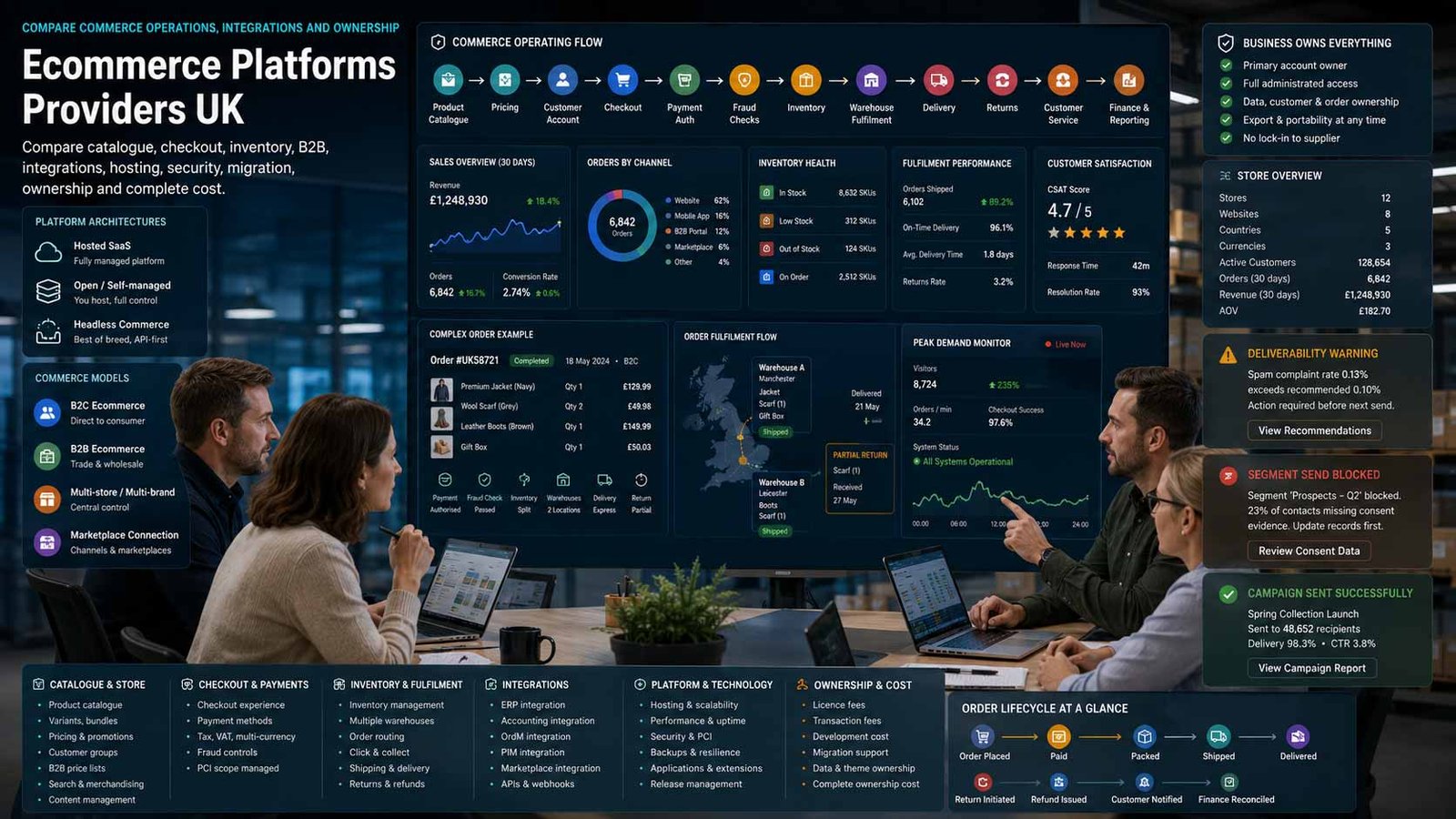
Compare The Commerce Operating System, Not Only The Storefront
An ecommerce platform controls product data, pricing, checkout, orders, customers and operational integrations. A visually attractive theme cannot compensate for unsuitable catalogue rules, weak inventory control, restricted checkout, poor data portability or fragile integrations.
- Document catalogue, order and fulfilment complexity
- Separate platform, implementation, apps and payment costs
- Test real operational scenarios before procurement
- Confirm data ownership and migration rights in writing
An ecommerce platform is the software foundation used to merchandise products or services, operate a digital storefront, manage baskets and checkout, receive order information and connect commerce activity with the wider business. Depending on the model, the platform may also provide hosting, security updates, content management, inventory, customer accounts, returns, promotions, marketplaces, point-of-sale connections and analytics.
Hosted software-as-a-service platforms usually reduce infrastructure responsibility and provide a managed upgrade path. Open-source or self-hosted platforms can offer greater code, data and architecture control but require stronger technical ownership. Enterprise and composable platforms support complex multi-brand, B2B and integration requirements but usually increase design, implementation and operating effort.
This page compares ecommerce platform capability and commercial fit. It does not compare general website-design agencies or payment gateways as standalone services. Design and implementation may be required to deploy a platform, while payment gateways and merchant acquiring remain separate contractual and regulated layers.
Choose The Right E-commerce Platform Structure
The delivery model changes control, responsibility, speed, flexibility, technical risk and total ownership cost.
| Platform Model | What It Usually Provides | Best-Fit Question |
|---|---|---|
| Hosted all-in-one SaaS | Platform subscription normally includes hosting, core updates, security operations and a controlled extension ecosystem | Does the business accept platform conventions in return for lower infrastructure responsibility? |
| Open-source commerce | The business can choose hosting, development partners, extensions and code-level customisation | Is there an accountable technical owner for updates, security, performance and compatibility? |
| Enterprise commerce suite | Advanced catalogue, B2B, multi-site, permissions, integration and governance capabilities | Will operational complexity justify licensing, implementation and specialist support costs? |
| Website-builder commerce | Storefront, content, basic catalogue and marketing tools are combined in a simpler editor | Are product, inventory, tax, fulfilment and integration needs genuinely straightforward? |
| UK-focused hosted platform | Hosted commerce with UK support, local integrations and packaged features for SMEs | Are product limits, turnover tiers, payment choices, exports and future scale acceptable? |
| B2B commerce platform | Company accounts, customer-specific pricing, terms, approvals, quotations and repeat ordering | Can it represent the actual buyer hierarchy, contract pricing and procurement workflow? |
| Headless or composable commerce | Commerce services are exposed through APIs and connected to a separately built customer experience | Does the business have architecture, development and monitoring capability to own the components? |
| Multi-store or international platform | Several brands, regions, currencies, languages or customer segments run from shared administration | Can tax, catalogue, pricing, domains, localisation and reporting be controlled without cross-store errors? |
Eight Areas That Determine E-commerce Platform Fit
Use the same catalogue, order flows, sales channels, locations, countries and integration assumptions for every platform demonstration.
Comparison Criterion
Catalogue, Product And Merchandising Control
Compare product types, variants, bundles, kits, subscriptions, digital products, attributes, collections, customer groups, price lists, promotions, search, filtering, reviews, media and bulk editing. Use a representative complex product rather than a simple demonstration item.
Comparison Criterion
Checkout, Tax, Delivery And Customer Experience
Review guest checkout, account creation, address validation, discount rules, VAT display, delivery options, click and collect, subscriptions, pre-orders, returns and accessible mobile completion. Confirm which checkout elements can be changed without unsupported code.
Comparison Criterion
Inventory, Orders, Returns And Fulfilment
Assess stock by location, safety stock, back orders, partial fulfilment, routing, order edits, cancellations, refunds, exchanges, returns, dispatch, tracking and exception queues. Test how the platform prevents overselling when several channels share inventory.
Comparison Criterion
B2B, Wholesale And Account-Based Commerce
Compare company accounts, users, roles, customer-specific catalogues, negotiated pricing, minimum quantities, payment terms, purchase orders, quotations, approvals, tax exemptions, repeat orders and sales-representative workflows.
Comparison Criterion
Integrations, APIs And Extension Governance
Map ERP, accounting, CRM, PIM, WMS, shipping, marketplace, tax, search, loyalty and support integrations. Review API limits, webhooks, middleware, extension quality, vendor dependencies, update compatibility and failure monitoring.
Comparison Criterion
Hosting, Performance, Availability And Security
Confirm hosting responsibility, content delivery, scaling, backups, recovery, updates, vulnerability response, MFA, staff permissions, audit logs, data residency, uptime commitments and incident communication. Self-hosted does not mean unsupported responsibility.
Comparison Criterion
Analytics, Attribution And Data Access
Review product, customer, order, refund, margin and channel reporting; analytics integrations; consent-aware tracking; raw exports; APIs; event data; and the ability to reconcile platform totals with finance and fulfilment systems.
Comparison Criterion
Migration, Ownership, Portability And Exit
Require a complete inventory of products, variants, customers, orders, subscriptions, URLs, redirects, reviews, gift balances, media, tax data and integrations. Define ownership, export formats, transition support, decommissioning and access after termination.
Measures To Define Before Selecting A Platform
Translate feature claims into auditable operational, customer, resilience and data evidence.
| Measure | What It Should Define | Evidence To Request | Common Weakness |
|---|---|---|---|
| Catalogue completeness | Whether products, variants, media, attributes, pricing and availability are accurate across channels | Sample SKUs, source system, update time, failed records and correction owner | A polished demo uses a small catalogue that avoids the business’s difficult product rules |
| Checkout completion | The proportion of eligible sessions that successfully complete the defined checkout path | Device, traffic source, basket, delivery, payment stage, error and abandonment reason | Conversion is reported without separating platform errors from customer choice |
| Order-flow accuracy | Whether order, payment, stock, tax, fulfilment and customer records remain consistent | Order ID, timestamps, status changes, integration events, exceptions and reconciliation | Each system shows a different order state and no team owns the discrepancy |
| Inventory accuracy | Whether sellable stock reflects physical and allocated inventory across every channel | SKU, location, on-hand, reserved, available, channel, timestamp and adjustment | A batch sync creates overselling during high demand or marketplace activity |
| Platform availability | Whether storefront, admin, checkout and APIs remain usable during agreed trading periods | Uptime, response time, error rate, component, incident, recovery and service credit | One headline uptime figure hides checkout or API degradation |
| Release quality | Whether platform, theme, extension and integration changes reach production safely | Change, test evidence, approval, release, monitoring, rollback and result | Automatic or agency releases are deployed without business acceptance or rollback |
| Customer-service efficiency | Whether agents can find orders, amend permitted details, refund and resolve exceptions efficiently | Contact reason, order, action, systems used, handling time and outcome | The platform creates manual work that is excluded from the software cost |
| Data portability | Whether the business can retrieve complete operational and historical data in usable formats | Products, customers, orders, subscriptions, URLs, reviews, files, schemas and API access | Only partial CSV exports are available when the business needs to migrate |
Define Who Owns Every Part Of The Commerce Service
The same feature can be supplied by the platform, an app vendor, an implementation partner or the business itself. Procurement should identify the accountable owner before launch.
| Responsibility Area | Questions For A Hosted Platform | Questions For Open Or Composable Commerce | Evidence To Retain |
|---|---|---|---|
| Infrastructure and availability | Which storefront, checkout, admin and API components are covered by the service commitment, and how are incidents communicated? | Who selects, configures and monitors hosting, CDN, databases, queues, search, scaling and disaster recovery? | Architecture, component ownership, service levels, monitoring, recovery objectives and escalation contacts |
| Security maintenance | Which platform vulnerabilities, certificates, network controls and core updates are managed by the provider, and what remains with the merchant? | Who applies software and extension patches, tests compatibility, reviews privileged access and responds to compromise? | Shared-responsibility statement, patch records, access register, vulnerability process and incident plan |
| Storefront and theme | Who owns the theme licence, custom code, design files and deployment rights when an agency or marketplace theme is used? | Which repositories, frameworks, packages and build pipelines create the customer experience, and who maintains them? | Business-owned accounts, repository access, licences, source files, deployment instructions and coding standards |
| Apps, plugins and modules | Who selects each app, accepts permissions, owns billing, checks data access and responds when the vendor changes or closes? | Who approves extensions, checks code quality, tests updates, tracks dependencies and replaces unsupported components? | Extension register, purpose, data access, owner, cost, renewal, support, version and replacement plan |
| Integrations and data movement | Does the platform or partner monitor API failures, delayed webhooks, rate limits, duplicate messages and reconciliation exceptions? | Who operates middleware, message queues, mappings, credentials, retries, logs, alerting and environment promotion? | Interface catalogue, data mappings, credentials owner, monitoring, error queues, support routes and runbooks |
| Compliance configuration | Which settings support tax, privacy, cookies, accessibility and consumer information, and which legal decisions remain with the business? | Who designs, tests and maintains compliant journeys when the business controls code and several components? | Legal requirements, configuration decisions, consent records, accessibility evidence, tests and approval history |
| Release and change control | How are provider releases, theme changes, apps and merchant configuration tested, communicated and rolled back? | Who owns environments, automated tests, acceptance, release windows, database changes, rollback and post-release monitoring? | Release calendar, test results, approvals, change records, rollback steps and post-launch checks |
| Support and business continuity | Which incidents receive platform support, which are redirected to app or agency vendors, and what cover exists during trading peaks? | Which internal and external teams cover infrastructure, code, applications, data, security and operations outside normal hours? | Support matrix, hours, priorities, SLAs, named contacts, peak calendar, continuity plan and supplier dependencies |
E-commerce Platforms UK Businesses Can Consider
Shortlist platforms whose operating model, capability, support and ownership structure fit the business. Confirm current plans, limits and terms directly before selection.
Provider Profile
Shopify
Shopify is a hosted commerce platform for selling online and in person, with storefront, checkout, orders, inventory, shipping, automation and an extensive app and partner ecosystem. Include it where a business wants managed infrastructure, rapid deployment and a standardised operating model that can scale from a small store to larger multi-channel operations. Confirm the selected plan, transaction-fee conditions, checkout and B2B requirements, app dependencies, product and market configuration, staff permissions, API limits, multi-store structure, payment-provider choice, data exports, theme ownership, development support and the cost of Shopify Plus where enterprise capability is required.
Review official Shopify informationProvider Profile
WooCommerce
WooCommerce is the open-source commerce platform for WordPress and provides extensive control over hosting, code, checkout, content, data and extension choice. Include it where a business values ownership, content-commerce integration and the ability to shape a tailored technical stack. Confirm the hosting architecture, responsible developer, theme and extension licences, update and staging process, security monitoring, backups, performance testing, payment and shipping integrations, plugin compatibility, support coverage, accessibility, database growth, order-volume testing and the complete cost of maintaining a secure production environment.
Review official WooCommerce informationProvider Profile
BigCommerce
BigCommerce is a hosted and open SaaS commerce platform supporting B2C, B2B, multi-storefront and integration-led operating models. Include it where a growing or established business needs managed infrastructure with stronger native multi-store, catalogue and B2B capability than a basic website builder. Confirm subscription and enterprise pricing, annual-sales thresholds where relevant, checkout requirements, storefront model, B2B edition, multi-store configuration, API limits, app costs, payment choices, product rules, international requirements, support tier, migration tooling, data export and implementation-partner responsibility.
Review official BigCommerce informationProvider Profile
Adobe Commerce
Adobe Commerce supports complex B2C and B2B commerce, multi-site structures, customer-specific catalogues, pricing, inventory and extensive integration. Include it where enterprise catalogue, account, regional or operational complexity requires deep configuration and dedicated technical governance. Confirm edition and licensing, hosting model, implementation architecture, upgrade path, extensions, security patches, performance engineering, multi-source inventory, B2B modules, integration ownership, release management, specialist skills, support arrangements, data migration and the long-term cost of operating a highly customised environment.
Review official Adobe Commerce informationProvider Profile
Wix eCommerce
Wix combines no-code website creation with hosted commerce, product catalogues, inventory, orders and multichannel selling. Include it where a smaller business values visual editing, quick setup and an integrated suite more than complex backend customisation. Confirm the ecommerce plan, product and variant needs, checkout and payment options, VAT and delivery rules, marketplace integrations, staff access, multilingual and multi-currency requirements, export formats, app dependencies, custom-code limits, analytics, subscriptions, POS availability and whether the business could outgrow operational constraints.
Review official Wix eCommerce informationProvider Profile
Squarespace Commerce
Squarespace Commerce combines design-led website management with tools for physical products, digital products, services, subscriptions, memberships and appointments. Include it where brand presentation and relatively straightforward selling requirements are more important than advanced inventory, B2B or multi-warehouse operations. Confirm the selected plan, transaction fees, product types, checkout, taxes, shipping, subscriptions, scheduling, payment processors, POS region and provider dependencies, customer accounts, integrations, exports, customisation limits and migration requirements.
Review official Squarespace Commerce informationProvider Profile
ShopWired
ShopWired is a hosted ecommerce platform offering UK-focused store creation, product and order management, themes, integrations and enterprise options. Include it where a UK SME wants an all-in-one platform, local support and built-in commerce features without managing hosting or an open-source stack. Confirm plan limits, turnover bands, product limits, admin users, B2B or trade-account requirements, payment-gateway choice, app and design costs, API access, marketplace integrations, support coverage, performance, data exports, migration assistance and the process and cost of moving away later.
Review official ShopWired informationProvider Profile
EKM
EKM is a UK-hosted ecommerce platform combining online-store software with UK-based support and service options for setup, migration, design and ongoing improvement. Include it where a smaller or mid-sized business values guided implementation and continuing platform support. Confirm the package and turnover basis, included ecommerce manager support, product and order requirements, theme and design services, payment choices, transaction and app costs, B2B needs, integrations, export capability, account ownership, cancellation, migration support and whether the platform can support the intended operational scale without manual workarounds.
Review official EKM informationWhat Changes E-commerce Platform Cost
Compare the complete two-year operating cost. A low monthly licence can be outweighed by implementation, apps, support, payment charges and manual work.
| Cost Driver | Why It Changes Spend | What A Comparable Quote Should Show |
|---|---|---|
| Platform subscription or licence | Hosted plans may vary by functionality, users, stores, turnover or enterprise agreement | Plan, billing currency, limits, included stores, users, support, renewal and price-change rights |
| Implementation and configuration | Catalogue setup, theme, checkout, tax, delivery, content and workflows require design and configuration | Discovery, solution design, configuration, development, testing, training, launch and contingency |
| Hosting and infrastructure | Included in SaaS; separately selected and operated for self-hosted or open-source platforms | Hosting, CDN, environments, backups, monitoring, scaling, security, support and disaster recovery |
| Themes, apps and extensions | Core gaps are often filled by paid themes, apps, plugins or enterprise modules | Licence, billing owner, vendor, permissions, data access, support, updates, compatibility and replacement |
| Payment-related platform charges | Some plans add transaction charges depending on the payment provider or arrangement | Platform transaction fee, gateway, acquirer, wallet, fraud, chargeback, refund and international costs |
| Integrations and middleware | ERP, PIM, WMS, CRM, finance and marketplaces can create material recurring cost | Connector, API, middleware, mapping, monitoring, support, change control and usage limits |
| Operational support and development | Stores need incident response, releases, optimisation and catalogue or campaign support | Support hours, SLA, retained development, release allowance, monitoring and out-of-scope rates |
| Migration and data preparation | Products, customers, orders, URLs, content, reviews and subscriptions must be cleaned and moved | Extraction, transformation, validation, redirects, testing, dual running and reconciliation |
| International and multi-store capability | Additional regions can require stores, domains, currencies, tax tools, translation and operations | Store licences, localisation, duties, tax, currency, content, support and reporting |
| Exit and replacement | Data extraction, subscription migration, redirects and decommissioning create end-of-life cost | Notice, exports, API access, transfer support, data retention, app cancellation and archive |
How Operating Complexity Changes The Shortlist
The correct platform depends on catalogue complexity, customers, channels, fulfilment, integrations, international scope and internal technical capability.
New Or Simple Online Seller
Prioritise fast deployment, clear hosted pricing, straightforward catalogue management, reliable checkout, delivery setup, support and clean exports. Avoid enterprise complexity and unnecessary apps.
Growing Multi-Channel Retailer
Prioritise inventory synchronisation, order routing, returns, marketplace and POS integration, promotions, customer data, automation, reporting and a support model that covers trading peaks.
B2B Or Wholesale Business
Prioritise company accounts, price lists, tax rules, quotations, purchase orders, approvals, credit terms, customer-specific catalogues, repeat ordering and ERP integration.
Complex Multi-Brand Or International Group
Prioritise multi-store governance, localisation, currencies, taxes, permissions, APIs, PIM and ERP integration, performance, release control, security and an architecture that can be operated by accountable teams.
How To Compare E-commerce Platform Proposals
Give every provider the same product catalogue, customer types, order volumes, countries, currencies, sales channels, warehouses, delivery services, returns model, payment requirements, integrations, support expectations and migration inventory. Require a standardised capability and cost response.
- Every mandatory scenario is demonstrated with representative data
- Standard features, paid modules and custom development are separated
- Hosting, security, upgrades and incident ownership are explicit
- API, integration and app dependencies are documented
- Two-year platform and operating costs use the same assumptions
- Data export, migration and exit rights are contractually defined
Demonstrate The Difficult Order, Not The Easy One
Use a product with variants, a promotion, stock in more than one location, a partial fulfilment, a return and a customer-service correction.
A platform should prove the business’s hardest routine workflow before it is selected.
Six Questions To Put To Every Platform Provider
The answers expose hidden modules, unclear ownership, weak integration design, incomplete costs and difficult exits.
Which Capability Is Native?
Identify what is standard, plan-specific, app-based, partner-built or custom and who supports each dependency.
Who Owns Hosting And Security?
Confirm infrastructure, patching, backups, monitoring, incident response, penetration testing and recovery responsibility.
How Will Our Systems Integrate?
Review APIs, webhooks, rate limits, middleware, mappings, retries, monitoring, environments and change control.
What Happens At Peak Trading?
Test catalogue, checkout, inventory, orders, promotions, APIs and admin performance under realistic demand and failure scenarios.
What Is The Complete Two-Year Cost?
Include licences, apps, implementation, payment-related platform fees, integrations, support, internal effort, migration and exit.
How Do We Leave Without Losing Operations?
Confirm exports, APIs, URLs, redirects, customers, orders, subscriptions, reviews, media, documentation and transition support.
A Seven-Stage E-commerce Platform Evaluation
Move from verified operating requirements to a tested and supportable platform rather than selecting from a generic feature list.
- Collect catalogue, product rules, price lists, customers, order volumes, channels, locations, returns, subscriptions, content, current technology, contracts, costs and accountable owners.
- Define target customer journeys and operational scenarios covering browse, search, promotion, checkout, tax, delivery, fulfilment, cancellation, return, refund, service and reporting.
- Map required integrations, data ownership, source systems, APIs, security, privacy, accessibility, performance, recovery, support and regulatory requirements.
- Issue one written brief and require providers to identify native features, paid modules, apps, custom work, limitations, implementation assumptions, support and complete cost.
- Run scripted demonstrations and a proof of concept using representative products, customers, orders, inventory, promotions, integrations, permissions and exception cases.
- Contract only after architecture, data migration, acceptance criteria, licences, intellectual property, security, service levels, releases, training, cutover, rollback and exit are agreed.
- Operate through monitored integrations, reconciled orders and stock, controlled releases, security review, accessibility testing, cost review, data exports and a maintained replacement plan.
E-commerce Platform Comparison Checklist
Use this checklist before approving a new store, replatforming project, enterprise upgrade or multi-store commerce programme.
| No. | Requirement | Evidence To Obtain Before Award | Confirmed |
|---|---|---|---|
| 01 | Commerce scope and owners agreed | Legal entity, product owners, ecommerce lead, operations, finance, technology, security, support and approvers | |
| 02 | Catalogue and pricing rules mapped | Products, variants, bundles, subscriptions, attributes, customer groups, prices, discounts and tax | |
| 03 | Customer journeys documented | Browse, search, account, basket, checkout, delivery, cancellation, return, refund and service | |
| 04 | Inventory and fulfilment model validated | Locations, available stock, reservations, back orders, routing, shipment, tracking and exceptions | |
| 05 | B2B and international needs confirmed | Companies, users, price lists, terms, approvals, languages, currencies, countries, duties and VAT | |
| 06 | Integration architecture approved | ERP, PIM, WMS, CRM, finance, marketplaces, carriers, middleware, APIs and monitoring | |
| 07 | Hosting and resilience accepted | Infrastructure, environments, scaling, backups, recovery, uptime, incidents and support | |
| 08 | Security and privacy controls confirmed | MFA, roles, logs, vulnerabilities, data processing, cookies, retention and supplier access | |
| 09 | Accessibility and consumer compliance tested | WCAG benchmark, product information, prices, delivery, cancellation, refunds and order confirmation | |
| 10 | Performance and peak trading tested | Pages, search, basket, checkout, admin, APIs, imports, promotions and order processing | |
| 11 | Migration inventory reconciled | Products, customers, orders, URLs, redirects, content, reviews, subscriptions, media and balances | |
| 12 | Complete two-year cost compared | Platform, implementation, hosting, apps, payments, integrations, support, staff, migration and exit | |
| 13 | Contracts and ownership accepted | Licences, accounts, domains, code, themes, content, data, intellectual property, renewals and termination | |
| 14 | Launch and rollback plan approved | Acceptance, training, content freeze, redirects, integrations, reconciliation, communications and recovery | |
| 15 | Exit and portability verified | Exports, APIs, schemas, documentation, archive, transition support, data deletion and access removal |
Common E-commerce Platform Buying Mistakes
Most avoidable failures begin with visual-first selection, incomplete operating requirements, hidden dependencies or weak migration control.
| Mistake | Why It Creates Risk | Better Control |
|---|---|---|
| Choosing from theme appearance | A theme does not prove catalogue, inventory, order, integration or support capability | Run operational demonstrations |
| Treating every platform as fully hosted | Open-source and composable models create infrastructure and maintenance responsibilities | Assign technical ownership |
| Ignoring app dependency | A simple feature list can require many vendors, subscriptions and data permissions | Create an extension register |
| Comparing licence price only | Implementation, support, payment-related fees and manual work can exceed the subscription | Model two-year cost |
| Skipping peak and failure testing | Normal demos do not expose overselling, queueing, API failure or checkout degradation | Test realistic load and exceptions |
| Migrating dirty data unchanged | Duplicate, incomplete and inconsistent records create operational problems on the new platform | Clean and reconcile first |
| Allowing suppliers to own core accounts | Domains, analytics, platform, apps and integrations can become difficult to transfer | Use business-owned accounts |
| Underestimating redirects and SEO continuity | Replatforming can break URLs, metadata, structured data and discoverability | Create a complete redirect and validation plan |
| Assuming compliance is automatic | The platform cannot determine the business’s legal disclosures, cookie choices and operating practices | Complete legal and privacy review |
| Leaving exit planning until termination | Data, subscriptions, URLs, reviews and integrations may be difficult to reproduce | Test exports before signing |
Frequently Asked Questions
Answers to common questions from UK businesses comparing hosted, open-source, B2B and enterprise ecommerce platforms.
What Is An E-commerce Platform?
An ecommerce platform is software used to operate an online store or digital selling service. It can manage products, pricing, content, baskets, checkout, customers, orders, inventory, promotions, returns, reporting and integrations. The exact scope depends on whether the platform is hosted, open source, enterprise, composable or part of a wider website builder.
Which E-commerce Platform Is Best For A UK Small Business?
There is no universal best platform. A small business with a straightforward catalogue may prioritise ease of use, hosted infrastructure, support and predictable costs. A business with complex products, B2B pricing, several warehouses or international stores may need stronger configuration and integration capability. Compare platforms against the same real operating scenarios.
How Much Does An E-commerce Platform Cost?
Cost can include the platform subscription or licence, implementation, hosting, themes, apps, extensions, integrations, payment-related platform charges, support, development, internal administration, migration and exit. Compare at least two years of cost using the same sales, order, store and integration assumptions rather than one monthly headline price.
Is Shopify The Same As WooCommerce?
No. Shopify is primarily a hosted commerce platform in which infrastructure and core platform operations are managed as part of the service. WooCommerce is an open-source commerce platform for WordPress, giving the business greater choice over hosting, code and extensions but also requiring clear responsibility for maintenance, security, performance and compatibility.
Do I Need A Developer To Run An Online Store?
Some hosted platforms allow a simple store to be configured without a developer. Development support becomes more important when the business needs custom product logic, advanced B2B, integrations, complex migrations, high traffic, accessibility remediation or tailored checkout and fulfilment workflows. Even no-code platforms need accountable operational administration.
Does An E-commerce Platform Include Payment Processing?
Platforms normally connect to one or more payment providers and may offer an integrated payment service, but the platform, payment gateway and merchant-acquiring arrangements are distinct commercial layers. Buyers should identify every legal entity, fee, settlement term, data flow and contract. This page does not compare payment gateways as a standalone service.
Can An E-commerce Platform Support B2B Sales?
Many platforms support some B2B features, but capability varies significantly. Compare company accounts, multiple buyers, customer-specific catalogues and pricing, quotations, purchase orders, approval workflows, payment terms, tax rules, repeat ordering, sales-representative access and ERP integration using representative customer scenarios.
What Data Should Be Migrated To A New Platform?
The migration plan can include products, variants, attributes, media, prices, inventory, customers, addresses, consent records, orders, refunds, reviews, content, URLs, redirects, subscriptions, gift balances and integration identifiers. Not every historical item needs to enter the live platform, but required records must remain accessible and legally retained.
How Long Does E-commerce Replatforming Take?
Timescales depend on catalogue quality, integrations, custom functionality, content, international scope, data migration, testing, internal availability and trading constraints. A simple store can move comparatively quickly, while complex B2B, multi-store or ERP-integrated programmes can require extensive discovery, build, migration, testing and controlled cutover.
How Should A UK Business Compare E-commerce Platform Providers?
Give every provider the same catalogue, customers, channels, order volumes, locations, integrations, countries, support requirements and migration inventory. Compare operating fit, native features, paid dependencies, hosting responsibility, security, performance, data access, implementation, two-year cost and exit—not only templates, brand popularity or a promotional monthly price.
Official Selling, Privacy, Security And Platform Resources
Reviewed by Bhav Giva, Founder & Lead Analyst at CompareServices.co.uk, on 30 July 2026.
Use UK Government selling guidance, ICO cookie requirements, NCSC online-service security guidance and current platform documentation to confirm legal, privacy, security, capability, plan and contract requirements. Platform features, limits, prices and partner ecosystems can change.
- UK Government — Online And Distance Selling For Businesses
- UK Government — Additional Rules For Selling Online
- ICO — Cookies And Similar Technologies
- NCSC — Building And Operating A Secure Online Service
- Shopify — UK Commerce Platform
- WooCommerce — Open-Source Commerce Platform
- BigCommerce — UK Commerce Platform
- Adobe Commerce — Commerce Platform
- Wix — Ecommerce Platform
- Squarespace — Ecommerce Website Platform
- ShopWired — Ecommerce Platform
- EKM — UK Ecommerce Platform