
Compare Conversion Rate Optimisation (CRO) Providers UK
Compare Research, Analytics, Experiment Design, Development, Governance, Commercial Measurement And Complete Programme Cost
Compare conversion rate optimisation agency UK providers by measurement integrity, customer research, hypothesis quality, statistical standards, experiment development, quality assurance, privacy, accessibility, fair-choice controls, commercial outcomes, implementation ownership, knowledge transfer and complete cost. Give every provider the same journeys, traffic, technology, conversion definitions, commercial measures and decision constraints.
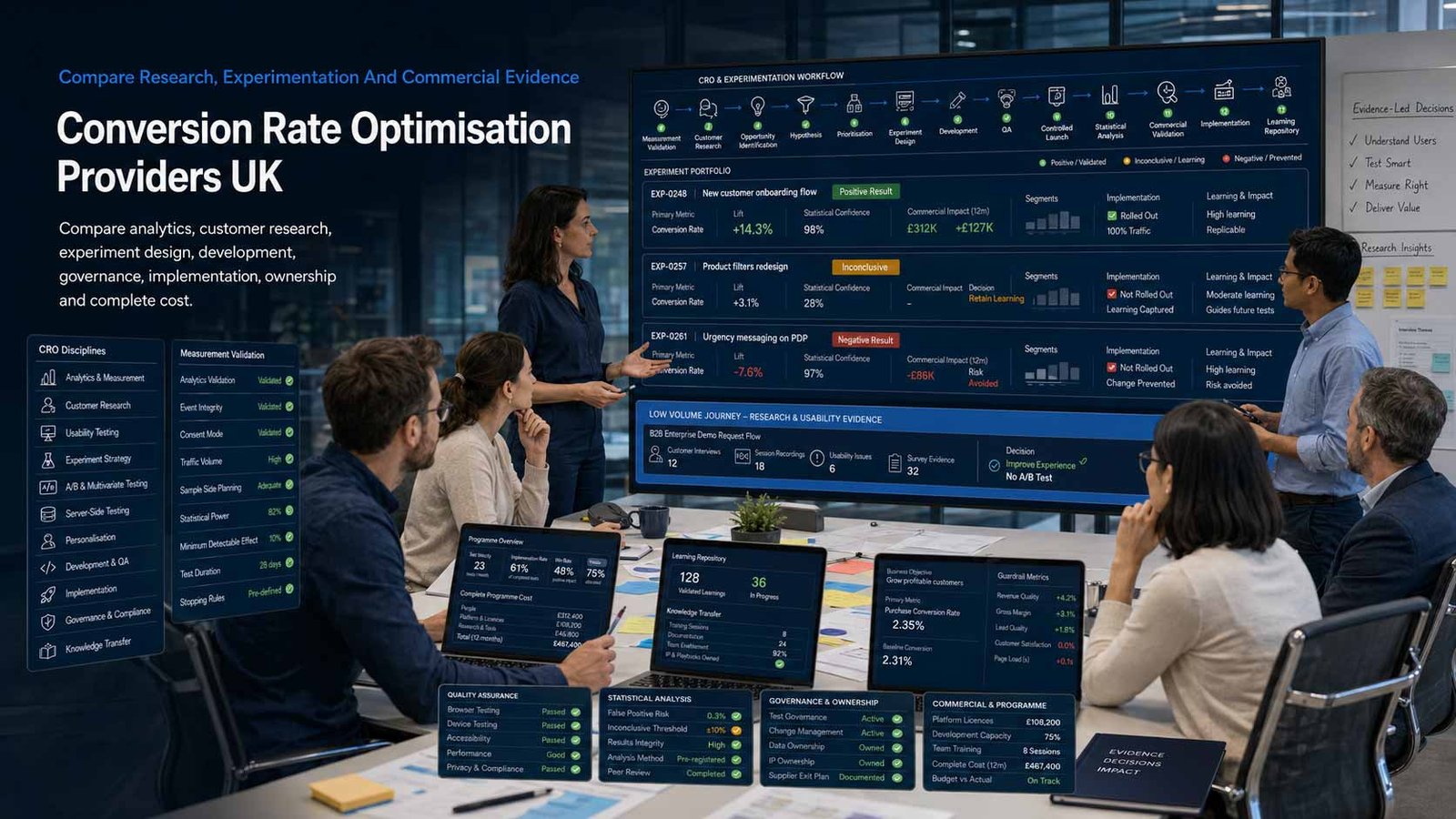
Buy A Reliable Decision System, Not A List Of Page Changes
CRO should identify customer and operational problems, test credible interventions, protect users and convert evidence into permanent improvements. A sequence of button-colour tests is not a complete optimisation programme.
- Validate analytics, consent and commercial definitions first
- Trace every hypothesis to observed customer evidence
- Predefine experiment metrics, guardrails and decision rules
- Retain research, accounts, code and learning at exit
Conversion rate optimisation combines quantitative analysis, customer research, hypothesis development, controlled experimentation, implementation and commercial measurement to improve valuable actions across a website, app or digital service. The objective is not simply to increase a top-line conversion percentage. Changes should improve outcomes such as revenue per visitor, contribution, qualified pipeline, activation, retention, task completion or customer understanding without weakening accessibility, privacy or fair choice.
A provider may audit analytics, study journeys, conduct interviews or usability tests, prioritise opportunities, design and build experiments, perform quality assurance, analyse results and support permanent implementation. The correct operating model depends on traffic, baseline conversion, decision value, technology, development access, internal capability and regulatory risk.
This page compares CRO agencies and experimentation services. It does not compare providers for a generic website design and development project. A complete rebuild, replatform or visual redesign requires its own architecture, migration, ownership and acceptance process.
Choose The Right CRO Service Model
The delivery model changes research depth, experiment throughput, engineering responsibility, internal workload and the organisation’s ability to continue learning after the supplier leaves.
| Service Model | What It Usually Includes | Best-Fit Question |
|---|---|---|
| CRO audit and opportunity study | Time-limited research and analytics review producing prioritised opportunities | Confirm research depth, access required, validation work, deliverables, prioritisation method and whether implementation is included |
| Managed experimentation retainer | Provider operates research, roadmap, design, development, QA, analysis and reporting | Compare team allocation, experiment throughput assumptions, unused capacity, development limits, governance and knowledge ownership |
| Embedded specialist or squad | Named consultants work alongside product, analytics, design and engineering teams | Check named roles, seniority, continuity, ways of working, decision rights, handover and replacement arrangements |
| CRO strategy and enablement | Maturity assessment, operating model, training, templates and coaching | Require practical artefacts, capability measures, platform setup, observation, coached delivery and a defined route to autonomy |
| E-commerce optimisation | Product discovery, merchandising, product pages, basket, checkout and retention journeys | Compare margin and stock data use, device and channel segments, checkout risk, personalisation, seasonality and incrementality |
| B2B lead-generation CRO | Value proposition, content journeys, forms, qualification and sales hand-off | Require lead-quality and pipeline metrics, CRM reconciliation, longer decision windows and alternatives to rapid A/B testing |
| Product experimentation | Authenticated journeys, onboarding, activation, feature adoption and retention | Check server-side capability, event taxonomy, release controls, user-level metrics, guardrails and product-team integration |
| Landing-page optimisation | Focused research and testing for defined campaign journeys | Separate media effects from page effects, preserve message continuity, track lead quality and include post-submit outcomes |
Eight Areas That Determine CRO Provider Fit
Give every provider the same journeys, traffic ranges, conversion definitions, commercial data, technology constraints, accessibility requirements and decision rules.
Comparison Criterion
Measurement And Tracking Integrity
The provider should validate analytics events, consent behaviour, conversion definitions, revenue values, CRM outcomes, bot filtering, duplicate events, cross-domain journeys and release changes before relying on reports. Ask how discrepancies between analytics, experimentation platforms, ecommerce systems and finance data are investigated.
Comparison Criterion
Research And Problem Discovery
Strong CRO begins with evidence about customer barriers, motivations and context. Compare funnel and segment analysis, journey reviews, usability testing, interviews, surveys, support and sales insight, session evidence and competitor context. Outputs should identify problems, not merely list design ideas.
Comparison Criterion
Hypothesis And Roadmap Governance
Require a documented chain from evidence to problem statement, hypothesis, intervention and expected business effect. Compare prioritisation criteria, opportunity sizing, dependencies, confidence, effort, strategic alignment, duplicate prevention and how urgent defects are separated from experiments.
Comparison Criterion
Experiment Design And Statistics
Ask suppliers to state the primary metric, guardrail metrics, unit of randomisation, minimum detectable effect, power assumptions, duration rules, peeking policy, multiple-comparison controls, novelty and seasonality treatment, sample-ratio checks and decision thresholds before launch.
Comparison Criterion
Design, Development And Quality Assurance
Clarify who creates copy, UX, visual design, front-end or server-side code, data-layer changes and QA. Verify browser and device coverage, accessibility checks, performance impact, security review, collision testing, fallback behaviour, release ownership and removal of test code.
Comparison Criterion
Commercial And Customer Outcomes
A conversion-rate rise can still reduce average order value, margin, lead quality, retention or customer trust. Require revenue per visitor, contribution, qualified pipeline, task completion, repeat behaviour, complaints and operational impact where relevant, with agreed attribution and observation windows.
Comparison Criterion
Privacy, Accessibility And Fair Choice
Experiments must respect consent and lawful processing, minimise personal data, protect vulnerable users and avoid manipulative interfaces. Compare privacy review, data protection by design, cookie configuration, accessibility testing, inclusive research and controls against false scarcity, hidden charges or obstructive cancellation.
Comparison Criterion
Learning, Ownership And Exit
The business should own accounts, experiment records, research, source files, code, dashboards, taxonomies and decisions. Compare documentation quality, searchable learning repositories, training, stakeholder communication, platform portability, access removal and the ability to continue without the supplier.
Measures To Define Before CRO Work Starts
Translate claimed uplift, test velocity and case studies into auditable data, research, experiment, implementation and commercial evidence.
| Measure | What It Should Prove | Evidence To Request | Common Weakness |
|---|---|---|---|
| Analytics reconciliation | Documented comparison of analytics, experimentation, ecommerce, CRM and finance values; known exclusions and acceptable tolerances | Prevents decisions being made on duplicated, missing or differently defined conversions | One analytics dashboard is accepted without reconciling CRM, ecommerce or finance outcomes |
| Research traceability | Each opportunity links to observed evidence, affected segment, journey, frequency, severity and business consequence | Separates customer problems from stakeholder preferences and copied best-practice lists | Ideas are presented as best practice without a recorded customer problem |
| Pre-analysis plan | Primary metric, guardrails, segments, sample assumptions, stopping rules and analysis method agreed before exposure begins | Reduces selective interpretation after results are visible | Metrics and segments are selected after results become visible |
| Experiment quality | QA evidence, allocation checks, data health, exposure logs, incident handling and change history | Shows that a result came from a controlled intervention rather than implementation failure | A result is reported without allocation, QA, incident or exposure evidence |
| Commercial validation | Revenue, margin, qualified lead, pipeline, retention or operational outcome reconciled after the immediate conversion event | Avoids optimising cheap or low-quality actions that do not create business value | The immediate action improves while margin, quality or retention declines |
| Accessibility and fairness | Keyboard, screen-reader, contrast, zoom and content checks plus review for misleading pressure or obstructive choice | Protects users and prevents apparent uplift being created by exclusion or manipulation | Uplift is achieved through exclusion, pressure or unclear information |
| Programme throughput | Opportunities researched, experiments launched, inconclusive results, defects found, implementation cycle time and learning reused | Makes capacity and bottlenecks visible without rewarding test volume alone | Test count is rewarded even when implementation and learning are blocked |
| Knowledge transfer | Complete experiment repository, recordings, designs, code, decisions, results, caveats and recommended next actions | Preserves value when staff, tools or suppliers change | Research and experiment history remain in supplier-owned tools |
CRO Providers UK Businesses Can Consider
Shortlist providers whose research, analytics, experimentation, development and governance model fits the decision environment. Confirm the current delivery team and written terms before award.
Provider Profile
Conversion
Published capability: Full-service experimentation programmes, research, strategy, design, development and programme scaling for organisations seeking a specialist partner.
Comparison note: A strong comparison candidate for businesses with sufficient traffic and executive support for an ongoing experimentation programme. Ask for the proposed team, test velocity assumptions, development allocation, statistical standards, learning repository and treatment of inconclusive or negative results.
Review official Conversion CRO servicesProvider Profile
Fresh Egg
Published capability: Combines analytics, customer research, experimentation, implementation support and team enablement across customer journeys.
Comparison note: Useful where a business wants qualitative research and organisational capability alongside testing. Verify the balance between research, implementation and experiments; any performance-linked commercial terms; platform costs; development responsibility; and how targets are baselined.
Review official Fresh Egg CRO servicesProvider Profile
Impression
Published capability: Offers CRO within a wider digital experience capability, including analysis, research, experimentation, UX and performance support.
Comparison note: Consider when CRO must coordinate with paid media, SEO, analytics or digital experience teams without losing independent measurement. Ask how channel teams are separated in reporting, who owns hypotheses and how traffic changes are controlled during experiments.
Review official Impression CRO servicesProvider Profile
Creative CX
Published capability: Supports experimentation strategy, opportunity discovery, research, UX, development, QA, analysis, training and programme enablement.
Comparison note: A relevant option for enterprises that need embedded experimentation expertise or want to improve an existing programme. Check consultant allocation, platform independence, server-side capability, governance artefacts, experimentation coaching and the route to internal autonomy.
Review official Creative CX CRO servicesProvider Profile
Speero
Published capability: Provides full-service experimentation, CRO research, programme audits, tool consulting, design and enablement across UK and international teams.
Comparison note: Compare where the brief includes experimentation maturity, research, tooling and organisational design as well as individual tests. Ask how proposed methods fit your traffic, B2B or ecommerce model, internal engineering capacity, decision cadence and commercial data.
Review official Speero CRO servicesProvider Profile
Croud
Published capability: Provides data-led optimisation, behavioural insight, structured experimentation and commerce experience support within a broader agency model.
Comparison note: Suitable where CRO must operate across markets or alongside commerce, media and data functions. Verify the named UK delivery team, specialist allocation, local research, platform access, market-level reporting and whether development is in scope or separately charged.
Review official Croud CRO servicesProvider Profile
Hallam
Published capability: Uses research, messaging, journey design and optimisation to reduce friction in complex B2B decision paths and improve sales-ready actions.
Comparison note: Relevant to lower-volume, high-value lead generation where form submissions alone are an incomplete outcome. Require CRM definitions, lead-quality reconciliation, sales-cycle observation, account or segment analysis and a realistic alternative when rapid A/B testing is not viable.
Review official Hallam CRO servicesProvider Profile
Noble Performance
Published capability: Combines conversion optimisation with analytics, UX, web and performance marketing capability for UK and international organisations.
Comparison note: Compare when the business needs implementation capacity as well as optimisation strategy. Clarify whether the proposal is a standalone CRO programme or part of broader marketing delivery, and separate redesign, media and platform costs from experimentation work.
Review official Noble Performance CRO servicesWhat Changes Conversion Rate Optimisation Cost
CRO prices vary because providers include different research, specialist time, engineering, tools, implementation and governance. Compare the complete operating cost rather than the headline retainer.
| Cost Driver | Common Charging Basis | What A Comparable Quote Should Show |
|---|---|---|
| Discovery or CRO audit | Fixed project fee based on journeys, research methods, analytics complexity and outputs | Data repair, recruitment incentives, specialist accessibility testing, additional markets and implementation may be separate |
| Monthly managed retainer | Dedicated capacity, team composition, experiment programme scope or agreed workstream | Check minimum term, unused capacity, rollover, development allowance, research cadence, meeting load and platform fees |
| Embedded consultant or squad | Day rate, monthly allocation or named-team subscription | Seniority mix, travel, replacement, holiday coverage, management overhead and internal engineering demand can change effective cost |
| Experiment development | Included allowance, story points, hours, complexity band or separate statement of work | Server-side tests, checkout changes, app releases, data-layer work, security review and regression testing often cost more |
| Research participants and tools | Included research budget or pass-through cost | Recruitment, incentives, panels, remote testing, survey tools, transcription and specialist research may be additional |
| Experimentation platform | Client-owned licence, agency licence, usage-based fee or existing enterprise tool | Monthly tested users, events, domains, environments, features, support, renewal and implementation can materially affect cost |
| Performance-linked component | Base fee plus bonus linked to agreed verified commercial outcomes | Examine baseline, attribution, duration, seasonality, implementation lag, downside treatment, caps and audit rights before accepting |
| Implementation of winning changes | Included, separate development project or delivered to the client team | A winning variation has no lasting value until safely implemented, retested, documented and monitored in production |
| Training and enablement | Workshop, maturity programme, coaching package or included knowledge transfer | Require practical templates, observed delivery, capability outcomes and retained materials rather than presentation-only training |
| Exit and transition | Included handover or separately chargeable support | Confirm exports, code, designs, research, repositories, platform changes, access removal, documentation and replacement-supplier assistance |
| Indicative Planning Band | Typical Scope | What Must Be Confirmed |
|---|---|---|
| £3,000–£10,000 fixed project | Focused analytics validation, customer research, journey audit and prioritised opportunity plan | Research methods, journeys, recruitment, tracking repair, outputs and whether design or implementation is included |
| £4,000–£12,000 per month | Specialist managed retainer covering research, roadmap, design, testing, analysis and selected implementation | Named capacity, development allowance, platform costs, expected launch range, unused time and minimum term |
| £10,000–£25,000 per month | Multi-disciplinary experimentation programme with dedicated research, design, engineering, QA and programme governance | Team allocation, traffic assumptions, markets, server-side work, platform licences, implementation and internal dependencies |
| £25,000+ or enterprise agreement | Large multi-market, product, commerce or high-assurance programme with embedded specialists and complex data or engineering | Operating model, executive governance, security, procurement, tooling, global delivery, change control, audit and exit |
Match The CRO Provider To The Decision Environment
The right shortlist depends on journey value, traffic, commercial data, customer risk, technology and the teams that must implement validated changes.
High-Traffic E-commerce
Prioritise data reliability, revenue per visitor, margin, product discovery, checkout integrity, device coverage, seasonality, personalisation and fast implementation of validated changes. Ensure stock, promotions and media changes are visible in analysis.
B2B Lead Generation
Focus on proposition clarity, account and role needs, content journeys, forms, qualification, meeting outcomes, opportunity creation and closed revenue. Low volume may require research, sequential evidence or larger changes rather than frequent significance-led tests.
SaaS And Digital Products
Compare onboarding, activation, feature adoption, upgrades, retention, server-side experimentation, event governance, release flags and user-level metrics. Product and engineering integration is usually as important as website design capability.
Regulated Or High-Risk Journeys
Require strong approvals, audit evidence, privacy, accessibility, vulnerability and consumer-fairness review. Optimise comprehension, completion and service outcomes without hiding material information, weakening consent or creating inappropriate pressure.
How To Compare CRO Proposals
Issue one brief containing the business model, priority journeys, traffic and conversion ranges, acquisition sources, commercial outcomes, analytics and consent stack, previous research, experiment history, development capacity, approval controls and ownership requirements.
- Measurement validation and research methods are specified
- Named team, capacity and engineering responsibility are clear
- Experiment metrics, guardrails and decision rules are defined
- Privacy, accessibility and consumer-fairness controls are included
- Platform, research, development and implementation costs are separated
- Accounts, data, code, research and transition rights remain business-controlled
Compare The Same Evidence Standard
Ask every provider to diagnose the same sample journey, challenge the same measurement pack and explain how it would choose, build, analyse and implement an experiment.
A cheaper quote is not comparable when it excludes research, development, experiment tooling, accessibility, downstream commercial measurement or permanent implementation.
Six Questions To Put To Every CRO Provider
Detailed answers expose weak measurement, method, delivery and ownership arrangements more clearly than uplift claims or case-study logos.
How Will You Validate Our Measurement Before Testing?
Ask for the analytics reconciliation, event and consent checks, conversion-definition review, platform comparison and minimum data-health evidence required before opportunities are prioritised.
How Do You Turn Research Into A Testable Hypothesis?
Require a worked example showing the source evidence, customer problem, affected segment, proposed mechanism, primary metric, guardrails, expected impact and decision that would follow each possible result.
What Statistical Rules Are Agreed Before Launch?
Request the minimum detectable effect, power assumption, allocation, duration, stopping rule, peeking policy, multiple-metric treatment, sample-ratio check, segment plan and approach to inconclusive results.
Who Designs, Builds, Tests And Implements Changes?
Identify named responsibilities for copy, UX, visual design, development, data layer, QA, accessibility, security, release, monitoring and permanent implementation. Confirm included capacity and approval dependencies.
How Will You Measure Business Value Beyond Conversion Rate?
Ask how revenue, margin, average order value, qualified leads, opportunities, retention, complaints, refunds and operational effects are linked to experiments and reconciled with commercial systems.
What Will We Own At Renewal Or Exit?
Require business-controlled platform and analytics access plus exports of research, hypotheses, designs, code, QA, results, decisions, dashboards, repositories, training materials and outstanding implementation work.
A Seven-Stage CRO Provider Evaluation
Move from commercial outcomes and measurement readiness to a governed experimentation capability rather than selecting an agency from uplift claims alone.
- Define the commercial objective and boundary. Agree the customer actions and downstream outcomes that matter, the journeys in scope, guardrails, excluded redesign work, countries, devices and regulated constraints. Do not begin with a list of page elements to change.
- Audit data, traffic and delivery readiness. Validate analytics, consent, event definitions, CRM or revenue reconciliation, traffic distribution, experimentation tooling, CMS, release process, internal development capacity and historical evidence.
- Build the evidence and opportunity map. Combine quantitative analysis, user and stakeholder research, support and sales evidence, usability findings and technical defects. Record affected users, frequency, severity, business consequence and confidence.
- Issue one requirements and scoring pack. Give shortlisted providers the same baseline, systems, journeys, volumes, research expectations, governance, team dependencies, pricing template, acceptance evidence and ownership requirements.
- Run method and proof workshops. Ask suppliers to diagnose a sample journey, challenge the tracking, create a hypothesis, outline experiment design, identify risks and explain how different result patterns would change the next decision.
- Contract the operating model and controls. Define named roles, capacity, deliverables, development, tools, decision rights, privacy, accessibility, fairness, security, QA, reporting, knowledge repository, implementation, change control and exit.
- Launch, review and institutionalise learning. Start with controlled work, monitor data health and incidents, review results against pre-agreed rules, permanently implement validated improvements, document failed or inconclusive tests and reuse learning across teams.
Conversion Rate Optimisation Comparison Checklist
Use this table before approving a CRO audit, managed experimentation retainer, embedded specialist, product programme or enterprise experimentation partner.
| No. | Requirement | Evidence To Obtain Before Award | Confirmed |
|---|---|---|---|
| 01 | Business outcomes and guardrails | Define the valuable action, downstream commercial result, customer outcome, non-negotiable protections and baseline period. | |
| 02 | Journey and segment scope | List brands, markets, devices, customer types, acquisition sources, authenticated states and priority steps included. | |
| 03 | Measurement integrity | Reconcile analytics, consent, revenue, CRM, duplicate events, missing events, attribution, bots and platform discrepancies. | |
| 04 | Research programme | Specify quantitative analysis, usability, interviews, surveys, support and sales evidence, recruitment and inclusive participation. | |
| 05 | Opportunity traceability | Require each idea to link to evidence, problem, segment, mechanism, expected effect, confidence, effort and dependency. | |
| 06 | Statistical design | Set primary metric, guardrails, unit, allocation, detectable effect, power, duration, stopping, peeking and multiple-test rules. | |
| 07 | Experiment platform | Check client ownership, domains, traffic limits, server-side support, feature flags, privacy, security, support, renewal and export. | |
| 08 | Design and content | Define research-informed copy, UX, visual design, brand review, legal review, content accuracy and source-file ownership. | |
| 09 | Development and QA | Confirm front-end and server-side capacity, environments, browser and device coverage, accessibility, performance, security and rollback. | |
| 10 | Privacy and consent | Map storage and access technologies, lawful processing, minimisation, notices, consent states, retention, processors and international transfers. | |
| 11 | Accessibility and fair choice | Require inclusive research, WCAG-informed testing, keyboard and screen-reader checks, clear information and no manipulative pressure. | |
| 12 | Commercial measurement | Connect immediate actions to revenue, margin, qualified pipeline, retention, refunds, complaints and operational cost where relevant. | |
| 13 | Programme reporting | Report data health, research, backlog, launches, outcomes, caveats, implementation status, learning reuse and internal bottlenecks. | |
| 14 | Contract and complete cost | Normalise team, research, development, platforms, implementation, travel, overage, uplift, renewal, termination and internal effort. | |
| 15 | Ownership and exit | Secure accounts, data, research, designs, code, repositories, reports, training, exports, access removal and transition support. |
Common CRO Procurement And Experimentation Mistakes
Most avoidable failures begin with weak measurement, opinion-led ideas, unsuitable tests, incomplete implementation or learning that remains with the supplier.
| Mistake | Why It Creates Risk | Better Control |
|---|---|---|
| Buying a guaranteed uplift | No responsible supplier can know future experiment outcomes before data and constraints are understood | Buy a documented capability, evidence standard and delivery model; treat guarantees with clear baselines, exclusions and independent verification |
| Starting with visual opinions | Colour, button and layout ideas are prioritised without evidence of a customer problem | Require research traceability and a plausible mechanism linking the intervention to an important outcome |
| Testing broken measurement | Missing or duplicated events make precise-looking results unreliable | Validate analytics, consent and platform allocation before running decision-making experiments |
| Peeking and stopping on a positive day | Repeatedly checking and ending early raises false-positive risk | Agree duration and stopping rules before launch and record every deviation |
| Optimising the easiest metric | More form starts or clicks may reduce quality, margin or completion | Use primary and guardrail metrics plus downstream commercial validation |
| Ignoring traffic and sample constraints | Low-volume journeys create long, noisy or impractical tests | Use research, larger interventions, sequential evidence, pooled learning or alternative methods appropriate to the decision |
| Letting test code become permanent | Client-side experiments can add latency, flicker, accessibility defects and technical debt | Plan safe permanent implementation, regression testing and removal of obsolete platform code |
| Using manipulative patterns for uplift | False urgency, hidden costs or obstructive choices can harm customers and create enforcement risk | Optimise comprehension and genuine value while reviewing experiments for fairness and transparency |
| Changing traffic during the test without controls | Campaign, audience, price or promotion changes can be mistaken for a page effect | Log material interventions, analyse allocation and segments, and coordinate releases and marketing calendars |
| Losing the learning at exit | The next team repeats failed work because research, hypotheses and caveats remain with the agency | Require a business-owned, searchable repository and tested exports throughout the contract |
Frequently Asked Questions
Answers to common questions from UK businesses comparing CRO agencies, experimentation specialists and conversion-optimisation programmes.
What Is Conversion Rate Optimisation?
Conversion rate optimisation is a structured process for improving valuable customer actions across a website, app or digital service. It combines analytics, customer research, hypothesis development, controlled experimentation, implementation and commercial measurement. The objective is better decisions and customer outcomes, not simply changing page design or increasing one percentage in isolation.
What Does A CRO Agency Do?
A CRO agency may validate tracking, analyse journeys, conduct user research, prioritise opportunities, design experiments, write copy, build variations, perform QA, analyse outcomes and help implement validated changes. Scope differs substantially, so buyers should confirm named roles, development capacity, platform costs, governance and knowledge transfer in writing.
How Much Does A CRO Agency Cost In The UK?
Pricing can be a fixed audit, monthly managed retainer, embedded consultant, dedicated squad, development allowance or performance-linked model. Cost depends on research, traffic, markets, journeys, data complexity, testing platform, specialist skills and implementation. Compare complete proposals against the same assumptions rather than relying on a headline monthly fee.
Does A Business Need High Traffic For CRO?
A business does not need high traffic to improve its customer journey, but it may need substantial volume for frequent controlled A/B tests that detect small effects. Lower-volume businesses can use analytics, interviews, usability testing, sales and support evidence, larger interventions, longer observation or other decision methods appropriate to the risk and value.
How Long Should An A/B Test Run?
There is no universal duration. The plan should consider traffic, baseline conversion, expected effect, statistical power, business cycles, delayed outcomes, sample allocation, novelty, seasonality and operational changes. Duration and stopping rules should be agreed before launch, and a test should not be stopped only because a dashboard briefly shows a positive result.
What Is Statistical Significance In CRO?
Statistical significance is one part of assessing whether an observed difference is unlikely under a stated null model. It does not prove that a change caused durable commercial value. Buyers should also examine experiment integrity, effect size, uncertainty, power, multiple comparisons, practical importance, guardrail metrics and downstream outcomes.
Can CRO Harm SEO Or Website Performance?
Poorly implemented experiments can create flicker, slow pages, expose duplicate content, change crawlable elements or leave temporary scripts in place. A capable provider should coordinate with technical teams, test performance and rendering, use appropriate implementation methods and permanently deploy successful changes without leaving unmanaged experiment code.
Do CRO Experiments Need Cookie Consent?
Some experimentation, analytics and personalisation technologies store or access information on user devices or process personal data. The exact requirement depends on the technology, purpose and applicable exemptions. Businesses should use current ICO guidance, configure consent correctly, minimise data and obtain specialist advice for complex tracking or profiling.
How Should CRO Agency Performance Be Measured?
Measure data quality, research evidence, experiment integrity, implementation speed, learning reuse and commercial outcomes. Relevant metrics may include revenue per visitor, contribution, qualified leads, opportunities, activation, retention, task completion, refunds and complaints. Test volume or headline conversion uplift alone can reward poor decisions.
What Should Be Included In A CRO Exit Plan?
The business should retain analytics and experimentation accounts, research, recordings, hypotheses, designs, code, QA evidence, result analyses, dashboards, decision records, implementation status and training materials. Exports should be tested before termination, supplier access removed and any temporary experiment code or platform dependency reconciled.
Official Guidance And Provider Resources
Reviewed by Bhav Giva, Founder & Lead Analyst at CompareServices.co.uk, on 30 July 2026.
Use current privacy, consumer-protection, accessibility and provider documentation to verify tracking requirements, interface controls, delivery capability and commercial terms. Supplier teams, tools, services and prices can change. Obtain specialist legal, statistical, accessibility or security advice where the programme carries material risk.
- ICO — Guidance On Storage And Access Technologies
- ICO — Data Protection By Design And By Default
- CMA — Unfair Commercial Practices Guidance
- CMA — Online Choice Architecture
- GOV.UK — Making Digital Services Accessible
- W3C — Web Content Accessibility Guidelines 2.2
- Conversion — CRO Services
- Fresh Egg — CRO Services
- Impression — CRO Services
- Creative CX — Experimentation Consultancy
- Speero — Conversion Rate Optimisation
- Croud — Commerce And Optimisation Services
- Hallam — UX And CRO
- Noble Performance — CRO Services