
Compare Content Marketing Providers UK (2026)
Compare Strategy, Audience Research, Editorial Quality, Expert Input, Production, Governance, Distribution, Measurement, Pricing And Ownership
Compare content marketing services UK providers by strategy, audience research, buyer-journey mapping, topic planning, subject-matter interviews, editorial standards, copywriting, design, video and data-led assets, fact checking, brand governance, approvals, content operations, distribution planning, repurposing, performance measurement, intellectual-property ownership, AI use, pricing and complete annual cost. Give every provider the same commercial objectives, audience, subject complexity, asset mix, publishing cadence, internal resources, approval requirements and measurement framework.
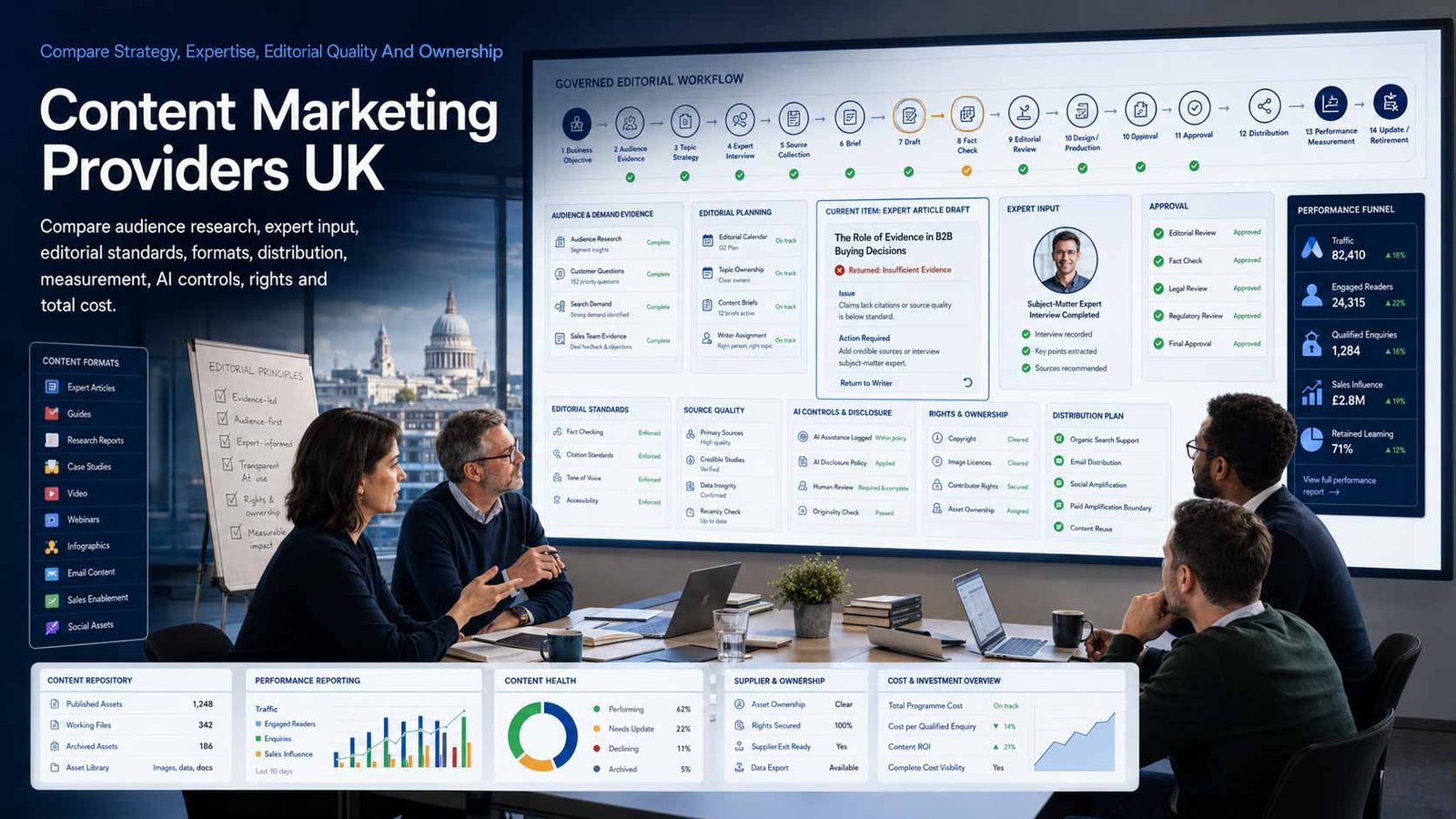
Own The Strategy, Source Material And Finished Assets
The business should retain control of its audience evidence, editorial roadmap, interview recordings, research, source files, drafts, approvals, published assets, analytics and intellectual-property rights.
- Use a company-approved editorial strategy and measurable commercial objectives
- Define who supplies expertise, evidence, approvals and legal or compliance review
- Record permitted AI use, human review and source-verification requirements
- Document ownership, editable files, reuse rights and complete handover before appointment
Content marketing is the planned creation, publication, distribution and improvement of useful editorial assets that help a defined audience understand a problem, evaluate choices, trust a business and take an appropriate next step. It can include articles, guides, reports, case studies, white papers, research, newsletters, webinars, podcasts, video, diagrams, tools and sales-enablement material.
A provider should do more than deliver a monthly word count. Strong programmes start with business goals, audience evidence, product or service expertise, credible source material, editorial standards, channel roles, an approval workflow and a measurement plan. The provider must also distinguish original insight from generic commentary and explain how content will remain accurate, current and useful after publication.
This page compares content marketing services only. It does not compare SEO-only retainers or social media account management. A content provider may coordinate with search, email, PR, design or social specialists, but those adjacent services must be separately scoped where they create different deliverables, accounts, media budgets, optimisation responsibilities or provider decisions.
Choose The Right Content Marketing Delivery Structure
The delivery model changes strategic depth, production responsibility, internal workload, quality control, pricing and the evidence needed before appointment.
| Service Model | What It Usually Provides | Best-Fit Question |
|---|---|---|
| Content strategy and audit consultancy | Audience research, existing-content review, proposition analysis, messaging, editorial priorities, governance and a roadmap without ongoing production | Does the business have capable writers or creators but need a defensible strategy and operating model? |
| Managed content marketing retainer | Ongoing strategy, planning, interviews, creation, editing, publishing support, reporting and continuous optimisation | Is a consistent external team needed to run the programme month after month? |
| Editorial production service | Brief-led articles, guides, case studies, landing-page copy, reports or newsletters produced to an agreed cadence | Is the strategy already defined, with the main gap being reliable specialist production? |
| B2B thought-leadership programme | Executive interviews, original points of view, research, reports, opinion pieces, webinars and sales-enablement assets | Can senior experts contribute distinctive insight that cannot be created from desk research alone? |
| Multi-format content studio | Copy, design, illustration, animation, video, audio and interactive assets delivered through one creative workflow | Does the campaign need several formats without coordinating multiple disconnected suppliers? |
| Content operations and governance service | Editorial calendars, templates, taxonomies, workflows, permissions, quality standards, localisation and lifecycle management | Is the main challenge scale, consistency, approvals or maintaining content across teams and markets? |
| Campaign and asset programme | A time-limited theme, research project or launch producing a connected set of flagship and supporting assets | Does the business need concentrated delivery around a product launch, event, sector issue or commercial priority? |
| Co-managed content team | Agency strategists, editors or creators work alongside internal marketers and subject-matter experts with shared ownership | Does the organisation want external capacity while retaining strategy, expertise and publishing control in-house? |
Eight Areas That Determine Content Marketing Fit
Give every provider the same objectives, audiences, subject complexity, asset mix, cadence, internal resources and governance requirements so proposals are genuinely comparable.
Comparison Criterion
Commercial Strategy And Content Role
Require a clear link between business objectives and the content programme. The provider should define which audiences, buying stages, customer questions and commercial actions each workstream supports, while separating awareness, education, consideration, conversion support and customer retention. Avoid a plan built only around publishing frequency or broad traffic growth.
Comparison Criterion
Audience Research And Information Needs
Compare interview research, customer evidence, sales and service input, analytics, market research, competitor review and existing-content performance. Strong providers identify the language, objections, decision criteria and information gaps of real buyers rather than inventing personas from assumptions or generic templates.
Comparison Criterion
Subject-Matter Expertise, Sources And Accuracy
Review how the agency obtains expert input, validates facts, records interviews, cites evidence, manages regulated or technical claims and handles corrections. Complex sectors need experienced writers and active client experts. A provider should never present confident prose as a substitute for verified knowledge.
Comparison Criterion
Editorial Quality, Originality And Brand Voice
Assess briefing, structure, argument, information gain, tone of voice, editing, proofreading, accessibility, examples and reader usefulness. Require samples that demonstrate depth and clarity in comparable subjects. Define unacceptable duplication, thin rewriting, unsupported claims and formulaic AI output.
Comparison Criterion
Formats, Design And Production Capability
Compare long-form articles, case studies, guides, white papers, research reports, data visualisation, diagrams, video, webinars, podcasts and sales assets. Confirm which skills are in-house, subcontracted or separately priced, and whether editable design, video and source files are included.
Comparison Criterion
Workflow, Approvals And Content Operations
Review editorial calendars, briefs, project management, stakeholder interviews, review rounds, legal or compliance approval, version control, publishing support and update cycles. The workflow should make bottlenecks visible and protect quality without forcing every asset through an unnecessarily slow process.
Comparison Criterion
Distribution, Repurposing And Channel Coordination
Clarify how each asset will reach the intended audience through owned websites, email, sales teams, partner channels, events, communities or separate paid and earned activity. Content creation without an agreed distribution plan can produce an expensive library that receives little meaningful attention.
Comparison Criterion
Measurement, Ownership, AI Use And Exit
Define leading and commercial measures, attribution limits, dashboards, source access, AI policies, confidentiality, copyright, asset ownership, editable-file delivery and handover. The business should be able to continue, reuse and improve the programme without depending permanently on one supplier.
Measures To Define Before A Content Provider Is Appointed
Translate promises about authority, engagement and leads into evidence that can be audited across strategy, production, distribution and commercial outcomes.
| Measure | What It Should Define | Evidence To Request | Common Weakness |
|---|---|---|---|
| Strategy coverage | Whether the programme maps commercial goals, audiences, customer questions, buying stages, formats and channel roles | Signed strategy, audience evidence, content pillars, journey map, editorial roadmap and exclusions | A calendar is presented as a strategy without explaining who the content serves or what decision it supports |
| Brief quality | Whether every asset has a clear audience, purpose, angle, evidence base, structure, action and acceptance criteria | Approved brief, source list, interview plan, examples, required claims, prohibited claims and measurement purpose | Writers receive only a title, keyword or approximate word count |
| Expert contribution | How reliably internal or external subject-matter expertise reaches the final asset | Interview notes or recording, named reviewer, quotation approval, evidence log and sign-off | The provider paraphrases public sources without obtaining distinctive company knowledge |
| Editorial accuracy | The proportion of assets approved without material factual, legal or brand corrections | Review comments, correction category, revision count, responsible reviewer and final approval | Revision volume is hidden inside email chains and quality problems recur |
| Production timeliness | Whether agreed assets move from brief to approval and publication within a realistic service timetable | Brief date, interview date, draft, client review, final, publication, delay reason and owner | Agency and client delays are combined, making the bottleneck impossible to manage |
| Audience engagement | Whether intended readers consume and interact with the content rather than merely arriving | Qualified visits, engaged time, scroll depth, downloads, return visits, subscriptions, event actions and assisted journeys | Page views are reported without audience quality or content consumption |
| Commercial contribution | How content supports enquiries, opportunities, sales conversations, retention or account growth | CRM source or influence, content-assisted journey, lead quality, opportunity stage, sales usage and revenue caveat | Last-click revenue is claimed for assets that played only an indirect role |
| Asset utilisation | Whether content is published, distributed, reused and adopted by sales or customer teams | Publication status, channel use, derivative assets, sales usage, campaign inclusion and internal feedback | A large asset library is created but rarely promoted or used |
| Content health | Whether published assets remain accurate, useful, discoverable and aligned with current offers | Review date, owner, performance trend, factual changes, update decision, redirect, archive or consolidation | Old content remains live after products, regulations, evidence or business priorities change |
| Ownership and portability | Whether the client can reuse and continue all work after the relationship ends | Contract, copyright assignment or licence, editable files, research, interview records, templates, calendar, logins and export | The agency retains source files, working documents or essential process knowledge |
Content Marketing Providers UK Businesses Can Consider
Shortlist providers whose strategy, editorial skills, subject expertise, formats, governance and measurement approach fit the business. Confirm the live proposal, named team and complete terms directly before appointment.
Provider Profile
Builtvisible
Builtvisible is a UK specialist agency combining organic strategy, content and digital PR around search-based customer journeys. Include it where a business needs strategy, audience understanding and editorial work connected to a wider organic-growth programme. Confirm the exact content deliverables, research and interview method, division between content, SEO and digital PR, named specialists, production volume, approval workflow, reporting, AI policy, source-file ownership, retained access and whether implementation or publishing support is included.
Review official Builtvisible servicesProvider Profile
Gripped
Gripped is a London B2B digital marketing agency focused on SaaS, AI and technology companies, with content used within demand-generation and revenue programmes. Include it where complex B2B offers require buyer-led strategy, expert interviews, thought leadership and content tied to pipeline. Confirm sector fit, account-team structure, writer expertise, role of SEO and paid channels, stakeholder access, content cadence, attribution method, minimum term, revision limits, ownership and whether sales-enablement or website work is separately priced.
Review official Gripped servicesProvider Profile
CopyHouse
CopyHouse is a specialist content marketing agency for technology and complex industries, providing strategy, specialist writing, design and related creative support. Include it where the business needs technical subjects translated into clear articles, white papers, case studies or designed assets. Confirm writer and editor experience, subject-matter interview time, research and fact checking, tone-of-voice controls, design scope, source files, localisation, AI use, approval stages, revisions, intellectual-property transfer and responsibility for publishing and distribution.
Review official CopyHouse content servicesProvider Profile
Brafton UK
Brafton operates as a full-service content marketing agency offering strategy, writing, design, video, animation and campaign support. Include it where a business wants a broad production capability and a single workflow across multiple formats. Confirm the UK delivery and account team, which services are in-house, strategy depth, production assumptions, editorial standards, subject expertise, analytics, distribution scope, tool access, revision rules, content ownership and the cost of high-production assets outside the core programme.
Review official Brafton content marketing servicesProvider Profile
Impression
Impression provides content marketing and content strategy within a wider performance-marketing agency, with an emphasis on audience expansion, data capture and measurable growth. Include it where content must connect with digital strategy, creative and organic performance while retaining clear commercial KPIs. Confirm the boundary between content marketing and SEO, planned formats, research, creative production, measurement framework, experimentation, publishing ownership, link or PR activity, account access, minimum term, usage rights and handover.
Review official Impression content marketingProvider Profile
Digitaloft
Digitaloft provides content and on-page services alongside technical SEO and digital PR, with experience across ecommerce, travel, finance and B2B. Include it where commercially useful website content and editorial quality need to work with an existing organic-growth plan. Confirm that the proposal is not an SEO-only retainer, which assets are new or optimised, expert input, research and E-E-A-T requirements, AI and human review, writing and editing ownership, digital PR separation, update cadence, measurement and editable-file delivery.
Review official Digitaloft content servicesProvider Profile
Hallam
Hallam is an integrated B2B marketing agency with content marketing capability spanning strategy, creative campaigns, organic search, digital PR and measurement. Include it where a business wants content coordinated across a larger B2B marketing programme but still needs defined editorial accountability. Confirm the dedicated content team, research and interview process, deliverable mix, channel boundaries, account ownership, approval workflow, commercial measures, subcontracting, revisions, copyright and the cost of adjacent media, PR or development services.
Review official Hallam content capabilityProvider Profile
TEAM LEWIS
TEAM LEWIS provides content strategy and integrated communications services across markets and channels. Include it where a larger or international organisation needs strategic narrative, multi-format production, campaign coordination and localisation under central governance. Confirm UK and in-market resources, editorial and translation standards, approval and compliance workflows, data and research ownership, paid or earned distribution boundaries, service levels, tool and production costs, rights for photography or video, and complete exit documentation.
Review official TEAM LEWIS content strategyWhat Changes Content Marketing Cost
Compare the complete programme cost and the usefulness of the finished assets rather than a headline price per word, article or month.
| Cost Driver | Why It Changes Spend | What A Comparable Proposal Should Show |
|---|---|---|
| Discovery and strategy | Research, workshops, stakeholder interviews, audit, proposition work, audience definition and roadmap can be a separate initial project | Activities, participants, outputs, number of workshops, research depth, revisions and ownership |
| Monthly retainer | Retainers can combine strategy, account management, planning, production, reporting and improvement with different inclusion levels | Named team, hours or output assumptions, service cadence, rollover, prioritisation, exclusions and minimum term |
| Per-asset production | Articles, guides, case studies, white papers, reports, newsletters, scripts and landing-page copy vary greatly in depth | Format, length, research, interviews, drafts, editing, design, accessibility, revisions and source files |
| Expert and research input | Primary research, surveys, data analysis, specialist interviews and regulated-sector review add value and cost | Sample, methodology, incentives, data ownership, expert time, verification, legal review and publication rights |
| Design and multimedia | Illustration, data visualisation, photography, animation, video, audio, interactive tools and templates require separate skills | Concepts, production days, licences, talent, locations, editing, captions, formats, editable files and usage term |
| Publishing and content operations | CMS entry, formatting, tagging, accessibility checks, image preparation, workflow and updates may not be included in writing fees | Publishing platform, permissions, responsibilities, service levels, quality checks, update volume and change requests |
| Distribution and promotion | Email, PR, partner, community, sales-enablement and paid distribution can require additional management or media budget | Owned-channel tasks, third-party fees, media spend, PR scope, outreach, asset adaptations and account ownership |
| Tools and subscriptions | Research, planning, project management, analytics, transcription, stock media and AI tools may be bundled or recharged | Tool, licence owner, users, data access, markup, renewal, export and what happens after termination |
| Revisions and stakeholder complexity | Extra review rounds, late scope changes, multiple approvers, legal feedback and rebriefs increase delivery effort | Included rounds, consolidated feedback, approval deadlines, rework rates, rush fees and decision authority |
| Localisation and market adaptation | Translation alone may be insufficient where examples, claims, culture, terminology and regulations differ | Language, market, native reviewer, transcreation, localisation, fact check, design changes and local approval |
| Rights, licences and exit | Copyright, stock-media licences, contributor permissions, editable files, research data and archive access affect long-term value | Assignment or licence, territories, duration, restrictions, source files, credentials, archive, handover and deletion |
How Audience And Operating Complexity Change The Shortlist
The right provider depends on subject difficulty, internal expertise, asset formats, approval risk, market coverage, publishing capacity and the role content plays in the buying journey.
Small Business Building A Reliable Content Base
Prioritise a focused audience, a small number of commercially useful themes, expert-led evergreen assets, clear ownership and a manageable publishing cadence. Avoid buying high volume before the proposition, expertise and review process are ready.
B2B Or Complex-Service Organisation
Prioritise buyer research, long decision journeys, subject-matter interviews, thought leadership, case studies, technical accuracy, sales-enablement reuse and CRM-informed measurement. The provider must work effectively with senior experts who have limited time.
Ecommerce Or Consumer Brand
Prioritise category education, buying guides, product stories, creative formats, seasonal planning, customer evidence, brand consistency and coordination with separately managed search, email and social channels. Asset production and adaptation capacity may be decisive.
Regulated, Multi-Brand Or International Organisation
Prioritise governance, claims evidence, legal review, accessibility, permissions, localisation, market adaptation, version control, author accountability, approved AI use, central reporting and a controlled archive across teams and territories.
How To Compare Content Marketing Proposals
Give every provider the same business objectives, audience evidence, propositions, subject areas, formats, monthly cadence, expert availability, approval workflow, distribution responsibilities, measurement access and twelve-month planning horizon. Require one standardised scope and cost schedule.
- The strategy explains audiences, decisions, themes, formats and commercial outcomes
- Named strategists, editors, writers, designers and subcontractors are identified
- Interview, research, fact-checking and approval responsibilities are documented
- SEO, PR, email, social and paid-distribution boundaries are explicit
- AI use, confidentiality, originality and human-review controls are written
- Copyright, source files, analytics access, archive and exit handover are included
Make Every Provider Price The Same Editorial Programme
Use the same assets, research depth, interviews, review rounds, formats, publishing support, distribution tasks and measurement obligations.
Compare the complete annual cost, internal workload and reusable asset value before comparing one article or retainer price.
Six Questions To Put To Every Content Marketing Provider
The answers expose generic strategies, hidden production assumptions, weak evidence, unclear channel boundaries and assets the business cannot fully reuse.
Which Commercial Decision Does The Content Support?
Ask the provider to connect every theme and asset to a defined audience question, buying stage, business objective and intended next action.
How Will You Obtain Original Expertise And Evidence?
Confirm customer research, subject-matter interviews, primary data, source standards, fact checking, quotations, citations and approval ownership.
Who Will Actually Create And Review The Work?
Request named strategists, writers, editors, designers, video specialists and subcontractors, with relevant sector samples and replacement arrangements.
How Do You Control AI, Originality And Confidentiality?
Define permitted tools, data handling, disclosure, plagiarism checks, human review, source verification, hallucination controls and prohibited uses.
How Will Content Reach The Intended Audience?
Separate website publishing, email, sales enablement, partner distribution, PR, social and paid promotion, including who owns each account and budget.
What Do We Own And Receive At Exit?
Confirm copyright, licences, source files, raw research, interview records, briefs, templates, calendars, performance history, credentials and handover support.
A Seven-Stage Content Marketing Evaluation
Move from evidence, audience needs and operating constraints to a controlled editorial programme rather than buying a volume of assets with no durable strategy.
- Collect the current strategy, audience research, proposition, content inventory, analytics, sales feedback, customer questions, brand guidance, compliance rules, contracts, asset rights and internal capacity.
- Define commercial objectives, priority audiences, buying stages, content roles, themes, formats, publishing cadence, expert contributors, distribution routes, measures and exclusions.
- Create a standard editorial brief covering source requirements, interview time, accuracy, tone, accessibility, claims, AI rules, review stages, acceptance criteria and ownership.
- Issue one written request and obtain comparable proposals identifying the team, method, deliverables, assumptions, dependencies, channel boundaries, timeline, cost and exit terms.
- Test shortlisted providers with a paid discovery stage, sample brief, workshop or controlled pilot that reflects the actual subject complexity and stakeholder process.
- Contract only after responsibilities for research, expertise, approval, publishing, distribution, measurement, confidentiality, copyright, source files and supplier access are agreed.
- Operate through an editorial calendar, consolidated feedback, quality checks, publication tracking, distribution, performance review, factual updates, content consolidation and planned handover.
Content Marketing Provider Comparison Checklist
Use this table before approving a strategy project, managed retainer, editorial production programme, multi-format campaign or co-managed content team.
| No. | Requirement | Evidence To Obtain Before Award | Confirmed |
|---|---|---|---|
| 01 | Content scope and accountable owner agreed | Business objective, audience, proposition, programme owner, budget owner, reviewers, publishers and escalation | |
| 02 | Current content and performance audited | Inventory, quality, duplication, outdated claims, gaps, analytics, conversions, sales use, rights and archive | |
| 03 | Audience and journey evidence validated | Customer interviews, sales and service input, search and market evidence, buying stages, objections and priority questions | |
| 04 | Editorial strategy and exclusions approved | Themes, formats, channel roles, cadence, commercial actions, SEO boundary, social boundary and out-of-scope topics | |
| 05 | Provider team and capability verified | Named strategists, writers, editors, designers, video specialists, researchers, subcontractors and relevant samples | |
| 06 | Subject-matter process agreed | Experts, interview time, recordings, source documents, quotations, review, evidence standards and correction process | |
| 07 | Brief and acceptance criteria standardised | Audience, purpose, angle, structure, sources, examples, claims, tone, accessibility, action and measurement | |
| 08 | Editorial workflow and service timetable accepted | Calendar, project system, interview, draft, consolidated feedback, revisions, final, publication, delay and escalation | |
| 09 | AI and originality controls documented | Permitted tools, confidential data, training restrictions, source verification, plagiarism, human review and disclosure | |
| 10 | Design and multimedia scope confirmed | Formats, concepts, production, stock or talent licences, captions, accessibility, derivatives and editable source files | |
| 11 | Distribution responsibilities separated | Website, email, sales, partner, event, community, PR, social and paid activity, account owner and budget | |
| 12 | Measurement and attribution agreed | Audience, engagement, assisted journey, lead quality, sales use, opportunity influence, update triggers and limitations | |
| 13 | Compliance and claims approval mapped | Copyright, advertorial disclosure, regulated claims, legal review, brand approval, permissions and records | |
| 14 | Complete annual cost compared | Strategy, account management, research, interviews, production, design, tools, publishing, distribution, revisions and internal effort | |
| 15 | Ownership, portability and exit accepted | Copyright, licences, research, raw files, editable files, briefs, templates, calendar, analytics, archive and handover |
Common Content Marketing Buying Mistakes
Most avoidable failures begin with volume-led procurement, weak access to expertise, unclear channel ownership or measurement that rewards publication rather than usefulness.
| Mistake | Why It Creates Risk | Better Control |
|---|---|---|
| Buying content volume before strategy | Publishing more does not solve unclear positioning, poor audience understanding or weak expertise | Define the commercial role first |
| Treating a title list as an editorial roadmap | Topics can look relevant while failing to answer real customer questions or support decisions | Map audiences, journeys and actions |
| Choosing on price per word | Word count does not measure research, insight, accuracy, editing, design or commercial usefulness | Compare the complete asset standard |
| Expecting the agency to invent expertise | Writers cannot safely create distinctive technical or regulated insight without expert access | Schedule subject-matter interviews |
| Allowing vague AI use | Uncontrolled tools can introduce factual, copyright, confidentiality and originality risk | Document permitted use and human review |
| Mixing content, SEO and social scopes | Overlapping retainers obscure accountability and can duplicate work or keywords | Keep service boundaries explicit |
| Ignoring distribution | Useful assets may receive little attention if no owned, earned, partner, sales or paid route is planned | Assign a distribution owner |
| Using page views as the only success measure | Traffic alone does not show audience quality, engagement, sales use or commercial contribution | Use a balanced measurement framework |
| Leaving copyright and source files unclear | The business may be unable to edit, reuse, localise or migrate valuable assets | Agree ownership and licences in writing |
| Never updating published content | Outdated claims, examples, products and evidence reduce usefulness and trust | Create a review, update and retirement cycle |
Frequently Asked Questions
Answers to common questions from UK businesses comparing strategy consultancies, specialist editorial agencies, multi-format studios and managed content programmes.
What Is Content Marketing?
Content marketing is a planned programme of useful editorial assets designed for a defined audience and business purpose. It can include articles, guides, reports, research, case studies, video, webinars, podcasts, newsletters and sales-enablement content. The value comes from strategy, expertise, quality, distribution and improvement—not publication volume alone.
What Does A Content Marketing Agency Do?
A content marketing agency may research audiences, develop strategy, plan themes, interview experts, create and edit assets, coordinate design or video, support publishing, plan distribution and report performance. Services vary widely, so buyers should confirm the exact team, deliverables, channel boundaries, approvals, ownership and measures in the proposal.
How Much Do Content Marketing Services Cost In The UK?
Cost depends on strategy depth, subject complexity, research, interviews, asset formats, production volume, design, video, localisation, publishing support, distribution, reporting and contract term. Compare the complete annual programme and internal workload rather than one price per word, article or month.
Is A Retainer Better Than A Content Project?
A retainer can suit an ongoing programme requiring continuous planning, production and improvement. A project can suit an audit, strategy, research report, launch or defined asset set. The better structure depends on the objective, internal capacity, approval process and whether the business needs a lasting editorial operation.
How Long Does Content Marketing Take To Work?
Timelines depend on the audience, existing authority, content type, distribution, sales cycle and the outcome being measured. Some assets can support sales conversations or launches immediately, while audience growth, trust and sustained demand usually require consistent delivery and improvement over a longer period. Providers should state assumptions rather than promise one universal timescale.
Who Owns Content Created By An Agency?
Ownership depends on the contract. The agreement should state whether copyright is assigned or licensed, when rights transfer, which territories and uses are covered, and whether the client receives editable files, research, interview material, photography, video, fonts and third-party licences. Payment alone should not be assumed to transfer every right.
Should Content Marketing Include SEO?
Content can be informed by search demand and technical publishing requirements, but this page does not compare SEO-only retainers. Buyers should define whether the content provider supplies search research, briefs or optimisation and whether a separate SEO provider owns technical SEO, keyword strategy, internal linking, migrations and organic-performance accountability.
Can A Content Agency Use Generative AI?
Yes, where the business permits it and appropriate controls are in place. The contract should define approved tools, confidential-data restrictions, human review, factual verification, originality checks, source use, disclosure and accountability. Generative AI should not replace subject expertise or be used to create large volumes of low-value content.
How Should Content Marketing Performance Be Measured?
Use measures that match the role of each asset. These can include qualified reach, engagement, downloads, subscriptions, return visits, sales-team use, assisted enquiries, lead quality, opportunity influence, customer education and retention. Record attribution limits and avoid treating page views or last-click revenue as complete proof of impact.
How Should A UK Business Compare Content Marketing Providers?
Give each provider the same objectives, audiences, subject areas, formats, expert access, cadence, approvals, distribution responsibilities and measurement requirements. Compare strategy, original insight, editorial quality, team expertise, workflow, AI controls, ownership, complete cost and exit—not only portfolio appearance or the number of monthly assets.
Content Quality, Advertising, Copyright And Provider Resources
Reviewed by Bhav Giva, Founder & Lead Analyst at CompareServices.co.uk, on 30 July 2026.
Use official Google Search guidance, ASA/CAP advertising rules, UK copyright guidance and current provider documentation to confirm content-quality, commercial-disclosure, ownership and service requirements. Provider teams, delivery models and offers can change.
- Google Search Central — Creating Helpful, Reliable, People-First Content
- Google Search Central — Guidance On Using Generative AI Content
- Google Search Central — Optimising For Generative AI Features
- ASA/CAP — Recognition Of Marketing Communications
- ASA/CAP — Misleading Advertising And Substantiation
- UK Government — Copyright Overview
- UK Government — License And Sell Your Copyright
- Builtvisible — Organic Strategy, Content And Digital PR
- Gripped — B2B Digital Marketing For SaaS, AI And Technology
- CopyHouse — Technology Content Marketing
- Brafton UK — Content Marketing Services
- Impression — Content Marketing
- Digitaloft — Content And On-Page Services
- Hallam — B2B Content And Organic Marketing Capability
- TEAM LEWIS — Content Strategy Agency