
Compare Branding & Creative Design Providers UK
Compare Strategy, Positioning, Naming, Verbal Identity, Visual Systems, Creative Assets, Governance, Ownership And Complete Project Cost
Compare branding agency for small business UK providers by research depth, positioning, customer insight, naming, trademark awareness, messaging, tone of voice, logo and identity design, typography, colour, image direction, accessibility, campaign systems, templates, brand guidelines, internal adoption, intellectual-property terms, pricing and supplier exit. Give every provider the same business context, audiences, markets, channels, deliverables and approval constraints.
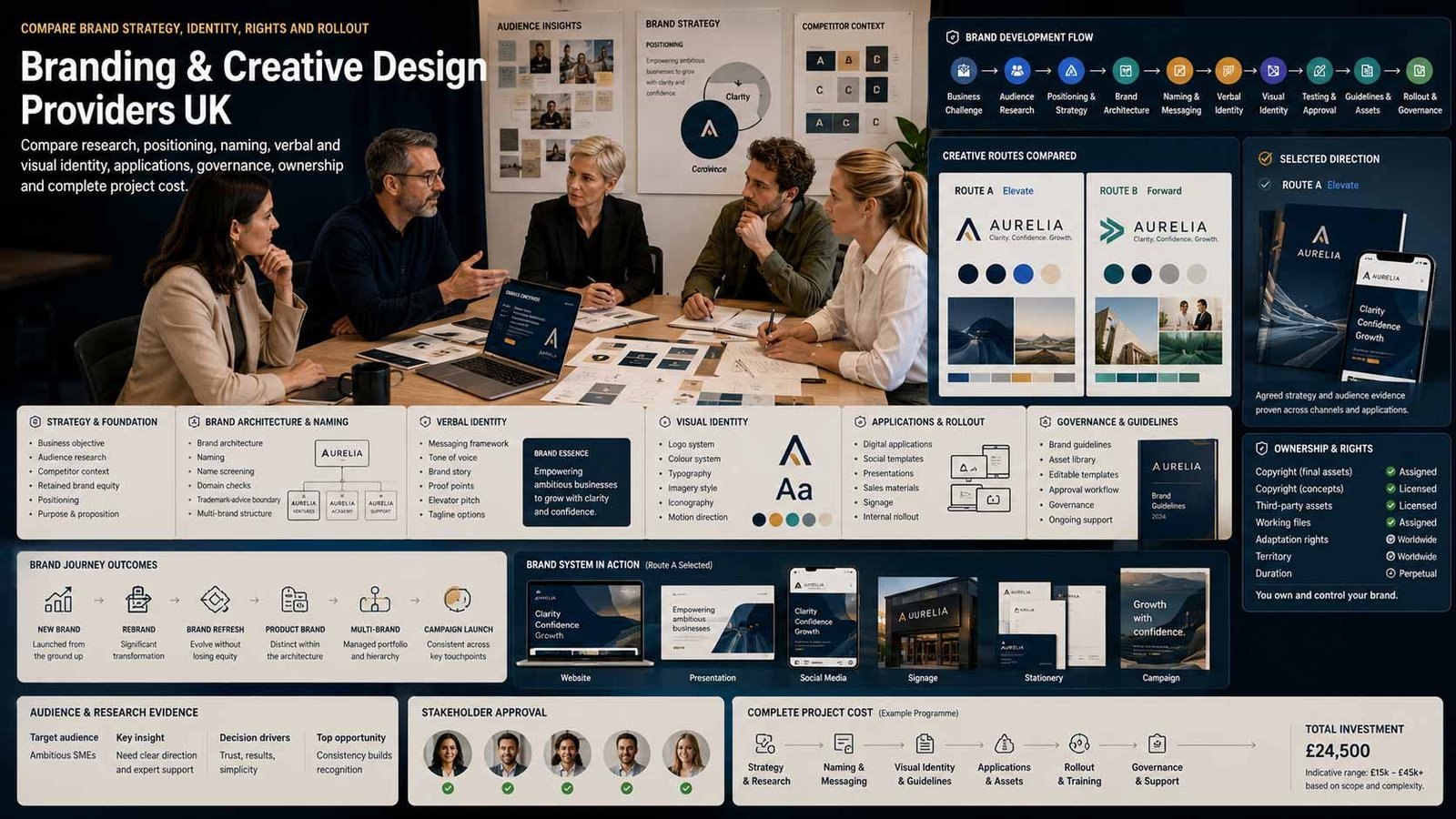
Buy A Usable Brand System, Not A Logo File
A strong brand project connects commercial strategy, audience understanding, language, identity, creative execution and operating discipline. A logo is one component, not the complete outcome.
- Define the business problem and audiences before creative routes
- Separate strategy, naming, identity and rollout responsibilities
- Require accessible, channel-ready and editable assets
- Confirm trademark checks, copyright, licences and source-file ownership
Branding and creative design combines research, positioning, verbal identity, visual identity and practical tools that help a business communicate consistently. A robust engagement usually moves from discovery and strategic definition into naming or messaging, creative exploration, identity-system development, application testing, guidelines, asset production, internal rollout and governance.
The correct scope depends on whether the organisation is launching, repositioning, merging, entering a new market, simplifying a portfolio or repairing inconsistent communications. The proposal should explain which decisions are strategic, which are creative, who supplies evidence, what is tested with customers and how the resulting system will work across real channels.
This page compares branding and creative design providers. It does not compare website-development-only suppliers or print purchasing and production services. Website implementation and search optimisation have separate technical, commercial and evidence requirements.
Choose The Right Branding And Creative Design Model
The model changes research depth, senior involvement, deliverables, internal workload, rights, rollout and the amount of future creative support required.
| Project Model | What It Usually Includes | Best-Fit Question |
|---|---|---|
| Brand Discovery And Positioning | Leadership workshops, customer and employee research, competitor context, category analysis, brand purpose, promise, values, personality, audience priorities and a differentiated position. | Does the provider convert evidence into a clear choice about who the brand serves, what it stands for and why it is credible? |
| New Brand Creation | Naming, positioning, narrative, verbal identity, visual identity, launch assets and guidelines for a new company, product, service or proposition. | Are naming, domain, trademark, market, language and future-extension risks addressed before identity approval? |
| Rebrand Or Brand Refresh | Strategic review, retained equity, repositioning, redesigned identity, migration planning and launch support for an established organisation. | Can the provider distinguish valuable recognition from outdated elements and manage stakeholder resistance? |
| Brand Architecture And Portfolio | Parent, endorsed, sub-brand, product and service relationships, naming rules, hierarchy, migration and portfolio governance. | Will customers and staff understand the offer more clearly after the proposed architecture is applied? |
| Verbal Identity And Messaging | Value proposition, messages, proof points, tone of voice, naming conventions, campaign lines, writing principles and practical examples. | Does the verbal system help different teams communicate consistently without sounding scripted? |
| Visual Identity System | Logo family, colour, typography, image direction, illustration, iconography, motion, layout principles, data visualisation and component rules. | Has the identity been tested across small, large, digital, physical, accessible and low-resource applications? |
| Campaign And Creative Platform | A creative idea and adaptable system for advertising, launches, content, social, events, recruitment or seasonal communications. | Is the platform distinctive, legally supportable, channel-flexible and usable by internal and external teams? |
| Internal Brand And Rollout | Employee engagement, leadership communication, templates, training, governance, launch planning, asset libraries and adoption measurement. | Who will make the brand operational after launch, and how will inconsistent legacy materials be retired? |
Eight Areas That Determine Branding Provider Fit
Use one brief, audience definition, market scope, application list, governance model and rights schedule for every provider.
Comparison Criterion
Research, Strategy And Decision Quality
Compare stakeholder, customer, employee and market research; category and competitor analysis; commercial context; brand equity; positioning options; evidence trails; decision criteria and leadership alignment. A credible provider should show how research changes the work, identify assumptions and prevent creative preference from replacing strategic choice.
Comparison Criterion
Positioning, Proposition And Brand Architecture
Review audience priorities, category frame, points of difference, reasons to believe, purpose, promise, values, personality and the relationship between company, product and service brands. Require a concise strategic platform that can guide marketing, sales, product, recruitment and customer experience decisions.
Comparison Criterion
Naming, Verbal Identity And Claims
Assess naming criteria, linguistic and cultural checks, domain research, preliminary trademark awareness, messaging hierarchy, proof points, tone of voice, terminology and writing examples. Objective claims should be supportable, and the provider should distinguish creative naming exploration from formal legal clearance.
Comparison Criterion
Visual Identity, Distinctiveness And Accessibility
Compare logo systems, colour, typography, imagery, illustration, iconography, motion, layout and data-visualisation principles. Test recognition, contrast, legibility, responsive use, black-and-white use, small formats and assistive needs. Avoid approving a presentation-only identity that cannot survive real operating constraints.
Comparison Criterion
Creative Applications And Production Readiness
Review how the system works across presentations, documents, social content, advertising, packaging concepts, signage concepts, events, internal communications and sales materials. Confirm which applications are fully designed, which are examples, which require specialist production and whether editable templates are included.
Comparison Criterion
Brand Guidelines, Templates And Asset Management
Assess guideline depth, rules and exceptions, downloadable assets, file naming, versions, formats, template controls, image licensing, font licensing, approval workflows and brand-portal options. The organisation should be able to find the correct asset and complete routine work without recreating the identity.
Comparison Criterion
Implementation, Adoption And Governance
Compare launch planning, leadership engagement, employee communication, partner briefing, training, migration, governance roles, review processes, supplier onboarding and adoption measures. A good system can still fail if teams lack authority, practical tools or a controlled route for exceptions.
Comparison Criterion
Ownership, Licensing, Support And Exit
Confirm rights to final and rejected names, logos, illustrations, photography, typefaces, copy, templates, source files, working files and AI-assisted outputs. Review moral rights, third-party licences, exclusivity, territories, archive access, future amendments, retained support and supplier transition.
Measures To Define Before Creative Work Starts
Translate portfolios and subjective language into auditable strategy, application, adoption and ownership evidence.
| Measure | What It Should Define | Evidence To Request | Common Weakness |
|---|---|---|---|
| Strategic clarity | Whether the brand platform makes a clear commercial and customer choice | Research summary, positioning options, decision record, final platform and rejected alternatives | Abstract language is presented without implications for products, messages or experience |
| Audience evidence | Whether priority audiences and needs are based on credible evidence | Research plan, recruitment, interview or survey evidence, limitations, themes and decision impact | Internal opinions are described as customer insight |
| Distinctiveness | Whether the identity can be recognised and differentiated in the real category | Competitor audit, memory structures, identity tests, application comparisons and rationale | A fashionable visual style resembles multiple competitors |
| Naming robustness | Whether a proposed name works across language, domain, category and legal review | Criteria, longlist, shortlist, linguistic checks, domain evidence and legal-referral record | A preferred name is designed before practical risks are investigated |
| Message support | Whether propositions and claims are understandable and evidentially supportable | Message hierarchy, proof library, substantiation owners, examples and approval rules | Creative claims exceed the available evidence or create inconsistent promises |
| Accessibility and usability | Whether typography, colour, layouts and templates remain usable across contexts | Contrast checks, type tests, small-format examples, digital states and accessible template evidence | Brand expression is prioritised over legibility and inclusive access |
| Application coverage | Whether the identity works across the channels the organisation actually uses | Prioritised application matrix, prototypes, edge cases, production constraints and sign-off | Only showcase mock-ups are produced, leaving routine materials unresolved |
| Asset completeness | Whether staff and suppliers receive the formats and files needed to operate | Asset register, source files, exports, templates, fonts, licences, naming and storage locations | The final delivery consists of a PDF and a limited logo folder |
| Adoption readiness | Whether teams can apply the system consistently after launch | Rollout plan, training, governance, approval, exception handling and adoption measures | The agency launches publicly before internal teams understand the change |
| Rights and exit | Whether the business can use, adapt and transfer the work as expected | IP schedule, licence terms, third-party assets, assignments, repositories, archive and exit pack | Ownership language is vague or excludes working files and important components |
Branding And Creative Design Providers UK Businesses Can Consider
Shortlist providers whose strategic method, creative capability, project scale, rights and implementation model fit the brief. Confirm the current team and terms before award.
Provider Profile
Wolff Olins
Published capability: A global brand consultancy that describes its work as uniting brand, culture and experience, with a London presence and experience across major organisational transformations.
Comparison note: Consider it for complex repositioning, portfolio, culture or experience-led change. Confirm project scale, exact London delivery team, research depth, implementation scope, specialist partners, decision governance, rights, ongoing support and whether the engagement is proportionate for an SME.
Review official Wolff Olins servicesProvider Profile
Further
Published capability: Formerly DesignStudio, Further presents itself as a creative, branding and design agency with London, New York and Dubai studios.
Comparison note: Consider it where ambitious identity, experience and launch work require a multidisciplinary international team. Confirm the current contracting entity, senior team, naming and strategy scope, digital boundaries, rollout deliverables, working-file rights, subcontractors and support after launch.
Review official Further servicesProvider Profile
Ragged Edge
Published capability: A London-based global branding agency focused on strategic and creative brand transformation, including verbal and visual identity work.
Comparison note: Consider it where a business wants a distinctive position, strong narrative and expressive identity. Confirm research, customer testing, writing scope, application depth, implementation partners, production exclusions, accessibility, governance and complete rights to final assets.
Review official Ragged Edge servicesProvider Profile
Koto
Published capability: An international creative company with a London studio and published work spanning brand, strategy, digital and campaigns.
Comparison note: Consider it for ambitious new brands, global systems or technology-led organisations. Confirm office and team allocation, strategy and naming, digital-versus-brand scope, campaign requirements, motion and custom type, licensing, rollout support, travel and ongoing partnership terms.
Review official Koto servicesProvider Profile
Bulletproof
Published capability: An independent global brand agency with London roots and published capabilities across strategic brand design and creative expression.
Comparison note: Consider it for consumer, packaging-led or multi-market brand programmes requiring scale and broad creative application. Confirm category fit, research, packaging-concept boundary, production responsibilities, regulatory review, adaptation markets, usage rights and minimum engagement.
Review official Bulletproof servicesProvider Profile
Pearlfisher
Published capability: An independent strategy-first brand design agency with London and New York studios and work across consumer, corporate and experience-led branding.
Comparison note: Consider it where strategic positioning and a high-craft identity or packaging system are central. Confirm project team, customer evidence, naming, packaging-production boundary, sustainability claims, testing, rollout, licences, source assets and post-launch support.
Review official Pearlfisher servicesProvider Profile
How&How
Published capability: A London and Los Angeles branding agency publishing work across verbal identity, visual identity and digital systems.
Comparison note: Consider it for founder-led, technology, sustainability or challenger brands that need a connected narrative and identity. Confirm senior involvement, strategy outputs, naming and copy, website boundaries, application list, accessibility, templates, implementation, IP and future support.
Review official How&How servicesProvider Profile
LoveGunn
Published capability: A London branding and design agency publishing work that combines strategy, storytelling and design for start-ups and established brands.
Comparison note: Consider it where an SME wants direct access to a focused team and a practical identity with launch applications. Confirm discovery depth, naming, customer evidence, creative routes, included assets, print-production exclusions, digital handoff, licences, source files and support terms.
Review official LoveGunn servicesWhat Changes Branding And Creative Design Cost
Branding prices vary because providers include different research, strategy, naming, creative development, applications, rights and rollout. Compare the complete project rather than the logo line item.
| Cost Driver | Why It Changes Spend | What A Comparable Quote Should Show |
|---|---|---|
| Discovery and research | Interviews, workshops, surveys, desk research, category analysis and stakeholder alignment change the evidence base and senior time required | Participants, methods, sample, outputs, limitations, workshops, decision gates and travel |
| Strategy and positioning | Complex portfolios, conflicting stakeholders and major repositioning require more analysis and facilitation | Strategic questions, options, brand architecture, platform, revisions, approvals and presentation |
| Naming and verbal identity | More markets, languages, legal sensitivity, domains, product families and message requirements increase work | Naming criteria, longlist, shortlist, linguistic screening, domain research, legal referral, tone and messaging outputs |
| Visual identity system | Custom type, illustration, motion, photography direction, extensive component systems and multiple brands increase design effort | Routes, concepts, revisions, logo family, typography, colour, imagery, icons, motion, layouts and final files |
| Application design | A few showcase mock-ups cost less than production-ready templates and complete channel systems | Named applications, states, sizes, editable templates, copy, artwork, approval and production boundary |
| Testing and validation | Customer research, stakeholder testing, accessibility checks and multi-market validation add specialist effort | Method, participants, prototypes, success criteria, findings, changes and evidence |
| Guidelines and asset delivery | Detailed rules, examples, templates, portals, localisation and supplier packs require more content and configuration | Guideline format, pages or modules, asset register, file types, storage, training and update owner |
| Launch and implementation | Internal engagement, partner onboarding, migration, campaign development and phased rollout increase programme cost | Rollout plan, audiences, training, launch assets, old-asset retirement, governance and support |
| Licences and third-party assets | Fonts, photography, illustration, music, stock, research tools and specialist contributors create direct and recurring charges | Asset, supplier, licence, territory, duration, users, renewal, transfer and replacement rights |
| Ongoing creative support | Retained brand guardianship, campaigns, templates and reviews should be priced separately from the core project | Hours, team, response, deliverables, minimum term, overage, ownership, archive and exit |
| Indicative Project Band | Typical Scope | What Must Be Confirmed |
|---|---|---|
| £3,000–£10,000 | Focused SME positioning, messaging or identity refinement with limited research and a compact asset set | Whether naming, customer research, applications, guidelines, source files, fonts and rollout are included |
| £10,000–£30,000 | A new SME brand or structured rebrand with strategy, verbal identity, custom visual identity and priority applications | Research depth, number of routes, naming, testing, templates, rights, implementation and senior team access |
| £30,000–£75,000 | A more complex rebrand, portfolio, multi-audience or multi-market system with broader rollout and governance | Architecture, markets, applications, testing, internal engagement, licences, partner adaptation and support |
| £75,000+ | Large transformation, global portfolio, major consumer brand or multi-agency programme with extensive implementation | Programme governance, workstreams, research, markets, production boundaries, rights, rollout and total lifecycle cost |
Match The Provider To The Brand Operating Model
The right shortlist depends on organisational maturity, audiences, markets, internal capability, legal risk, application needs and the scale of rollout.
Start-Up Or New SME
Prioritise proposition clarity, a usable name, essential legal checks, a scalable identity, core templates, digital-first assets and straightforward guidelines. Avoid buying a large brand world before the offer and operating model are stable.
Established SME Repositioning
Prioritise customer and employee evidence, retained recognition, clearer differentiation, message consistency, sales and marketing applications, migration control and practical adoption across a small internal team.
Consumer, Retail Or Hospitality Brand
Prioritise distinctive identity, packaging or environment concepts, campaign expression, content systems, photography, motion, multi-channel application, claim substantiation, production partners and consistency at scale.
Corporate, Multi-Brand Or Regulated Organisation
Prioritise architecture, stakeholder governance, accessible design, controlled claims, multiple markets, formal rights, templates, supplier onboarding, employee rollout, asset management, auditability and long-term brand governance.
How To Compare Branding Proposals
Issue one brief containing the business context, current brand evidence, priority audiences, markets, offer structure, decision problem, desired outcomes, mandatory applications, internal responsibilities, legal constraints, implementation needs and ownership expectations. Require a response matrix rather than relying on a credentials presentation.
- Research methods and decision outputs are specified
- Strategy, naming, verbal and visual deliverables are counted
- Applications are separated into concepts and production-ready assets
- Testing, accessibility, claims and legal-referral boundaries are clear
- Licences, source files, copyright and usage rights are documented
- Rollout, training, governance and retained support are separated
Compare The Same Brand System
Ask every provider to price the same research depth, strategic outputs, naming scope, identity components, applications, templates, guidelines, training and rights.
A lower quote is not comparable when it excludes research, messaging, applications, source files, licences, internal rollout or post-launch governance.
Six Questions To Put To Every Branding Provider
Detailed answers expose weak strategy, incomplete assets, unclear rights and rollout gaps more effectively than portfolio awards or creative chemistry alone.
What Business Decision Will The Brand Work Resolve?
Ask the provider to restate the commercial problem, audiences, market context, evidence gaps, decisions required and outcomes. A vague objective such as “modernise the brand” is not a sufficient strategic brief.
Which Research And Strategy Outputs Are Included?
Confirm participants, methods, workshops, category analysis, positioning options, architecture, proposition, values, personality, message hierarchy, limitations and approval gates.
How Will Naming And Legal Risk Be Handled?
Ask for naming criteria, language and domain checks, preliminary conflict awareness, record keeping and the hand-off to a qualified trademark adviser. Creative agencies should not present informal searches as legal clearance.
Which Identity Components And Applications Will Be Delivered?
Request a counted list of logos, lock-ups, colours, typefaces, imagery, icons, motion, layouts, templates, campaign assets, file formats, source files, examples and production exclusions.
Who Owns The Work And Third-Party Licences?
Confirm copyright assignment or licence, territories, duration, adaptation rights, rejected routes, fonts, images, illustrations, AI-assisted material, working files, moral rights, archives and future supplier access.
How Will The Brand Be Implemented And Governed?
Review rollout, old-asset retirement, employee training, partner briefing, approval rules, exceptions, asset storage, retained support, success measures and the handover or exit process.
A Seven-Stage Branding Provider Evaluation
Move from business evidence and audience needs to an operational brand system rather than selecting an agency on visual portfolios alone.
- Create a current-state inventory covering names, messages, identity assets, templates, websites, social accounts, documents, campaigns, packaging concepts, suppliers, licences, customer evidence, staff feedback and known inconsistencies.
- Define the business change, priority audiences, markets, offer architecture, decision owners, desired outcomes, retained equity, legal constraints, accessible-design requirements, rollout scope and budget context.
- Prepare one provider brief with mandatory, optional and future deliverables; research expectations; naming and legal boundaries; application list; response format; timeline; rights; and evidence required.
- Shortlist providers by relevant project scale, strategic method, creative fit, sector understanding, team availability, application capability, rights model, financial stability, implementation support and referenceable work.
- Run structured chemistry and method workshops, then ask each provider to interpret the problem, identify evidence gaps, explain a comparable process and discuss how strategic decisions will control creative development.
- Contract only after scope, team, milestones, revisions, acceptance, payment, change control, confidentiality, data protection, claims, subcontracting, licences, intellectual property, termination and transition are clear.
- Deliver through controlled discovery, strategy, naming, verbal identity, visual identity, application, testing, guidelines and rollout gates, followed by training, asset handover, adoption review and an agreed improvement backlog.
Branding And Creative Design Comparison Checklist
Use this table before approving a new brand, rebrand, portfolio system, naming project, verbal identity or campaign platform.
| No. | Requirement | Evidence To Obtain Before Award | Confirmed |
|---|---|---|---|
| 01 | Business problem and accountable owner agreed | Commercial objective, decision-maker, project owner, brand owner, legal contact, implementation owner and approvers | |
| 02 | Current brand estate inventoried | Names, messages, assets, channels, templates, suppliers, licences, customer evidence, inconsistencies and dependencies | |
| 03 | Audiences and markets defined | Priority customers, employees, partners, locations, languages, buying contexts, accessibility needs and evidence gaps | |
| 04 | Scope and exclusions documented | Research, strategy, naming, verbal identity, visual identity, applications, rollout, support and production boundaries | |
| 05 | Research method accepted | Methods, participants, recruitment, questions, limitations, outputs, decisions and data-protection responsibilities | |
| 06 | Positioning and architecture outputs agreed | Category, audience, difference, proof, purpose, promise, values, personality, portfolio relationships and approval gate | |
| 07 | Naming and trademark pathway defined | Criteria, longlist, shortlist, linguistic checks, domains, conflict awareness, legal adviser and final registration owner | |
| 08 | Identity-system components counted | Logo family, colour, typography, imagery, illustration, icons, motion, layouts, data visualisation and responsive variants | |
| 09 | Accessibility and usability included | Contrast, legibility, type sizes, digital states, small formats, templates, alternative formats and remediation process | |
| 10 | Applications and templates specified | Priority channels, production-ready assets, editable files, copy, sizes, variants, examples and supplier handoffs | |
| 11 | Claims and messaging governance accepted | Message hierarchy, proof points, objective claim evidence, tone, terminology, legal review and approval owners | |
| 12 | Licences and intellectual property approved | Copyright, assignment, territories, duration, fonts, photography, illustration, AI outputs, working files and rejected routes | |
| 13 | Pricing and change control normalised | Fees, expenses, licences, third parties, revisions, overage, cancellation, retained support and internal effort | |
| 14 | Rollout and governance ready | Launch plan, old-asset retirement, training, approval, exceptions, asset library, partner onboarding and adoption measures | |
| 15 | Handover and supplier exit tested | Source files, exports, credentials, repositories, licences, documentation, archives, access removal and transition support |
Common Branding And Creative Design Buying Mistakes
Most avoidable failures begin with visual-led selection, incomplete evidence, unclear applications, weak rights or a rollout that nobody owns.
| Mistake | Why It Creates Risk | Better Control |
|---|---|---|
| Choosing from logo style alone | A visual preference does not prove strategic clarity, audience relevance, usability, rights or implementation fit | Score the complete strategy and operating method |
| Briefing “make us look modern” | The agency must guess which business problem, audience or market shift it is solving | Define the commercial change and decision criteria |
| Skipping customer and employee evidence | Leadership opinion can reinforce internal assumptions and miss real recognition or trust drivers | Use proportionate research and document limitations |
| Naming before architecture | A new name may create confusion when product, service and parent-brand relationships are unresolved | Agree the offer and naming system first |
| Treating informal searches as trademark clearance | Domains and search-engine results do not establish legal availability or registrability | Use a qualified trademark adviser before commitment |
| Approving identity only in showcase mock-ups | The system may fail in small formats, routine documents, accessible digital use or low-cost production | Test real priority applications and edge cases |
| Ignoring fonts, imagery and licence renewals | Third-party assets can restrict users, territories, channels, editing or supplier transfer | Record every licence and recurring obligation |
| Buying concepts without production-ready assets | Internal teams then pay again to create templates, variants and correct file formats | Specify the full application and asset register |
| Launching externally before internal adoption | Employees and partners continue using old materials or explain the change inconsistently | Train users and control migration before public launch |
| Leaving ownership and archives with the agency | Future suppliers cannot safely adapt, reproduce or verify the brand system | Secure rights, source files, working files and tested exports |
Frequently Asked Questions
Answers to common questions from UK businesses comparing branding consultancies, identity studios and creative design agencies.
What Does A Branding And Creative Design Agency Do?
A branding agency can research audiences and markets, define positioning, create names and messaging, design verbal and visual identity systems, develop creative applications, produce guidelines and support launch and governance. Scope varies widely, so every strategic, creative, application and ownership deliverable should be listed in the proposal.
How Much Does Branding Cost For A Small Business In The UK?
A focused identity or positioning project may cost a few thousand pounds, while research-led new brands and rebrands commonly move into five figures. Complex portfolios, naming, multiple markets, custom assets, testing, extensive templates and rollout can cost substantially more. Compare like-for-like scope rather than a headline logo price.
What Is The Difference Between A Logo And A Brand Identity?
A logo is one identifying mark. A brand identity is the wider system of logo variants, colour, typography, imagery, illustration, icons, motion, layouts and rules used across communications. A complete brand also includes positioning, messages, behaviours and customer experience, not only visual assets.
Should A Small Business Rebrand Or Refresh Its Existing Identity?
A refresh may be suitable when the strategy and recognition remain valuable but the identity is inconsistent or difficult to use. A deeper rebrand may be needed when the audience, offer, market, ownership or positioning has materially changed. Research retained equity before removing familiar assets.
Can A Branding Agency Check Whether A Name Or Logo Is Legally Available?
An agency can conduct creative, language, domain and preliminary conflict research, but formal legal clearance and registration should be handled by a qualified trademark professional. The contract should define the agency’s checking boundary and who commissions and acts on legal advice.
Who Owns The Logo And Brand Assets After The Project?
Ownership depends on the contract. It should state whether copyright is assigned or licensed, the permitted territories and uses, rights to adapt, ownership of working files, and terms for fonts, photography, illustration, music, stock and other third-party assets. Do not assume payment automatically transfers every right.
What Files Should A Branding Agency Provide?
The handover normally includes appropriate vector and raster logo formats, colour references, typeface details, image and illustration assets, templates, guidelines, source or working files where agreed, licence records and an asset register. Request versions for digital, print-ready artwork handoff, small sizes, monochrome and accessible use.
How Long Does A Branding Project Take?
A focused project may take several weeks, while a research-led rebrand, naming project or multi-brand programme can take several months. Timing depends on research, stakeholder availability, legal checks, creative development, testing, applications, approvals and rollout. Ask for stage gates and client responsibilities.
How Should Businesses Compare Branding Agencies?
Give every provider the same brief and response template. Compare relevant experience, research, strategic method, naming, verbal and visual capability, team, applications, testing, accessibility, rights, implementation, governance, complete cost and exit. Do not rank agencies on visual taste or awards alone.
Does Branding Include Website Design, SEO Or Print Buying?
Branding can define the identity, content principles and design direction used by those services, but website development, SEO delivery and print purchasing are separate specialist scopes. This comparison excludes web-development-only and print-buying services so providers can be assessed against the correct branding requirements.
Official Guidance And Provider Resources
Reviewed by Bhav Giva, Founder & Lead Analyst at CompareServices.co.uk, on 30 July 2026.
Use current intellectual-property, advertising, accessibility and provider documentation to verify names, claims, design use, delivery capability and commercial terms. Provider teams, services, ownership and offers can change. Obtain qualified legal advice for trademark clearance, copyright disputes and material licensing decisions.
- GOV.UK — Register A Trade Mark
- UK Intellectual Property Office — Trade Mark Guidance
- GOV.UK — Using Somebody Else’s Trade Mark
- ASA/CAP — Advice For Businesses
- ASA/CAP — Substantiation Of Objective Claims
- W3C — Web Content Accessibility Guidelines 2.2
- Wolff Olins — Global Brand Consultancy
- Further — Branding And Creative Agency
- Ragged Edge — Global Branding Agency
- Koto — Creative Company
- Bulletproof — Independent Brand Agency
- Pearlfisher — Brand Design Agency
- How&How — Branding Services
- LoveGunn — Branding And Design Agency