
Compare Managed Detection & Response (MDR/XDR/SOC) Providers UK (2026)
Compare Telemetry, Threat Hunting, Investigation, Containment, SOC Coverage And Cost
Compare managed detection response UK services by endpoint, identity, cloud, email and network telemetry, 24/7 SOC coverage, threat hunting, triage, investigation, containment, remediation, incident communication, integrations, data retention, service levels, onboarding and total cost. Evaluate MDR, managed XDR and SOC providers against the same attack surface and response authority before outsourcing security operations.
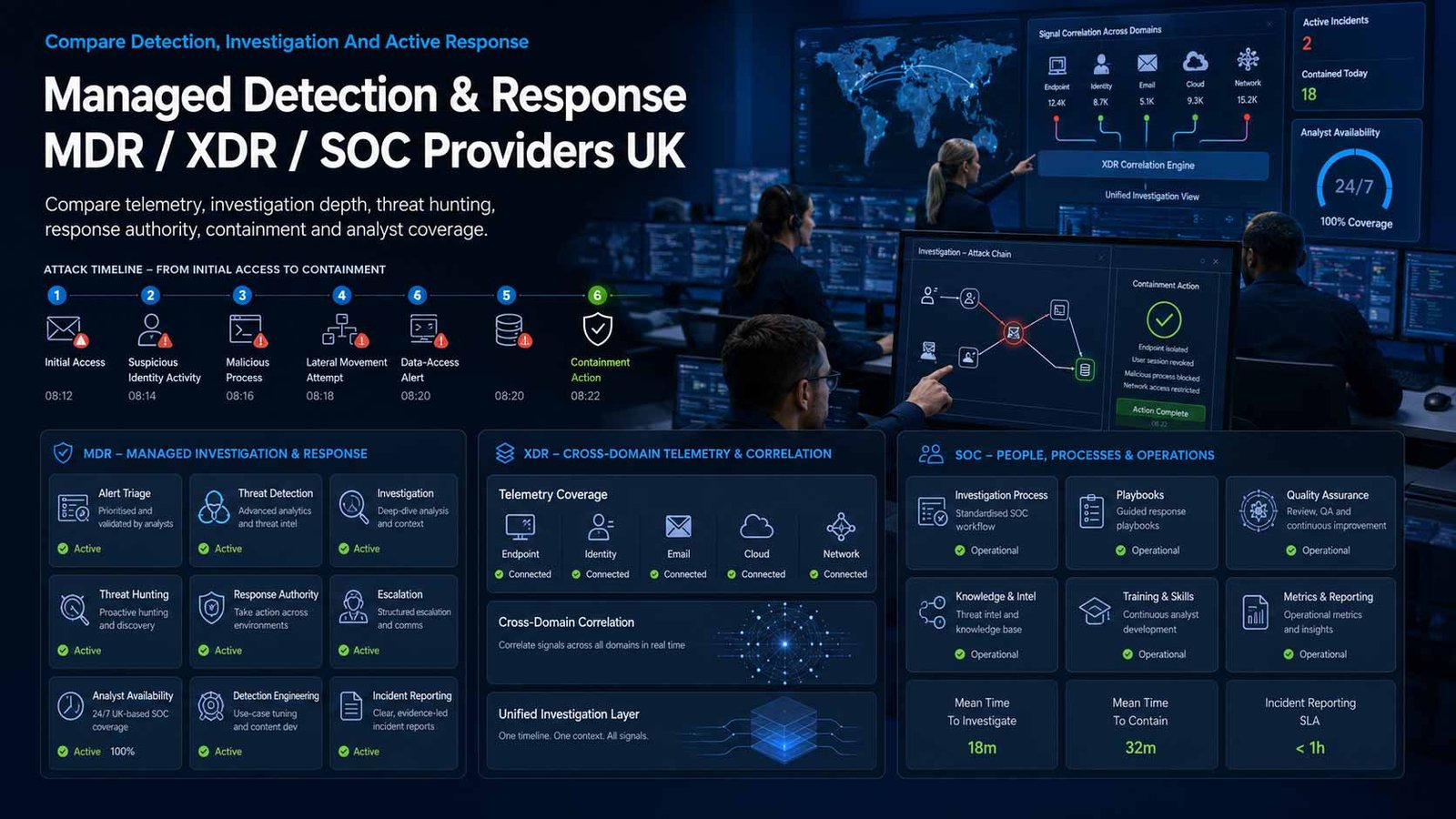
MDR Should Investigate And Act—Not Forward More Alerts
The service must convert security telemetry into validated threats, clear decisions and authorised response actions around the clock.
- Define the attack surfaces and telemetry the provider must monitor
- Agree which threats the provider investigates and which it only notifies
- Pre-authorise safe containment actions and emergency escalation paths
- Measure detection quality, response outcomes and unresolved coverage gaps
Managed detection and response combines security technology with a 24/7 team that monitors, investigates, hunts and responds to threats. Depending on the service, analysts may use endpoint detection and response, identity, email, cloud, network, SIEM and third-party telemetry to identify malicious activity and contain it before disruption grows.
MDR, XDR and SOC are related but not interchangeable. XDR is generally the technology layer that correlates security information across several domains. A SOC is the people, processes and operating environment used to monitor and handle security events. MDR is the outsourced service outcome: qualified people operate detection and response technology on the customer’s behalf. Some providers use MXDR when managed coverage extends well beyond endpoints.
This page does not compare antivirus-only products or one-off penetration tests. Endpoint protection software can prevent and detect activity on devices, but it does not automatically provide continuous expert investigation. A penetration test is an authorised assessment during a defined period, not an always-on monitoring service. Wider MSSP contracts may include governance, vulnerability, firewall and cloud-management functions beyond the narrower detection-and-response boundary covered here.
Separate MDR, XDR And SOC Operating Models
Providers may use the same terminology for different telemetry, technology and analyst responsibilities. Compare the actual operating model.
| Service Model | What It Usually Provides | Best-Fit Question |
|---|---|---|
| Endpoint-led MDR | Uses one endpoint or EDR platform as the main detection and response source, sometimes with identity and cloud extensions | Does endpoint coverage address the organisation’s main attack paths, or leave email, cloud and network blind spots? |
| Managed XDR | Correlates telemetry across endpoints, identities, email, cloud, network and other security products | Which domains are genuinely integrated, investigated and actionable rather than displayed in one portal? |
| SIEM-led MDR | Collects broader logs into a managed SIEM and combines use cases, analyst investigation and response processes | Which log sources, data volume, retention, custom detections and response integrations are included? |
| Open-platform MDR | Operates several customer-owned technologies and integrates third-party products rather than requiring one vendor stack | Which products are supported at full depth, and who resolves integration or vendor faults? |
| Vendor-native MDR | Uses the security vendor’s own endpoint, identity, cloud or XDR platform with direct product expertise | Does deep platform expertise outweigh the cost or limitation of consolidating onto that vendor’s stack? |
| Co-managed SOC | Customer and provider teams share investigations, hunting, engineering, incident actions and service hours | How are queues, ownership, handovers, evidence and decisions divided between both SOC teams? |
| Fully managed MDR | The provider owns most day-to-day monitoring, investigation, communication and approved containment for a lean customer team | Which decisions, remediation tasks and incident-management responsibilities still require internal staff? |
| MDR with incident-response retainer | Combines continuous detection with pre-agreed access to forensic and incident-response specialists | When does a managed case become a chargeable incident-response engagement, and which hours or actions are included? |
Eight Areas That Determine MDR Fit
Use the same telemetry and response criteria for every provider so platform claims and alert statistics do not hide operational gaps.
Comparison Criterion
Telemetry And Attack-Surface Coverage
Compare endpoints, servers, identities, Active Directory, Microsoft 365, email, cloud platforms, SaaS, networks, firewalls and other security tools separately. Require an explicit source inventory, health monitoring, coverage exceptions and a process for onboarding new assets.
Comparison Criterion
SOC Coverage And Analyst Operating Model
Review 24/7 human coverage, SOC and analyst locations, staffing, tiers, threat hunters, language, customer ratios, shift handovers, quality assurance and escalation. Confirm whether overnight coverage is active investigation or only automated notification.
Comparison Criterion
Detection Engineering And Threat Hunting
Assess provider-authored detections, vendor rules, customer-specific use cases, threat intelligence, proactive hunting, tuning, suppression, testing and continuous improvement. Detection coverage should map to relevant threats and available telemetry rather than a large generic rule count.
Comparison Criterion
Investigation Quality And Case Evidence
Compare alert enrichment, timeline reconstruction, identity and host context, process analysis, related events, confidence, business impact, case notes and analyst communication. The customer should receive a validated explanation and clear next action, not raw alerts or unexplained severity scores.
Comparison Criterion
Containment, Response And Remediation
Define endpoint isolation, account disablement, token revocation, process termination, email removal, network blocking, persistence removal and restoration support. Confirm pre-authorisation, exclusions, emergency access, rollback and the boundary between included response and chargeable incident response.
Comparison Criterion
Technology Ownership And Integrations
Review whether the provider supplies or operates EDR, XDR, SIEM and data lake technology; supported third-party products; APIs; ticketing; collaboration; automation and customer access. Confirm configuration ownership, licence portability, custom detections and dependencies at exit.
Comparison Criterion
Data, Retention And Investigation Access
Assess log volume, filtering, collection delay, hot and archive retention, data region, encryption, customer search, evidence export, personal-data handling and subprocessors. Retention must be long enough to investigate threats that are discovered after initial compromise.
Comparison Criterion
Governance, Service Levels And Assurance
Compare onboarding milestones, detection and response measures, customer obligations, review meetings, reporting, service credits, audit evidence, provider security, continuity, subcontractors, incident notification, financial stability, liability and transition support.
Measures To Define Before An MDR Contract Is Signed
Translate always-on detection and rapid response into consistent coverage, investigation and containment outcomes.
| Measure | What It Should Define | Evidence To Request | Common Weakness |
|---|---|---|---|
| Telemetry coverage | Whether every required security source is connected, current and usable for investigation | Required source, connected, healthy, delayed, excluded, owner, last event and remediation | Coverage uses licensed endpoint counts while missing identity, cloud and email sources are ignored |
| Detection coverage | Whether agreed threat scenarios have active and tested detections supported by the available telemetry | Threat scenario, technique, data source, detection, test date, gap, owner and compensating control | The provider reports thousands of rules without showing relevance or test evidence |
| Time to meaningful investigation | Elapsed time from a qualifying event to human analysis with a defensible conclusion | Event time, detection, analyst ownership, evidence review, conclusion, escalation and exclusions | The SLA measures ticket creation instead of analyst understanding |
| Time to containment | Elapsed time from validated threat to an authorised action that limits further harm | Decision, authority, action, customer dependency, elapsed time, result, rollback and validation | The provider recommends isolation but cannot perform it or reach an authorised customer contact |
| True-positive and escalation quality | Whether escalations represent genuine threats with enough context for action | Escalated cases, confirmed threats, false positives, insufficient evidence, severity changes and customer feedback | Low alert volume is achieved by suppressing uncertain activity rather than improving detections |
| Response-action success | Whether provider actions complete successfully and remove the intended threat or access | Action type, target, status, retries, verification, residual risk, restoration and owner | An isolation command is issued but never confirmed on the affected device |
| Threat-hunting outcomes | Whether proactive hunts are relevant, documented and converted into detections or control improvements | Hypothesis, scope, evidence, result, affected assets, new rule, customer action and follow-up | Hunting is advertised but reports contain only routine automated searches |
| Coverage and agent health | Whether devices, sensors, connectors and service accounts remain active and correctly configured | Expected, healthy, stale, failed, unsupported, policy, credential status, owner and due date | A licensed source remains silent for weeks without creating an operational alert |
| Customer action backlog | Whether required remediation, access and architecture actions are completed after provider findings | Action, risk, owner, due date, dependency, status, evidence and accepted residual risk | The MDR service repeatedly detects the same weakness while customer actions remain unowned |
| Total cost per monitored user or asset | The complete platform, data, onboarding, managed service, response and internal oversight cost | Users, endpoints, servers, data, integrations, service tier, incidents, internal effort and growth | A low endpoint fee excludes SIEM data, servers, identity, response and engineering |
Managed Detection And Response Providers UK Businesses Can Consider
Shortlist providers whose telemetry, analyst model and response authority fit the organisation. Confirm current UK availability, scope and pricing directly before award.
Provider Profile
Microsoft Defender Experts For XDR
Microsoft’s managed XDR service provides continuous expert-led monitoring, investigation, proactive hunting and managed-response support across eligible Microsoft Defender and Entra products. Include it where Defender for Endpoint, Office 365, Identity, Cloud Apps, Entra ID and related Microsoft security services form the core telemetry stack. Confirm prerequisite licences, supported products, readiness checks, excluded users or devices, response authority, Microsoft Sentinel relationship, analyst communication, data residency, service reporting and which remediation tasks remain with the customer’s SOC.
Review official Microsoft Defender ExpertsProvider Profile
Sophos MDR
Sophos MDR combines a 24/7 team with the Sophos security platform and integrations for third-party endpoint, identity, firewall, cloud and other telemetry. The service offers different response modes so customers can authorise Sophos to take actions or collaborate on them. Include it where an SME or mid-market organisation wants a fully managed route with relatively simple per-user and server commercial structures. Confirm the service tier, supported integrations, endpoint and server licences, response mode, data retention, included incident support, warranty conditions, onboarding and partner responsibilities.
Review official Sophos MDRProvider Profile
CrowdStrike Falcon Complete Next-Gen MDR
Falcon Complete provides 24/7 managed detection, threat hunting and full-cycle remediation through CrowdStrike’s Falcon platform, with coverage that can extend across endpoints, identities, cloud workloads and other attack surfaces according to the selected modules. Include it where a business wants vendor-native Falcon expertise and strong provider-led containment or remediation. Confirm the exact Falcon licences, modules, data retention, identity and cloud scope, full-cycle remediation limits, exclusions, customer access, service region, warranty terms, incident-response relationship and commercial minimums.
Review official Falcon Complete MDRProvider Profile
SentinelOne Wayfinder MDR
SentinelOne’s current Wayfinder Managed Detection and Response service provides 24/7 expert-led detection, threat hunting, investigation and response using the Singularity platform, extending beyond endpoints into cloud, identity and other telemetry where configured. Include it where a business values autonomous platform response combined with vendor-managed expertise. Confirm the Wayfinder service edition, Singularity package, retention, supported third-party sources, response actions, rollback constraints, cloud and identity modules, onboarding, customer responsibilities and how any prior Vigilance service terminology maps to the current contract.
Review official SentinelOne Wayfinder MDRProvider Profile
Arctic Wolf Aurora Managed Detection And Response
Arctic Wolf Aurora MDR uses an open-XDR approach, broad integrations and a concierge operating model to combine 24/7 security operations with continuing security-posture guidance. Include it where a business wants an operating partner across existing endpoint, identity, network and cloud technologies rather than one fixed security stack. Confirm supported integrations, telemetry and network collection, concierge-team responsibilities, containment actions, data retention, incident support, proactive review scope, optional endpoint products, implementation, customer obligations and commercial unit definitions.
Review official Arctic Wolf MDRProvider Profile
Rapid7 Managed Detection And Response
Rapid7 MDR is delivered through Rapid7’s SIEM and detection platform with 24/7 analysts, threat hunting, containment, exposure context and included incident-response capability according to the selected service. Include it where a business wants SIEM-led MDR, broader log visibility and coordination between detection, response and vulnerability information. Confirm the Core, Elite or Enterprise service proposed, supported third-party tools, log and data assumptions, retention, custom use cases, containment authority, unlimited incident-response definition, onboarding, customer access and any required Rapid7 platform licences.
Review official Rapid7 MDRProvider Profile
eSentire Managed Detection And Response
eSentire provides 24/7 MDR across endpoint, network, cloud, identity and other security signals with threat hunting, investigation and containment through an open technology ecosystem and UK market presence. Include it where a business wants multi-signal coverage, flexible bring-your-own-licence options and provider-led response. Confirm the precise signal packages, technology ownership, supported products, SOC and data locations, mean-time commitments, containment authority, log retention, service portal, onboarding, incident-response access, pricing units and the boundary from separate vulnerability or managed-risk services.
Review official eSentire MDRProvider Profile
Red Canary Managed Detection And Response
Red Canary delivers 24/7 MDR across endpoints, identities, cloud, email and other supported security products, emphasising expert-confirmed detections, detection engineering, investigation transparency and automated or provider-assisted response. Include it where an organisation wants an open MDR model that can operationalise existing EDR or Microsoft security investments. Confirm UK contracting and support arrangements, supported integrations, plan level, telemetry and retention, active-remediation rights, customer responsibilities, response automation, incident support, service hours, data location, implementation and commercial availability.
Review official Red Canary MDRWhat Changes MDR And Managed-XDR Cost
The per-user or endpoint fee is only one component. Telemetry, licences, log retention, response, engineering and incident support can materially change the budget.
| Cost Driver | Why It Changes Spend | What A Comparable Proposal Should Show |
|---|---|---|
| Users, endpoints and servers | Many MDR services price through user, endpoint, server or workload counts, often with separate minimums | Current and forecast users, devices, servers, virtual workloads, inactive assets, seasonal growth and minimum commitment |
| Telemetry and attack surfaces | Identity, email, cloud, network, firewall, SaaS and operational telemetry may require separate modules or service tiers | Required sources, products, event volume, supported integrations, exclusions, health monitoring and ownership |
| EDR, XDR and SIEM licences | The provider may require its own platform, bundle licences or operate customer-owned technology | Product edition, quantity, licence owner, duplicated tools, portability, renewal, support and exit |
| Log ingestion and retention | SIEM-led or open-XDR services can charge for event volume, storage, hot retention, archive and searches | Daily volume, peak, filtering, retention, data region, queries, export, overage and future growth |
| Response and remediation authority | Advisory-only, collaborative and fully authorised response models use different staffing and risk arrangements | Included actions, approval, exclusions, after-hours authority, restoration, customer dependencies and charges |
| Onboarding and detection engineering | Connectors, agents, architecture, tuning, use-case design, baseline hunting and runbooks create initial and ongoing work | Milestones, integrations, custom detections, acceptance, customer tasks, change allowance and project fees |
| Incident response and forensics | Some services include remote incident-response hours while others use separate retainers or daily rates | Trigger, hours, investigation scope, forensics, travel, legal support, minimums, rate card and unused retainer |
| Managed service tier and named resources | Standard, premium and enterprise services may differ in analysts, customisation, meetings, hunts and response depth | Service edition, SOC coverage, dedicated roles, review cadence, reports, hunts, engineering and support |
| Third-party integration and support | Operating external tools can require engineering, vendor coordination and paid connectors | Supported version, API, vendor support, failure ownership, custom integration, maintenance and removal |
| Contract change and exit | Asset reductions, product changes, acquisitions, data export, rule transfer and service transition affect lifetime cost | Term, indexation, true-up, reduction, transition, data, detections, runbooks, credential removal and deletion |
How The Security Estate Changes The Shortlist
The right provider depends on existing tools, internal skills, telemetry coverage, incident authority and how much operational responsibility the business will outsource.
SME Without A 24/7 Security Team
Prioritise fully managed investigation, clear containment authority, straightforward onboarding, endpoint and identity coverage, practical reporting, incident support and a service that does not assume an internal SOC.
Microsoft Security Customer
Prioritise Defender and Entra telemetry, licence prerequisites, Microsoft-native investigation and response, Sentinel integration, non-Microsoft visibility and clarity on actions still assigned to the internal team.
Organisation With Existing EDR Or SIEM
Prioritise open integrations, supported product depth, customer access, custom detections, data retention, tool ownership and a transition plan that avoids unnecessary platform replacement.
Established Security Team
Prioritise co-managed investigations, advanced hunting, detection engineering, APIs, custom playbooks, shared case workflow, transparent evidence and specialist escalation that extends internal capability.
How To Compare MDR Proposals
Give every provider the same users, endpoints, servers, identities, cloud platforms, email, networks, security tools, log volumes, incident history, response requirements and internal capability. Require each proposal to show exactly what the SOC can see and do.
- Every required telemetry source maps to a supported integration and owner
- Human 24/7 investigation is distinguished from automated notification
- Containment and remediation authority are demonstrated safely
- Licences, data, retention and incident-response costs are normalised
- Provider actions and customer remediation are contractually separated
- Detections, case data, credentials and integrations are covered at exit
Make Every Provider Investigate The Same Attack
Use one compromised cloud account, one suspicious endpoint process, one malicious inbox rule and one lateral-movement scenario.
Compare telemetry, analyst conclusion, communication, containment, evidence and customer actions before comparing dashboards or alert counts.
Six Questions To Put To Every MDR Provider
The answers expose endpoint-only scope, notification-only services, hidden data costs and weak response authority before the agreement starts.
Which Attack Surfaces Are Truly Monitored?
Request a source-by-source matrix for endpoint, server, identity, email, cloud, network, firewall, SaaS and third-party security products.
What Happens During The First 30 Minutes Of A Confirmed Threat?
Test investigation, contacts, authority, isolation, account actions, evidence, communication, rollback and customer dependencies.
Which Response Actions Can You Take Without Approval?
Confirm pre-authorised actions, exclusions, sensitive systems, emergency access, change records, restoration responsibility and legal constraints.
How Are Detections Tested And Improved?
Ask for customer-specific use cases, threat hunts, detection testing, tuning, suppression governance, missed-threat reviews and new-rule deployment.
What Data, Technology And Incident Costs Are Separate?
Identify EDR, XDR, SIEM, ingestion, retention, connectors, response hours, forensics, travel, engineering, overage and customer remediation.
What Can We Transfer At Exit?
Confirm logs, cases, reports, detections, playbooks, integrations, configurations, data exports, licences, credentials, transition assistance and deletion.
A Seven-Stage MDR And Managed-XDR Evaluation
Move from attack-surface evidence to tested response operations rather than buying a 24/7 label before defining telemetry and authority.
- Inventory endpoints, servers, identities, cloud, email, networks, security tools, log sources, existing detections, incidents, internal responders and business-critical systems.
- Define the threats, attack surfaces, service hours, investigation depth, response authority, recovery handoff, regulatory evidence and decisions that remain internal.
- Choose endpoint-led MDR, managed XDR, SIEM-led MDR, open-platform or co-managed SOC models while keeping antivirus-only and point-in-time testing outside scope.
- Issue one written brief and obtain comparable telemetry, platform, analyst, response, incident-support, assurance and three-year commercial responses.
- Run technical and operational due diligence using source-health checks, representative detections, threat-hunting evidence, response actions and provider-continuity scenarios.
- Onboard in controlled stages with inventory reconciliation, agents and connectors, detection tuning, authority, contacts, runbooks, baseline hunting and acceptance.
- Operate through service reviews, source-health monitoring, detection tests, response exercises, customer-action tracking, access review, incident lessons and exit readiness.
MDR, XDR And SOC Provider Comparison Checklist
Use this table before approving a managed detection-and-response contract or SOC transition.
| No. | Requirement | Evidence To Obtain Before Award | Confirmed |
|---|---|---|---|
| 01 | Critical services and accountable security owner agreed | Business impact, recovery priorities, risk owner, incident decision makers and communication contacts | |
| 02 | Attack-surface inventory completed | Endpoints, servers, identities, email, cloud, SaaS, networks, gateways, security products and owners | |
| 03 | Required MDR operating model approved | Endpoint-led, XDR, SIEM-led, open platform, fully managed, co-managed and excluded MSSP scope | |
| 04 | Telemetry and integration matrix accepted | Required sources, supported products, versions, event health, retention, exclusions and customer actions | |
| 05 | SOC and analyst model confirmed | Locations, hours, language, staffing, tiers, threat hunters, handovers, quality and subcontractors | |
| 06 | Detection coverage demonstrated | Threat scenarios, data, use cases, custom rules, tests, tuning, suppression, hunting and known gaps | |
| 07 | Investigation and escalation quality tested | Evidence, timeline, identity and host context, conclusion, severity, communication and false-positive handling | |
| 08 | Containment and remediation authority agreed | Isolation, account disablement, token revocation, process action, email removal, blocking, rollback and approval | |
| 09 | Incident-response boundary accepted | Managed case, major incident trigger, forensic scope, included hours, rate card, legal, recovery and travel | |
| 10 | Technology and data costs normalised | EDR, XDR, SIEM, users, endpoints, servers, ingestion, retention, connectors, licences and overage | |
| 11 | Provider access and security assessed | Accounts, strong authentication, least privilege, session evidence, reviews, provider incidents and continuity | |
| 12 | Service metrics and reporting approved | Coverage, investigation, containment, response success, hunts, source health, actions and executive risk | |
| 13 | Onboarding and acceptance plan agreed | Discovery, deployment, connectors, tuning, baseline hunt, contacts, authority, runbooks and legacy transition | |
| 14 | Three-year total cost compared | Platform, data, managed service, onboarding, engineering, incident response, customer remediation and internal oversight | |
| 15 | Exit and service transfer agreed | Logs, cases, detections, playbooks, configurations, credentials, licences, assistance, deletion and proof of access removal |
Common MDR And SOC Buying Mistakes
Most avoidable failures begin with endpoint-only coverage, ambiguous response authority or service metrics that reward ticket processing rather than security outcomes.
| Mistake | Why It Creates Risk | Better Control |
|---|---|---|
| Buying endpoint antivirus with an MDR label | The service may monitor only one product and lack human investigation across the wider attack surface | Verify telemetry and analyst responsibilities |
| Treating a one-off penetration test as continuous detection | Testing identifies weaknesses at a point in time but does not monitor live attacker activity | Keep point-in-time assurance separate |
| Assuming 24/7 means human investigation | Some services only send automated alerts outside business hours | Test the overnight SOC operating model |
| Choosing XDR technology without an operating team | Correlated alerts still require investigation, authority and remediation | Compare the managed service outcome |
| Sending every available log without purpose | Cost and noise increase without improving detection or response | Map sources to threats and investigations |
| Accepting notification-only response | The customer receives urgent homework but no containment during an attack | Agree authorised actions and dependencies |
| Ignoring identity, email and cloud coverage | Attackers increasingly operate beyond managed endpoints | Assess the complete attack surface |
| Using ticket volume as the main SOC metric | More closed tickets do not prove detection quality or reduced impact | Measure evidence and response outcomes |
| Leaving customer remediation unowned | The MDR team repeatedly detects the same exposure without risk reduction | Track actions, owners and residual risk |
| Deferring data and detection portability | The business becomes dependent on provider-owned rules, cases and platforms | Agree export and transition before award |
Frequently Asked Questions
Answers to common questions from UK businesses comparing MDR, managed XDR and outsourced SOC services.
What Is Managed Detection And Response?
Managed detection and response is a 24/7 security service that combines technology with expert analysts who monitor, investigate, hunt and respond to cyber threats. The provider operates agreed telemetry and response processes rather than simply selling a security product or forwarding alerts.
What Is The Difference Between MDR, XDR And A SOC?
XDR is generally technology that correlates detections across security domains. A SOC is the people, processes and operating environment handling security events. MDR is an outsourced service in which a provider uses technology and a SOC team to deliver managed investigation and response outcomes.
How Is MDR Different From An MSSP?
MDR focuses specifically on detecting, investigating and responding to active threats. A broader MSSP may also manage firewalls, vulnerability, cloud configuration, compliance, awareness and other security operations. Some providers offer both, but the contracted service boundary should remain explicit.
How Is MDR Different From Endpoint Protection?
Endpoint protection is software that prevents and detects threats on devices. MDR adds human analysts, continuous monitoring, investigation, hunting, communication and response. Some MDR services are endpoint-led, while others include identity, email, cloud, network and SIEM telemetry.
Does MDR Replace Penetration Testing?
No. A penetration test is an authorised point-in-time assessment designed to find exploitable weaknesses. MDR continuously monitors live security telemetry for malicious activity. Organisations may need both, but they solve different problems and should be compared separately.
Does Every MDR Provider Offer 24/7 Human Monitoring?
No. Some services provide continuous human-led investigation, while others rely heavily on automation or notify an internal team outside business hours. Confirm SOC staffing, analyst location, escalation, investigation depth and the actions taken overnight.
What Response Actions Can An MDR Provider Take?
Depending on the contract and technology, providers may isolate endpoints, stop processes, disable accounts, revoke sessions, remove malicious emails or block indicators. Actions require agreed authority, exclusions, emergency contacts, change evidence, rollback and clear restoration responsibility.
How Much Does MDR Cost?
Cost depends on users, endpoints, servers, telemetry, security licences, log volume, retention, service tier, onboarding, response authority, engineering and incident support. Compare a three-year total for the same coverage and outcome rather than only a per-device figure.
How Long Does MDR Onboarding Take?
Timing depends on asset visibility, agents, log sources, integration access, data quality, detection tuning, existing incidents and response approvals. A controlled onboarding includes discovery, deployment, baseline hunting, source-health validation, runbooks, contacts and formal acceptance.
How Should A UK Business Compare MDR Providers?
Give every provider the same attack surface, security tools, telemetry, incidents, service hours and response requirements. Compare integrations, human investigation, containment authority, evidence, service metrics, three-year cost, supplier risk and exit—not only platform branding or alert volume.
Official Guidance And MDR Provider Resources
Reviewed by Bhav Giva, Founder & Lead Analyst at CompareServices.co.uk, on 17 July 2026.
Use NCSC, ICO and official provider documentation to confirm current telemetry, service tiers, response authority, data retention, incident support, delivery locations and pricing. MDR product names and platform requirements can change during procurement.
- NCSC — Logging And Monitoring
- NCSC — Security Operations Centre Log Sources
- NCSC — Choosing A Managed Service Provider
- ICO — Ransomware Detection And Response
- Microsoft — Defender Experts For XDR
- Sophos — Managed Detection And Response
- CrowdStrike — Falcon Complete MDR
- SentinelOne — Wayfinder MDR
- Arctic Wolf — Aurora MDR
- Rapid7 — Managed Detection And Response
- eSentire — Managed Detection And Response
- Red Canary — Managed Detection And Response