
Compare Managed Cyber Security (MSSP) Providers UK (2026)
Compare Security Operations, Risk Reduction, Monitoring, Response And Governance
Compare cyber security services for business by security operations, monitoring, vulnerability management, cloud and identity oversight, threat intelligence, incident escalation, response readiness, governance, reporting, service levels and total cost. Evaluate UK MSSPs against the same assets, risks, technology stack and operating responsibilities before granting privileged access or outsourcing continuous security functions.
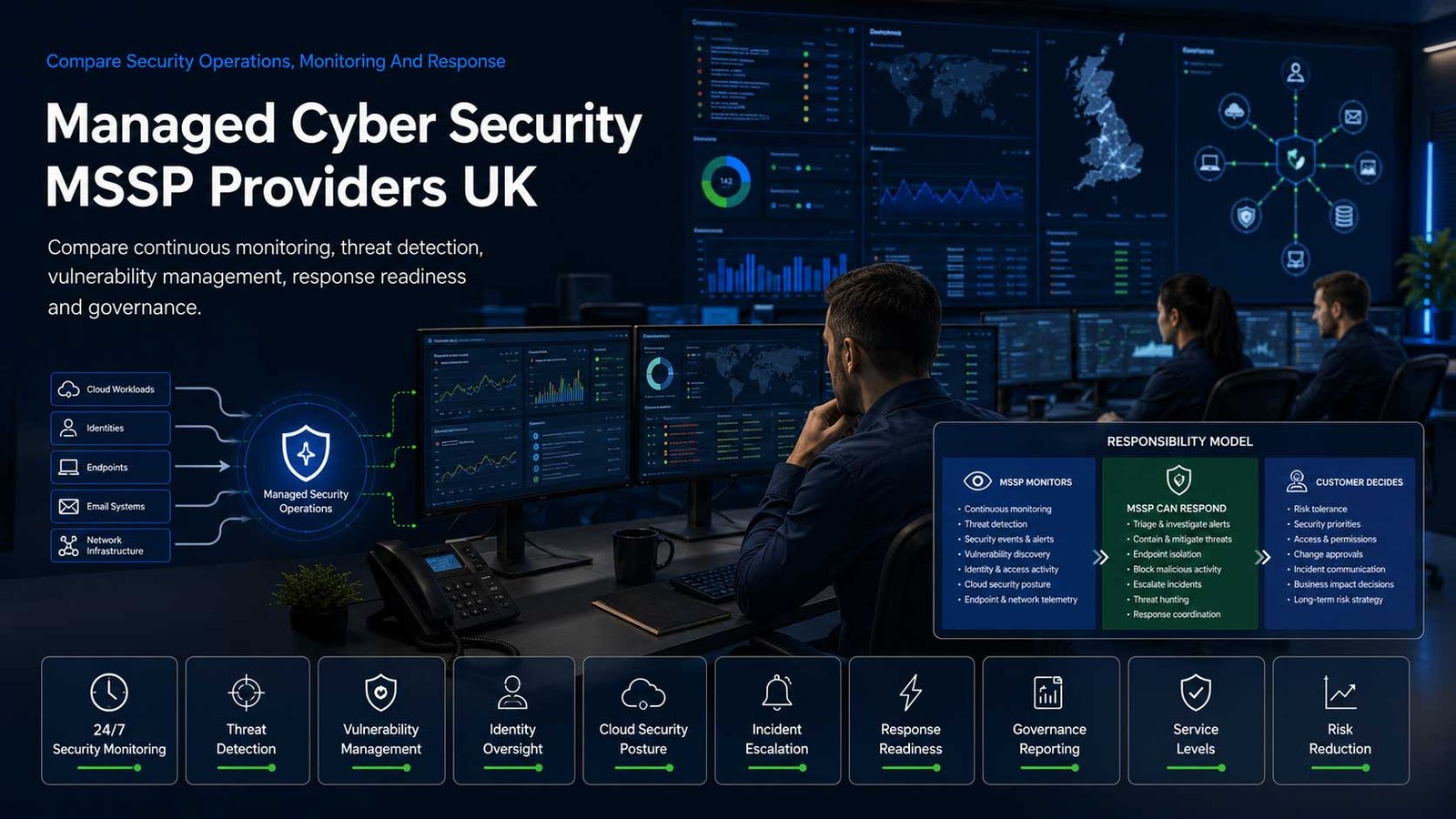
An MSSP Extends Security Capability, Not Accountability
The provider may monitor, administer and respond, but business leaders remain responsible for risk decisions, legal duties, recovery priorities and supplier oversight.
- Define the assets, threats, business impact and minimum security outcomes
- Map every managed control and privileged action to a named owner
- Agree escalation and response authority before a serious incident
- Review service evidence, access and risk reduction throughout the contract
A managed security service provider supplies specialist people, processes and technology to operate agreed cyber security functions continuously. The scope may include security monitoring, SIEM administration, threat detection, vulnerability management, cloud security posture, identity oversight, managed network controls, threat intelligence, exposure management, incident readiness, reporting and virtual security leadership.
A comprehensive MSSP relationship differs from buying one security product. The provider must understand the organisation’s assets, identity services, cloud platforms, networks, endpoints, critical applications, suppliers and recovery priorities. It must then integrate agreed technologies, tune detection and control processes, investigate exceptions, communicate risk and coordinate actions with internal teams.
This page does not compare general IT support providers or consumer antivirus subscriptions. Service desks, user troubleshooting, device setup and routine infrastructure administration belong on the IT Support page. Standalone endpoint-protection products have their own comparison page. A provider may deliver both IT and security services, but the cyber security scope, personnel, privileged access, evidence and service levels must remain contractually separate.
Choose The Managed Security Operating Model
Providers may use the same MSSP label for very different combinations of monitoring, administration, engineering, governance and response.
| Service Model | What It Usually Provides | Best-Fit Question |
|---|---|---|
| Fully managed security operations | The provider operates agreed monitoring, analysis, escalation, control-management and reporting functions with limited internal security staffing | Which risk decisions, approvals and incident actions still require an authorised customer owner? |
| Co-managed security operations | Internal and provider teams share tools, queues, investigations, engineering and response under a joint operating model | How are cases, shifts, authority, handovers, duplicate work and accountability divided? |
| Microsoft-centred managed security | The provider designs and operates services around Microsoft Sentinel, Defender, Entra, Purview and related controls | Can the provider make effective use of existing licences while covering non-Microsoft systems and maintaining independent challenge? |
| Technology-agnostic MSSP | The provider supports several SIEM, endpoint, network, cloud and identity technologies rather than one fixed stack | Which platforms are genuinely supported at expert depth, and how are third-party vendor escalations handled? |
| Mid-market packaged service | A defined bundle combines core monitoring, vulnerability, advisory and reporting capabilities for smaller organisations | Which assumptions, asset limits, log sources, response actions and exclusions sit behind the package price? |
| Regulated and critical-environment service | The service emphasises evidence, resilience, sector controls, operational technology, assurance and formal incident governance | Which sector accreditations, personnel controls, locations and response arrangements apply to the exact delivery team? |
| Managed security improvement programme | The provider combines continuous operations with a roadmap for control maturity, remediation and measurable risk reduction | How are improvement priorities funded, owned, tracked and separated from recurring monitoring charges? |
| Virtual security leadership with managed operations | A virtual CISO or security manager coordinates governance while operational teams deliver monitoring and control services | Does the advisory role provide independent oversight, or assess and approve the same services the provider operates? |
Eight Areas That Determine MSSP Fit
Use the same security and supplier-risk criteria for every provider so SOC branding, tool badges and alert-volume claims do not hide responsibility or access gaps.
Comparison Criterion
Security Scope And Responsibility
Compare the exact assets, users, identities, cloud platforms, networks, applications, log sources and controls included. Require a responsibility matrix for configuration, monitoring, triage, investigation, containment, remediation, recovery, evidence, regulatory decisions and third-party escalation.
Comparison Criterion
Onboarding, Discovery And Baseline
Assess asset discovery, architecture review, log and control validation, vulnerability baseline, threat modelling, detection coverage, existing incidents, privileged access and improvement planning. Onboarding should expose unknown assets and weak data rather than merely connect tools.
Comparison Criterion
Security Operations And Monitoring
Review SOC locations, operating hours, staffing, analyst tiers, language, threat intelligence, event normalisation, use-case development, alert triage, investigation, hunting, case management, handovers and customer communication. Distinguish continuous coverage from an after-hours notification service.
Comparison Criterion
Control Management And Exposure Reduction
Compare vulnerability prioritisation, cloud posture, attack-surface monitoring, identity review, network controls, email security, endpoint policy, patch evidence and remediation coordination. The provider should track closure and residual risk, not only issue alerts.
Comparison Criterion
Incident Escalation And Response Authority
Define severity, notification, investigation, evidence preservation, isolation, account action, blocking, legal contact, recovery handoff and incident-response retainer. Confirm which actions the provider may take automatically and which require named customer approval.
Comparison Criterion
Data, Tools And Privileged Access
Review log content, collection, data location, retention, encryption, customer-owned versus provider-owned technology, administrator accounts, remote access, service identities, strong authentication, session logging and emergency access. Treat the MSSP as a high-impact supplier.
Comparison Criterion
Governance, Reporting And Improvement
Assess service reviews, risk reporting, executive summaries, operational metrics, incident trends, control coverage, unresolved weaknesses, roadmap, audit evidence and board communication. Reports should show security outcomes and customer actions rather than large alert totals.
Comparison Criterion
Resilience, Assurance And Exit
Compare the provider’s own security, supply chain, staff screening, continuity, SOC resilience, subcontractors, certifications, incident notification, financial stability, cyber insurance, audit rights, data return, credential removal, tooling transfer and transition support.
Measures To Define Before An MSSP Contract Is Signed
Translate continuous protection and rapid response into measurable coverage, investigation, containment, remediation and supplier-control outcomes.
| Measure | What It Should Define | Evidence To Request | Common Weakness |
|---|---|---|---|
| Asset and log-source coverage | Whether all approved critical systems and required telemetry are connected, current and usable | Asset inventory, required sources, connected, healthy, delayed, excluded, owner and remediation date | A percentage is based only on sources originally ordered and ignores unknown or newly deployed assets |
| Detection coverage | Whether agreed threat scenarios have active, tested and appropriately tuned detection logic | Threat scenario, data dependency, rule, test evidence, last review, gap and compensating control | The provider reports thousands of rules without showing relevance to the customer’s environment |
| Time to acknowledge and investigate | Elapsed time from a qualifying alert or event to analyst ownership and meaningful investigation | Severity, timestamp, queue, analyst action, evidence, handoff and exclusions | The SLA stops at automated ticket creation rather than human investigation |
| Time to contain or support containment | How quickly an approved action limits an active threat after confirmation | Authority, action, elapsed time, dependency, customer approval, result and validation | The provider can advise containment but has no tested access or customer contact to execute it |
| False-positive and closure quality | Whether cases are accurately classified, documented and improved without suppressing genuine risk | Case sample, rationale, evidence, tuning, reopened case, customer feedback and quality review | Alerts fall because broad suppression hides recurring malicious or policy-violating activity |
| Vulnerability remediation progress | Whether prioritised weaknesses are assigned, corrected or formally accepted within risk-based targets | Asset, vulnerability, exploitability, business impact, owner, due date, closure and exception | The MSSP repeatedly reports the same issue without a remediation governance process |
| Privileged-access compliance | Whether provider identities, service accounts and remote access remain authorised, limited and traceable | Account owner, entitlement, authentication, session evidence, access review, dormant account and emergency use | Shared support accounts remain active because supplier access is not reconciled |
| Incident and escalation readiness | Whether contacts, authority, response plans, evidence handling and recovery handoffs work under pressure | Exercise result, notification, decision, containment, legal and insurer contacts, recovery and lessons | A response plan exists but the MSSP and internal leaders have never exercised it together |
| Service improvement completion | Whether agreed control, process and detection improvements are delivered within the review period | Action, owner, due date, dependency, status, evidence, risk effect and overdue reason | Monthly meetings discuss risks without funded actions or accountable owners |
| Total cost per protected asset or user | The complete recurring, technology, onboarding, response, change and internal oversight cost | Assets, users, data volume, tools, service modules, changes, incidents, internal effort and growth | A low per-user fee excludes log ingestion, cloud consumption, response and engineering changes |
Managed Cyber Security Providers UK Businesses Can Consider
Shortlist providers whose operating model, technology depth, privileged-access controls and response authority fit the organisation. Confirm current scope, availability and pricing directly before award.
Provider Profile
NCC Group Managed Services
UK-headquartered cyber security and resilience provider offering managed services alongside consulting, threat intelligence and incident response. Its current portfolio includes managed detection and response, attack-surface management and security programme support across several technologies. Include NCC Group where a business values broad cyber expertise, technology-agnostic service design and access to wider assurance or response capability. Confirm the exact managed modules, SOC and data locations, supported technology, response authority, subcontractors, improvement commitments and commercial boundaries.
Review official NCC Group managed servicesProvider Profile
Bridewell Managed Security
UK cyber security provider offering managed security, SOC, managed detection and response, vulnerability, threat-intelligence and Microsoft cloud security services, with strong positioning in regulated and critical environments. Include Bridewell where a business requires a tailored managed-security operating model and close integration with Microsoft technologies or critical-infrastructure controls. Confirm the exact SOC model, telemetry, analyst coverage, response actions, service onboarding, assurance, data handling, sector requirements and the separation between managed security and consultancy projects.
Review official Bridewell managed securityProvider Profile
Integrity360 Managed Cyber Services
European cyber security specialist providing managed services across SIEM, XDR, NDR, cloud, identity, exposure management, awareness and incident response. Include Integrity360 where a business wants a broad managed-security portfolio and flexibility across several security technologies. Confirm the selected services and platform, SOC and data location, customer responsibilities, investigation and containment authority, integrations, reporting, incident support, implementation scope and how acquisitions or technology partnerships affect the contracted operating model.
Review official Integrity360 managed servicesProvider Profile
Sapphire Managed Cyber Security
UK cyber security provider offering managed detection and response, managed SIEM, vulnerability, threat intelligence, patch and operational-technology security services through UK-based capability. Include Sapphire where a business values direct UK expertise, IT and OT coverage or a service assembled around existing technologies. Confirm which modules form the MSSP service, analyst coverage, platform ownership, log and asset limits, remote actions, remediation support, incident response, service reporting and any work that remains a separate consulting or testing engagement.
Review official Sapphire managed servicesProvider Profile
Orange Cyberdefense Managed Services
Global security-services provider with European and UK operations, offering managed security operations, threat detection and response, network and cloud security, vulnerability and incident services. Include Orange Cyberdefense where international coverage, a broad technology ecosystem or multi-country delivery matters. Confirm the UK contracting entity, delivery and data locations, exact managed services, local account and incident contacts, technology dependencies, response authority, cross-border support, subcontractors, service-transition process and exit arrangements.
Review official Orange Cyberdefense managed servicesProvider Profile
LRQA Managed Cyber Security Services
LRQA’s integrated cyber security division, formerly associated with the Nettitude brand, provides managed security across assurance, defence, risk and compliance with 24/7 SOC and incident-response capability. Include LRQA where a business wants managed operations connected to testing, governance and formal assurance. Confirm the exact LRQA service identity, SOC delivery, supported platforms, monitoring and response scope, regulatory evidence, incident-retainer relationship, service locations, subcontractors, improvement roadmap and handover from any legacy Nettitude contract.
Review official LRQA managed cyber securityProvider Profile
Quorum Cyber Managed Security Services
Edinburgh-founded, Microsoft-first cyber security provider offering managed detection and response, data security and broader managed services centred on Microsoft security technologies and selected third-party coverage. Include Quorum Cyber where Microsoft Sentinel, Defender, Entra and Purview form the core security stack. Confirm the required Microsoft licences, coverage beyond Microsoft, telemetry and ingestion assumptions, Clarity service tier, analyst and response scope, incident authority, data locations, integrations, service reporting and portability if the Microsoft estate changes.
Review official Quorum Cyber managed servicesProvider Profile
Cyberfort Cyber Security Services
UK cyber security provider offering consultancy, managed security, MXDR, vulnerability management, threat intelligence and incident-response services across the security lifecycle. Include Cyberfort where a business wants a UK provider combining security improvement with managed detect-and-respond capability. Confirm the exact recurring services, technology stack, SOC and support model, onboarding, remediation responsibilities, customer access, service measures, certifications, incident-response integration, commercial minimums and the boundary from Cyberfort’s cloud, data-centre and broader managed-infrastructure services.
Review official Cyberfort security servicesWhat Changes Managed Cyber Security Cost
The per-user or monthly SOC figure is only one component. Data volume, security technology, onboarding, response, remediation and improvement services can materially change the budget.
| Cost Driver | Why It Changes Spend | What A Comparable Proposal Should Show |
|---|---|---|
| Users, assets and sites | MSSPs may price by employee, endpoint, identity, server, cloud account, network device, site or a blended service band | Current and forecast population, inactive assets, remote users, acquisitions, seasonal demand and minimum commitment |
| Log volume, retention and SIEM platform | Events per second, gigabytes ingested, data retention, search, cloud storage and SIEM licensing can materially change cost | Sources, daily volume, peaks, filtering, hot and archive retention, queries, platform owner and overage |
| Managed technology modules | SIEM, endpoint, network, cloud, identity, vulnerability, email, attack-surface and threat-intelligence services may be separate modules | Required controls, current tools, supported versions, duplicated licences, integration and service boundary |
| Operating hours and analyst coverage | Business-hours monitoring, 24/7 triage, dedicated analysts, language and named specialists use different staffing models | Coverage, locations, shifts, queue, analyst tier, dedicated time, holiday model and escalation |
| Onboarding and engineering | Discovery, architecture, connectors, agents, tuning, rule development, dashboards and remediation planning create one-off and recurring effort | Assets, integrations, tasks, assumptions, acceptance, customer dependencies, project price and change allowance |
| Incident response and containment | Investigation depth, remote actions, on-call response, retained hours, forensic support and recovery coordination may sit outside the base service | Included actions, authority, retainer, rates, minimum call-out, travel, legal and insurer coordination |
| Vulnerability and remediation support | Scanning, exposure management, validation, prioritisation and engineering assistance differ significantly between services | Assets, frequency, authenticated coverage, validation, remediation ownership, retest and project charges |
| Compliance and reporting | Regulatory mappings, audit packs, board reporting, virtual security leadership and evidence workshops can require premium services | Frameworks, reports, meetings, named adviser, hours, audit support and document ownership |
| Third-party licences and cloud consumption | Security products, Microsoft licences, endpoint agents, cloud compute, storage and API services may be invoiced separately | Product list, licence owner, quantity, consumption assumptions, discount, uplift, portability and unused rights |
| Contract change and exit | Asset reductions, technology changes, acquisitions, data return, rule export, credential removal and transition affect lifetime cost | Term, indexation, volume bands, reduction rights, export, transition assistance, deletion and final access review |
How Security Maturity Changes The Shortlist
The right MSSP depends on internal capability, technology, regulation, risk appetite and how much investigation or response authority the business will delegate.
SME Without A Security Team
Prioritise clear packaged scope, security baseline, 24/7 escalation, named guidance, vulnerability closure, incident readiness and practical reporting that does not assume an internal SOC or security engineer.
Microsoft-Centred Organisation
Prioritise Sentinel, Defender, Entra and Purview depth, licence optimisation, ingestion economics, Microsoft-native response, coverage of non-Microsoft assets and service portability.
Regulated Or Critical Organisation
Prioritise personnel, location and supply-chain assurance, evidence, sector controls, operational resilience, exercise capability, formal response authority, audit support and executive reporting.
Established Internal Security Team
Prioritise co-managed queues, tool flexibility, advanced hunting, engineering, threat intelligence, specialist escalation, shared runbooks and a service model that strengthens rather than displaces internal capability.
How To Compare MSSP Proposals
Give every provider the same asset inventory, architecture, users, identities, clouds, networks, critical applications, security tools, log volumes, business impact, regulatory obligations, incidents and internal capabilities. Require every response to show the service boundary, customer actions and privileged-access model.
- Every asset and control maps to a named provider or customer owner
- SOC, data, analyst and subcontractor locations are disclosed
- Detection, escalation and containment authority are demonstrated
- Technology licences and log assumptions are normalised
- Provider compromise and service-continuity scenarios are tested
- Credential removal, data return and transition are covered at exit
Make Every Provider Handle The Same Incident
Give each finalist the same compromised administrator account, suspicious cloud login, malware alert, exposed vulnerability and unavailable internal contact.
Compare investigation, evidence, authority, containment, communication and recovery handoff before comparing dashboard appearance.
Six Questions To Put To Every MSSP
The answers expose incomplete scope, supplier-access risk, hidden incident charges and difficult service transfer before the contract starts.
Which Assets, Controls And Actions Are Included?
Request a responsibility matrix covering monitoring, investigation, containment, remediation, recovery, vulnerability, cloud, identity, network, reporting and customer actions.
Where Are Our Data And Security Operations Delivered?
Confirm SOCs, analysts, log processing, storage, backups, support, subcontractors, remote access, cross-border transfers and continuity arrangements.
How Are Privileged Provider Identities Controlled?
Ask for named or attributable accounts, least privilege, strong authentication, vaulting, approvals, session logging, access review and emergency-access removal.
What Happens During A Serious Incident?
Test contacts, severity, investigation, evidence, containment authority, legal and insurer coordination, forensic support, recovery handoff, communications and extra charges.
How Will You Prove Risk Is Reducing?
Request asset and detection coverage, vulnerability closure, access exceptions, incident trends, improvement actions, residual risk and business-level reporting.
What Can We Recover And Transfer At Exit?
Confirm rules, configurations, cases, logs, reports, asset data, credentials, documentation, tooling licences, transition assistance, deletion and final access evidence.
A Seven-Stage Managed Cyber Security Evaluation
Move from business-risk evidence to tested security operations rather than selecting a SOC brand before defining assets, authority and customer responsibilities.
- Inventory critical services, data, assets, users, identities, clouds, networks, applications, security tools, suppliers, incidents and existing security responsibilities.
- Define risk outcomes, minimum controls, monitoring and response coverage, regulatory evidence, recovery priorities and decisions that must remain internal.
- Choose a fully managed, co-managed, Microsoft-centred, technology-agnostic or regulated operating model for each security function.
- Issue one written brief and obtain comparable scope, technology, onboarding, data, privileged-access, response, assurance and three-year commercial responses.
- Run technical and operational due diligence using representative telemetry, investigation cases, access reviews, response scenarios and provider-continuity evidence.
- Onboard in controlled stages with asset reconciliation, integration testing, use-case tuning, contacts, authority, runbooks, acceptance and legacy-service transition.
- Operate through service reviews, access reconciliation, detection testing, vulnerability closure, exercises, improvement tracking, supplier assurance and exit readiness.
Managed Cyber Security (MSSP) Comparison Checklist
Use this table before approving a managed-security contract, SOC onboarding or privileged supplier access.
| No. | Requirement | Evidence To Obtain Before Award | Confirmed |
|---|---|---|---|
| 01 | Critical services, data and accountable owner agreed | Business services, impact, data, recovery priority, risk owner and security decision makers | |
| 02 | Asset and technology inventory completed | Users, identities, endpoints, servers, clouds, networks, applications, log sources and security tools | |
| 03 | Managed and retained responsibilities approved | Monitoring, investigation, containment, remediation, recovery, governance, legal and communications | |
| 04 | Exact service modules identified | SOC, SIEM, MDR, vulnerability, cloud, identity, network, exposure, intelligence, advisory and response | |
| 05 | Onboarding and coverage baseline accepted | Discovery, connectors, agents, logs, detections, vulnerabilities, access, gaps and improvement plan | |
| 06 | SOC and data locations confirmed | Analysts, operations centres, processing, storage, backups, subprocessors, transfers and continuity | |
| 07 | Privileged-access controls demonstrated | Accounts, authentication, vault, approvals, session evidence, review, emergency use and removal | |
| 08 | Detection and investigation quality tested | Threat scenarios, data, use cases, triage, evidence, hunting, tuning, false positives and escalation | |
| 09 | Containment and incident authority agreed | Severity, notification, isolation, account action, blocking, evidence, legal, insurer and recovery handoff | |
| 10 | Vulnerability and remediation governance approved | Coverage, prioritisation, validation, owner, due date, retest, exceptions and residual risk | |
| 11 | Provider security and supply chain assessed | Own controls, staff screening, certifications, incidents, suppliers, resilience, insurance and audit rights | |
| 12 | Reporting and improvement model accepted | Operational metrics, executive risk, trends, unresolved actions, roadmap, review frequency and owners | |
| 13 | Technology, data and incident charges normalised | Licences, ingestion, retention, assets, modules, engineering, response, projects and overage | |
| 14 | Three-year total cost and customer effort compared | Recurring fees, onboarding, tools, cloud, changes, incidents, remediation and internal oversight | |
| 15 | Exit, transfer and access closure agreed | Rules, cases, logs, data, documentation, licences, credentials, transition, deletion and proof of removal |
Common MSSP Buying Mistakes To Avoid
Most avoidable failures begin with an unclear service boundary, untested response authority or supplier access that receives less scrutiny than internal administration.
| Mistake | Why It Creates Risk | Better Control |
|---|---|---|
| Buying IT support and assuming security is included | Routine IT administration does not automatically provide specialist monitoring, threat analysis or response | Contract managed security as a distinct scope |
| Comparing consumer antivirus with an MSSP | A product subscription does not provide the people, processes, governance and continuous service required | Compare complete managed-security outcomes |
| Selecting on alert volume | More alerts can indicate weak tuning and increased internal work rather than better protection | Measure coverage, investigation and risk reduction |
| Leaving assets and log sources undefined | The provider cannot monitor systems it does not know or cannot access | Reconcile coverage during onboarding and continuously |
| Giving broad privileged access for convenience | A compromised supplier account can create organisation-wide impact | Apply least privilege, traceable access and review |
| Assuming 24/7 means full incident response | The service may only notify an internal contact outside business hours | Test authority, containment and response support |
| Ignoring the provider’s own supply chain | Subprocessors, platforms and remote-support tools create concentrated risk | Map, assure and monitor supplier dependencies |
| Treating vulnerability reports as remediation | Known weaknesses remain open without business ownership and deadlines | Track validated closure and residual risk |
| Outsourcing every security decision | The provider cannot decide the customer’s risk appetite, legal duties or recovery priorities | Retain accountable internal governance |
| Deferring exit and credential removal | Logs, rules, licences and privileged identities remain dependent on the provider | Agree transfer, deletion and closure before award |
Frequently Asked Questions
Answers to common questions from UK businesses comparing comprehensive managed cyber security providers.
What Is A Managed Security Service Provider?
A managed security service provider supplies specialist people, processes and technology to operate agreed cyber security functions. Services may include monitoring, SIEM, vulnerability management, cloud and identity oversight, network controls, threat intelligence, incident escalation, reporting and security improvement.
How Is An MSSP Different From An IT Support Provider?
IT support focuses on users, devices, applications and infrastructure operation. An MSSP provides specialist cyber security monitoring, investigation, control management and risk reporting. One supplier may offer both, but the security team, access, responsibilities, service levels and evidence should remain clearly separated.
How Is An MSSP Different From Endpoint Protection?
Endpoint protection is a security product or control for laptops, desktops and servers. An MSSP may manage endpoint technology alongside identity, cloud, network, vulnerability and security operations. Businesses comparing standalone endpoint products should use the dedicated Endpoint Protection page.
Does Every MSSP Provide A 24/7 SOC?
No. Some providers operate continuous monitoring and human investigation, while others provide business-hours service with after-hours alerting or escalation. Confirm analyst coverage, locations, response authority, queue ownership and what actually happens during a serious incident outside normal hours.
Can An MSSP Replace An Internal Security Team?
An MSSP can supply skills and continuous operations, but the organisation must retain accountable risk ownership, legal and regulatory decisions, recovery priorities, supplier oversight and executive governance. Co-managed services often work well where an internal team needs additional capacity or specialist capability.
What Should Be Included In An MSSP Contract?
The contract should define assets, services, responsibilities, data, locations, privileged access, monitoring, investigation, response authority, service levels, reporting, subcontractors, incident notification, audit rights, charges, continuity, transition, data return and credential removal.
How Much Does Managed Cyber Security Cost?
Cost depends on users, assets, sites, log volume, retention, security tools, service modules, operating hours, onboarding, engineering, incident response and compliance support. Compare a three-year total including cloud consumption, licences, internal remediation and supplier oversight.
How Long Does MSSP Onboarding Take?
Timing depends on asset visibility, technology, log sources, access approvals, data quality, integrations, existing incidents and tuning. A controlled onboarding includes discovery, baseline assessment, connectors, detection tests, contacts, response authority, runbooks, acceptance and transition from previous services.
What Happens If The MSSP Is Compromised?
A compromised provider can create supply-chain risk through privileged access, tools and shared infrastructure. Buyers should assess the MSSP's own controls, staff access, incident notification, isolation, continuity and subcontractors, then limit access and maintain tested customer recovery options.
How Should A UK Business Compare MSSPs?
Give every provider the same assets, risks, technology, log volume, response requirements and internal capabilities. Compare service boundaries, technical evidence, privileged access, incident scenarios, supplier assurance, three-year cost and exit—not only SOC branding, certifications or alert counts.
Provider Information And UK Supplier-Security Resources
Reviewed by Bhav Giva, Founder & Lead Analyst at CompareServices.co.uk, on 16 July 2026.
Use NCSC, ICO and official provider documentation to confirm current service scope, delivery locations, technology, access controls, incident support, assurance and pricing. MSSP ownership and service portfolios can change during a procurement cycle.
- NCSC — Choosing A Managed Service Provider
- NCSC — Supplier Assurance Questions
- NCSC — Supply Chain Security Guidance
- ICO — IT Supplier Relationships
- UK Government — Cyber Security Breaches Survey 2025/2026
- NCC Group — Managed Services
- Bridewell — Managed Security
- Integrity360 — Managed Cyber Services
- Sapphire — Managed Cyber Security Services
- Orange Cyberdefense — Managed Services
- LRQA — Managed Cyber Security Services
- Quorum Cyber — Managed Security Services
- Cyberfort — Cyber Security Services