
Compare Incident Response & Digital Forensics Providers UK (2026)
Compare Emergency Response, Forensic Investigation, Containment, Recovery, Evidence And Cost
Compare incident response services UK cyber providers by 24/7 activation, triage, containment, digital evidence collection, cloud and endpoint forensics, ransomware and business email compromise investigation, eradication, recovery support, legal and insurer coordination, reporting, chain of custody, response time, retainer terms and complete incident cost. Evaluate providers before an emergency makes procurement slower and riskier.
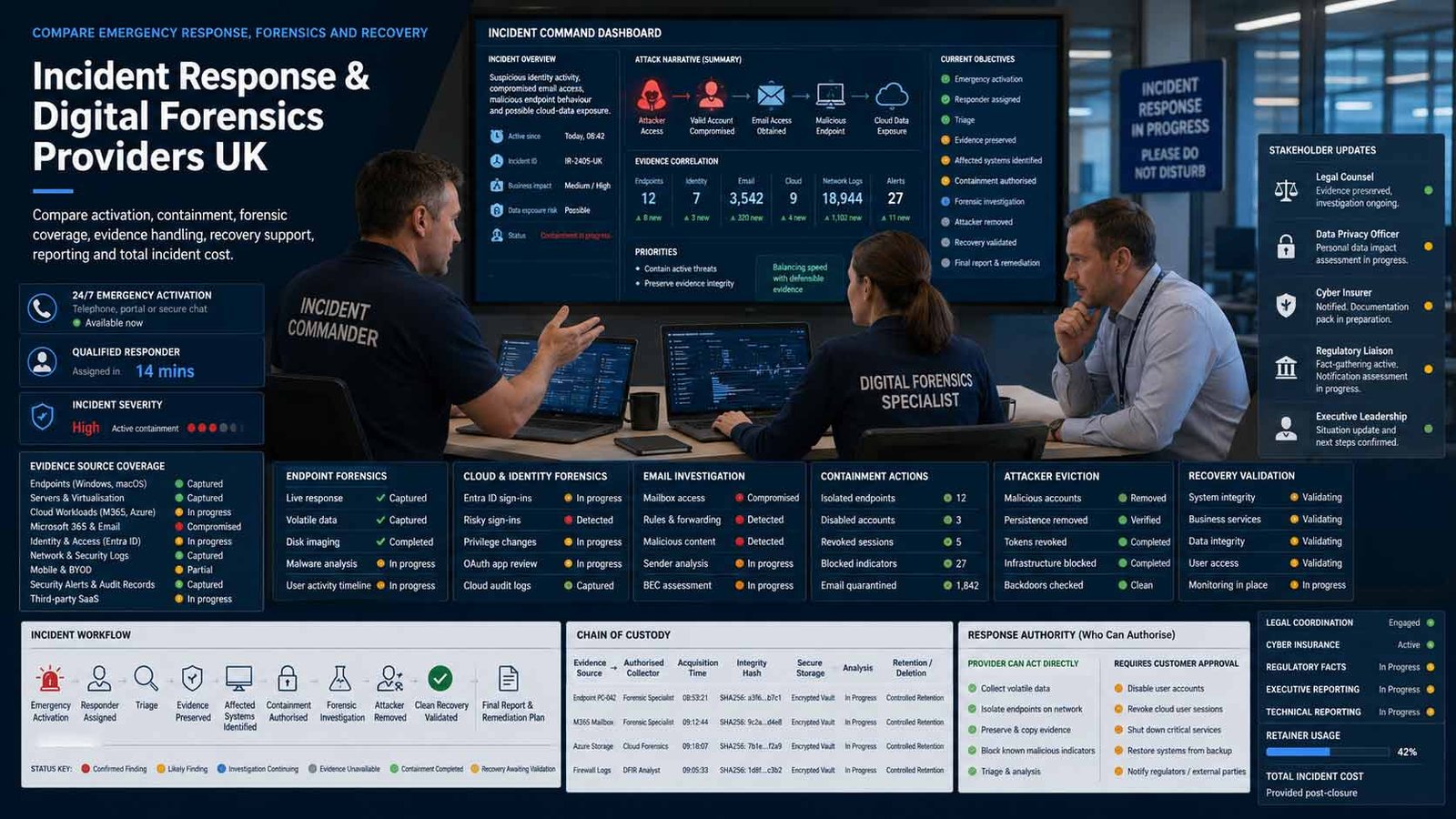
Contain The Threat Without Destroying The Evidence
Response decisions must reduce harm while preserving enough reliable evidence to determine what happened, what was affected and whether the attacker remains present.
- Activate a qualified team through an independently tested emergency route
- Record time, authority, evidence source and every containment action
- Coordinate legal, privacy, insurer and law-enforcement decisions early
- Validate eradication and recovery before restoring normal trust
Incident response is the structured work used to identify, contain, eradicate and recover from a cyber incident. Digital forensics supports that response by collecting and analysing evidence from endpoints, servers, cloud services, identities, email, networks, mobile devices and other relevant systems.
The two disciplines must work together. Containment can stop ransomware, account misuse or data theft, but poorly planned actions may overwrite memory, logs, timestamps or attacker artefacts. Forensic collection without urgent containment can preserve evidence while allowing harm to continue. The provider should therefore explain how operational risk and evidence value are balanced throughout the engagement.
This page does not compare preventative managed-security retainers that only monitor or harden systems. It covers reactive incident response, digital forensic investigation and retainers that provide assured access to those capabilities during a real incident. MDR and MSSP services may detect or escalate an incident, but the specialist DFIR engagement begins when deeper scoping, evidence, containment, eradication, recovery or defensible reporting is required.
Choose The Right Incident Response And Forensic Engagement
Emergency response, forensic investigation and retained access use different assumptions, evidence and commercial structures.
| Engagement Model | What It Usually Provides | Best-Fit Question |
|---|---|---|
| Emergency incident response | Rapid remote or onsite activation during a suspected or confirmed cyber incident | How quickly can qualified responders begin triage after the authorised call? |
| Incident response retainer | Pre-agreed terms, contacts, onboarding and access to responders when an incident occurs | Are retained hours usable for real response, readiness or both, and what happens when they are exhausted? |
| Digital forensic investigation | Evidence acquisition, preservation, examination and reporting for cyber, insider, fraud or legal matters | Which evidence types, forensic tools, chain-of-custody controls and reporting standards are included? |
| Ransomware response | Containment, attacker scoping, negotiation support, recovery advice and forensic investigation | How are sanctions, insurance, law enforcement, backups, negotiation and restoration decisions coordinated? |
| Business email compromise investigation | Mailbox, identity, payment, forwarding-rule and message-trace analysis after account or payment compromise | Can the provider investigate cloud identity, email logs, endpoints, transactions and affected external parties together? |
| Cloud and identity incident response | Investigation of Microsoft 365, Azure, AWS, Google Cloud, SaaS, tokens, identities and audit data | Which cloud logs must already be enabled and who preserves them before retention expires? |
| Insider and employee investigation | Controlled forensic analysis of authorised devices, accounts and records for suspected misuse or data loss | How are legal authority, employee privacy, proportionality and evidence handling governed? |
| Recovery and post-incident assurance | Eviction validation, clean rebuild guidance, control remediation and lessons after the active threat is contained | Which restoration decisions and control improvements are included, and which require separate suppliers? |
Eight Areas That Determine Incident Response Fit
Use the same attack scenarios, evidence sources and decision requirements for every provider so headline response times do not hide forensic or recovery gaps.
Comparison Criterion
24/7 Activation And Initial Triage
Compare emergency contact routes, authorised callers, response commitment, initial conference, secure communications, remote access, conflict checks and mobilisation. Test the route before purchase. A published hotline is not enough unless qualified responders can accept the engagement and start evidence-led triage.
Comparison Criterion
Forensic Coverage And Technical Depth
Review Windows, macOS, Linux, mobile, Active Directory, Microsoft 365, Azure, AWS, Google Cloud, email, network, memory, malware and virtual-platform capability. Require named technical leads and clarity where specialist OT, mobile, database or legal-evidence expertise needs a separate team.
Comparison Criterion
Evidence Preservation And Chain Of Custody
Assess collection methods, forensic imaging, volatile data, hashing, time sources, evidence logs, secure storage, transfers, access, retention and disposal. The provider should preserve original evidence where practical and document who handled every item and why.
Comparison Criterion
Investigation, Scoping And Root Cause
Compare timeline creation, initial-access analysis, persistence, privilege escalation, lateral movement, identity misuse, malware, data access, exfiltration, affected systems and attacker eviction. Require evidence-based confidence levels and a clear distinction between confirmed, likely and unknown findings.
Comparison Criterion
Containment, Eradication And Recovery
Define endpoint isolation, account disablement, token revocation, network blocking, malicious persistence removal, rebuild, password resets, service restoration and validation. Confirm which actions the provider can take directly and which depend on the customer, MSP, cloud provider or insurer.
Comparison Criterion
Legal, Privacy, Insurance And Crisis Coordination
Review experience working with breach counsel, data-protection teams, cyber insurers, brokers, communications advisers, law enforcement and regulators. The technical team should produce timely facts without making legal, notification or ransom-payment decisions outside its authority.
Comparison Criterion
Reporting And Decision Support
Compare situation reports, incident timelines, executive updates, affected-asset lists, indicators, evidence schedules, technical reports, regulatory facts, remediation plans and expert-witness support. Reporting should support decisions during the incident and remain defensible afterwards.
Comparison Criterion
Commercial Terms, Readiness And Exit
Assess retainers, emergency rates, minimum call-outs, travel, forensic storage, tools, subcontractors, insurance-panel arrangements, service limits, unused hours, readiness work, data return, evidence retention, secure deletion and handover to internal or replacement teams.
Measures To Define Before An Incident Response Contract Is Signed
Translate rapid, thorough and defensible response into consistent activation, evidence, containment and recovery outcomes.
| Measure | What It Should Define | Evidence To Request | Common Weakness |
|---|---|---|---|
| Time to qualified responder | Elapsed time from authorised activation to a responder who can direct technical triage | Call time, acknowledgement, conflict check, responder assigned, conference opened and assumptions | The SLA measures call-centre acknowledgement rather than expert engagement |
| Time to containment decision | Elapsed time from evidence review to an authorised action that limits further harm | Evidence, decision, authority, customer dependency, action, result and rollback | The provider identifies malicious activity but cannot reach an authorised decision maker |
| Evidence-source coverage | Whether relevant endpoint, identity, email, cloud and network evidence is available and collected safely | Source, retention, access, collection method, time range, gaps, hash and custodian | Critical cloud logs have already expired before the provider receives access |
| Affected-asset confidence | How reliably the investigation identifies compromised, exposed and unaffected systems or accounts | Asset, evidence, status, confidence, last malicious activity, action and owner | The final scope is inferred from alerts without forensic validation |
| Chain-of-custody completeness | Whether every evidential item has a documented history from collection to return or destruction | Item ID, source, collector, date, hash, transfer, storage, access and disposal | Evidence is copied informally through shared drives without a complete record |
| Attacker-eviction validation | Whether persistence, stolen credentials and unauthorised access have been removed before recovery | Accounts, tokens, malware, scheduled tasks, rules, remote tools, tests and residual risk | Systems are restored before identity compromise and persistence are addressed |
| Recovery validation | Whether rebuilt or restored services are clean, supported and monitored before normal operation resumes | Build source, updates, credentials, controls, scan, logging, owner and approval | Backups are restored into the same compromised trust environment |
| Decision and reporting timeliness | Whether leaders, legal advisers and response teams receive reliable facts at the required cadence | Update time, facts, uncertainty, decisions, actions, next review and recipients | Reports are technically detailed but too late for regulatory or business decisions |
| Customer action backlog | Whether remediation actions have owners, dates and evidence after the urgent engagement | Action, risk, priority, owner, due date, dependency, status and acceptance | The provider closes the incident while critical recovery actions remain unassigned |
| Total incident and readiness cost | The complete retainer, emergency labour, tools, travel, storage, recovery and internal-effort cost | Rates, minimums, hours, roles, expenses, evidence, recovery suppliers and unused retainer | A low retainer excludes most chargeable emergency work and forensic storage |
Incident Response And Digital Forensics Providers UK Businesses Can Consider
Shortlist providers whose activation, forensic depth and recovery model fit the organisation. Confirm current UK availability, accreditation and pricing directly before award.
Provider Profile
NCC Group Digital Forensics And Incident Response
NCC Group provides 24/7 cyber incident response, digital forensics, crisis support, readiness and recovery services with a substantial UK presence. Include it where a business wants a UK-led provider with broad enterprise, ransomware, cloud, IT and specialist-sector capability. Confirm the proposed response commitment, NCSC or CREST scheme status relevant to the engagement, named team, evidence coverage, onsite availability, retainer use, insurer-panel arrangements, minimum charges, crisis-management scope, recovery boundary, report type and data-retention terms.
Review official NCC Group DFIRProvider Profile
Mandiant Incident Response Services
Mandiant, part of Google Cloud, provides global incident response, threat intelligence, crisis management, attack analysis and remediation support for complex breaches. Include it where a business values frontline threat intelligence, cloud expertise and experience with sophisticated or cross-border incidents. Confirm activation route, retainer response commitment, team location, Google Cloud and non-Google coverage, forensic collection, crisis and recovery responsibilities, legal and insurer coordination, rates, travel, subcontractors, data location and the exact services included before and after containment.
Review official Mandiant incident responseProvider Profile
Kroll Incident Response And Digital Forensics
Kroll provides end-to-end cyber incident response, digital forensics, breach response, ransomware, business email compromise, data review and recovery coordination, often working with law firms and cyber insurers. Include it where legal, regulatory, notification and investigation work must be coordinated across one response ecosystem. Confirm the UK team, 24/7 activation, forensic platforms, evidence and chain of custody, breach-counsel relationship, insurer approval, notification services, negotiation boundaries, minimum fees, forensic storage, expert reporting and international support.
Review official Kroll incident responseProvider Profile
Microsoft Incident Response
Microsoft Incident Response provides reactive and proactive services covering investigation, containment, eviction, recovery and planning, with direct access to Microsoft product engineering and threat intelligence. Include it where Microsoft 365, Entra, Azure and Defender form a significant part of the affected environment. Confirm the two-hour response commitment conditions, non-Microsoft coverage, evidence acquisition, endpoint and cloud access, customer prerequisites, recovery scope, law-firm and insurer coordination, rate structure, support region, report deliverables and the boundary from Defender Experts or ongoing managed services.
Review official Microsoft Incident ResponseProvider Profile
IBM X-Force Incident Response
IBM X-Force Incident Response provides 24/7 preparedness, investigation, containment and recovery support through experienced responders, threat hunters and investigators. Include it where a business wants a global provider with crisis exercises, threat intelligence and enterprise-scale response capability. Confirm the proposed UK delivery team, response commitment, retainer structure, forensic and cloud coverage, tooling, evidence storage, crisis management, restoration role, onsite travel, insurer arrangements, minimum hours, report format, subcontractors and coordination with existing IBM security services.
Review official IBM X-Force incident responseProvider Profile
Bridewell Digital Forensics And Incident Response
Bridewell provides UK-based 24/7 incident response, digital forensics, cyber incident exercises, compromise assessments and chain-of-custody support through a CREST-recognised team. Include it where a UK organisation values direct access to a specialist provider with technology-agnostic investigation and regulated-sector experience. Confirm mobilisation time, responder seniority, regional onsite coverage, evidence handling, cloud and identity capability, retainer terms, readiness work, legal and insurer coordination, ransomware support, recovery boundary, report options and charges outside the agreed scope.
Review official Bridewell DFIRProvider Profile
Rapid7 Incident Response Services
Rapid7 provides 24/7 incident response, forensic investigation, containment and recovery support, with retainer customers offered a stated one-hour response and integration with Rapid7 tooling where applicable. Include it where a business wants a global response provider and may already use Rapid7 detection or forensic technology. Confirm the exact retainer response commitment, UK delivery and onsite support, non-Rapid7 technology coverage, endpoint and cloud collection, included readiness activities, forensic storage, incident duration, recovery scope, rate card, expenses, customer prerequisites and whether any MDR-inclusive response terms apply.
Review official Rapid7 incident responseProvider Profile
Arctic Wolf Incident Response
Arctic Wolf provides full-service incident response and digital forensic investigation covering evidence collection, analysis, containment, remediation and business restoration, with retainer and insurance-channel routes. Include it where a business wants a provider that can coordinate forensics, ransomware response and recovery, whether or not it uses Arctic Wolf’s ongoing security services. Confirm UK availability, activation and conflict checks, forensic coverage, negotiation and restoration boundaries, evidence handling, insurer approval, retainer flexibility, charges, third-party recovery resources, reporting and clear separation from Aurora MDR or other preventative subscriptions.
Review official Arctic Wolf incident responseWhat Changes Incident Response And Digital Forensics Cost
There is rarely one standard incident price. Activation, evidence volume, specialist roles, recovery and legal coordination can materially change spend.
| Cost Driver | Why It Changes Spend | What A Comparable Proposal Should Show |
|---|---|---|
| Retainer structure and annual commitment | Providers may require prepaid hours, annual access fees, minimum spend or flexible credits | Retainer fee, included hours, activation rights, expiry, rollover, proactive use, top-up and cancellation |
| Emergency response time | Faster mobilisation and reserved capacity usually increase the annual or incident price | Acknowledgement, qualified responder, remote start, onsite target, conditions, exclusions and service credits |
| Incident type and complexity | Ransomware, cloud compromise, insider misuse, fraud and cross-border breaches use different skills and workstreams | Scenarios, systems, jurisdictions, likely evidence, stakeholders, specialist roles and rate assumptions |
| Number and type of systems | Endpoints, servers, cloud tenants, mailboxes, mobile devices, networks and data volumes drive collection and analysis effort | Estimated assets, evidence sources, users, locations, retention, collection method and volume |
| Forensic acquisition and storage | Imaging, remote collection, secure evidence storage, specialist tools and long retention create direct cost | Devices, cloud exports, data volume, tools, shipping, storage period, access, return and destruction |
| Responder seniority and specialist roles | Incident commanders, forensic analysts, malware specialists, cloud experts and crisis advisers use different rates | Role, rate, availability, minimum hours, supervision, expert report and replacement |
| Onsite work and travel | Physical evidence collection, complex networks and sensitive environments may require onsite teams | Locations, travel time, expenses, accommodation, equipment, security clearance and cancellation |
| Legal, insurer and notification coordination | Breach counsel, cyber insurance, notification, communications and expert evidence may add specialist work | Included coordination, separate suppliers, approval, privilege, reporting, notification and rate card |
| Recovery and remediation support | Clean rebuilds, identity reset, hardening, validation and restoration can extend beyond forensic investigation | Included actions, customer or MSP tasks, third-party suppliers, change control, testing and completion criteria |
| Post-incident reporting and support | Detailed forensic reports, executive summaries, expert witness work and remediation reviews require additional effort | Report types, draft review, evidence schedule, presentation, regulator support, testimony and retention |
How Incident Complexity Changes The Shortlist
The right provider depends on evidence sources, legal exposure, recovery urgency, internal capability, geography and the incidents most likely to disrupt the business.
Small Business Without An Internal Response Team
Prioritise a clear emergency route, rapid remote triage, practical containment guidance, Microsoft 365 and endpoint forensics, insurer coordination, straightforward rates and a provider that does not assume an internal SOC.
Microsoft 365 Or Cloud-Centred Organisation
Prioritise identity, email, token, audit and cloud evidence, rapid preservation before logs expire, direct platform expertise, containment of compromised accounts and clear handling of non-cloud endpoints.
Regulated Or Data-Intensive Business
Prioritise chain of custody, defensible reporting, legal and data-protection coordination, evidence retention, role separation, decision logs, regulator facts and experienced handling of sensitive records.
Multi-Site Or Enterprise Environment
Prioritise global mobilisation, parallel forensic workstreams, incident command, cloud and on-premises depth, onsite capability, crisis communications, insurer-panel experience, recovery coordination and scalable evidence handling.
How To Compare DFIR Proposals
Give every provider the same incident scenarios, critical services, endpoints, servers, identities, cloud platforms, email, log retention, locations, insurer, legal contacts, recovery objectives and internal response capability. Require complete activation and rate terms.
- Qualified responders—not a call centre—are covered by the activation target
- Endpoint, cloud, identity, email and network evidence are explicitly scoped
- Containment authority and evidence-preservation decisions are demonstrated
- Retainer, emergency rates, tools, storage, travel and recovery are itemised
- Legal, insurer, regulator and communications coordination is defined
- Evidence, reports, credentials and collected data are covered at exit
Make Every Provider Respond To The Same Incident
Use one ransomware compromise with identity takeover, cloud-mailbox access, possible data theft and several unavailable servers.
Compare the first two hours, evidence preservation, containment, executive update, recovery plan and cost before comparing brand claims.
Six Questions To Put To Every Incident Response Provider
The answers expose call-centre SLAs, narrow forensic coverage, hidden emergency costs and weak evidence ownership before an incident occurs.
Who Answers The Emergency Call?
Confirm the authorised activation route, conflict check, qualified responder target, secure communications, remote start, onsite mobilisation and fallback contacts.
Which Evidence Sources Can You Collect And Analyse?
Request coverage for endpoint, server, memory, identity, Microsoft 365, cloud, email, network, mobile, malware and specialist environments.
How Do You Balance Containment And Evidence Preservation?
Test endpoint isolation, account actions, token revocation, logging, forensic collection, approval, chain of custody, rollback and business continuity.
Which Legal, Insurance And Regulatory Work Is Included?
Confirm breach counsel, insurer approval, notification facts, law enforcement, communications, expert evidence and activities requiring separate suppliers.
What Does The Retainer Exclude?
Identify minimum call-outs, rate uplifts, travel, tools, forensic storage, negotiation, recovery, notification, unused hours and work after the retainer is consumed.
What Will We Receive At Closure?
Confirm executive and technical reports, evidence schedule, indicators, timeline, affected assets, remediation actions, collected data, retention, return and secure deletion.
A Seven-Stage Incident Response And DFIR Evaluation
Move from likely incident scenarios to tested activation rather than negotiating evidence, authority and rates during a live breach.
- Identify likely incident scenarios, critical services, decision makers, insurer and legal contacts, evidence sources, logging gaps, recovery objectives and current internal response capability.
- Define activation, forensic coverage, containment authority, reporting, chain of custody, regulatory facts, recovery support and commercial requirements while excluding preventative-only managed services.
- Choose emergency-only, retainer, forensic-investigation or combined response models based on risk, insurance, sector and internal capability.
- Issue one written brief and obtain comparable response, evidence, recovery, legal-coordination, retainer and incident-cost proposals.
- Run due diligence through a tabletop or technical scenario covering activation, secure access, evidence preservation, containment, executive updates, insurer coordination and recovery.
- Onboard contacts, authority, access prerequisites, logging, evidence transfer, communications, insurer approval and emergency documentation before the retainer starts.
- Maintain readiness through plan reviews, exercises, access tests, log checks, supplier updates, lessons, rate reviews and annual confirmation that the provider can still respond.
Incident Response & Digital Forensics Comparison Checklist
Use this table before approving an emergency-response arrangement, DFIR retainer or forensic investigation supplier.
| No. | Requirement | Evidence To Obtain Before Award | Confirmed |
|---|---|---|---|
| 01 | Incident scenarios and accountable owners agreed | Ransomware, cloud compromise, BEC, insider, data theft, decision makers and recovery priorities | |
| 02 | Emergency activation route tested | Authorised callers, hotline, secure communication, conflict check, acknowledgement and qualified responder | |
| 03 | Provider capability and accreditation verified | Current organisation, team, relevant NCSC or CREST status, locations, subcontractors and specialist skills | |
| 04 | Evidence-source inventory completed | Endpoints, servers, identities, email, cloud, networks, mobile, logs, retention, owners and access | |
| 05 | Containment authority agreed | Isolation, account disablement, token revocation, blocking, shutdown, approval, exceptions and rollback | |
| 06 | Chain-of-custody process accepted | Item IDs, collection, hashing, time, transfer, storage, access, retention, return and destruction | |
| 07 | Legal and privacy coordination defined | Breach counsel, DPO, facts, privilege approach, employee issues, notification decisions and evidence | |
| 08 | Cyber-insurance process confirmed | Insurer, broker, policy, approved vendors, notification, consent, costs, negotiation and claims evidence | |
| 09 | Ransomware and law-enforcement decisions prepared | Sanctions, negotiator, payment authority, backups, law enforcement, communications and restoration | |
| 10 | Recovery and validation scope agreed | Eviction, rebuild, credentials, updates, controls, monitoring, restoration tests and sign-off | |
| 11 | Reporting deliverables approved | Situation reports, timeline, affected assets, indicators, executive report, technical report and remediation | |
| 12 | Retainer and emergency rates normalised | Fee, hours, expiry, response target, minimums, roles, tools, storage, travel and top-up | |
| 13 | Readiness onboarding completed | Contacts, authority, access, architecture, tools, log checks, exercise, documentation and acceptance | |
| 14 | Complete incident-cost scenarios compared | Ransomware and cloud compromise hours, roles, evidence, legal coordination, recovery and internal effort | |
| 15 | Closure, retention and exit agreed | Evidence, reports, data, credentials, access removal, retention, return, deletion and transition assistance |
Common Incident Response And Digital Forensics Buying Mistakes
Most avoidable failures begin with untested activation, expired evidence, unclear authority or a retainer that does not fund the response the business expects.
| Mistake | Why It Creates Risk | Better Control |
|---|---|---|
| Buying a preventative-only retainer | The contract may provide advice or monitoring but no assured emergency forensic team | Verify reactive DFIR activation rights |
| Calling the provider after logs expire | Cloud and security evidence may be unavailable before investigation begins | Preserve critical logs immediately |
| Rebuilding systems before collection | Malware, memory, timestamps and attacker artefacts can be destroyed | Coordinate containment and forensics |
| Using unapproved suppliers under cyber insurance | Costs may not be reimbursed or insurer consent may be delayed | Test policy notification and vendor approval |
| Allowing one person to control every decision | Unavailable or conflicted staff can delay containment, notification and recovery | Define deputies and authority |
| Treating every forensic statement as confirmed fact | Early hypotheses can drive incorrect regulatory or public decisions | Use evidence and confidence levels |
| Failing to preserve chain of custody | Evidence may be challenged or unusable for legal and disciplinary purposes | Document every evidence movement |
| Restoring into compromised identity | Fresh systems can be re-entered through stolen accounts, tokens or persistence | Validate eviction before recovery |
| Leaving remediation outside closure | The business returns to service with the same exploitable weaknesses | Track actions and residual risk |
| Comparing retainers by annual fee only | Emergency rates, minimums, tools, travel and storage may dominate total cost | Model realistic incident spend |
Frequently Asked Questions
Answers to common questions from UK businesses comparing incident response, forensic investigation and DFIR retainers.
What Is Incident Response?
Incident response is the structured process used to identify, contain, eradicate and recover from a cyber incident. It combines technical investigation with business, legal, privacy, insurance and communications decisions intended to reduce immediate and long-term harm.
What Is Digital Forensics?
Digital forensics is the controlled collection, preservation, examination and reporting of evidence from computers, cloud services, identities, email, networks, mobile devices and other systems. It helps determine what happened, when it happened and what was affected.
What Is The Difference Between MDR And Incident Response?
MDR continuously monitors security telemetry and investigates threats. Incident response is activated when a suspected or confirmed incident requires deeper scoping, containment, forensics, eradication, recovery or defensible reporting. Some MDR providers include limited DFIR, but the service boundaries should be explicit.
What Is An Incident Response Retainer?
A retainer is a pre-agreed arrangement giving an organisation access to incident responders under known contacts, rates and terms. It may include readiness work and reserved response capacity. Buyers should confirm unused hours, response commitments and costs after the retainer is consumed.
How Quickly Should An Incident Response Provider Respond?
The required time depends on business risk, but critical incidents usually need expert triage as soon as possible. Compare time to a qualified responder, not only telephone acknowledgement. Also confirm conflict checks, secure access, onsite mobilisation and customer dependencies.
Should A Business Preserve Evidence Before Containment?
Both containment and evidence matter. Some immediate action may be essential to stop harm, while careless shutdown, wiping or rebuilding can destroy valuable evidence. Use qualified responders to balance operational risk, volatile data, logging and later investigation.
When Must A Personal Data Breach Be Reported To The ICO?
A notifiable personal data breach must be reported without undue delay and, where feasible, within 72 hours of awareness. Not every cyber incident is reportable, but organisations should start a documented assessment promptly and involve appropriate legal or data-protection advisers.
How Much Does Incident Response Cost?
Cost depends on retainer terms, response time, incident complexity, systems, evidence volume, specialist roles, travel, legal coordination, forensic storage and recovery. Compare both the annual readiness cost and realistic emergency engagement cost.
What Should An Incident Response Report Include?
Useful deliverables may include an executive summary, timeline, confirmed and suspected findings, affected assets, evidence sources, indicators, containment actions, recovery decisions, residual risks and prioritised remediation. Legal or expert reports may require additional controls.
How Should A UK Business Compare Incident Response Providers?
Give every provider the same incident scenarios, systems, evidence, insurer, legal contacts and recovery requirements. Compare activation, forensic depth, chain of custody, containment, reporting, commercial terms, exercises and exit—not only annual retainer price.
Official Guidance And Incident Response Provider Resources
Reviewed by Bhav Giva, Founder & Lead Analyst at CompareServices.co.uk, on 17 July 2026.
Use NCSC, ICO and official provider documentation to confirm current incident-response capability, accreditation, activation, forensic coverage, data handling, support and pricing. Response teams, service names and scheme status can change.
- NCSC — Incident Management Guidance
- NCSC — Digital Forensics And Protective Monitoring
- NCSC — Technical Response Capabilities
- ICO — 72 Hours: Responding To A Personal Data Breach
- NCC Group — Digital Forensics And Incident Response
- Mandiant — Incident Response Services
- Kroll — Incident Response
- Microsoft — Incident Response
- IBM X-Force — Incident Response
- Bridewell — Digital Forensics And Incident Response
- Rapid7 — Incident Response Services
- Arctic Wolf — Incident Response