
Compare Identity & Access Management (MFA/SSO) Providers UK (2026)
Compare MFA, SSO, Conditional Access, Provisioning, Passwordless Access And Cost
Compare business MFA and SSO providers UK by directory integration, application coverage, phishing-resistant authentication, conditional access, passwordless sign-in, user provisioning, joiner-mover-leaver automation, delegated administration, device signals, reporting, resilience, support, implementation and total cost. Evaluate providers against the same workforce, applications, administrators, partners and access policies before centralising authentication.
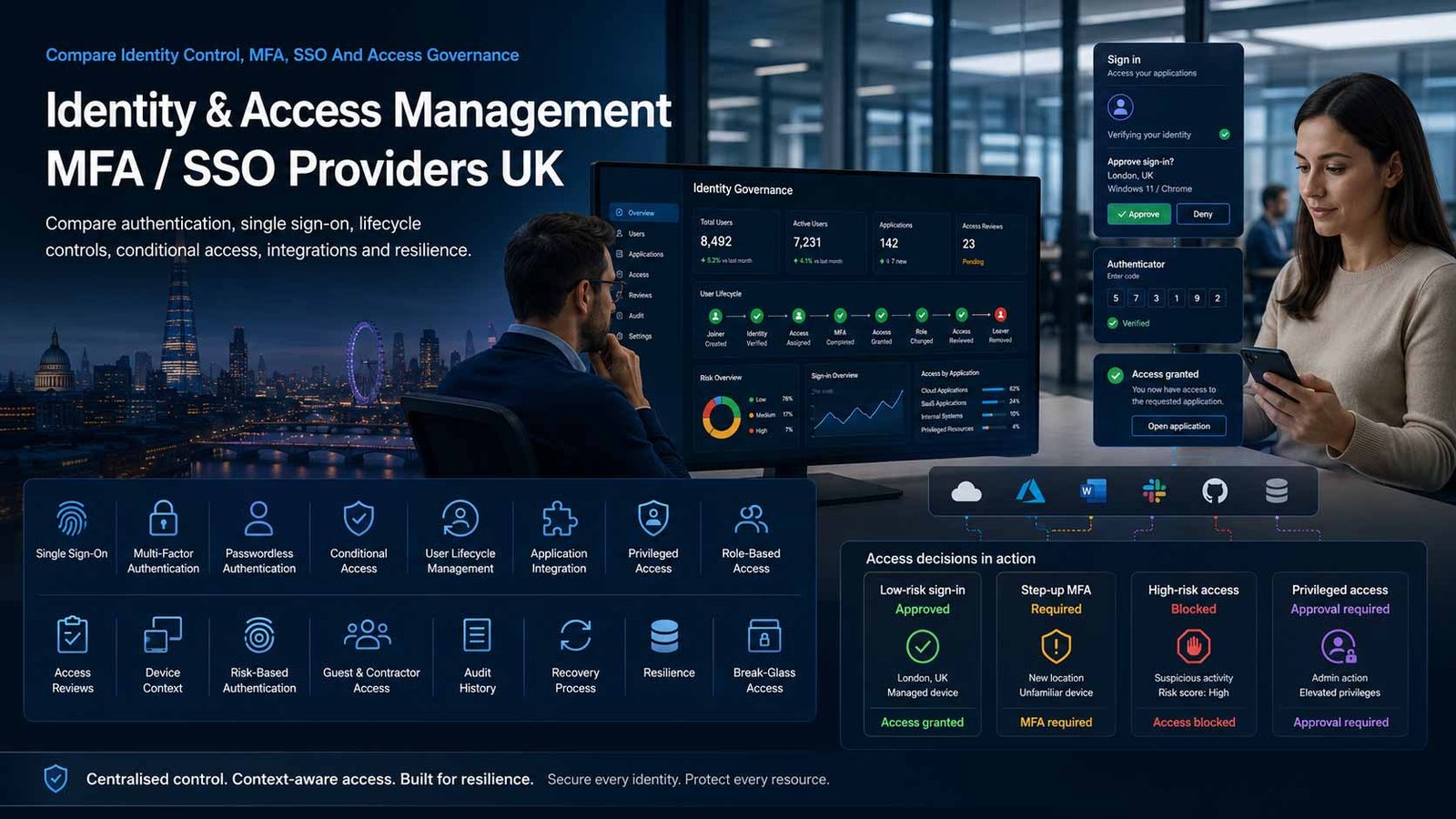
Centralise Access Without Creating One Fragile Login
SSO simplifies access, but the identity provider becomes critical infrastructure. Strong authentication, resilient recovery and careful administration are essential.
- Protect every administrator and remote-access path with strong MFA
- Prefer FIDO2, passkeys or challenge-based authentication where practical
- Automate joiners, movers and leavers without granting excessive access
- Maintain tested emergency access and identity-provider outage procedures
Identity and access management controls who can access business applications, data and infrastructure, under which conditions and for how long. Workforce IAM platforms usually combine a directory or identity provider, single sign-on, multifactor authentication, conditional access, passwordless sign-in, application integration, provisioning and access reporting.
Single sign-on reduces repeated passwords by allowing users to authenticate once and access approved applications through federation standards such as SAML or OpenID Connect. MFA adds another verification factor. The strongest methods resist phishing by cryptographically binding authentication to the legitimate service, rather than relying only on codes or push approvals that can be relayed or approved accidentally.
This page does not compare general HR identity checks, right-to-work verification, background screening or document-verification services. It also does not compare CRM usernames or login-page features as a standalone product. A CRM may connect to an IAM platform, but the commercial comparison here is the central workforce identity and access service used across multiple business applications.
Choose The Right MFA And SSO Operating Model
Identity platforms vary from MFA overlays to full cloud directories and enterprise federation services. Match the model to the existing estate.
| Service Model | What It Usually Provides | Best-Fit Question |
|---|---|---|
| Cloud identity provider and SSO | Centralises workforce authentication and federates access to SaaS and selected on-premises applications | Does the provider integrate every priority application and support required federation standards? |
| MFA-first access platform | Adds strong authentication to VPN, cloud apps, Windows or other access paths while coexisting with an existing directory | Is the main requirement stronger authentication or a complete replacement for the current identity provider? |
| Unified directory, device and access platform | Combines cloud directory, SSO, MFA, device signals and sometimes device management | Will consolidation simplify operations without weakening specialist controls or migration flexibility? |
| Microsoft-centred workforce IAM | Uses Entra ID, Conditional Access and Microsoft authentication across Microsoft 365 and connected applications | Which Entra and Microsoft 365 licences already exist, and which premium controls require additional plans? |
| Google-centred workforce IAM | Uses Google Cloud Identity or Workspace identity to provide SSO, MFA and endpoint-aware access | Does the application estate fit Google federation and management, or require extensive third-party integration? |
| Hybrid-enterprise identity platform | Connects cloud, legacy, on-premises and custom applications with federation, adaptive authentication and orchestration | Does the organisation need enterprise flexibility that justifies greater design and operating complexity? |
| Passwordless and phishing-resistant programme | Prioritises FIDO2, passkeys, security keys or device-bound credentials across supported apps and operating systems | Which users, devices and legacy applications cannot support the target method, and what is the fallback? |
| Managed IAM service | A specialist provider designs, migrates, operates and reviews the identity platform for the customer | Which security decisions, application integrations and emergency actions remain under customer control? |
Eight Areas That Determine IAM Platform Fit
Use the same identities, applications and access policies for every provider so application-catalog size does not hide authentication or lifecycle gaps.
Comparison Criterion
Directory And Identity Source Integration
Compare cloud directories, Active Directory, LDAP, Google Workspace, HR-driven provisioning, contractor sources and external partners. Define the authoritative source for each identity attribute and how conflicts, duplicates, mergers, service accounts and non-human identities are handled.
Comparison Criterion
Application SSO And Federation Coverage
Review pre-integrated applications, SAML, OpenID Connect, OAuth, WS-Federation, RADIUS, LDAP, password vaulting and custom connectors. Require a priority-application matrix showing protocol, provisioning, logout, test environment, owner and fallback.
Comparison Criterion
MFA Strength And Authentication Methods
Assess FIDO2 security keys, device-bound passkeys, platform authenticators, challenge-based authenticator apps, push with number matching, TOTP, hardware tokens, SMS, voice and offline methods. Prefer phishing-resistant options for administrators and high-risk access.
Comparison Criterion
Conditional Access And Risk Policy
Compare user, role, device, location, network, application, authentication strength, risk, session and sign-in behaviour used to permit, block or step up access. Policies should be understandable, testable and protected against accidental tenant-wide lockout.
Comparison Criterion
Provisioning And Joiner-Mover-Leaver Automation
Review SCIM, APIs, application provisioning, group assignment, role mapping, access removal, temporary access, contractors, dormant accounts, failed workflows and approval. Automation should remove access quickly without copying every HR attribute into every application.
Comparison Criterion
Passwordless Access And Account Recovery
Assess passkeys, security keys, device registration, desktop login, certificate-based methods, temporary access passes, lost-device recovery, helpdesk verification and break-glass accounts. Recovery must not be easier to exploit than normal authentication.
Comparison Criterion
Administration, Logging And Identity Governance
Compare delegated administration, least privilege, separate privileged accounts, approval, access reviews, entitlement visibility, authentication logs, audit export, API activity, service-account governance, SIEM integration and detection of suspicious identity events.
Comparison Criterion
Resilience, Support And Exit
Review service availability, regional dependencies, status communication, backup authentication, offline access, emergency accounts, support, implementation partners, data location, tenant export, application configuration, credential removal and migration to a replacement identity provider.
Measures To Define Before An IAM Contract Is Signed
Translate secure and seamless access into measurable coverage, lifecycle, resilience and administration outcomes.
| Measure | What It Should Define | Evidence To Request | Common Weakness |
|---|---|---|---|
| MFA coverage | Whether every required account and access path is protected by an approved method | Users, administrators, apps, VPN, remote access, method, exception, owner and expiry | MFA is enabled for Microsoft 365 but not for VPN, legacy apps or partner access |
| Phishing-resistant authentication coverage | The proportion of high-risk users and applications using FIDO2, passkeys or equivalent strong methods | User group, application, credential type, device support, fallback, registration and last test | Security keys are purchased for administrators but recovery falls back to weak helpdesk questions |
| SSO application coverage | Whether priority applications use central authentication and policy | Application, owner, protocol, users, SSO status, provisioning, MFA policy, logout and fallback | The platform reports thousands of integrations while the business’s legacy systems remain password-based |
| Provisioning and deprovisioning time | How quickly new access is granted and leaver access is removed across connected applications | Trigger, approval, account created or disabled, failures, completion, owner and evidence | The identity account is disabled promptly but application-local accounts remain active |
| Orphaned and dormant account rate | Whether accounts without a current owner or business need are identified and resolved | Account, application, owner, last use, source, reason, action, review and exception | Service and test accounts are excluded from reviews because ownership is unclear |
| Conditional-access policy effectiveness | Whether access decisions block relevant risk without excessive user disruption | Policy, target, condition, control, result, exception, false positive, test and owner | Policies exist in report-only mode indefinitely or overlap unpredictably |
| Authentication failure and lockout trend | Whether unusual failures, prompt fatigue and recovery issues are detected and addressed | User, app, method, failures, source, risk, support case, investigation and outcome | Helpdesk resets are tracked separately from security monitoring |
| Privileged-access hygiene | Whether administrators use separate, strongly protected and reviewed accounts | Administrator, role, scope, MFA, device, last use, approval, review and removal | Global administrator rights are granted permanently for convenience |
| Identity-provider resilience | Whether users can access critical services during provider, connector or directory disruption | Dependency, outage scenario, emergency account, offline path, test date, result and owner | Break-glass accounts exist but are expired, blocked or unknown to responders |
| Total cost per active workforce identity | The complete licence, implementation, authentication, connector, support and internal-operation cost | Users, admins, external users, apps, MFA methods, services, internal effort and growth | A low SSO price excludes lifecycle, adaptive MFA, device trust or support |
Identity And Access Management Providers UK Businesses Can Consider
Shortlist platforms whose authentication, application coverage and lifecycle automation fit the workforce. Confirm current UK packages, licences and support directly before award.
Provider Profile
Microsoft Entra ID
Microsoft Entra ID is the core cloud identity and access platform for Microsoft 365 and Azure, with SSO, MFA, Conditional Access, application integration, provisioning, identity protection and governance capabilities depending on licence. Include it where Microsoft 365 is already central to the business or where a broad SaaS and hybrid application estate can use Entra federation. Confirm Free, P1, P2, Microsoft 365 and Entra Suite entitlements, privileged administration, authentication methods, Conditional Access, legacy authentication, external users, application provisioning, hybrid connectors and emergency-access design.
Review official Microsoft Entra IDProvider Profile
Okta Workforce Identity
Okta Workforce Identity combines SSO, Adaptive MFA, lifecycle management, directory integration, identity governance and a large application network across cloud and hybrid environments. Include it where a vendor-neutral identity layer, extensive SaaS integration and strong workforce automation are priorities. Confirm the exact Workforce Identity products, user categories, MFA and FastPass rights, lifecycle and governance modules, application integrations, custom connectors, support tier, implementation, data location, admin roles, recovery controls and commercial minimums.
Review official Okta Workforce IdentityProvider Profile
JumpCloud
JumpCloud provides a cloud directory platform combining SSO, MFA, conditional access, RADIUS, LDAP, device trust and cross-platform device-management capabilities. Include it where an SME wants to replace or reduce dependence on traditional directory infrastructure while managing Windows, Apple and Linux environments from one platform. Confirm the selected package, SSO and MFA rights, device-management scope, directory and network integrations, passwordless methods, partner administration, minimum users, support, data location, migration from Active Directory or Google and the boundary between IAM and device-management pricing.
Review official JumpCloud platformProvider Profile
Cisco Duo
Cisco Duo provides MFA, phishing-resistant authentication, device trust, access policy and cloud-hosted SSO while integrating with many VPNs, applications and existing identity providers. Include it where the primary need is strong, flexible MFA across remote access, Windows logon, RADIUS and cloud applications without replacing the existing directory immediately. Confirm Duo Essentials, Advantage or Premier, SSO rights, passkeys and security-key support, device trust, trusted endpoints, offline access, telephony charges, RADIUS and VPN integrations, administrator recovery, support and whether another identity provider is still required.
Review official Cisco DuoProvider Profile
OneLogin Workforce Identity
OneLogin provides workforce SSO, MFA, directory integration, lifecycle management, application provisioning, desktop access and adaptive authentication through tiered packages. Include it where a business wants straightforward cloud IAM with broad application integration and packaged price bands. Confirm the current Basic, Essentials, Business or Enterprise plan, included lifecycle connectors, advanced directory, SmartFactor, desktop MFA, RADIUS, delegated administration, support, migration, custom connectors, minimum users, data handling and the effect of One Identity ownership on contracting and roadmap.
Review official OneLogin Workforce IdentityProvider Profile
Ping Identity Workforce IAM
Ping Identity provides cloud and hybrid workforce identity capabilities spanning SSO, MFA, federation, authentication authority, orchestration and complex legacy integration. Include it where an enterprise has demanding hybrid, custom or regulated application requirements that exceed simpler SaaS-only deployments. Confirm PingOne for Workforce, PingFederate, PingID and other components proposed, hosting model, application protocols, adaptive authentication, passwordless support, professional services, data region, resilience, licensing units, support and whether customer-identity or identity-verification modules are outside scope.
Review official Ping workforce identityProvider Profile
CyberArk Workforce Identity
CyberArk Workforce Identity combines SSO, adaptive MFA, directory, lifecycle and access controls with broader identity-security capabilities that can extend into endpoint, browser, session and privileged access. Include it where the organisation wants workforce access integrated with a wider privileged-access strategy. Confirm the exact Workforce Identity and Access Management modules, SSO, MFA methods, endpoint and browser protection, application catalogue, lifecycle, privileged integration, support, implementation, data location, licensing, existing CyberArk dependencies and separation from customer-identity or standalone privileged-access projects.
Review official CyberArk Workforce IdentityProvider Profile
Google Cloud Identity
Google Cloud Identity provides workforce identity, SSO, MFA and endpoint-aware access through the Google Admin environment, with close alignment to Google Workspace and thousands of pre-integrated applications. Include it where Google Workspace is the primary productivity platform or where a business wants Google-managed identities without licensing the full productivity suite for every account. Confirm Free versus Premium, Workspace overlap, application federation, MFA methods, security keys and passkeys, Windows and device management, directory synchronisation, context-aware access, external users, support and migration from existing identity sources.
Review official Google Cloud IdentityWhat Changes Identity And Access Management Cost
The per-user licence is only one component. Premium policy, provisioning, hardware credentials, integration and migration can materially change the budget.
| Cost Driver | Why It Changes Spend | What A Comparable Proposal Should Show |
|---|---|---|
| Workforce users and identity types | Providers may charge by active user, assigned user, workforce identity, external user, administrator or monthly active user | Employees, contractors, partners, administrators, shared or service identities, growth and minimums |
| SSO and application integrations | Basic SSO may be included while custom connectors, provisioning or on-premises applications require higher plans or services | Priority apps, protocol, prebuilt integration, provisioning, custom work, maintenance and owner |
| MFA methods and authentication usage | Push, FIDO2, passkeys, hardware tokens, SMS, voice and telephony can use different licences or transaction charges | Required methods, user groups, devices, security keys, messages, fallback, replacement and support |
| Conditional access and risk | Adaptive access, identity risk, device context, authentication strength and session controls commonly require premium tiers | Policies, signals, required licence, test mode, reports, integration and operational ownership |
| Lifecycle management and governance | Automated provisioning, access reviews, approvals, entitlement management and governance may be separate products | Sources, applications, workflows, reviewers, frequency, licences, professional services and audit evidence |
| Directory and hybrid integration | Active Directory, LDAP, RADIUS, Google, HR systems, legacy apps and custom environments create connector and infrastructure costs | Connectors, agents, servers, certificates, redundancy, upgrades, support and customer responsibilities |
| Device trust and endpoint functions | Device compliance, desktop login, certificates and device management can be bundled or separately priced | Operating systems, devices, posture, MDM dependency, desktop MFA, support and duplicated products |
| Implementation and migration | Application discovery, tenant design, policy, connector setup, user migration and pilot work create significant one-off cost | Discovery, architecture, apps, users, migration waves, testing, rollback, documentation and acceptance |
| Support and managed IAM service | Premium support, named technical contacts, 24/7 response and managed policy or lifecycle administration vary by contract | Support tier, response, contacts, service hours, changes, incident assistance, reviews and rate card |
| Contract term, growth and exit | Multi-year discounts, annual uplift, acquisitions, data export, connector transfer and re-federation affect lifetime cost | Term, indexation, user true-up, reduction, transition, configuration, logs, credentials and deletion |
How The Identity Estate Changes The Shortlist
The right platform depends on productivity suite, operating systems, legacy applications, authentication risk, internal skill and lifecycle complexity.
Microsoft 365-Centred SME
Prioritise Entra entitlements already owned, strong Conditional Access, phishing-resistant authentication, Microsoft and third-party app coverage, lifecycle automation and clear operation of emergency accounts.
Mixed Windows, Mac And Linux Business
Prioritise a platform-neutral directory, SSO, MFA, RADIUS, LDAP, device signals, desktop access and simple administration across operating systems without forcing an unnecessary productivity-suite change.
Enterprise With Legacy And Custom Applications
Prioritise hybrid federation, SAML, OIDC, RADIUS, LDAP, custom connectors, orchestration, high availability, professional services, complex policy and transparent support for older applications.
High-Risk Or Regulated Organisation
Prioritise FIDO2 or passkeys, separate privileged accounts, device-aware access, detailed logs, access reviews, strong recovery, service resilience, delegated administration and verified emergency procedures.
How To Compare IAM Proposals
Give every provider the same workforce groups, administrators, contractors, applications, directories, devices, authentication methods, lifecycle events, access policies, audit needs, resilience requirements and internal operating capacity.
- Every priority application maps to a tested SSO and provisioning method
- Administrators use phishing-resistant MFA wherever practical
- Joiner, mover and leaver workflows include failure and exception handling
- Recovery and emergency access cannot bypass normal security carelessly
- Licences, tokens, telephony, connectors and services are normalised
- Configuration, logs, credentials and application trusts are covered at exit
Make Every Provider Demonstrate The Same Access Journey
Use one new starter, role change, contractor, administrator, lost device, risky sign-in and urgent leaver across the same applications.
Compare authentication, approval, provisioning, logging, recovery and removal before comparing portal design or integration counts.
Six Questions To Put To Every IAM Provider
The answers expose unsupported applications, weak recovery, hidden premium modules and difficult migration before the agreement starts.
Which Applications And Access Paths Are Fully Supported?
Request a matrix for SaaS, on-premises, VPN, RADIUS, desktop, cloud consoles, legacy apps, provisioning, logout and fallback.
Which MFA Methods Are Phishing-Resistant?
Confirm FIDO2, passkeys, security keys, platform credentials, challenge-based apps, push, TOTP, SMS, offline use and recovery.
How Are Joiners, Movers And Leavers Controlled?
Ask for authoritative sources, approvals, provisioning, failed workflows, temporary access, contractors, dormant accounts and evidence of removal.
How Do You Prevent Administrator Lockout Or Takeover?
Review separate admin accounts, authentication strength, device restrictions, emergency access, recovery, delegated roles, monitoring and tests.
Which Licences And Services Are Required For Our Policies?
Separate base SSO, MFA, conditional access, lifecycle, governance, device trust, connectors, tokens, support and implementation.
What Can We Transfer At Exit?
Confirm users, groups, application configuration, certificates, secrets, policies, logs, provisioning mappings, credentials, assistance and deletion.
A Seven-Stage IAM, MFA And SSO Evaluation
Move from verified identities and applications to tested access outcomes rather than selecting a platform from integration count alone.
- Inventory employees, contractors, administrators, service identities, directories, devices, applications, authentication methods, privileged roles, joiner-mover-leaver processes and current incidents.
- Define SSO, MFA strength, passwordless, conditional access, lifecycle, logging, resilience, recovery and administration requirements while excluding HR identity checks and CRM-login features.
- Choose a cloud identity provider, MFA overlay, unified directory, hybrid-enterprise or managed IAM model based on the existing estate and target architecture.
- Issue one written brief and obtain comparable licence, application, authentication, lifecycle, implementation, support and three-year commercial responses.
- Run a representative proof of concept covering priority apps, phishing-resistant MFA, policy, provisioning, deprovisioning, recovery, emergency access and audit evidence.
- Migrate in controlled waves with pilot users, application trusts, connector resilience, policy testing, helpdesk preparation, rollback and formal acceptance.
- Operate through application and account reviews, policy tests, credential lifecycle, access reporting, emergency exercises, incident lessons and exit readiness.
Identity & Access Management Comparison Checklist
Use this table before approving an IAM platform, MFA rollout, SSO migration or managed identity service.
| No. | Requirement | Evidence To Obtain Before Award | Confirmed |
|---|---|---|---|
| 01 | Identity scope and accountable owner agreed | Employees, contractors, partners, administrators, service identities, risk owner and technical owner | |
| 02 | Authoritative identity sources confirmed | Active Directory, cloud directory, HR source, contractor source, attributes, owners and conflict rules | |
| 03 | Priority application inventory completed | SaaS, on-premises, VPN, desktop, cloud consoles, owners, protocols, users and criticality | |
| 04 | Target IAM operating model approved | Cloud IdP, MFA overlay, unified directory, hybrid platform, managed service and excluded HR verification | |
| 05 | MFA policy and method hierarchy agreed | FIDO2, passkeys, security keys, platform credentials, challenge app, TOTP, SMS, fallback and exceptions | |
| 06 | SSO and federation coverage demonstrated | SAML, OIDC, OAuth, RADIUS, LDAP, password vaulting, logout, certificates and failure handling | |
| 07 | Conditional access tested | Users, devices, locations, apps, risk, authentication strength, session, report-only test and exclusions | |
| 08 | Joiner-mover-leaver workflow accepted | Source event, approval, provisioning, group or role change, disablement, failure, evidence and owner | |
| 09 | Privileged administration hardened | Separate accounts, least privilege, strong MFA, device controls, delegated roles, audit and access review | |
| 10 | Recovery and emergency access tested | Lost device, new credential, helpdesk verification, temporary access, break-glass account and monitoring | |
| 11 | Logging and identity monitoring approved | Sign-ins, failures, risk, policy, admin, provisioning, API, retention, SIEM and investigation | |
| 12 | Resilience and support accepted | Service region, connectors, outage, emergency path, status, support hours, escalation and recovery test | |
| 13 | Implementation and migration plan agreed | Discovery, tenant design, connectors, applications, pilot, communications, helpdesk, rollback and acceptance | |
| 14 | Three-year total cost compared | Users, admins, apps, MFA, tokens, telephony, premium modules, services, support and internal effort | |
| 15 | Exit and identity-provider transfer agreed | Users, groups, apps, certificates, secrets, policies, logs, provisioning, credentials, assistance and deletion |
Common IAM, MFA And SSO Buying Mistakes
Most avoidable failures begin with weak recovery, incomplete application scope or an SSO project that never controls the full identity lifecycle.
| Mistake | Why It Creates Risk | Better Control |
|---|---|---|
| Treating SSO as complete IAM | Users may sign in centrally while lifecycle, recovery and local accounts remain unmanaged | Compare the full identity lifecycle |
| Choosing SMS as the default for high-risk users | SMS and basic codes offer weaker phishing and takeover resistance than FIDO2 methods | Prioritise phishing-resistant MFA |
| Protecting users but not administrators | A compromised privileged account can alter identity policy and every connected application | Use separate, strongly protected admin access |
| Automating provisioning without deprovisioning tests | Leavers may retain local or failed application accounts | Test removal and exception handling |
| Using one broad Conditional Access policy | A mistake can lock out the organisation or create unmanaged exclusions | Design, stage and test policies |
| Keeping emergency accounts untested | Break-glass access may be expired, blocked or unknown during an outage | Exercise emergency access safely |
| Counting application catalogue entries | A listed integration may not support provisioning, logout or required legacy features | Test priority applications |
| Mixing HR identity verification into IAM procurement | Document checks and employment screening use different suppliers, data and controls | Keep the service boundary workforce access |
| Assuming a CRM login is an IAM platform | One application’s login does not centralise access across the business | Evaluate cross-application identity control |
| Deferring certificate and secret ownership | The business becomes dependent on provider-held federation credentials | Agree ownership and exit transfer |
Frequently Asked Questions
Answers to common questions from UK businesses comparing workforce IAM, MFA and SSO platforms.
What Is Identity And Access Management?
Identity and access management controls who can access business applications, data and infrastructure, under which conditions and for how long. Workforce IAM commonly includes a directory or identity provider, SSO, MFA, conditional access, provisioning, passwordless access and reporting.
What Is The Difference Between SSO And MFA?
SSO allows a user to authenticate once and access several approved applications. MFA requires more than one verification factor. SSO improves usability and central control, while MFA strengthens authentication. A secure SSO deployment normally uses strong MFA.
Which MFA Methods Are Most Secure?
NCSC guidance gives FIDO2 strong phishing, guessing and theft resistance. Device-bound passkeys and security keys are therefore strong options where supported. Challenge-based authenticator apps can also offer better protection than simple push approval, SMS or reusable passwords.
Does Microsoft 365 Include IAM And MFA?
Microsoft Entra ID provides the identity foundation for Microsoft 365. Basic capabilities are included, while Conditional Access, identity protection, governance and other advanced functions require specific Entra or Microsoft 365 licences. Confirm the exact entitlement and configuration.
Can IAM Automate Joiners And Leavers?
Yes. Many platforms can create, update and disable accounts through SCIM, APIs, directories and group rules. Automation still requires authoritative data, approvals, exception handling and evidence that application-local accounts were removed successfully.
Are Passkeys Suitable For Business Users?
Passkeys can provide phishing-resistant, passwordless authentication using trusted devices or security keys. Suitability depends on operating systems, application support, device ownership, recovery and workforce needs. Businesses should pilot methods and maintain secure fallback for unsupported users.
Does IAM Replace Privileged Access Management?
Not completely. Workforce IAM protects general user authentication and application access. Privileged access management adds controls for elevated accounts, credentials and sessions. Some platforms integrate both, but privileged workflows require separate comparison and governance.
How Much Does IAM Cost?
Cost depends on users, applications, MFA methods, conditional access, provisioning, governance, device trust, connectors, implementation, support and contract term. Compare a three-year total including tokens, telephony, migration and internal administration.
How Long Does An SSO Migration Take?
Timing depends on application count, protocols, directories, user groups, custom integrations, policy, helpdesk readiness and testing. A staged programme may connect priority applications first, then migrate lower-risk and legacy services after successful pilots.
How Should A UK Business Compare IAM Providers?
Give every provider the same users, applications, directories, authentication methods, lifecycle events and resilience requirements. Compare tested integration, MFA strength, provisioning, recovery, administration, three-year cost and exit—not only app-catalogue size.
Official Guidance And IAM Provider Resources
Reviewed by Bhav Giva, Founder & Lead Analyst at CompareServices.co.uk, on 17 July 2026.
Use NCSC, ICO and official provider documentation to confirm current authentication methods, application coverage, licence requirements, data handling, support and pricing. Product names and identity-platform packages can change during procurement.
- NCSC — MFA For Corporate Online Services
- NCSC — Recommended Types Of MFA
- NCSC — Know User, Service And Device Identities
- ICO — Access Control
- Microsoft — Entra ID
- Okta — Workforce Identity
- JumpCloud — Identity, Access And Device Platform
- Cisco Duo — Identity Security And MFA
- OneLogin — Workforce Identity
- Ping Identity — Workforce IAM
- CyberArk — Workforce Identity
- Google — Cloud Identity