
Compare Firewall / Network Security Providers UK (2026)
Compare Threat Prevention, Segmentation, VPN, SD-WAN, Management, Support And Cost
Compare business firewall providers UK by next-generation threat prevention, application control, intrusion prevention, encrypted-traffic inspection, network segmentation, site-to-site and remote-access VPN, secure SD-WAN, cloud and virtual deployment, central management, logging, resilience, licensing, managed support and total cost. Evaluate providers against the same sites, users, traffic and security requirements before replacing network controls.
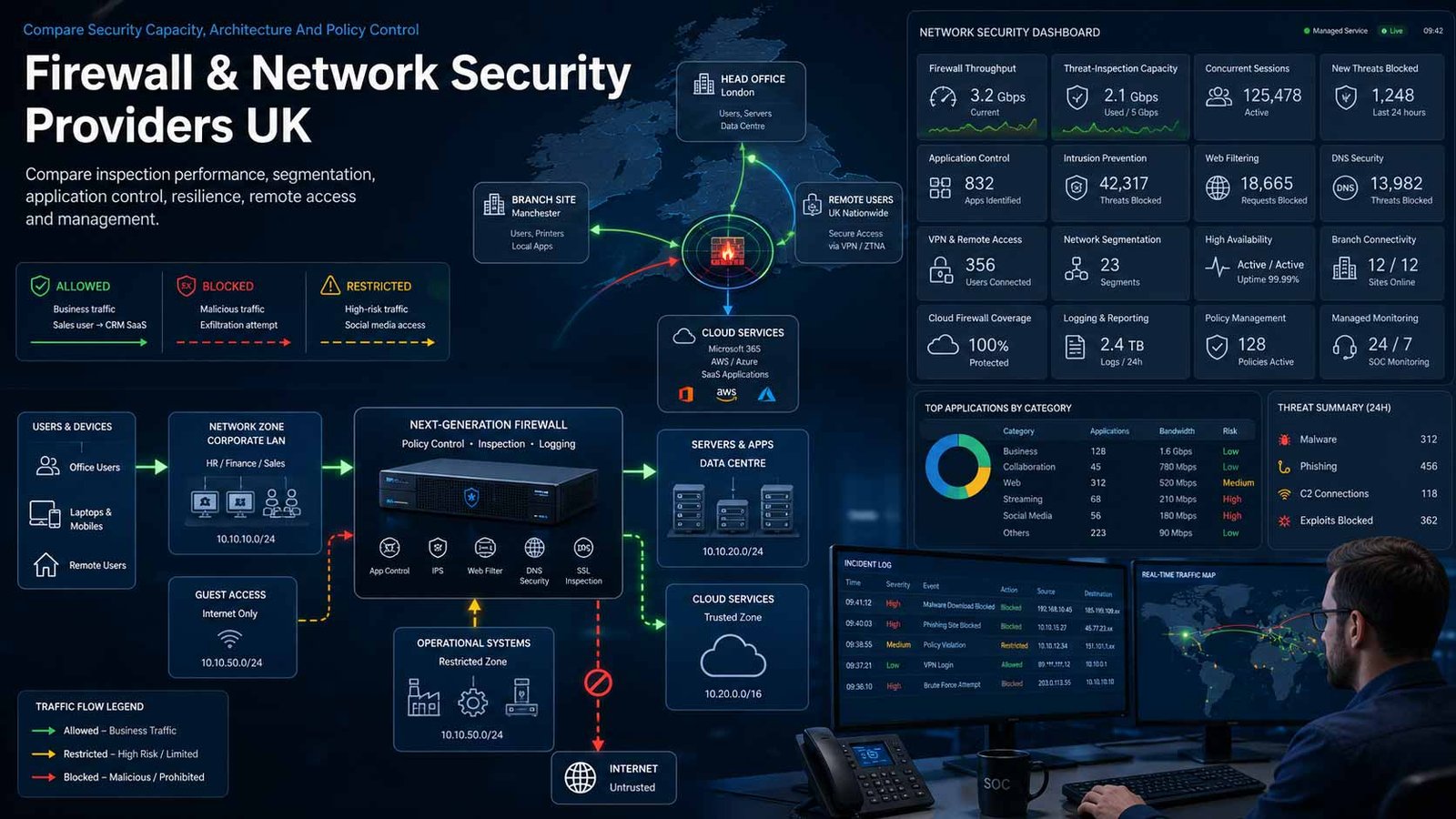
Buy Security Capacity—Not A Headline Firewall Speed
The appliance or virtual firewall must sustain real traffic while the required inspection, VPN, logging and resilience features are enabled.
- Size against protected throughput and realistic traffic growth
- Segment users, servers, guests, devices and sensitive systems deliberately
- Restrict management access and keep firmware fully supported
- Test failover, VPN recovery, logging and configuration restoration
A business firewall controls traffic between networks according to approved security policy. Modern next-generation firewalls can identify applications and users, prevent exploits, inspect malicious content, filter web traffic, terminate VPNs, segment internal networks, route traffic between sites and provide logs for investigation.
Network security is broader than one perimeter box. A sound design may use external and internal firewalls, virtual or cloud firewalls, security groups, VLANs, network access controls, secure remote access, central management and monitoring. The correct design depends on where applications, users and data now operate—not on an assumption that everything sits inside one office.
This page does not compare leased lines, broadband packages, internet-service providers or connection speeds as a connectivity purchase. Firewall products may provide WAN failover, traffic steering and secure SD-WAN, but the underlying broadband, leased-line, mobile or other circuits must be procured and compared separately. Endpoint security and wider managed-security services also remain distinct decisions.
Choose The Right Firewall And Network Architecture
Physical, virtual, cloud and managed models differ in performance, policy ownership, resilience and operating effort.
| Deployment Model | What It Usually Provides | Best-Fit Question |
|---|---|---|
| Physical next-generation firewall | Dedicated appliance at an office, branch, data centre or network edge | Can the appliance sustain required protected throughput, VPN and high availability throughout its lifecycle? |
| Virtual firewall | Software firewall deployed in a private cloud, virtual environment or supported hypervisor | Are resource reservation, licensing, platform support and performance testing clearly defined? |
| Cloud-native or cloud firewall | Provider-managed or virtual controls protecting public-cloud networks and internet-facing workloads | How are policies, routing, scaling, availability zones, cloud costs and shared responsibility managed? |
| Small-business all-in-one firewall | Combines firewall, VPN, web filtering, intrusion prevention and sometimes wireless or switching for one site | Does operational simplicity preserve the segmentation, logging and resilience the business needs? |
| Branch security and SD-WAN appliance | Combines threat prevention with multi-link traffic steering and central branch management | Are secure SD-WAN features included without tying the business to a specific connectivity package? |
| High-availability firewall pair | Uses active-passive or active-active appliances to reduce disruption from device failure or maintenance | Which failures are covered, how is state synchronised and when was failover last tested? |
| Managed firewall service | A provider supplies or operates policy, updates, monitoring, change control and support | Which operational tasks and service levels are included, and which security decisions remain with the customer? |
| Zero-trust and secure-access architecture | Uses identity, device and application context alongside segmentation and policy enforcement | How do firewalls, ZTNA and network controls work together without leaving local lateral movement unrestricted? |
Eight Areas That Determine Firewall And Network Security Fit
Use the same architecture and traffic criteria for every provider so appliance specifications do not hide licensing or protected-performance gaps.
Comparison Criterion
Protected Throughput And Appliance Sizing
Compare firewall, threat-protection, IPS, TLS inspection, VPN and mixed-traffic performance separately. Use representative packet sizes, concurrent sessions, users, applications, encrypted traffic and growth. Marketing firewall throughput measured without security services is not a safe sizing figure.
Comparison Criterion
Threat Prevention And Encrypted-Traffic Inspection
Assess intrusion prevention, malware and command-and-control detection, DNS and web filtering, application control, sandbox or advanced-threat services and inspection of encrypted traffic. Confirm certificate deployment, privacy exclusions, unsupported protocols, false positives and performance impact.
Comparison Criterion
Segmentation And Least-Privilege Policy
Review VLANs, zones, internal firewalls, identity-aware policy, guest, IoT, server, finance, development and management separation. Require deny-by-default rules where appropriate, documented business owners, expiry dates and controls that limit lateral movement after compromise.
Comparison Criterion
Remote Access, Site VPN And Secure Connectivity
Compare site-to-site VPN, remote-access VPN, ZTNA integration, strong authentication, device posture, client support, split tunnelling, certificate handling, high availability and emergency access. Confirm licensing and operational ownership for remote users and third parties.
Comparison Criterion
SD-WAN, Routing And Resilience
Assess multi-WAN policy, path selection, application steering, dynamic routing, branch templates, cellular backup, link monitoring, quality of service and failover. Treat these as firewall or network functions only; internet circuits remain a separate commercial purchase.
Comparison Criterion
Central Management, Logging And Automation
Review cloud and on-premises management, templates, role-based administration, change workflow, backups, APIs, automation, SIEM, ticketing, log detail, retention and health monitoring. Confirm whether management stops functioning during licence expiry or internet outage.
Comparison Criterion
Security Lifecycle And Administrative Hardening
Compare firmware support, vulnerability notifications, automatic or controlled updates, emergency fixes, secure boot, signed software, MFA, local and remote management restrictions, configuration encryption, support lifecycle and product end-of-sale or end-of-support handling.
Comparison Criterion
Support, Managed Operation And Exit
Assess implementation, policy migration, change control, monitoring, incident support, hardware replacement, service levels, named engineers, escalation, provider access, configuration ownership, licence transfer, data export, secure wipe and transition to a replacement platform.
Measures To Define Before A Firewall Contract Is Signed
Translate secure, resilient and high-performance into measurable policy, lifecycle and service outcomes.
| Measure | What It Should Define | Evidence To Request | Common Weakness |
|---|---|---|---|
| Protected throughput headroom | Whether the deployed model sustains normal and peak traffic with required security services enabled | Actual peak, inspected traffic, VPN, latency, CPU, memory, sessions, growth and threshold | The appliance is sized using uninspected firewall throughput |
| Rule-base quality | Whether policies remain necessary, least-privileged, owned and reviewed | Rule, source, destination, service, action, owner, reason, expiry, hit count and review | Old temporary rules remain permanently open because no owner or expiry is recorded |
| Segmentation effectiveness | Whether network zones restrict unnecessary movement between users, servers, guests and devices | Zone, permitted flows, blocked tests, exceptions, owner, review and residual risk | VLANs exist but broad any-to-any rules remove the security benefit |
| Firmware and security-service currency | Whether every firewall runs a supported release with current threat signatures and licences | Model, version, support status, release date, update, signature, licence expiry and owner | One branch appliance remains unsupported because updating may interrupt service |
| Administrative-access control | Whether privileged access is strongly authenticated, limited, reviewed and logged | Administrator, role, MFA, source restriction, last use, partner access, audit and removal | An MSP uses one shared full-administrator account across multiple customer environments |
| Failed-login and exposure monitoring | Whether management, VPN and internet-facing services are monitored for abuse | Service, source, failures, lockout, detection, investigation, block, notification and trend | Remote management remains exposed broadly without meaningful alerting |
| Availability and failover readiness | Whether device, link, power or software failure can be handled within the required recovery time | HA state, last test, failover duration, session impact, backup, spare, support and result | A second appliance is installed but configuration synchronisation and failover are untested |
| Threat-prevention outcomes | Whether IPS, malware, DNS, application and web controls block relevant activity without unacceptable disruption | Control, event, action, confidence, affected service, false positive, tuning and recurrence | The provider reports raw block counts without showing business relevance or investigation |
| Configuration recovery | Whether a known-good configuration can be restored securely after failure or compromise | Backup frequency, encryption, location, access, restore test, version and owner | Backups exist only on the firewall that has failed or been compromised |
| Total cost per protected site | The complete appliance, licence, subscription, implementation, management, support and replacement cost | Sites, models, licences, HA, services, labour, spares, growth and renewal | A low hardware price excludes essential security subscriptions and managed changes |
Firewall And Network Security Providers UK Businesses Can Consider
Shortlist platforms whose protected performance, architecture and lifecycle fit the network. Confirm current UK models, licences and support directly before award.
Provider Profile
Fortinet FortiGate Next-Generation Firewall
FortiGate provides physical, virtual and cloud next-generation firewalls with threat prevention, application control, VPN, segmentation, SD-WAN and central-management options across a wide model range. Include Fortinet where a business wants one platform from small offices to large sites or cloud environments. Confirm the exact FortiGate model, protected throughput, FortiGuard services, FortiManager or cloud-management requirement, high availability, VPN users, logging, support level, firmware lifecycle, MSP access and urgent-vulnerability response process.
Review official FortiGate firewallsProvider Profile
Sophos Firewall And XGS Series
Sophos Firewall runs on XGS appliances, virtual or cloud deployments and integrates with Sophos Central, endpoint products and managed services. Current second-generation XGS desktop models add higher performance and modern connectivity for SMB and branch use. Include Sophos where an SME values straightforward management and alignment with Sophos endpoint or MDR. Confirm XGS generation, protected performance, Network Protection and optional subscriptions, central management, HA, VPN, zero-touch deployment, support, lifecycle, policy migration and whether partner operation is included.
Review official Sophos FirewallProvider Profile
Cisco Meraki MX Security And SD-WAN
Cisco Meraki MX appliances combine cloud-managed firewall, security, VPN, routing and SD-WAN capabilities across teleworker, branch and larger-site models. Include Meraki where central cloud administration, templates and a wider Meraki network estate are important. Confirm the exact MX model, Advanced Security or Secure SD-WAN licence, protected throughput, client VPN or secure-access roadmap, warm spare, management-cloud dependency, logging, API, content filtering, support, subscription renewal and how security changes are governed by the customer or MSP.
Review official Cisco Meraki MXProvider Profile
Palo Alto Networks Next-Generation Firewall
Palo Alto Networks supplies PA-Series hardware, VM-Series and cloud firewall options using application, user and content-aware policy with advanced threat-prevention subscriptions and Panorama or cloud management. Include it where application control, complex segmentation, enterprise integration or hybrid-cloud consistency are priorities. Confirm the appropriate PA-Series or virtual model, threat, URL, DNS, malware and support subscriptions, decryption capacity, Panorama licensing, branch suitability, HA, remote-access integration, implementation skill, update process and three-year operational cost.
Review official Palo Alto Networks firewallsProvider Profile
Check Point Spark Firewall
Check Point Spark, formerly marketed as Quantum Spark, provides all-in-one next-generation firewalls for small businesses, branches and managed-service providers, with threat prevention, VPN, SD-WAN and central cloud management. Include it where an SME wants Check Point security in a compact appliance or an MSP-managed route. Confirm the current Spark model, security package, protected throughput, local or cloud management, Wi-Fi and LTE options, VPN, zero-touch deployment, support, licence term, logging, policy ownership, hardware lifecycle and how older Quantum Spark product names map to the proposed contract.
Review official Check Point SparkProvider Profile
WatchGuard Firebox
WatchGuard Firebox appliances and virtual or cloud options combine firewall, VPN, segmentation and subscription security services through Basic and Total Security Suite packages and WatchGuard Cloud management. Include it where an SME, multi-site organisation or MSP wants a broad security bundle and accessible central administration. Confirm the exact tabletop or rackmount model, protected throughput, suite, logging and retention, VPN, MFA or identity integrations, high availability, cloud-management mode, RapidDeploy, support, partner responsibilities and replacement or renewal terms.
Review official WatchGuard FireboxProvider Profile
SonicWall TZ Series Gen 8
SonicWall’s current Gen 8 TZ Series targets small and mid-sized businesses, branches and distributed organisations with next-generation firewall, threat prevention, VPN, SD-WAN and cloud-management options. Include it where an SME wants an established channel-led firewall platform and compact branch appliances. Confirm the precise Gen 8 TZ model, Essential or Advanced Protection Service Suite, protected throughput, TLS inspection, VPN users, high availability, Network Security Manager, support, zero-touch deployment, lifecycle, migration from older TZ devices and any optional Wi-Fi or secure-access services.
Review official SonicWall TZ firewallsProvider Profile
Barracuda CloudGen Firewall
Barracuda CloudGen Firewall provides hardware, virtual and cloud firewalls with threat prevention, VPN, application control, central management and advanced SD-WAN capabilities for distributed and hybrid environments. Include it where a business has multiple branches, public-cloud workloads or complex traffic-routing requirements. Confirm the model or virtual entitlement, security and support subscriptions, Control Center requirement, protected throughput, VPN, cloud integrations, HA, SD-WAN policy, logging, administration skill, implementation, support, licence portability and exit from central management.
Review official Barracuda CloudGen FirewallWhat Changes Firewall And Network Security Cost
The hardware price is only one component. Protected throughput, subscriptions, resilience, management, implementation and lifecycle can materially change the budget.
| Cost Driver | Why It Changes Spend | What A Comparable Proposal Should Show |
|---|---|---|
| Sites, users and required performance | More users, encrypted traffic, applications, sessions and branch sites require larger appliances or more virtual capacity | Current and forecast users, peak traffic, sessions, packet mix, growth, sites and target headroom |
| Protected security throughput | IPS, malware, application control and TLS inspection reduce usable throughput compared with headline firewall figures | Enabled services, tested throughput, latency, decryption, VPN, traffic assumptions and acceptance threshold |
| Hardware, virtual or cloud deployment | Appliance, hypervisor and cloud consumption models use different capital, subscription and platform costs | Models, compute, cloud marketplace, storage, zones, licences, support, scaling and replacement |
| Security subscriptions | Threat prevention, web, DNS, sandboxing, support and advanced services commonly require annual subscriptions | Exact bundle, included services, updates, support, term, renewal, expiry behaviour and optional modules |
| High availability and resilience | A second appliance, duplicate licences, power, interfaces, deployment and testing increase cost | HA mode, models, licence treatment, spares, failover, session state, support and test schedule |
| Central management and logging | Multi-site templates, management servers, cloud management, analytics and log retention may be separately licensed | Managed devices, manager, logging, retention, reports, API, SIEM, storage and support |
| VPN, ZTNA and remote users | Remote-access users, clients, MFA, certificates and secure-access services can require extra licences or infrastructure | Users, devices, platforms, authentication, client, concurrent sessions, support and migration |
| SD-WAN and branch functions | Advanced path control, cellular backup, orchestration and analytics may require higher subscriptions | Sites, links, applications, policies, controllers, data, licences and connectivity responsibilities |
| Implementation and managed service | Design, rule migration, segmentation, testing, monitoring, changes and incident support create professional-service costs | Discovery, architecture, configuration, migration, changes, service hours, reports and rate card |
| Lifecycle, renewal and exit | Hardware replacement, support expiry, licence uplift, configuration export and transition affect long-term cost | Term, end of support, renewal, replacement, trade-in, transfer, data, configuration and secure disposal |
How The Network Architecture Changes The Shortlist
The right platform depends on sites, applications, encrypted traffic, cloud design, resilience, internal skill and who will operate policy changes.
Single-Site Small Business
Prioritise correct protected sizing, straightforward policies, secure remote administration, automatic security updates, VPN, useful logging, dependable support and a clear replacement lifecycle.
Multi-Site Or Branch Organisation
Prioritise templates, zero-touch deployment, site VPN, secure SD-WAN, central logging, policy consistency, branch failover, role-based administration and predictable subscription management.
Hybrid Cloud And Data-Centre Estate
Prioritise hardware, virtual and cloud policy consistency, dynamic routing, segmentation, decryption capacity, central management, APIs, cloud integrations, HA and skilled implementation.
Regulated Or High-Availability Environment
Prioritise deny-by-default segmentation, formal rule governance, redundant appliances, controlled updates, extensive logs, change evidence, tested recovery, supplier assurance and incident escalation.
How To Compare Firewall Proposals
Give every provider the same sites, users, peak traffic, applications, encrypted traffic, server and cloud zones, VPN users, current rules, security services, logs, resilience, support and growth requirements. Require a complete bill of materials and responsibility matrix.
- Models are sized using protected—not basic—throughput
- Every security subscription and renewal is itemised
- Segmentation, VPN, HA and management are demonstrated
- Internet circuits and broadband charges remain outside scope
- Rule migration, testing and rollback are fully costed
- Configuration, logs, licences and credentials are covered at exit
Make Every Provider Protect The Same Traffic
Use representative web, cloud, voice, file-transfer, remote-access and site-to-site traffic with the required security inspection enabled.
Compare latency, protected throughput, failover, policy evidence and operational effort before comparing hardware specifications.
Six Questions To Put To Every Firewall Provider
The answers expose undersized appliances, hidden subscriptions, unmanaged rules and weak lifecycle support before the agreement starts.
Which Performance Figure Sizes The Proposed Model?
Request firewall, IPS, threat-protection, TLS-inspection, VPN and mixed-traffic results with required services enabled and growth headroom.
How Will The Network Be Segmented?
Ask for zones, permitted flows, deny rules, management network, guests, servers, IoT, sensitive users, exceptions, owners and review.
Which Licences And Subscriptions Are Essential?
Separate hardware, threat services, support, central management, logging, VPN, ZTNA, SD-WAN, sandboxing and renewal.
How Are Updates And Emergency Vulnerabilities Managed?
Confirm firmware policy, support release, urgent fixes, maintenance windows, rollback, provider alerts, testing and unsupported-device replacement.
What Happens When A Firewall Or Link Fails?
Test HA, power, configuration sync, session impact, WAN failover, spare hardware, vendor replacement, support and recovery evidence.
What Can We Export And Transfer At Exit?
Confirm configuration, rules, objects, logs, reports, certificates, backups, licences, manager access, credentials, transition and secure wipe.
A Seven-Stage Firewall And Network Security Evaluation
Move from verified traffic and architecture to tested policy rather than selecting an appliance from user count or headline throughput.
- Inventory sites, zones, applications, users, devices, servers, cloud networks, traffic, VPNs, firewall rules, incidents, support contracts and current lifecycle dates.
- Define threat prevention, segmentation, remote access, SD-WAN, resilience, logging, administration, change control and recovery requirements while excluding connectivity packages.
- Choose physical, virtual, cloud, high-availability or managed architectures based on where users, applications and data operate.
- Issue one written brief and obtain comparable model, licence, subscription, implementation, support and three-year commercial responses.
- Run a technical evaluation using protected-performance assumptions, representative policy, segmentation, VPN, failover, logging and management scenarios.
- Deploy in controlled stages with configuration backup, pilot traffic, rule migration, testing, monitoring, rollback, documentation and formal acceptance.
- Operate through rule reviews, firmware and licence management, health monitoring, failover tests, access review, incident lessons and planned lifecycle replacement.
Firewall / Network Security Comparison Checklist
Use this table before approving a firewall platform, network-security redesign or managed-firewall contract.
| No. | Requirement | Evidence To Obtain Before Award | Confirmed |
|---|---|---|---|
| 01 | Network scope and accountable owner agreed | Sites, cloud networks, zones, critical services, risk owner, technical owner and support contacts | |
| 02 | Traffic and performance baseline completed | Peak and average traffic, sessions, encrypted proportion, applications, VPN, latency and growth | |
| 03 | Firewall architecture approved | Physical, virtual, cloud, HA, branch, SD-WAN, management, logging and excluded connectivity circuits | |
| 04 | Exact models and protected capacity verified | Firewall, IPS, threat, TLS, VPN and mixed-traffic performance with required headroom | |
| 05 | Security subscriptions itemised | Threat prevention, DNS, web, sandbox, support, management, logging, term and expiry behaviour | |
| 06 | Segmentation and rule policy designed | Zones, permitted flows, deny rules, owners, expiry, exceptions, management plane and lateral-movement tests | |
| 07 | VPN and remote access accepted | Site VPN, users, clients, MFA, certificates, posture, split tunnel, third parties, failover and support | |
| 08 | HA and recovery tested | Device failover, configuration sync, power, link failure, session impact, backup, restore, spare and vendor replacement | |
| 09 | Management and administrator controls approved | Roles, MFA, source restrictions, partner access, audit, emergency use, reviews and removal | |
| 10 | Logging and monitoring requirements confirmed | Events, traffic, configuration, administrator, retention, SIEM, alerts, time sync and investigation | |
| 11 | Firmware and lifecycle process accepted | Supported release, update schedule, emergency patches, end of sale, end of support and replacement owner | |
| 12 | Implementation and rollback plan agreed | Discovery, build, rule migration, DNS or routing, pilot, testing, communication, rollback and acceptance | |
| 13 | Complete managed-service responsibilities defined | Monitoring, changes, updates, incidents, reports, service hours, exclusions, escalation and rate card | |
| 14 | Three-year total cost compared | Hardware, virtual or cloud licences, subscriptions, HA, management, logs, implementation, support and replacement | |
| 15 | Exit and secure disposal agreed | Configuration, rules, logs, backups, certificates, credentials, licences, assistance, wipe and destruction evidence |
Common Firewall And Network Security Buying Mistakes
Most avoidable failures begin with basic-throughput sizing, flat networks, unclear subscription costs or perimeter devices that are not maintained urgently.
| Mistake | Why It Creates Risk | Better Control |
|---|---|---|
| Buying broadband and firewall as one comparison | Connectivity price can hide an undersized or weakly specified security product | Procure circuits and security separately |
| Sizing from headline firewall throughput | Enabled threat prevention and TLS inspection reduce real usable performance | Use protected-performance evidence |
| Using one flat internal network | A compromised user or device can move freely toward critical systems | Design practical segmentation |
| Keeping broad any-to-any rules | Temporary convenience becomes permanent excessive access | Use owners, expiry and regular review |
| Exposing management interfaces widely | Perimeter devices become high-value targets for credential and vulnerability attacks | Restrict, harden and monitor administration |
| Deferring firmware updates indefinitely | Known vulnerabilities remain exploitable on an internet-facing security device | Operate controlled urgent patching |
| Buying HA without testing failover | The standby appliance may not have current configuration or working links | Exercise failure and restoration |
| Ignoring licence-expiry behaviour | Threat updates, support, management or advanced functions may stop at renewal | Document essential subscriptions |
| Allowing an MSP to own all credentials | The business cannot audit or transition the service safely | Maintain controlled customer ownership |
| Replacing the appliance without exporting policy | Rules, objects and evidence are lost or recreated inaccurately | Plan configuration and data transfer |
Frequently Asked Questions
Answers to common questions from UK businesses comparing firewall and network-security platforms.
What Is A Business Firewall?
A business firewall controls traffic between networks according to approved security rules. Modern next-generation firewalls can identify applications and users, prevent exploits, inspect malicious content, terminate VPNs, segment networks and produce logs for monitoring and investigation.
What Is The Difference Between A Firewall And Network Security?
A firewall is one network-security control. Network security also includes segmentation, secure routing, VPN or ZTNA, access control, wireless security, cloud controls, monitoring, configuration management and resilient architecture. The firewall platform may deliver several of these functions.
What Is A Next-Generation Firewall?
A next-generation firewall combines traditional traffic filtering with application awareness, intrusion prevention, user context, threat detection and other security services. Capabilities vary by product and subscription, so compare the configured design rather than the NGFW label.
Does A Firewall Replace Endpoint Protection?
No. A firewall protects traffic between network zones and external services. Endpoint protection operates on laptops, desktops and servers, including when devices are away from the office. Businesses normally require both controls with clearly defined roles.
Does A Firewall Include Broadband Or A Leased Line?
No. A firewall can connect to broadband, leased-line, mobile or other internet circuits and may steer traffic between them, but the connectivity service is a separate purchase. Compare circuit speed, service levels and pricing on the relevant connectivity page.
What Is Network Segmentation?
Network segmentation divides users, servers, guests, devices and sensitive systems into controlled zones. Firewall or access rules permit only required communication. Segmentation limits unnecessary exposure and can reduce an attacker's ability to move laterally after compromise.
How Much Does A Business Firewall Cost?
Cost depends on sites, protected throughput, hardware or cloud deployment, security subscriptions, high availability, management, logs, VPN, SD-WAN, implementation and support. Compare three-year total cost rather than the appliance price alone.
How Often Should Firewall Rules Be Reviewed?
Review rules regularly and after system, supplier or network changes. High-risk and temporary rules should have owners and expiry dates. Use hit counts and business justification to remove unused access while preserving required services.
How Long Does A Firewall Last?
Useful life depends on vendor support, security subscriptions, performance, interfaces, traffic growth and architecture. Plan replacement before end of support or before protected throughput becomes inadequate. Maintain configuration backups and a funded lifecycle plan.
How Should A UK Business Compare Firewall Providers?
Give every provider the same sites, users, traffic, applications, VPN, segmentation, resilience, logging and support requirements. Compare protected performance, subscriptions, policy design, lifecycle, implementation, three-year cost and exit—not only headline throughput.
Official Guidance And Firewall Provider Resources
Reviewed by Bhav Giva, Founder & Lead Analyst at CompareServices.co.uk, on 17 July 2026.
Use NCSC, ICO and official provider documentation to confirm current models, protected performance, subscriptions, firmware support, management, data handling and pricing. Perimeter-security products and lifecycle status can change during procurement.
- NCSC — Network Security Fundamentals
- NCSC — Security Architecture Anti-Patterns
- NCSC — Preventing Lateral Movement
- ICO — System And Network Security
- Fortinet — FortiGate Next-Generation Firewall
- Sophos — Sophos Firewall
- Cisco — Meraki MX Security And SD-WAN
- Palo Alto Networks — Next-Generation Firewall
- Check Point — Spark Firewall
- WatchGuard — Firebox Firewalls
- SonicWall — TZ Series Firewalls
- Barracuda — CloudGen Firewall