
Compare Cyber Insurance Providers UK (2026)
Compare Cover, Limits, Exclusions, Incident Support, Claims And Cost
Compare cyber insurance for UK businesses by incident response, business interruption, data restoration, cybercrime, privacy liability, regulatory defence, media liability, extortion, dependent-system failure, indemnity limits, excesses, exclusions, security warranties, claims handling and total premium. Evaluate insurers against the same turnover, data, systems, dependencies and loss scenarios before binding cover.
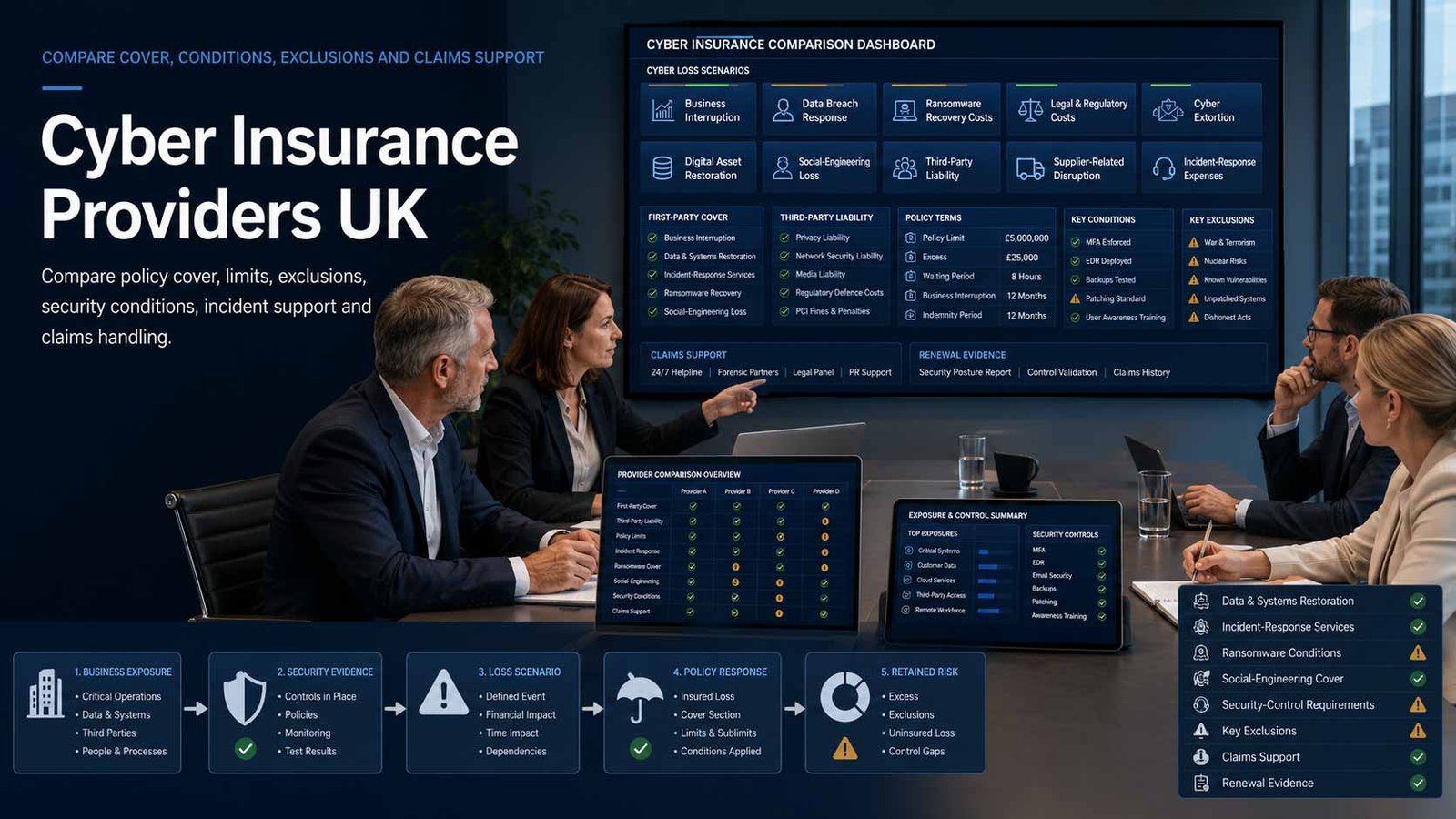
Insurance Transfers Financial Risk—It Does Not Remove Cyber Risk
A policy can fund covered response and losses, but it cannot restore unsupported systems, replace weak access controls or guarantee that an incident will be covered.
- Match policy wording to realistic business interruption and fraud scenarios
- Answer underwriting questions accurately and preserve supporting evidence
- Keep required security controls operating throughout the policy period
- Know the incident hotline, notification trigger and approved response process
Cyber insurance is commercial insurance designed to fund specified first-party losses and third-party liabilities arising from covered cyber events. Depending on the wording, cover may include forensic investigation, specialist legal advice, notification, public relations, data restoration, business interruption, cyber extortion, payment diversion, privacy claims, regulatory defence and media liability.
Policy design varies materially. A broad headline limit may contain smaller sub-limits for cybercrime, dependent-system failure, telecommunications fraud, bricking, reputational loss or voluntary shutdown. Waiting periods, indemnity periods, excesses, retroactive dates, territorial limits and definitions of computer system or security failure can change how a claim responds.
This page compares insurance cover and insurer claims support only. It does not compare cyber security suppliers, managed security services or technical products. Insurers may offer risk tools or preferred response vendors, but those services do not replace the organisation’s own prevention, resilience and recovery controls. Use the related cyber-security pages only where a separate control or managed-service procurement is required.
Compare The Losses Each Policy Is Designed To Cover
Do not compare policies using the main indemnity limit alone. The response depends on definitions, triggers, sub-limits, waiting periods and exclusions.
| Coverage Area | What It May Fund | Best-Fit Question |
|---|---|---|
| Incident response costs | Forensics, breach counsel, notification, credit monitoring, public relations and crisis-management support | Are costs paid from inside the main limit, under a separate limit or through an insurer-controlled response fund? |
| Business interruption | Lost net profit, continuing expenses and extra expense after a covered system interruption | What waiting period, measurement method, indemnity period and system-dependency definition apply? |
| Data and system restoration | Reconstruction, restoration or replacement of data, software and systems following a covered event | Does the wording cover corrupted data, improved replacement, hardware bricking, backups and internal labour? |
| Cyber extortion | Specialist response, negotiation and certain payments where lawful and approved | Which consent, sanctions, law-enforcement, payment and sub-limit conditions apply before any commitment is made? |
| Cybercrime and social engineering | Specified fraudulent transfer, payment diversion, phishing, invoice manipulation or telecommunications loss | Is cybercrime included, optional or tightly sub-limited, and which verification controls must have failed or been followed? |
| Privacy and network liability | Defence and damages arising from privacy breaches, confidentiality failures or transmission of malicious code | Which contractual liabilities, jurisdictions, claim definitions, records and notification events are covered? |
| Regulatory investigation and fines | Legal representation and certain penalties where insurable by law | Does cover apply to investigation costs only, and how does the wording address legally insurable fines? |
| Dependent and supply-chain loss | Business interruption or extra expense caused by a covered incident at a named or qualifying third party | Are cloud, payment, telecoms and outsourced-service dependencies named, unnamed, sub-limited or excluded? |
Eight Areas That Determine Cyber Insurance Fit
Use the same loss scenarios and commercial assumptions for every insurer so broad marketing language does not hide sub-limits or conditions.
Comparison Criterion
First-Party Incident And Recovery Cover
Compare forensic investigation, legal advice, breach notification, public relations, call centres, identity monitoring, data restoration, system repair, bricking and extra expense. Confirm whether the insurer appoints vendors, pays them directly or reimburses the insured after approval.
Comparison Criterion
Business Interruption And Dependency
Review triggers for security failure, system failure, voluntary shutdown and dependent-business interruption. Compare waiting periods, indemnity periods, profit calculations, ordinary payroll, seasonal growth, extra expense, cloud providers and named or unnamed dependencies.
Comparison Criterion
Cybercrime, Fraud And Extortion
Assess fraudulent transfer, payment diversion, social engineering, funds transfer, telecommunications fraud and extortion separately. These sections often have lower limits, different excesses and control conditions. Confirm whether employee, customer or vendor impersonation scenarios fit the wording.
Comparison Criterion
Third-Party Liability And Regulatory Costs
Compare privacy liability, network security liability, media liability, contractual liability, defence costs, regulatory investigation, notification and legally insurable penalties. Determine how the policy coordinates with professional indemnity, crime, directors and officers and general liability insurance.
Comparison Criterion
Limits, Excesses And Sub-Limits
Review the aggregate policy limit, each claim or event basis, reinstatement, defence-cost treatment, coinsurance, retention and every sub-limit. Model one realistic incident to show how much funding remains after forensics, legal, interruption and cybercrime claims.
Comparison Criterion
Exclusions, Conditions And Security Warranties
Examine prior known matters, war and infrastructure exclusions, contractual liability, bodily injury, property damage, professional services, intellectual property, failure to maintain controls, unsupported software, backups, multifactor authentication and payment-verification conditions.
Comparison Criterion
Claims Response And Vendor Panel
Compare hotline availability, notification obligations, insurer consent, appointed counsel, forensic firms, negotiators, public relations, restoration specialists and freedom to use existing advisers. Test what happens outside business hours and when a supplier reports the incident first.
Comparison Criterion
Underwriting, Renewal And Broker Service
Review proposal questions, external scanning, control evidence, declared revenue, records, sectors, prior incidents, acquisitions and change notification. Compare insurer appetite, broker expertise, renewal information, mid-term changes, claims advocacy and alternative-market access.
Information To Prepare Before Requesting Cyber Insurance Quotes
Accurate and consistent information produces more comparable terms and reduces the risk of disputed assumptions during a claim.
| Evidence Area | What It Should Define | Information To Prepare | Common Weakness |
|---|---|---|---|
| Declared turnover and gross profit | The revenue and profit basis used for underwriting and business-interruption calculations | Latest accounts, current management figures, forecast, seasonality, acquisitions and group allocation | An outdated turnover figure understates premium and may complicate loss measurement |
| Data and records profile | The volume and type of personal, payment, health, employee or confidential records handled | Record categories, approximate counts, locations, processors, retention, jurisdictions and owner | Only customer records are declared while employee and archived records are omitted |
| Critical systems and dependencies | The systems and third parties whose failure could stop revenue or service delivery | Applications, cloud, payment, telecoms, suppliers, recovery objectives, alternatives and contract limits | The policy limit is selected without modelling the failure of the main cloud or payment provider |
| Security-control evidence | The controls represented in the proposal and any conditions attached to cover | MFA, backups, updates, endpoint protection, email controls, access, testing, ownership and review date | The business answers yes because a control exists somewhere, although it is not applied across the declared scope |
| Business-interruption exposure | The maximum plausible lost profit and extra expense during interruption and recovery | Daily revenue, gross profit, continuing costs, seasonal peak, waiting period and restoration timeline | The selected limit funds technical response but not several weeks of lost trading |
| Cybercrime transaction exposure | The maximum funds-transfer, invoice or payment-diversion loss that could occur before discovery | Payment values, approval routes, verification, banking limits, customers, suppliers and reconciliation frequency | The cybercrime sub-limit is far below one normal supplier or client payment |
| Incident and claims readiness | Whether staff know when and how to notify the insurer and preserve policy rights | Hotline, policy number, contacts, notification trigger, panel vendors, consent, evidence and exercise result | The IT supplier begins chargeable work before the insurer is notified or approves vendors |
| Policy-change accuracy | Whether acquisitions, new services, data growth, cloud changes and material incidents are disclosed when required | Change log, policy condition, broker notification, endorsement, effective date and evidence | A material new service or acquisition remains outside the information used to underwrite the risk |
| Renewal comparability | Whether renewal terms are compared on the same limits, wording, exposure and control assumptions | Expiring and proposed schedules, endorsements, wording changes, premium, taxes, fees and broker analysis | A lower renewal price results from reduced cybercrime or dependency cover |
| Claims and remediation closure | Whether recommendations, open incidents and known weaknesses are resolved or disclosed before renewal | Claim status, lessons, control actions, dates, evidence, open issue, underwriter disclosure and acceptance | A prior event is described as closed while material remediation remains incomplete |
Cyber Insurance Providers UK Businesses Can Consider
Shortlist insurers and specialist underwriters whose wording, appetite, limits and claims model fit the business. Most specialist policies are accessed through authorised insurance brokers.
Provider Profile
Hiscox Cyber And Data Insurance
Hiscox offers UK cyber and data insurance with an online quote route for eligible businesses and cover positioned around data breaches, security failures, cyber attacks and associated recovery. Include Hiscox where an SME values direct digital access and a policy designed for smaller commercial organisations. Confirm eligibility, main limit, interruption period, cybercrime, extortion, data-restoration scope, panel response, excess, security conditions, optional cover, claims notification and whether an advised broker review is still appropriate for a complex risk.
Review official Hiscox cyber insurance →Provider Profile
CFC Cyber Insurance
CFC is a specialist cyber underwriter distributing policies through insurance brokers, with cyber cover, incident response, claims handling and proactive risk services integrated into its proposition. Include CFC where a business wants specialist wording and a cyber-focused response model. Confirm the exact primary or excess product, insurer and capacity, policy limit, cybercrime and dependency sub-limits, deductible, risk-service access, broker route, sanctions process, panel control, claims authority, territory and the current Cyber Proactive Response wording proposed.
Review official CFC cyber insurance →Provider Profile
Coalition Active Cyber Insurance
Coalition’s UK proposition combines broker-distributed cyber insurance with external risk assessment, monitoring, pre-claims support and incident response. Include Coalition where an SME or mid-market organisation values an active-insurance model and technology-led risk visibility. Confirm insured entity and capacity, eligible turnover and sectors, policy limits, pay-on-behalf terms, cybercrime, dependent interruption, extortion, monitoring data, response vendors, broker appointment, excess, exclusions, security requirements and whether services continue throughout the complete policy period.
Review official Coalition cyber insurance →Provider Profile
Beazley Full Spectrum Cyber
Beazley provides cyber insurance for SMEs and larger organisations through broker-led distribution, combining coverage with in-house pre-breach, incident-response and claims capability. Include Beazley where a business values a mature specialist cyber ecosystem or requires cover that can scale with organisational complexity. Confirm whether the proposal is the SME digital product or corporate solution, underwriting entity, territory, policy wording, interruption and dependency, cybercrime, technology or media liability, services, panel use, limits, sub-limits, excesses and multinational requirements.
Review official Beazley cyber information →Provider Profile
Chubb Cyber Enterprise Risk Management
Chubb’s UK Cyber ERM product combines first- and third-party cyber cover with risk-improvement resources, a 24/7 incident-response route and broker-distributed commercial underwriting. Include Chubb where a business wants a global insurer and a structured enterprise-risk approach. Confirm the precise Cyber ERM wording and version, event definitions, widespread-event terms, interruption and dependent-business cover, cybercrime, media liability, services, limits, retentions, panel vendors, international exposure, sanctions, claims process and any difference between Ignite and individually underwritten routes.
Review official Chubb Cyber ERM →Provider Profile
QBE QCyberProtect
QBE’s European cyber proposition includes standalone cyber insurance and the QCyberProtect global policy, with access to cyber-service resources and preferred partners for policyholders. Include QBE where a business needs broker-led specialist cover, international consistency or coordination with technology errors and omissions or other commercial policies. Confirm the exact UK or global wording, insured entities, countries, interruption, dependency, cybercrime, event aggregation, services, panel firms, limits, excesses, multinational programme structure, claims handling and broker support.
Review official QBE cyber insurance →Provider Profile
AIG CyberEdge
AIG’s UK CyberEdge proposition provides modular cyber cover, claims support, cyber-risk analytics and loss-control resources, including an SME route for eligible UK businesses through broker platforms. Include AIG where a company wants flexible sections, established international claims capability or an insurer that can accommodate growth. Confirm the exact SME or individually underwritten package, turnover and record eligibility, selected coverage modules, cybercrime, interruption, extortion, media, services, limit, retention, notification, external scanning, global entities and the effect of omitted optional sections.
Review official AIG CyberEdge →Provider Profile
Aviva Cyber Insurance
Aviva offers broker-distributed cyber insurance with coverage and incident-response support for commercial customers, alongside risk-management resources and optional tailored terms. Include Aviva where a business or broker values a major UK composite insurer and coordination with a wider commercial-insurance programme. Confirm the exact product and underwriting route, qualifying business size and sector, main and sub-limits, interruption, cybercrime, extortion, data and privacy cover, incident-response panel, reputation services, security requirements, exclusions, excesses, broker service and claims escalation.
Review official Aviva cyber insurance →What Changes Cyber Insurance Cost
Premium is individual to the risk. Insurers price the probable severity of interruption, response, fraud and liability losses as well as the quality of underwriting information.
| Cost Driver | Why It Changes Premium | What A Comparable Quote Should Show |
|---|---|---|
| Turnover, revenue and gross profit | Higher business-interruption exposure and larger operations generally increase the potential claim and underwriting complexity | Current and forecast figures, group breakdown, seasonality, acquisition and selected indemnity basis |
| Industry and business activity | Technology, healthcare, financial, professional, retail, manufacturing and other sectors present different data, dependency and liability risks | Exact activities, customers, contracts, regulated services, excluded work and changes planned during the policy year |
| Data volume and sensitivity | Personal, payment, health, employee and confidential records influence privacy response and liability exposure | Record type, approximate number, location, processor, retention, jurisdictions and protection controls |
| Security controls and external exposure | MFA, backups, email security, updates, remote access, endpoint protection and internet-facing weaknesses can affect eligibility and terms | Control coverage, evidence, exceptions, unsupported systems, recent tests, remediation and ownership |
| Policy limit and sub-limits | Higher main, cybercrime, dependent-interruption, extortion and restoration limits increase the insurer’s maximum exposure | Loss scenarios, requested limits, existing policies, contractual requirements, sub-limits and coinsurance |
| Excess and waiting period | A larger retention or longer business-interruption waiting period transfers more loss back to the insured | Affordable retained loss, cash reserves, waiting period, deductible by section and aggregation |
| Claims history and known incidents | Prior attacks, losses, notifications, open weaknesses and control failures can influence terms and insurer appetite | Five-year events, circumstances, claims, costs, remediation, open matters and underwriter disclosure |
| Cloud and supplier dependency | Reliance on a small number of critical providers can create correlated or prolonged interruption exposure | Named providers, alternatives, contracts, recovery objectives, concentration, interruption limits and current resilience |
| Territories, entities and regulation | International entities, data subjects, operations and regulatory exposure add wording and programme complexity | Insured entities, countries, revenue, employees, records, local-policy need and claims jurisdictions |
| Broker fees, taxes and annual change | Premium, Insurance Premium Tax, broker remuneration, administration and mid-term changes affect the complete cost | Net premium, tax, fees, commission disclosure, instalments, endorsements, cancellation and renewal basis |
How Business Exposure Changes The Shortlist
The right insurer depends on revenue concentration, data, system dependency, contractual obligations, international activity and the loss the business can retain.
Micro Or Small Service Business
Prioritise straightforward eligibility, incident-response access, privacy and restoration cover, proportionate interruption, useful cybercrime protection, clear security questions and a limit aligned to realistic cash exposure.
Online Retail Or Payment-Dependent Business
Prioritise business interruption, dependent systems, payment diversion, data response, cloud and payment-provider failure, peak-season exposure, cybercrime sub-limits and rapid 24/7 claims coordination.
Technology Or Professional Services Firm
Prioritise coordination between cyber, technology errors and omissions, professional indemnity, media and contractual liability, including client data, hosted services and international customers.
Mid-Market Or Multi-Entity Organisation
Prioritise entity and territory coverage, higher limits, multinational coordination, widespread-event wording, complex dependencies, experienced breach counsel, claims authority and broker-led market negotiation.
How To Compare Cyber Insurance Quotes
Give every insurer the same turnover, entities, data, systems, cloud providers, security controls, incidents, loss scenarios, requested limits and policy period. Compare complete schedules, endorsements and wording—not broker summary tables alone.
- Main limits, sub-limits, excesses and waiting periods are normalised
- Business-interruption calculations use the same loss scenario
- Cybercrime and dependent-system cover are shown separately
- Security conditions match controls that actually operate
- 24/7 notification, consent and response-vendor processes are tested
- Insurer, intermediary, fees, taxes and renewal terms are disclosed
Make Every Insurer Price The Same Loss Scenarios
Use one ransomware interruption, one supplier outage, one payment-diversion fraud and one personal-data breach with stated durations and costs.
Compare how each wording responds, which sub-limit applies and how much loss remains uninsured before comparing premium.
Six Questions To Put To Every Cyber Insurance Provider
The answers expose policy gaps, weak claims access and inaccurate security assumptions before cover is bound.
Which Insurer And Policy Wording Are Proposed?
Confirm the legal insurer, underwriter, intermediary, wording version, endorsements, policy period, territorial scope and financial-services authorisation.
How Does The Policy Respond To Our Main Loss Scenarios?
Request written analysis of ransomware interruption, data breach, supplier outage, payment fraud and system restoration using the proposed limits and conditions.
Which Sub-Limits, Excesses And Waiting Periods Apply?
Map every coverage section, retention, coinsurance, waiting period, aggregate, reinstatement and erosion of the main limit.
Which Security Statements Become Conditions Of Cover?
Identify all proposal answers, warranties, conditions precedent, minimum controls, change duties and consequences of inaccurate or outdated information.
What Must We Do In The First Hours Of An Incident?
Confirm hotline, notification trigger, consent, panel vendors, existing advisers, evidence, law enforcement, ransomware decisions, communications and emergency spending.
How Will The Broker Support Claims And Renewal?
Ask for claims advocacy, wording comparison, market access, fees, disclosure support, renewal timetable, alternative quotes and mid-term change management.
A Seven-Stage Cyber Insurance Evaluation
Move from quantified loss scenarios to verified policy documents rather than choosing cover from premium and headline limit alone.
- Define the business loss scenarios, maximum affordable retained loss, required contractual limits, entities, territories and accountable insurance owner.
- Inventory turnover, gross profit, data, critical systems, cloud and supplier dependencies, security controls, incidents and planned business changes.
- Choose an authorised broker or direct route appropriate to the organisation's complexity and obtain consistent underwriting information.
- Issue one written brief and request comparable insurers, wordings, schedules, endorsements, claims models, limits and complete annual costs.
- Model ransomware, supplier interruption, payment fraud and privacy breach outcomes against every quote, including sub-limits and waiting periods.
- Bind cover only after proposal answers, security conditions, incident contacts, panel vendors, invoices and policy documents are verified.
- Maintain controls, record material changes, exercise notification, review open recommendations and begin renewal before information or market capacity becomes constrained.
Cyber Insurance Comparison Checklist
Use this table before accepting a cyber policy, broker recommendation or renewal.
| No. | Requirement | Evidence To Obtain Before Binding Cover | Confirmed |
|---|---|---|---|
| 01 | Business loss scenarios and insurance owner agreed | Ransomware, breach, fraud, supplier failure, restoration, maximum retained loss and accountable owner | |
| 02 | Insured entities and activities confirmed | Legal names, turnover, business activities, subsidiaries, acquisitions, territories and contractual requirements | |
| 03 | Data and record exposure inventoried | Personal, payment, employee, health and confidential records, counts, locations, processors and retention | |
| 04 | Critical systems and dependencies modelled | Applications, cloud, payment, telecoms, suppliers, recovery objectives, alternatives and maximum downtime | |
| 05 | Security-control answers evidenced | MFA, backups, updates, endpoint, email, access, remote administration, unsupported systems and owners | |
| 06 | Prior incidents and known matters disclosed | Attacks, claims, circumstances, control gaps, remediation, open investigations and supporting records | |
| 07 | Insurer, broker and wording verified | Legal insurer, intermediary, authorisation, wording version, endorsements, schedule and policy period | |
| 08 | Main limits and all sub-limits compared | Response, interruption, cybercrime, dependency, extortion, restoration, liability, media and regulatory cover | |
| 09 | Excesses, waiting periods and coinsurance accepted | Amount by section, event aggregation, interruption threshold, retained loss and cash availability | |
| 10 | Exclusions and security conditions reviewed | War, infrastructure, prior acts, professional services, unsupported systems, MFA, backups and payment verification | |
| 11 | Claims response and vendor access tested | 24/7 hotline, notification, consent, breach counsel, forensics, PR, restoration, negotiator and existing advisers | |
| 12 | Policy overlap and gaps assessed | Professional indemnity, crime, property, business interruption, D&O, media and technology liability coordination | |
| 13 | Complete annual cost calculated | Premium, Insurance Premium Tax, broker fee, administration, instalment, retained loss and control costs | |
| 14 | Renewal and material-change process agreed | Timetable, acquisitions, new services, data growth, cloud changes, incidents, endorsements and broker duties | |
| 15 | Incident and claims plan exercised | Policy number, contacts, notification trigger, approval, evidence, law enforcement, communications and lessons |
Common Cyber Insurance Buying Mistakes
Most avoidable gaps begin with inconsistent underwriting information, headline-limit comparisons or incident processes that have never been tested.
| Mistake | Why It Creates Risk | Better Control |
|---|---|---|
| Buying the highest headline limit | Lower sub-limits and long waiting periods can leave the main loss poorly covered | Model realistic incidents against the wording |
| Treating insurance as a security service | The policy funds covered loss but does not operate the organisation’s controls | Maintain separate prevention and recovery ownership |
| Comparing premiums with different scopes | A cheaper quote may exclude cybercrime, dependency or useful interruption cover | Normalise every coverage section and condition |
| Answering control questions optimistically | Inaccurate representations can create underwriting and claims disputes | Verify answers with technical owners and evidence |
| Ignoring cloud and supplier dependency | A major outage can stop trading without directly compromising the insured’s own network | Compare dependent-system definitions and limits |
| Selecting a cybercrime sub-limit below normal payments | One fraudulent transfer can exceed the available section limit | Use real transaction values and approval exposure |
| Using non-panel vendors before notification | Unapproved work may not be reimbursed or may complicate claims control | Exercise the notification and consent process |
| Assuming regulatory fines are always covered | Insurability depends on law, facts and policy wording | Focus on defence, response and legally insurable amounts |
| Failing to disclose acquisitions or incidents | The risk can change materially during the policy period | Use a documented broker-notification process |
| Renewing from the schedule only | Wording and endorsements may change while the limit and insurer remain the same | Compare the full renewal documents line by line |
Compare Security Controls Separately From Insurance
Use the category hub and approved sibling pages where the business needs technical risk reduction or ongoing security operation in addition to insurance.
Frequently Asked Questions
Answers to common questions from UK businesses comparing commercial cyber insurance.
What Is Cyber Insurance?
Cyber insurance is commercial cover for specified financial losses and liabilities arising from covered cyber events. Depending on the policy, it may fund incident response, data restoration, business interruption, cybercrime, privacy liability, regulatory defence, extortion and media claims.
Does A Small UK Business Need Cyber Insurance?
A small business should assess its dependence on systems, data, cloud providers, payments and suppliers, then consider whether it could fund a serious incident itself. Insurance may be valuable where interruption, response or liability loss would exceed available cash and contractual cover is required.
Does Cyber Insurance Replace Cyber Security?
No. Insurance transfers specified financial risk after a covered event. It does not replace secure configuration, updates, MFA, backups, endpoint protection, access control, incident planning or recovery. Insurers may require these controls and can restrict cover where declared safeguards are not maintained.
What Does Cyber Insurance Usually Cover?
Common sections include incident response, legal and forensic costs, data restoration, business interruption, cyber extortion, privacy liability, regulatory defence, media liability and selected cybercrime. Coverage varies by wording, limit, sub-limit, excess, waiting period, exclusion and security condition.
Does Cyber Insurance Cover Ransomware Payments?
Some policies may cover lawful and insurer-approved extortion response and payments, subject to sanctions, policy terms, consent and sub-limits. Payment is not guaranteed or always advisable. Businesses should contact the insurer immediately and follow specialist, legal and law-enforcement guidance.
Does Cyber Insurance Cover GDPR Fines?
Policies may cover regulatory investigation, legal defence and fines or penalties only where the amount is insurable by law and the wording responds. A policy cannot guarantee payment of every regulatory penalty. Read the exact section and obtain professional advice for a claim.
How Much Does Cyber Insurance Cost?
Premium depends on turnover, industry, data, systems, dependencies, security controls, claims history, limits, excesses, territories and requested coverage. Include Insurance Premium Tax, broker fees, sub-limits, waiting periods and retained losses when comparing complete cost.
Can A Business Buy Cyber Insurance Directly?
Some insurers offer direct online routes for eligible smaller businesses, while many specialist policies are distributed through authorised insurance brokers. Complex, multi-entity or international organisations usually benefit from broker-led wording, market and claims comparison.
What Should A Business Do After A Cyber Incident?
Follow the response plan, contain immediate harm safely and contact the insurer or broker through the policy's stated notification route as soon as required. Obtain consent before appointing costly vendors where the wording requires it, preserve evidence and meet legal or regulatory duties.
How Should A UK Business Compare Cyber Insurance Providers?
Give every insurer the same exposure, controls, incidents, limits and loss scenarios. Compare the full wording, schedule, endorsements, sub-limits, excesses, interruption terms, claims response, insurer, broker service and annual cost—not only premium or the headline limit.
Official Guidance And Cyber Insurance Provider Resources
Reviewed by Bhav Giva, Founder & Lead Analyst at CompareServices.co.uk, on 16 July 2026.
Use NCSC, FCA, ICO and official insurer documentation to confirm current policy wording, appetite, limits, incident services, claims conditions and intermediary arrangements. Cover is subject to underwriting and the issued policy documents.
- NCSC — Cyber Insurance Guidance
- UK Government — Adoption Of Cyber Insurance By SMEs
- FCA — Insurance Regulatory Priorities
- ICO — Personal Data Breach Reporting
- Hiscox — Cyber And Data Insurance
- CFC — Cyber Insurance
- Coalition — Active Cyber Insurance
- Beazley — Cyber And Technology Insurance
- Chubb — Cyber Enterprise Risk Management
- QBE — Cyber Insurance
- AIG — CyberEdge
- Aviva — Cyber Insurance
Compare Providers With A Loss-Scenario Brief
Define interruption, fraud, breach and supplier-loss scenarios, then compare insurers against the same limits, controls and claims requirements.