
Compare SIP Trunk Providers UK (2026)
Compare PBX Compatibility, Channels, Porting, Resilience And Support
Compare SIP trunk providers for UK businesses by PBX compatibility, concurrent channels, number porting, call tariffs, resilience, fraud controls, emergency calling and support ownership. Assess how each provider connects an existing phone system to the public network before choosing capacity, migration, security, commercial terms and long-term service management with confidence.
Why SIP Trunks Are A Separate Buying Decision
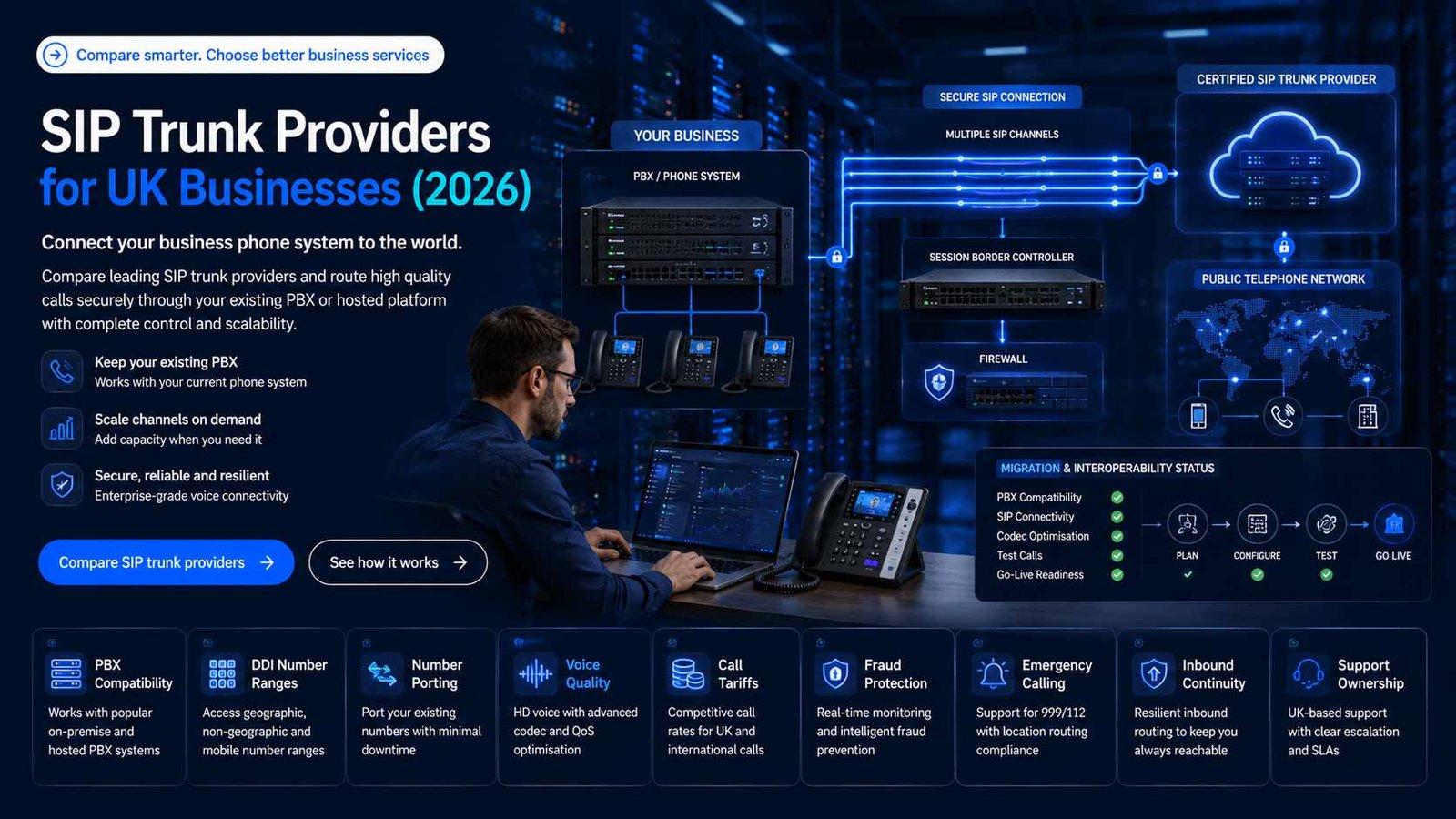
SIP trunking replaces traditional voice circuits between a business phone system and the public telephone network. It is designed for organisations that want to retain a compatible PBX while changing the carrier connection, call capacity and resilience model.
- Preserve a suitable on-premises or privately hosted PBX investment
- Buy concurrent call channels rather than hosted seats for every user
- Port existing geographic and non-geographic number ranges
- Centralise call routing, continuity and carrier management across sites
What To Check Before Choosing SIP Trunks
SIP trunking is not the same purchase as a hosted phone system. A hosted service normally provides the user platform, licences and calling together. A SIP trunk supplies the network connection that lets an existing PBX make and receive public calls.
The distinction matters because responsibility is divided between the SIP provider, PBX maintainer, session border controller, site network, number carrier and internal IT team. A low channel price can be poor value when interoperability, porting, security or incident ownership is unclear.
The UK is also moving away from legacy analogue and ISDN infrastructure, with the PSTN retirement expected by 31 January 2027. Businesses retaining a compatible PBX therefore need a controlled migration path rather than simply renewing ageing circuits.
Use the VoIP Phone Systems comparison when the requirement is a provider-hosted user platform. Use this page when the commercial focus is SIP connectivity for an existing PBX.
Compare SIP Trunk Providers By PBX And Service Fit
Provider fit depends on interoperability, number migration, capacity, resilience, security and who takes responsibility when calls fail.
| Provider | Positioning | Relevant Strengths | Potential Fit | Points To Verify |
|---|---|---|---|---|
| Gamma | UK channel-led SIP trunking | A mature UK voice network, broad reseller availability, number services, inbound call-control options and established PBX interworking through partners. | SMEs and multi-site organisations that want local implementation and support through a communications reseller. | Confirm the reseller support model, certified PBX versions, fraud controls, porting ownership, call tariffs and escalation route. |
| BT Business | UK and multinational carrier voice | One Voice SIP and Cloud Voice SIP options, enterprise network reach, number services, resilience choices and published technical guidance. | Organisations wanting a major carrier relationship, structured service schedules and potential alignment with wider BT connectivity. | Check the exact product variant, PBX compatibility, service-management boundary, connectivity dependency, minimum commitments and change charges. |
| Virgin Media Business | Managed UK SIP connectivity | SIP trunking over managed IP options, portal-based routing, statistics, continuity features and geographically resilient platform positioning. | Businesses already using Virgin Media Business connectivity or wanting carrier-managed voice and data relationships. | Verify access-network requirements, supported PBXs, QoS scope, DDI resilience, portal functionality and support coverage. |
| TalkTalk Business | Scalable business SIP with routing control | Scalable channels, optional call-management controls, migration from legacy voice and integration with broader business connectivity services. | UK businesses with on-site voice platforms that need flexible channel growth and central inbound routing. | Confirm channel increments, call bundles, number porting, disaster-routing features, compatible equipment and partner responsibilities. |
| Wavenet | Managed SIP and communications services | High-capacity SIP options, channel scalability, disaster recovery and hands-on managed service capability across voice, network and security. | Growing or complex organisations that value a managed provider for design, rollout, monitoring and ongoing support. | Validate whether service is delivered directly or through an underlying carrier, plus SBC, monitoring, SLA and incident ownership. |
| Daisy | UK business voice and migration support | SIP trunking within a wider voice portfolio, experience replacing legacy circuits and options to combine voice with managed technology services. | SMEs and public-sector organisations seeking one supplier for migration, PBX support and related communications services. | Clarify the underlying carrier, PBX support boundary, number porting process, contract structure, call recording and after-hours support. |
| M247 | Network-led voice and managed connectivity | SIP and voice capability within a broader managed network portfolio, with experience integrating PBXs, contact-centre systems and multi-site estates. | Organisations that want voice assessed alongside WAN, LAN, security and data-centre dependencies. | Request current product documentation, supported architectures, number coverage, service levels, fraud monitoring and billing detail. |
| Pure IP | Global enterprise voice specialist | Managed SIP trunking, international number services, migration expertise and support for complex multinational voice estates. | Enterprises needing multi-country numbers, central carrier management or a bridge between existing PBXs and future cloud platforms. | Validate country-by-country regulation, emergency calling, local porting, managed connectivity, support hours and contract entities. |
Provider services, underlying networks, delivery models and contract terms vary. Confirm current availability, PBX compatibility, number coverage, support ownership and all charges in the written quotation and service schedule.
Evaluate The Full SIP Trunk Service Boundary
The trunk, PBX, SBC, network and number estate must work as one operational service, even when several suppliers are involved.
Comparison Criterion
PBX Compatibility And Interoperability
Confirm the exact PBX manufacturer, software release, licensing, gateway and session border controller combination supported by the provider. A generic claim of SIP compatibility is not enough for a controlled deployment.
Comparison Criterion
Concurrent Channel Capacity
Size channels around simultaneous inbound and outbound calls, seasonal peaks, contact-centre traffic and failover demand. Ask how quickly capacity can be increased and whether channels can be shared across sites.
Comparison Criterion
Number Porting And DDI Management
Audit every main number, DDI range, fax, alarm, conference and non-geographic service. Compare validation, lead times, rejection handling, partial-range restrictions, temporary routing and rollback procedures.
Comparison Criterion
Session Border Controller And Security
Establish whether the SBC is customer-owned, provider-managed or included. Review topology hiding, encryption, access controls, rate limits, anomaly detection and protection against toll fraud or unauthorised registration.
Comparison Criterion
Resilience And Inbound Continuity
Compare dual trunks, diverse access, geographic platforms, automatic failover, DDI rerouting and portal-based diversion. Resilience should cover PBX, site, access circuit and provider-platform failures.
Comparison Criterion
Voice Quality And Network Design
Assess codec support, latency, jitter, packet loss, QoS, bandwidth reservation and monitoring. The provider should explain where its managed responsibility ends and how faults are isolated across the LAN, WAN and carrier network.
Comparison Criterion
Call Tariffs And Billing Control
Review channel rentals, bundles, mobile and international rates, connection charges, billing increments, premium-number controls, CLI presentation and itemised reporting. Model real traffic rather than comparing headline rates.
Comparison Criterion
Support And Change Management
Compare service desk hours, severity definitions, response targets, proactive monitoring, PBX vendor escalation, porting support and charges for routing, number or capacity changes after go-live.
Compare Total SIP Trunk Cost, Not Channel Rental Alone
The lowest monthly channel rate can be outweighed by porting, equipment, call usage, resilience, project work and ongoing support.
| Cost Component | How It Is Commonly Charged | Commercial Check |
|---|---|---|
| SIP channels | Usually charged per concurrent channel or capacity block. Some providers apply minimum quantities or different inbound and outbound models. | Use busy-hour call data and growth assumptions. Do not buy one channel per employee unless traffic evidence supports it. |
| Telephone numbers and DDI ranges | May include monthly rental, setup fees, block charges and separate rates for geographic, non-geographic or international numbers. | Reconcile the complete number inventory and identify numbers that cannot be ported, split or moved independently. |
| Number porting | Commonly charged per number, range, order or project, with extra cost for complex or failed submissions. | Ask what evidence is required, who corrects rejections and whether the quote includes temporary routing and project coordination. |
| Call usage | Charged by destination, duration, bundle or committed-spend model. Mobile and international traffic can dominate the bill. | Provide representative call records and compare total monthly usage, not one advertised pence-per-minute figure. |
| SBC, gateway and PBX work | Hardware, virtual appliances, licences, configuration, certification testing and maintenance may be separate. | Confirm whether the provider, PBX maintainer or internal team owns the SBC and software lifecycle. |
| Connectivity and quality controls | Private access, managed circuits, QoS, diverse routes or monitored internet access may add monthly and installation costs. | Separate voice access requirements from unrelated broadband procurement while ensuring the chosen network can meet the voice design. |
| Implementation and testing | Discovery, dial-plan design, porting, pilot calls, out-of-hours cutover and rollback support may be project-priced. | Require a written acceptance plan covering inbound, outbound, emergency, CLI, DDI, failover and recording tests. |
| Support, monitoring and add-ons | 24/7 support, proactive monitoring, call recording, fraud alerts, analytics and continuity portals can be bundled or optional. | Compare the included operational service, escalation rights and change allowances before accepting the lowest rental price. |
Ask shortlisted providers to price the same channel profile, number estate, call sample, resilience design, support level and contract term. Comparable assumptions matter more than a headline saving claim.
Decide Whether SIP Trunking Fits The Existing Voice Estate
The strongest case normally combines a viable PBX, meaningful call demand, clear technical ownership and a reason to preserve current telephony investment.
Established PBX Estate
A business with a supported PBX and useful remaining asset life may use SIP trunks to replace legacy circuits without changing every handset or workflow immediately.
Multi-Site Organisation
Centralised SIP can consolidate number management and call capacity across sites, provided the WAN, routing and continuity design avoids creating a single point of failure.
High Concurrent Call Demand
Reception teams, sales floors and service operations may benefit from capacity based on simultaneous calls rather than purchasing a full hosted licence for every employee.
International Voice Estate
A specialist provider can consolidate numbers and carrier relationships across countries, but local regulation, emergency calling and porting must be validated market by market.
Contact Centre With Existing PBX
SIP may preserve routing, recording and workforce integrations while modernising carrier access, although capacity, fraud controls and resilience require careful testing.
Phased Cloud Migration
SIP trunks can act as an interim or coexistence layer while a business migrates selected users or sites to cloud calling over time.
Very Small Greenfield Business
A small organisation with no PBX investment may find a hosted phone system simpler because SIP trunking retains infrastructure and operational responsibilities.
Unsupported Or End-Of-Life PBX
Replacing legacy circuits does not remove PBX lifecycle risk. An unsupported platform may justify a broader phone-system migration instead of a trunk-only project.
PBX And Network Readiness Determine Migration Risk
A SIP order should not be treated as a simple replacement line. The provider and PBX maintainer need an agreed technical design covering signalling, codecs, DDI presentation, caller ID, firewall rules, SBC placement, emergency calling, recording, fax or analogue dependencies and bandwidth.
Run a readiness assessment before committing a port date. Confirm the exact software versions, licences and interfaces required by the PBX. Review whether existing routers or firewalls use SIP ALG, whether public IP addressing is needed and how the provider authenticates the trunk.
Voice-quality testing should include realistic concurrent calls and traffic conditions. Successful registration does not prove that busy-hour calls, transfers, queues, recording, DTMF and failover will behave correctly.
Port Numbers Through A Controlled Cutover
Porting errors can interrupt inbound service even when the SIP trunk itself is working. Build the migration around verified customer records, complete number ranges and a documented fallback.
- Validate account names, addresses, line details and range ownership
- Protect hidden DDIs, alarms, fax, lifts and payment terminals from omission
- Test new numbers and routing before moving business-critical ranges
- Agree cutover contacts, escalation windows and rollback decisions
- Keep legacy services until acceptance criteria are completed
Ask Questions That Expose Technical And Operational Risk
Useful answers should be specific enough to appear in the order form, implementation plan, support schedule or service description.
Which PBX Builds Are Supported?
Request an interoperability statement naming manufacturer, model, software release, SBC and known limitations. “Standards-based” does not replace tested compatibility.
How Were The Channel Numbers Calculated?
Ask the provider to show busy-hour assumptions, inbound and outbound concurrency, seasonal peaks, failover capacity and the lead time for adding channels.
Who Owns Number Porting End To End?
Clarify who audits ranges, submits orders, resolves rejections, coordinates the losing carrier and communicates cutover progress to your project team.
What Happens When A Site Or Trunk Fails?
Require a routing diagram for PBX, access, SBC and provider-platform failures, including automatic diversion, portal control and recovery procedures.
How Is Toll Fraud Detected And Contained?
Ask about rate limits, destination blocks, spend alerts, unusual-pattern monitoring, credential controls and liability for fraudulent traffic.
Where Does Provider Responsibility End?
Define whether the SLA covers only the SIP platform or also the access circuit, SBC, PBX, LAN and third-party maintainer. Map every fault domain to an accountable party.
Build A Weighted SIP Trunk Provider Shortlist
Weight the areas around the current PBX, number estate, call profile and operational risk rather than choosing on brand familiarity or channel price alone.
| Assessment Area | Illustrative Weight | Evidence To Request |
|---|---|---|
| PBX and SBC interoperability | 20% | Written compatibility evidence, software requirements, test plan and ownership matrix. |
| Number porting and DDI control | 15% | Complete number audit, porting process, lead times, rejection handling and rollback plan. |
| Resilience and continuity | 15% | Architecture diagram, failover demonstrations, DDI routing controls and recovery commitments. |
| Security and fraud management | 15% | SBC controls, encryption options, rate limits, monitoring, alerts and fraud-response process. |
| Voice quality and network assurance | 10% | Codec support, QoS design, monitoring, quality reports and demarcation points. |
| Call tariffs and total cost | 10% | Normalised price model covering channels, numbers, usage, hardware, project work and support. |
| Support and escalation | 10% | Hours, severity definitions, response targets, proactive monitoring and named escalation routes. |
| Scalability and administration | 5% | Channel-change times, portal controls, reporting, multi-site management and API capability. |
How To Compare SIP Trunk Provider Proposals
Give every shortlisted provider the same PBX inventory, number list, call profile, resilience requirements and support expectations. This makes it easier to compare interoperability, channel flexibility, number services, security, voice quality, migration work and ongoing service ownership on a like-for-like basis.
Check exactly what each quotation includes. One proposal may include a managed SBC, access circuit and 24/7 monitoring, while another may cover only trunk rental. Ask suppliers to separate recurring charges, implementation work, call usage, equipment, porting, support and optional services.
Request written confirmation of assumptions, exclusions, customer responsibilities, acceptance tests, fault demarcation and escalation routes before selecting a provider.
What A Strong Proposal Should Confirm
A suitable proposal should explain exactly how the SIP service will work with your PBX, numbers, network and support arrangements.
- Named PBX, software and SBC compatibility
- Channel sizing based on realistic busy-hour demand
- Number-porting stages, validation and fallback arrangements
- Security, fraud monitoring and spend-control responsibilities
- Clear fault ownership across the trunk, PBX, SBC and network
Use This Sequence Before Signing A SIP Trunk Contract
A controlled procurement process protects number continuity, call quality, security and service accountability.
- Audit the PBX model, release, licences, handsets, gateways, SBCs and support status.
- Export at least one representative month of call records and identify the busiest hour.
- Create a complete inventory of main numbers, DDI ranges, non-geographic numbers and special devices.
- Define required call channels, growth headroom, international destinations and spend controls.
- Map failure scenarios for site access, PBX, SBC, carrier platform and inbound number routing.
- Ask each provider to price the same channel, number, usage, resilience and support assumptions.
- Complete interoperability, security, emergency-call, DTMF, recording, queue and failover testing.
- Port a controlled number group before business-critical ranges where the estate allows it.
- Keep the previous service active until written acceptance and fallback conditions are satisfied.
- Record who owns ongoing PBX, SBC, network, number, fraud and carrier support responsibilities.
Frequently Asked Questions
Answers to common technical, commercial and migration questions from UK businesses comparing SIP trunk providers.
What is a SIP trunk?
A SIP trunk is an IP-based connection between a compatible business phone system and the public telephone network. It replaces physical voice circuits with virtual call channels while allowing the organisation to retain its PBX, numbers and many existing call flows.
How many SIP channels does a business need?
Channel demand is based on simultaneous calls rather than total employees. Use busy-hour records, inbound and outbound peaks, queue traffic, seasonal demand and resilience requirements. Add sensible headroom, then confirm how quickly the provider can increase capacity.
Can a business keep its existing telephone numbers?
Eligible geographic, non-geographic and DDI ranges can normally be ported, but feasibility depends on the current carrier, range structure, account data and number type. Audit every number and dependency before agreeing a cutover date.
Does SIP trunking require a new phone system?
Not necessarily. SIP trunking is often selected to retain a compatible on-premises or privately hosted PBX. The provider should confirm the exact PBX release, gateway, licences and SBC required. An unsupported PBX may make a wider replacement more appropriate.
What is the difference between SIP trunks and hosted VoIP?
SIP trunks connect an existing PBX to public calling. Hosted VoIP normally places the phone-system platform in the provider cloud and charges user licences or seats. The right choice depends on existing infrastructure, operational ownership and migration goals.
How should SIP trunks be protected against fraud?
Use a properly configured SBC, strong authentication, destination restrictions, rate limits, spend alerts, unusual-call monitoring and rapid blocking procedures. Contract terms should explain notification, response and liability when fraudulent traffic occurs.
What happens to calls if the main site loses connectivity?
A resilient design may automatically reroute inbound numbers to another trunk, site, mobile destination or continuity service. The exact behaviour depends on provider features, number hosting, PBX design and whether alternative access remains available.
How long does a SIP trunk migration take?
Technical setup can be relatively quick for a supported PBX, but number porting, range validation, equipment changes, testing and governance often determine the schedule. Complex multi-site or international estates should be migrated in controlled phases.
Will SIP trunks work after the UK PSTN switch-off?
SIP trunks are an all-IP alternative to legacy PSTN and ISDN voice circuits. The provider must still confirm PBX compatibility, digital dependencies, emergency calling and continuity. The UK retirement of the old PSTN is expected by 31 January 2027.
Do SIP trunks include broadband or internet access?
Not automatically. Some providers bundle managed access, but SIP trunking is the voice service connecting the PBX to the carrier network. The provider proposal should identify any access dependency without treating the SIP trunk as a broadband package.
Provider Information And Verification Resources
Use these official resources to verify current SIP trunk services, PBX requirements, number-porting arrangements and the UK transition from analogue to digital landlines. Product availability, compatibility, call charges and support terms can change, so confirm all material details in the final quotation, interoperability statement and service schedule.
Review before signing: supported PBX and SBC versions, channel quantities, number inventory, porting responsibilities, emergency calling, resilience, fraud controls, call tariffs, service levels and contract terms.
- Ofcom — Moving Landline Phones To Digital Technology
- GOV.UK — UK Transition From Analogue To Digital Landlines
- BT Business — Global SIP And Voice Services
- Virgin Media Business — SIP Trunking
- TalkTalk Business — SIP Trunking
- Gamma — Business Communications And SIP Trunks
- Wavenet — SIP Trunking Services
- Daisy Group — SIP Trunking And Business Voice
- M247 — PSTN Replacement And SIP Trunking
- Pure IP — What Is SIP Trunking?