
Compare Contact Centre Solutions Providers UK (2026)
Compare Agent Operations, Omnichannel Routing, Analytics And Customer-Service Control
Compare contact centre solutions for UK customer-service and sales teams by routing, digital channels, workforce tools, quality management, analytics, AI assistance, integrations, compliance and implementation support. Evaluate how each platform handles agent workloads, customer journeys, supervision, resilience and operational change before requesting tailored provider quotes for your organisation with confidence.
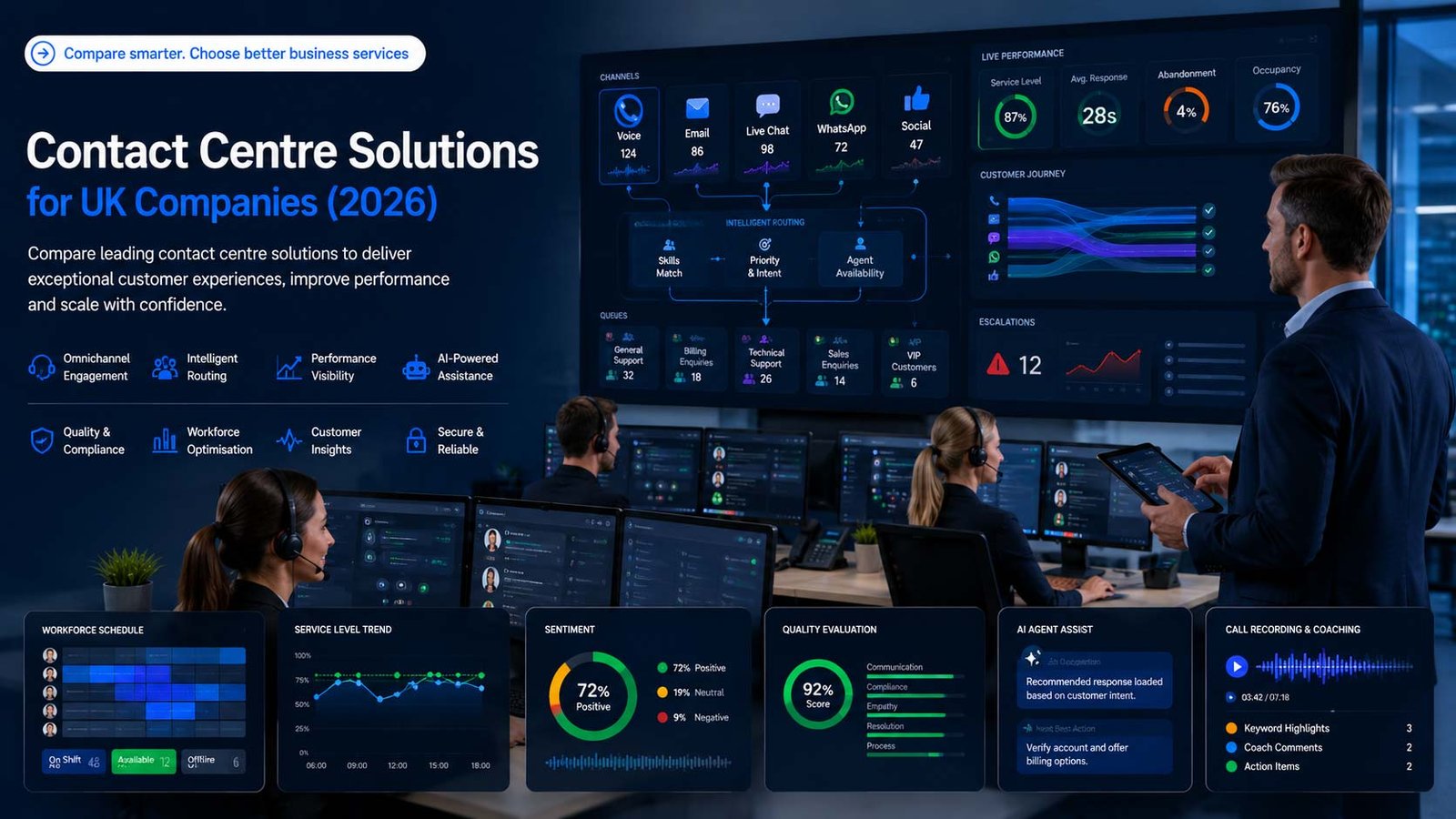
Why Contact Centre Operations Need A Dedicated Platform
A contact centre coordinates high-volume customer interactions, agent workloads, service levels, quality controls and management reporting. The platform therefore needs to support operational decisions, not simply connect calls.
- Route interactions by skill, priority, language, customer value or enquiry type
- Give agents one workspace for voice and approved digital channels
- Monitor queue conditions, service levels, outcomes and customer effort
- Control recording, evaluation, coaching, permissions and retention policies
What To Check Before Choosing A Contact Centre Platform
Contact centre solutions are designed for structured customer-service and sales operations. Compare inbound and outbound handling, omnichannel routing, agent desktops, supervisor tools, workforce management, quality management, analytics, AI assistance, self-service, integrations, resilience and implementation responsibility.
Build the shortlist around interaction volume, agent count, operating hours, customer channels, queue complexity, compliance obligations, existing case-management processes and the level of change your organisation can absorb.
Choose a dedicated contact centre platform when you need measurable customer-interaction operations, controlled queues, supervisor oversight and accountable service delivery. Standard business calling and customer-record management should be assessed separately.
Compare Contact Centre Providers By Operating Fit
Shortlist platforms by routing depth, channel coverage, workforce controls, analytics, integration capability, implementation support and long-term administration rather than headline AI claims alone.
| Provider or platform | Best-fit buyer profile | What to compare closely | Questions before choosing |
|---|---|---|---|
| RingCentral RingCX | SMEs and mid-market teams seeking voice and digital channels with a comparatively streamlined cloud deployment route. | Channel entitlements, routing, AI assistance, quality tools, workforce options, integrations, implementation and support boundaries. | Which functions are included in the core licence, and which require additional packages or services? |
| 8×8 Contact Center | Distributed customer-service and sales operations wanting omnichannel engagement, outbound capability and unified administration. | Queue design, proactive outreach, workforce tools, reporting, regional voice coverage, integration options and partner support. | Will the supplier manage design and adoption, or will responsibility sit with an implementation partner? |
| Genesys Cloud CX | Organisations with complex routing, digital journeys, workforce engagement and enterprise-scale customer-experience requirements. | Architecture, orchestration, AI capabilities, workforce engagement, journey management, data integration, professional services and governance. | Does the organisation have the operational maturity and resources needed to configure and continuously improve the platform? |
| NiCE CXone | Contact centres prioritising advanced workforce engagement, quality management, analytics, automation and enterprise controls. | Package structure, interaction analytics, workforce management, quality workflows, AI governance, data residency and service support. | Which applications are essential at launch, and which should be phased to avoid unnecessary complexity? |
| Five9 | Inbound, outbound or blended operations seeking a mature cloud contact-centre platform with automation and migration services. | Inbound and outbound features, dialling controls, workflow automation, workforce engagement, integration, migration and commercial bundles. | How will outbound activity, consent controls and suppression processes be configured and audited? |
| Cisco Webex Contact Center | Businesses invested in Cisco collaboration, networking or security and wanting an integrated customer-experience platform. | Agent licensing, digital channels, AI assistance, interoperability, deployment design, analytics, security controls and support ownership. | Will Cisco alignment reduce operational complexity, or create dependencies that need specialist administration? |
| Microsoft Dynamics 365 Contact Center | Microsoft-centred organisations wanting voice and digital engagement with Copilot, Teams Phone extensibility and composable service workflows. | Licence combinations, existing application integration, voice design, AI usage, implementation partner capability, data governance and support. | Can the platform work with current systems without turning the project into a wider business-application replacement? |
| Talkdesk | Customer-service teams looking for cloud contact-centre deployment, industry workflows, AI features and a broad integration ecosystem. | Workspace design, digital channels, automation, workforce tools, reporting, implementation approach and regional service coverage. | Which industry features are genuinely useful, and which add cost without improving the target operating model? |
Key Features To Compare Before Requesting Quotes
Translate operational requirements into measurable platform criteria before discussing products, licences or demonstrations.
Interaction Routing
Queue, Skill And Priority Logic
Assess skills-based routing, priority rules, overflow, callbacks, estimated wait times, VIP treatment, language handling and routing changes during peak demand.
Channel Coverage
Voice And Digital Engagement
Confirm which channels are native, how conversations move between channels, whether customer context follows the interaction and how digital work is prioritised.
Agent Experience
Workspace, Knowledge And Assistance
Compare desktop usability, knowledge access, scripting, disposition codes, summaries, suggested actions, accessibility and the number of systems an agent must use.
Supervisor Control
Live Management And Escalation
Review wallboards, alerts, queue intervention, silent monitoring, coaching, escalation, role permissions and the clarity of real-time operational views.
Quality Management
Recording, Evaluation And Coaching
Check recording coverage, pause-and-resume controls, evaluation forms, sampling, calibration, coaching workflows, retention and access permissions.
Workforce Planning
Forecasting And Scheduling
Determine whether forecasting, shift planning, adherence, leave management and intraday adjustments are included or supplied through separate workforce applications.
Analytics
Outcome And Journey Visibility
Compare queue, agent, channel, sentiment, resolution, transfer, abandonment and customer-effort reporting, including export and business-intelligence access.
Resilience
Continuity And Service Accountability
Review platform availability, voice resilience, geographic failover, status communications, recovery procedures, service credits and escalation ownership.
What Shapes Contact Centre Solution Costs
Headline seat prices rarely represent the total commercial commitment. Build a cost model that includes platform, usage, delivery, integration and ongoing operational ownership.
| Cost area | What may be charged | Why it changes the budget | What to confirm |
|---|---|---|---|
| Agent licensing | Named, concurrent, full-time, occasional, supervisor or specialist licences. | The commercial model can materially affect seasonal, shift-based and part-time operations. | Define active users, peak concurrency, supervisors and non-agent access separately. |
| Channels and usage | Voice minutes, numbers, messaging, email, social channels, recording storage and transcription. | Consumption can rise with volume even when licence count remains stable. | Model normal, peak and campaign demand using realistic interaction data. |
| Workforce and quality tools | Forecasting, scheduling, evaluation, speech analytics, screen recording and coaching applications. | Advanced management tools may sit outside the core agent package. | Separate must-have controls from future optimisation capabilities. |
| AI and automation | Virtual agents, summaries, agent assist, transcription, sentiment, knowledge generation and consumption credits. | AI pricing may depend on sessions, minutes, tokens, interactions or usage tiers. | Request transparent limits, monitoring and safeguards against uncontrolled consumption. |
| Integration and data | Connectors, APIs, middleware, data migration, reporting feeds and custom development. | Complex customer context and case workflows often create the largest project variance. | Document each system, data owner, workflow and support dependency before contracting. |
| Professional services | Discovery, design, configuration, testing, training, migration, cutover and project management. | A low platform price can be outweighed by weak implementation planning or repeated change requests. | Agree deliverables, acceptance criteria, responsibilities and post-launch support. |
| Support and success | Standard support, premium support, named service management, optimisation reviews and managed administration. | Mission-critical operations may need faster response and proactive management. | Compare service hours, severity definitions, escalation and configuration support. |
Match The Platform To Your Contact Centre Model
Different operating models require different routing, management, compliance and integration depth.
Customer-Service Teams
Prioritise case context, queue visibility, resolution outcomes, knowledge access, quality evaluation, escalation and accessible customer channels.
Inbound Sales Operations
Focus on response speed, lead routing, conversion reporting, callback management, attribution and consistent follow-up without duplicating customer records.
Outbound And Campaign Teams
Require careful list governance, dialling controls, consent and suppression processes, pacing, campaign reporting, call outcomes and supervisor intervention.
Blended Contact Centres
Need balanced workload distribution across inbound, outbound and digital work so agents can switch tasks without harming service levels.
Regulated Operations
Emphasise recording controls, access permissions, retention, audit trails, data processing, supplier assurance, business continuity and documented change.
Seasonal Or Variable Demand
Compare concurrent licensing, rapid onboarding, temporary users, overflow routing, remote-agent readiness and commercial flexibility during demand spikes.
Multi-Site And Remote Teams
Assess consistent policies, supervisor visibility, voice quality, home-working support, identity controls, device standards and location-independent resilience.
Growing SMEs
Choose a platform that meets current routing and reporting needs without imposing enterprise complexity before operational processes are ready.
Implementation Readiness Matters As Much As Features
Contact centre migration touches customer journeys, numbers, queues, recordings, agent workflows, reporting, training and management routines. A demonstration can show features, but it cannot prove that the operating model is ready.
- Baseline current contact volumes, channels, queue outcomes and peak patterns
- Map routing logic, opening hours, overflow, callbacks and escalation paths
- Document integrations, data ownership, recording rules and reporting outputs
- Define pilot groups, acceptance tests, rollback steps and cutover support
Protect Service Levels During Change
Implementation should preserve customer access while agents learn a new workspace and supervisors validate reporting. Ask providers how they test queues, prompts, emergency routing, digital channels, recording, permissions and data flows before launch.
For complex operations, phased delivery is usually safer than activating every channel, workflow and AI function on day one. The platform should support improvement after launch without forcing disruptive redesign.
Questions That Expose Commercial And Operational Risk
Use the same questions with every shortlisted provider so proposals can be compared on a consistent basis.
How Are Licences Counted?
Ask whether licences are named, concurrent or usage-based and how supervisors, temporary users and administrators are treated.
Who Designs The Routing?
Confirm who translates business rules into queues, priorities, skills, overflow and callback logic and who maintains it later.
Which Channels Are Native?
Identify channels delivered directly by the platform versus third-party connectors with separate contracts or support paths.
How Is Recording Governed?
Review capture, pause controls, access, encryption, retention, export, deletion and how subject-access requests are supported.
How Are AI Costs Controlled?
Ask what triggers consumption, how usage is monitored, which data is processed and how automated outputs are reviewed.
What Does Support Include?
Separate platform incidents from configuration changes, integration faults, carrier issues, reporting help and ongoing optimisation.
How Is Resilience Tested?
Request the continuity design, service commitments, failover approach, incident communications and evidence from operational testing.
What Happens At Contract Exit?
Confirm number transfer, recording export, data retrieval, configuration documentation, deletion processes and transition assistance.
Who Owns Adoption?
Clarify training, floor support, supervisor enablement, knowledge preparation and responsibility for post-launch performance improvement.
Build A Weighted Contact Centre Scorecard
Use evidence-based scoring so a polished demonstration does not outweigh delivery risk, governance or operational fit.
| Score area | Suggested weighting | Evidence to request | Red flags |
|---|---|---|---|
| Routing and channel fit | 20% | Configured demonstration using your queue, priority and customer-channel scenarios. | Generic demonstrations, manual workarounds or unclear channel ownership. |
| Agent and supervisor usability | 15% | Role-based trials, accessibility checks and realistic daily tasks. | Excessive application switching or critical controls hidden from supervisors. |
| Quality, workforce and analytics | 15% | Example evaluation, forecasting, adherence and outcome-reporting workflows. | Important management tools available only through costly additions discovered late. |
| Integration and data governance | 15% | Architecture, data-flow diagrams, connector scope, security information and support model. | Unowned middleware, vague data processing or custom work without maintenance terms. |
| Implementation capability | 15% | Named delivery team, plan, testing method, acceptance criteria and relevant references. | No discovery phase, compressed testing or dependence on undocumented assumptions. |
| Service and resilience | 10% | Service levels, incident process, status reporting, continuity design and escalation map. | Support limited to platform tickets while carriers and integrations sit elsewhere. |
| Commercial transparency | 10% | Five-year cost model, licence rules, usage assumptions, indexation, change fees and exit terms. | Low initial price with unclear consumption, professional-service or storage exposure. |
How To Compare Contact Centre Provider Proposals
Compare every proposal against the same operating requirements. Weight routing, channels, agent and supervisor experience, quality controls, workforce tools, analytics, AI governance, integrations, resilience, implementation, support accountability, contract transparency and total cost according to your organisation’s priorities.
Ask each supplier to demonstrate real queues, escalation rules, customer journeys, reporting outputs and management tasks. Confirm which capabilities are included, which require additional licences and which depend on a separate partner or carrier.
Verify features, packaging, service responsibilities and usage terms in the final written proposal. Address-level availability, integration scope and professional-service assumptions can materially change the suitability and cost of the solution.
What A Strong Proposal Should Confirm
The proposal should match the scale and maturity of your operation. An enterprise suite may be excessive for a growing SME, while a simpler platform may not meet demanding workforce, compliance or integration requirements.
Look for clear evidence that the provider and delivery model can support your operating requirements, implementation plan and ongoing improvement—not simply the longest feature list or most polished demonstration.
Use This Sequence Before Signing A Contact Centre Contract
A disciplined buying sequence reduces licensing surprises, implementation delays and operational disruption.
- Define the business outcomes: response time, resolution, conversion, customer effort, quality or cost control.
- Measure current volumes, peaks, channels, queues, abandonment, transfers, handling and staffing patterns.
- Map customer journeys, routing, escalation, callback, recording and supervisor workflows.
- Separate launch requirements from later optimisation and AI phases.
- Document integrations, data processing, retention, access and reporting responsibilities.
- Issue the same requirement and pricing template to every shortlisted provider.
- Run role-based demonstrations and tests using real operational scenarios.
- Validate implementation, training, acceptance, cutover, rollback and post-launch support.
- Review contract indexation, usage assumptions, service commitments, change control and exit terms.
Frequently Asked Questions
Quick answers for UK organisations comparing contact centre solutions and providers.
What Is The Difference Between A Contact Centre And A Business Phone System?
A business phone system supports everyday organisational calling. A contact centre platform manages structured customer interactions with queues, routing, agent roles, supervisor controls, quality processes, analytics and often digital channels. The buying requirement is operationally broader and usually involves implementation and ongoing optimisation.
How Many Agents Are Needed Before A Contact Centre Platform Makes Sense?
There is no fixed threshold. A smaller team may benefit when it handles high contact volumes, complex queues, regulated recordings, multiple channels or strict service levels. The decision should be based on operational complexity and management needs rather than agent count alone.
How Are Contact Centre Solutions Usually Priced?
Pricing commonly combines agent or concurrent licences with channel usage, telephone services, recording storage, workforce applications, AI consumption, integrations, implementation and support. Buyers should request a multi-year cost model using realistic volume assumptions.
Can A Contact Centre Platform Support Remote Agents?
Cloud platforms can support remote and multi-site agents, but success depends on secure identity, suitable devices, voice quality, home-working support, supervisor visibility, continuity procedures and clear responsibility for local connectivity problems.
What Should Businesses Check Before Recording Customer Calls?
Businesses should define a lawful and transparent purpose, tell people appropriately, control access, set retention, protect recordings and support relevant data rights. Marketing activity must also follow applicable PECR and data-protection rules. Obtain specialist advice for the organisation’s specific processing.
Should AI Features Be Enabled At Launch?
Not automatically. AI assistance, summaries, virtual agents and analytics should be tied to defined outcomes, approved data, quality controls, human oversight and transparent costs. A phased approach can reduce risk and create clearer evidence of value.
How Long Does Contact Centre Implementation Take?
Timing depends on channels, numbers, routing complexity, integrations, data migration, recording, workforce tools, testing and training. A straightforward deployment may be relatively quick, while complex multi-channel or regulated operations require a longer discovery and phased migration.
Provider Information And Regulatory Resources
Use these official provider and regulatory resources to verify platform capabilities, channel availability, recording controls, direct-marketing requirements and current commercial terms. Ask shortlisted suppliers to confirm all material details in the final proposal and contract.
Reviewed: July 2026. Obtain appropriate legal, data-protection, employment or technical advice where your planned contact centre processes require it.
- RingCentral RingCX official product information
- 8×8 Contact Center official product information
- Genesys contact centre software information
- NiCE CXone official product information
- Five9 UK contact centre platform information
- Cisco Webex Contact Center official information
- Microsoft Dynamics 365 Contact Center official information
- Talkdesk cloud contact centre platform information
- ICO guidance on direct marketing using live calls
- ICO business-to-business marketing guidance
- Ofcom guidance on nuisance calls and messages