
Compare Product Liability Insurance Providers UK
Compare Products Supplied, Supply-Chain Roles, Injury And Property-Damage Cover, Aggregate Limits, Exports, Exclusions, Recall Position, Claims Support, Pricing And Complete Policy Cost
Compare product liability insurance UK business providers by legal entities, manufacturer, designer, assembler, processor, repairer, installer, importer, own-brand, wholesaler, distributor, retailer and online-seller roles, products supplied, components, raw materials, finished goods, food and drink, cosmetics, electrical goods, machinery, furniture, children’s products, safety-critical items, territories, exports, US and Canada exposure, bodily injury, illness, death, third-party property damage, legal defence, claimant costs, limit of indemnity, annual aggregate, batch and series claims, excesses, vendors’ liability, indemnity to principals, efficacy and failure-to-perform exclusions, damage to the product itself, rectification, withdrawal and recall costs, cyber and software elements, pollution, asbestos and specialist-product restrictions, quality assurance, testing, traceability, complaints, incident response, claims handling, insurer identity, FCA status, annual premium, Insurance Premium Tax, finance, fees, renewal and cancellation. Give every provider the same product catalogue, supply-chain roles, turnover split, territories, quality controls, claims history, contracts, required limit and payment assumptions before comparing proposals.
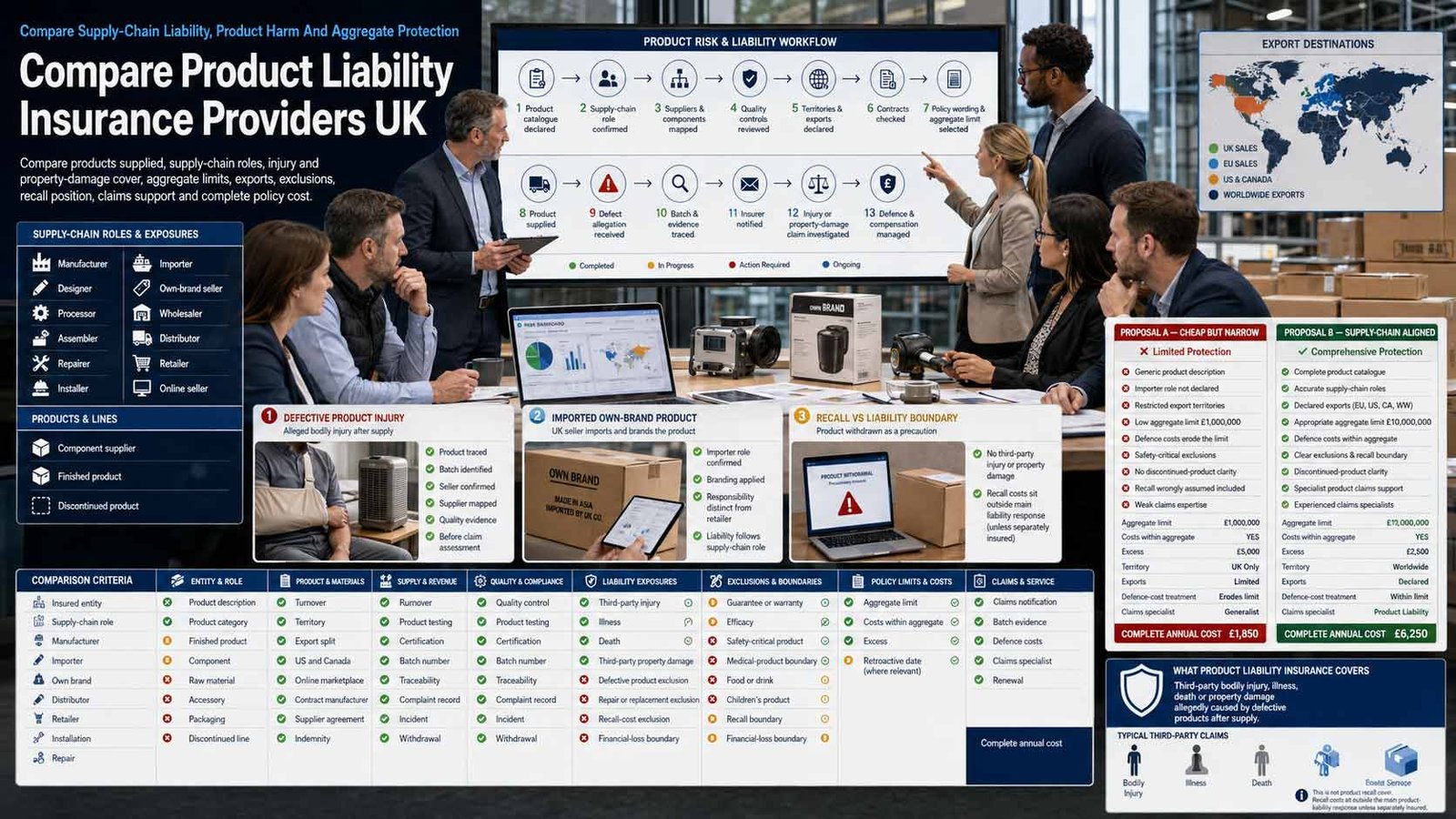
Protect The Business When A Supplied Product Causes Harm
Product liability insurance is designed for compensation and defence costs when an allegedly defective product causes bodily injury, illness, death or damage to third-party property.
- Map every product and supply-chain role before requesting quotations
- Separate injury and property damage from recall and rectification costs
- Check aggregate limits, territories, jurisdictions and export restrictions
- Maintain testing, batch, supplier and customer traceability evidence
Manufacturers and other businesses in a product supply chain can face liability when an unsafe or defective product causes harm. Exposure can extend beyond the original manufacturer to businesses that import, brand, distribute, sell, assemble, alter, repair, install, service or supply component parts.
The insurance normally addresses covered third-party bodily injury and property damage, plus associated legal defence and claimant costs. It does not automatically pay to repair or replace the defective product itself, honour a warranty, refund customers, restore reputation, withdraw stock or run a recall. Those costs must be checked as separate extensions or specialist protection.
This page remains focused on claims caused by products after supply. Claims arising from business activities at premises or during work are handled on the separate public liability insurance comparison page.
Choose The Right Product Liability Insurance Route
Match the buying route to products, supply-chain responsibility, turnover, territories, quality controls, contracts and the potential severity of injury or property damage.
| Buying Model | What It Usually Includes | Best-Fit Question |
|---|---|---|
| Direct Online SME Product Liability | Digital quotation and standard limits for eligible retailers, makers, trades, food businesses, online sellers and lower-complexity product risks. | Can the online questions capture every product, import source, own-brand role, export territory and claims circumstance accurately? |
| Combined Liability Package With Product Section | Products liability included alongside other selected business-liability sections under one schedule and annual premium. | Is the products aggregate, territory and exclusion structure clearly separated rather than assumed from the package headline? |
| Broker-Placed SME Product Liability | A broker gathers product, turnover and quality-control information and approaches one or more insurers for suitable products cover. | Which insurers were considered and what advice, claims support, commission or fees are included? |
| Manufacturer Or Processor Liability Programme | Cover designed around manufacturing, assembly, processing, testing, batch production, quality assurance and contractual supply obligations. | How does the wording treat defective batches, components, failure to perform, completed products and product incorporation? |
| Importer, Own-Brand Or Online Retailer Policy | Protection arranged around overseas sourcing, private labelling, online marketplaces, supplier evidence, territorial sales and UK consumer exposure. | Does the insurer understand that an importer or own-brand seller can carry greater responsibility than an ordinary retailer? |
| Wholesale, Distribution Or Component-Supplier Cover | Products protection for businesses supplying goods or components to retailers, manufacturers, installers or other commercial buyers. | Are contractual indemnities, vendors’ liability, component incorporation and downstream loss scenarios accepted? |
| Mid-Market Or International Products Liability | Manually underwritten primary and excess limits for higher turnover, complex products, exports, multiple subsidiaries and severe-loss potential. | Can the insurer support US or Canadian exposure, international claims, large batches and higher limit requirements? |
| Specialist Product, Recall Or Excess Programme | Additional protection for regulated, safety-critical, medical, food, automotive, aviation, chemical, technology or recall-intensive risks. | Which exposures are insured under the primary products wording and which require specialist recall, efficacy or excess capacity? |
Eight Areas That Determine Product Liability Policy Fit
Use the same product catalogue, supply-chain roles, turnover splits, territories, contracts, quality controls, claims history and limit assumptions for every provider.
Comparison Criterion
Products Supplied And Supply-Chain Role
List every finished product, component, raw material, accessory, packaging item and discontinued line. Define whether the business designs, manufactures, processes, assembles, alters, repairs, installs, imports, brands, wholesales, distributes, sells or services each product. Insurer appetite and legal exposure can change materially with the role.
Comparison Criterion
Bodily Injury, Illness And Property Damage
Compare accidental injury, illness, disease, death and damage to third-party property caused by products. Confirm the definition of product, when a product is treated as supplied, whether installation or repair is included and how consequential physical damage is handled. Pure financial loss and the product’s own replacement are commonly outside standard cover.
Comparison Criterion
Limit Of Indemnity, Aggregate And Batch Claims
Products liability is commonly subject to one aggregate limit for all claims during the policy period. Check defence costs inside or outside the limit, sublimits, excesses, batch or series aggregation, one-source clauses, pollution aggregates and how several injured parties or multiple product units reduce the remaining capacity.
Comparison Criterion
Territories, Jurisdictions And Exports
Separate where products are sold from where claims can be brought. Review UK, European, worldwide and US or Canadian sales, online availability, overseas subsidiaries, local distributors and contractual jurisdiction. North American exposure often requires specific disclosure, higher premiums, special conditions or separate capacity.
Comparison Criterion
Efficacy, Guarantee And Own-Product Exclusions
Standard wording can exclude failure to perform the intended function, contractual guarantees, repair, replacement, refund, rectification, withdrawal, recall and damage to the supplied product itself. Test whether a failed product causes covered injury or external property damage and whether any limited efficacy or financial-loss extension is required.
Comparison Criterion
Recall, Withdrawal And Crisis Response
Product liability and product recall are different protections. Compare whether the policy funds only third-party claims or also first-party withdrawal, notification, transport, disposal, testing, replacement, customer communication, business interruption and reputation management. Confirm trigger, discovery, government order, contamination and malicious-tampering conditions.
Comparison Criterion
Quality Assurance, Traceability And Contract Controls
Insurers assess design review, supplier approval, incoming checks, testing, certification, batch coding, complaint monitoring, retention samples, recall plans and document retention. Review warranties, indemnities, hold-harmless clauses, contractual liability, vendors’ endorsements, rights of recovery and whether supplier contracts preserve evidence and recourse.
Comparison Criterion
Claims, Provider Status, Pricing And Exit
Compare incident notification, evidence preservation, expert appointment, defence strategy, settlement consent, product testing, batch tracing, insurer identity, financial strength, FCA status, annual premium, Insurance Premium Tax, finance, broker fees, changes, renewal, cancellation and continued access to historic policy documents.
Measures To Define Before Selecting A Product Liability Provider
Translate broad product descriptions into written supply-chain, limit, territorial, exclusion, recall, quality, claims and commercial evidence.
| Measure | What It Should Define | Evidence To Request | Common Weakness |
|---|---|---|---|
| Product catalogue | Every product, component, material, use, customer group and discontinued line | SKU list, technical files, instructions, labels, photographs and sales records | The quotation uses a broad trade description instead of the actual products |
| Supply-chain role | Who designs, manufactures, imports, brands, distributes, installs, repairs or sells | Supplier contracts, manufacturing agreements, invoices, labels and ownership records | An own-brand or importer role is described as retail only |
| Turnover split | Revenue by product class, activity, territory and customer type | Audited accounts, management data, export reports and forecasts | High-risk products are hidden inside total turnover |
| Territory and jurisdiction | Where products are supplied and where claims can be pursued | Sales data, website delivery settings, distributor contracts and governing-law clauses | Worldwide online availability is treated as UK-only exposure |
| Aggregate limit | The total available for products claims, defence costs and related events | Schedule, batch clause, costs wording, excesses and exhaustion scenario | A headline limit is mistaken for a separate amount per claimant |
| Efficacy and own product | Whether non-performance, repair, replacement and consequential damage are insured | Exclusion wording, extension schedule, product scenario and written clarification | Warranty and recall costs are assumed to be part of liability cover |
| Quality controls | The controls that prevent, detect and contain defective products | Testing, certificates, supplier audits, batch records, retention samples and complaints | Quality procedures exist informally but cannot be evidenced |
| Recall capability | How unsafe products are identified, notified, traced, withdrawn and disposed of | Recall plan, OPSS or authority notification process, customer records and crisis contacts | The business cannot identify affected batches or customers quickly |
| Claims evidence | How product condition, supply, causation, defence and recovery will be proved | Incident protocol, retained product, photographs, expert reports, contracts and supplier evidence | The product is destroyed or admitted defective before insurer review |
| Provider verification and cost | The insurer, intermediary, claims handler and complete annual commercial position | FCA Firm Checker, Register, wording, premium, IPT, finance and fees | A comparison brand is selected without identifying the risk carrier |
Product Liability Insurance Providers UK Businesses Can Consider
Shortlist providers whose product appetite, supply-chain understanding, aggregate structure, export capability, exclusions, claims expertise, regulated role and complete cost fit the business. Confirm current written terms before purchase.
Provider Profile
Allianz Insurance
Allianz provides products liability within commercial liability and package propositions distributed directly or through brokers, depending on the business. Its official guidance describes protection when products cause personal injury or third-party property damage. Include Allianz where an SME or larger commercial organisation wants established casualty underwriting and claims support. Confirm product classes, aggregate limit, exports, exclusions, broker route and complete cost.
Review official Allianz business liability informationProvider Profile
AXA Business Insurance
AXA offers a dedicated product-liability information and quotation route for eligible SMEs, covering compensation for personal injury and third-party property damage caused by faulty products, subject to policy terms. Published guidance also recognises seller exposure in defined circumstances. Include it where a smaller UK business wants direct digital purchase. Confirm products, turnover, limits, exports, exclusions, claims process and annual total.
Review official AXA product liability informationProvider Profile
Hiscox
Hiscox offers product liability for businesses that design, produce, supply, alter, repair, install, test, service, maintain, clean or treat products. Its published product page focuses on claims for illness, injury and property damage and determining limits from maximum claim severity. Include it where an SME wants a direct or broker route. Confirm product appetite, aggregate, territories, efficacy, recall, excesses and claims support.
Review official Hiscox product liability informationProvider Profile
Markel Direct
Markel Direct includes products liability within selected small-business liability packages for eligible consultants, trades, charities, designers and online sellers. Current published pricing examples start from £5 per month for a combined £1 million liability limit, subject to occupation and underwriting. Include it where a microbusiness wants an online route. Confirm the actual products, package scope, exports, limit, excess, exclusions, instalments and cancellation terms.
Review official Markel Direct liability informationProvider Profile
Aviva
Aviva supports products-liability risks through broker-distributed business insurance and current risk-management resources addressing manufactured, supplied and sold products. Include it where a business wants an established commercial insurer, broker advice and risk-control support rather than a simple standalone online quote. Confirm the underwriting product, supply-chain roles, exports, aggregate, quality requirements, claims route, broker charges and renewal.
Review official Aviva products-liability risk informationProvider Profile
Zurich
Zurich offers public-and-products liability for mid-market organisations through brokers, with current published appetite typically covering businesses from approximately £5 million to £500 million turnover. Include it where a larger manufacturer, distributor or multi-site business needs higher limits and experienced casualty claims support. Confirm product and export appetite, primary and excess capacity, aggregate, pollution, US exposure, risk engineering and claims governance.
Review official Zurich products-liability informationProvider Profile
QBE
QBE provides general-liability and sector-specific products solutions with substantial capacity and specialist casualty underwriting. Its current UK material highlights broad third-party injury and property-damage protection, while its risk guidance addresses product-liability controls and dangerous-product exposure. Include it for manufacturers, contractors, healthcare, international or complex risks. Confirm product wording, aggregate, territories, local policies, claims experts and programme structure.
Review official QBE general-liability informationProvider Profile
Simply Business
Simply Business is an insurance broker and comparison route presenting product-liability quotations from participating insurers for eligible SMEs. Its current product page publishes selected quotes from £5.40 per month and explains that product and activity-related liability are often purchased together but remain distinct. Include it where a business wants several insurer options through one application. Confirm the underlying insurer, exact cover, fees, claims route and annual total.
Review official Simply Business product liability informationWhat Changes Product Liability Insurance Cost UK 2026
There is no reliable universal price because products, roles, units, territories, controls, limits and claims histories differ. Compare the complete annual cost of the same products exposure.
| Cost Driver | Why It Changes Premium | What A Comparable Quote Should Show |
|---|---|---|
| Product type and potential severity | Food, cosmetics, children’s goods, electrical items, machinery, safety equipment and medical products can create severe injury or property-damage claims | Product catalogue, intended use, users, hazards, warnings and worst credible loss |
| Supply-chain responsibility | Manufacturers, processors, importers and own-brand sellers can attract greater exposure than ordinary resellers | Role by product, supplier location, branding, design control and contracts |
| Turnover and units supplied | More products and revenue increase the number of units exposed and possible claim frequency | Turnover and unit count by product, territory, channel and customer type |
| Territory and jurisdiction | US, Canada and other overseas markets can increase legal costs, awards and programme complexity | Countries, online sales, distributors, governing law and local-policy requirements |
| Limit and aggregation | Higher aggregate limits and broader batch treatment increase insurer capacity at risk | Required limit, defence costs, batch clause, excess, sublimits and excess layers |
| Quality, testing and certification | Strong controls can reduce defect frequency and contain affected batches | Standards, certificates, test records, audits, complaints and corrective actions |
| Recall and traceability capability | Poor records can expand the affected population and delay containment | Batch coding, customer records, supplier traceability, recall plan and exercises |
| Claims and incident history | Complaints, injuries, property damage, withdrawals and near misses indicate future exposure | Five-year or requested claims data, complaints, recalls and corrective action |
| Contracts and indemnities | Retailer, distributor and customer agreements can transfer or expand responsibility | Indemnities, warranties, vendor clauses, rights of recovery and required limits |
| Payment method and intermediary fees | Finance, broker charges and administration can change total payable | Annual premium, IPT, deposit, instalment total, broker and change fees |
| Commercial Model | Typical Position | What Must Be Confirmed |
|---|---|---|
| Direct Online SME Policy | Digital underwriting for accepted products, turnover and territories | Products, role, limit, aggregate, excess, exclusions, annual total and cancellation |
| Broker-Placed Liability Package | A broker arranges products cover within a wider commercial policy | Insurer, advice basis, products section, aggregate, commission or fees and claims role |
| Manually Underwritten Products Programme | Specialist review of manufacturing, imports, exports, controls and higher limits | Surveys, warranties, primary and excess capacity, territories and service team |
| Primary Liability Plus Product Recall | Third-party liability and first-party recall costs are arranged under separate sections or policies | Triggers, exclusions, limits, overlap, notification, crisis response and total cost |
Match The Provider To The Product, Supply Chain And Claim Severity
The right shortlist depends on what is supplied, who controls design and manufacture, where products are sold, the quality system and how quickly affected units can be traced.
Small Maker, Retailer Or Online Seller
Prioritise accepted products, clear online questions, own-brand and imported-goods disclosure, UK and overseas online sales, straightforward limits, affordable excesses, same-day documents, seller contracts, complaints handling and a claims route that understands marketplace and direct-to-consumer records.
Importer, Private-Label Or Distributor
Prioritise overseas supplier due diligence, own-brand status, UK responsibility, certificates, testing, distributor contracts, vendor requirements, product traceability, recoveries against manufacturers, exports, aggregation and wording that accurately reflects the business rather than treating it as a low-risk reseller.
Manufacturer, Processor Or Component Supplier
Prioritise design responsibility, raw materials, batch production, work in progress, quality assurance, component incorporation, product efficacy, contractual indemnities, safety standards, product recall interfaces, large downstream losses, technical claims experts and limits that reflect multiple affected units.
International Or Safety-Critical Products Business
Prioritise specialist underwriting, US and Canadian jurisdictions, local policies, higher primary and excess capacity, medical or regulated products, testing and certification, pollution or contamination, cyber-physical products, crisis response, recall protection, insurer financial strength and international claims coordination.
How To Compare Product Liability Insurance Proposals
Issue one products-risk pack containing every legal entity, product and component, use, customer group, supply-chain role, design responsibility, manufacturer and supplier country, own-brand arrangement, annual turnover and units by product, UK and export territories, online sales, contracts, required limits, testing, standards, certifications, supplier approval, batch coding, complaints, withdrawals, claims, incidents, recall plan, discontinued products, planned launches, preferred excess and payment method. Require the provider to return a completed products, territorial, limit, exclusion, quality, claims and commercial schedule rather than a premium-only summary.
- Every provider assesses the same products, roles, units and turnover splits
- Aggregate, batch, defence-cost and excess treatment is explicit
- Territories, jurisdictions, online sales and exports are demonstrated
- Efficacy, own-product, recall and contractual exclusions are returned
- Insurer, intermediary, claims handler and expert arrangements are identified
- Annual and monthly totals include IPT, finance and fees
Compare The Same Defective-Product Incident End To End
Ask each provider how the policy would respond if one production batch causes several injuries, damages customers’ property, triggers regulatory notification, requires product testing and withdrawal, and leads a retailer to enforce a contractual indemnity.
A low premium is not a strong result when the aggregate is too small, exports are excluded, batch claims consume the limit or recall costs sit completely outside the policy.
Six Questions To Put To Every Product Liability Provider
The answers expose omitted products, incorrect roles, weak aggregates, export restrictions, own-product exclusions and incomplete annual costs.
Which Products And Supply-Chain Roles Are Accepted?
Request written confirmation for every product, component, imported or own-brand line and whether design, manufacture, assembly, alteration, repair, installation, distribution and online selling are included.
How Does The Aggregate Limit Apply?
Confirm the annual aggregate, defence costs, excess, batch and series claims, one-source wording, pollution or specialist sublimits and whether several claimants share the same remaining capacity.
Which Territories And Jurisdictions Are Covered?
Ask about UK, Europe, worldwide, US and Canada, website sales, distributors, overseas subsidiaries, local policies, governing law, exports and claims brought outside the territory of supply.
What Is Excluded Around Performance And The Product Itself?
Obtain efficacy, guarantee, contractual liability, rectification, repair, replacement, refund, product incorporation, pure financial loss, cyber, pollution and specialist-product wording.
How Are Recall, Notification And Quality Controls Treated?
Confirm whether withdrawal and recall costs are excluded or insured separately, and request required testing, standards, supplier audits, batch records, complaint escalation, retention samples and authority notification.
What Is The Complete Annual Cost And Claims Model?
Obtain premium, IPT, deposit, finance, broker and administration fees, claims contacts, expert appointment, settlement authority, policy changes, cancellation, renewal and historic-document access.
A Seven-Stage Product Liability Provider Evaluation
Move from a verified product and supply-chain map to tested aggregate, territorial and recall wording rather than selecting a policy from price alone.
- Create a verified product baseline covering entities, products, components, uses, customers, supply-chain roles, turnover, units, territories, standards, contracts, complaints, incidents and discontinued lines.
- Define the coverage architecture: bodily injury and property damage, aggregate limit, defence costs, excess, vendors’ liability, exports, product incorporation, efficacy, recall and excess-layer requirements.
- Prepare a prioritised requirement catalogue covering definitions, territories, jurisdictions, batch claims, exclusions, quality conditions, claims response, contractual obligations and complete cost.
- Issue one quotation brief and scripted defective-product incident using the same product data, turnover, roles, controls, claims history, inception date, limit and payment assumptions.
- Shortlist providers by product appetite, supply-chain expertise, territorial capability, aggregate structure, wording, claims resources, financial strength, regulated status and complete cost.
- Complete due diligence and document review. Check FCA status, insurer identity, IPID, wording, schedule, statement of fact, product and turnover declarations, endorsements, fees and claims instructions.
- Purchase only after correcting inaccuracies. Maintain quality and traceability, retain samples and records, notify incidents promptly, report product or territory changes and compare again before renewal.
Product Liability Insurance Comparison Checklist
Use this table before purchasing, changing or renewing product liability cover.
| No. | Requirement | Evidence To Obtain Before Purchase | Confirmed |
|---|---|---|---|
| 01 | Product-liability service boundary retained | The comparison remains focused on injury and third-party property damage caused by supplied products | |
| 02 | Every legal entity and product declared | Parent, subsidiaries, brands, SKUs, components, discontinued products and planned launches | |
| 03 | Supply-chain roles recorded by product | Design, manufacture, process, assemble, import, brand, distribute, repair, install and sell | |
| 04 | Turnover and unit splits verified | Product class, territory, customer type, sales channel and forecast | |
| 05 | Territory and jurisdiction approved | UK, Europe, worldwide, US, Canada, online sales and local-policy needs | |
| 06 | Aggregate and batch treatment understood | Annual limit, defence costs, excess, related claims, series and pollution sublimits | |
| 07 | Bodily injury and property damage wording accepted | Illness, disease, death, external property damage and completed-product timing | |
| 08 | Own-product and efficacy exclusions tested | Repair, replacement, refund, rectification, non-performance and incorporation | |
| 09 | Recall position documented | Withdrawal, notification, transport, disposal, replacement, crisis and business interruption | |
| 10 | Quality controls evidenced | Design review, testing, standards, supplier audits, certificates and corrective action | |
| 11 | Traceability and complaints ready | Batch codes, supplier and customer records, retention samples and escalation | |
| 12 | Contracts and recovery rights reviewed | Indemnities, warranties, vendors’ clauses, limits, governing law and supplier recourse | |
| 13 | Claims protocol tested | Evidence preservation, notification, authority contact, experts, admissions and settlement | |
| 14 | Provider and insurer verified | FCA status, insurer, intermediary, claims handler and financial strength | |
| 15 | Three-year cost and change governance complete | Premium, IPT, finance, fees, new products, exports, acquisitions, renewal and cancellation |
Common Product Liability Insurance Buying Mistakes
Most avoidable problems begin with incorrect supply-chain roles, incomplete product data, misunderstood aggregates, undeclared exports or recall costs assumed to be included.
| Mistake | Why It Creates Risk | Better Control |
|---|---|---|
| Describing the business as a retailer when it imports or owns the brand | The insurer can assess a materially different legal and underwriting exposure | Record the true role for every product |
| Using one broad product description | High-risk goods, components or discontinued lines can be missed | Provide a complete catalogue and turnover split |
| Treating the limit as available for every claim | Products cover is commonly one aggregate for the whole policy period | Model batch and multi-claim exhaustion |
| Ignoring online and overseas sales | Website reach and distributors can create undeclared territorial exposure | Map supply and jurisdiction separately |
| Assuming failure to perform is insured | Efficacy, guarantee and pure financial-loss claims are often excluded | Test the exact non-performance scenario |
| Assuming the defective product itself is covered | Repair, replacement, refund and rectification are commonly excluded | Separate liability from own-product costs |
| Assuming product recall is included | Withdrawal, disposal, communication and replacement can require specialist cover | Obtain a separate recall assessment |
| Accepting customer indemnities without insurer review | Contract terms can extend liability beyond the policy wording | Review contracts before agreeing limits and warranties |
| Keeping weak batch and customer records | The business may be unable to contain an incident or defend causation | Maintain auditable end-to-end traceability |
| Comparing monthly prices with different products and territories | The cheaper quote may exclude key lines, exports or higher aggregates | Normalise the exposure and complete annual cost |
Frequently Asked Questions
Answers to common questions from UK businesses comparing product scope, supply-chain roles, aggregate limits, imports, exports, recall, claims and pricing.
What Is Product Liability Insurance?
Product liability insurance can cover compensation and legal defence costs if a product a business designs, manufactures, imports, supplies, distributes, installs, repairs or sells causes bodily injury, illness, death or damage to third-party property. The exact products, territories, limits and exclusions must appear in the policy.
Is Product Liability Insurance Legally Required In The UK?
Product liability insurance is not generally compulsory. Manufacturers and other businesses in a supply chain can still be legally liable for unsafe or defective products, and retailers, distributors, customers, marketplaces, lenders or contracts may require evidence of specified cover.
Who May Need Product Liability Insurance?
Manufacturers, designers, processors, assemblers, importers, private-label sellers, wholesalers, distributors, retailers, online sellers, installers, repairers and component suppliers may need cover. The business should disclose its exact role for each product rather than relying on one trade description.
Does Product Liability Insurance Cover Imported Or Own-Brand Products?
It can, but importers and businesses placing their own name or brand on products may face greater responsibility and underwriting scrutiny. The insurer should receive supplier countries, testing, standards, contracts, labels, turnover, territories and evidence of quality and traceability.
Does Product Liability Insurance Cover Product Recall Costs?
Standard products liability normally focuses on third-party injury and property-damage claims. Withdrawal, transport, testing, disposal, customer notification, replacement, business interruption and reputation costs are commonly excluded unless a recall extension or specialist policy applies.
Does Product Liability Insurance Pay To Replace A Defective Product?
Policies commonly exclude repair, replacement, refund, rectification and damage to the supplied product itself. Cover may respond if the product causes insured bodily injury or damage to other property. Buyers should review efficacy, guarantee and product-incorporation wording.
How Does The Product Liability Limit Work?
Products liability is commonly written with one aggregate limit for all covered claims during the policy period. Defence costs, sublimits, pollution, batch and series claims can reduce the amount remaining. Buyers should model several claims arising from one defective product batch.
Does Product Liability Insurance Cover Products Sold Overseas?
Cover depends on both territorial and jurisdiction wording. UK, European, worldwide, US and Canadian sales can be treated differently. Online availability, distributors, governing-law clauses and claims brought overseas must be declared before purchase.
What Evidence Helps With A Product Liability Claim?
Useful evidence includes product and batch records, supplier documents, test results, certificates, instructions, labels, photographs, complaints, retained samples, sales records, contracts, authority notifications and the allegedly defective item. Businesses should avoid admissions or destruction before insurer guidance.
How Should UK Businesses Compare Product Liability Providers?
Give every insurer or broker the same product catalogue, supply-chain roles, turnover and unit splits, territories, exports, contracts, quality controls, claims history, required aggregate and payment assumptions. Compare definitions, exclusions, recall position, claims expertise, complete annual cost, fees, renewal and cancellation.
Official Guidance And Provider Resources
Reviewed by Bhav Giva, Founder & Lead Analyst at CompareServices.co.uk, on 5 August 2026.
Use current GOV.UK, UK legislation, ABI, FCA, insurer and broker documentation to verify product-safety responsibilities, supplied-product definitions, injury and property-damage cover, aggregate limits, territories, exports, efficacy and own-product exclusions, recall position, quality conditions, claims procedures, insurer and intermediary status, Insurance Premium Tax, fees and policy terms. Product appetite, premiums, legislation and wording can change. Obtain product-safety, legal, recall or appropriately authorised insurance advice where products, jurisdictions, contracts or potential claim severity are complex.
- GOV.UK — Product Safety Advice For Businesses
- UK Legislation — Consumer Protection Act 1987, Part I
- GOV.UK — Product Recalls And Alerts
- GOV.UK — Business Notifications Of Unsafe And Noncompliant Products
- Association Of British Insurers — Product Liability Insurance
- FCA — FCA Firm Checker
- FCA — Financial Services Register
- GOV.UK — Insurance Premium Tax
- Allianz — Business Liability Insurance
- AXA — Product Liability Insurance
- Hiscox — Product Liability Insurance
- Markel Direct — Business Liability Insurance
- Aviva — Products Liability Risk Management
- Zurich — Products Liability For Mid-Market Businesses
- QBE — General Liability
- Simply Business — Product Liability Insurance