
Compare Employers Liability Insurance Providers UK
Compare Legal Compliance, Employee Definitions, £5 Million Minimum Cover, £10 Million Policy Options, Claims Support, Certificates, Pricing And Complete Policy Cost
Compare employers liability insurance UK providers by legal-entity scope, employees and former employees, directors, part-time and temporary staff, apprentices, work experience, volunteers, labour-only subcontractors, work locations, occupational injury and disease wording, minimum and higher limits, legal defence costs, motor-related restrictions, territorial scope, certificate access, Employers’ Liability Tracing Office records, claims notification, authorised-insurer status, annual premium, Insurance Premium Tax, instalment charges, broker fees, renewal, cancellation and complete policy documents. Give every provider the same workforce, payroll, occupations, locations, activities, claims history, health-and-safety controls, required limit and inception date before comparing quotations.
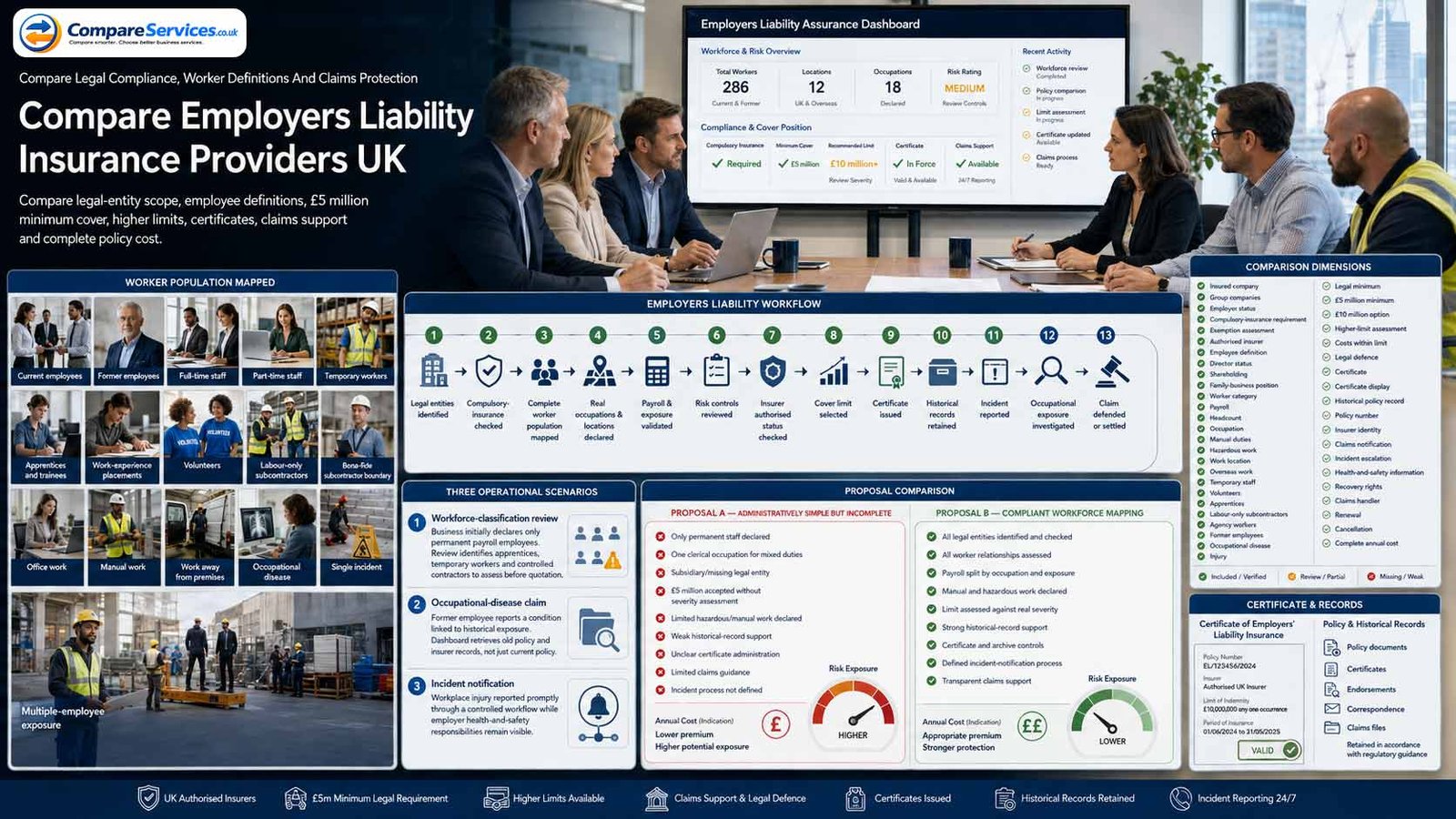
Meet The Compulsory Insurance Duty And Protect Employee Claims
Most employers in Great Britain must insure against liability for injury or disease suffered by employees arising out of their employment.
- Use an authorised insurer and maintain at least £5 million of cover
- Assess the real working relationship, not only payroll or tax labels
- Make the current certificate reasonably accessible to employees
- Keep complete historical policy records for delayed occupational-disease claims
Employers liability insurance helps an employer meet covered compensation and legal costs when a current or former employee alleges that work caused an injury or disease. The injury can occur on or away from the employer’s premises, although motor accidents involving employees can fall under motor insurance instead.
The statutory minimum is £5 million and includes costs. The Health and Safety Executive advises employers to consider whether their risk requires more; in practice, many insurers provide at least £10 million. Businesses must use an authorised insurer and can face a fine of up to £2,500 for each day without suitable insurance and up to £1,000 for certificate-display or production failures.
This page remains within employers liability insurance. Claims by customers or members of the public, and claims alleging financial loss from professional advice, belong to separate policy decisions linked near the end of the page.
Choose The Right Employers Liability Insurance Route
Match the buying route to workforce composition, occupation risk, locations, claims history, group structure and the level of advice required.
| Buying Model | What It Usually Includes | Best-Fit Question |
|---|---|---|
| Direct Online Small-Business Policy | Digital quotation, standard £10 million limit for eligible trades, immediate documents and self-service administration. | Can the question set capture all worker categories, occupations, locations and hazardous activities accurately? |
| Broker Comparison Route | A broker discusses worker status and risk, approaches one or more insurers and supports placement, renewal and claims communication. | Which insurers were considered and what advice, fees and claims support are included? |
| Combined Liability Package | Employers liability is arranged with other liability or business covers under one policy or package. | Is the compulsory section clear and suitable rather than being treated as a routine add-on? |
| Trades And Contractor Policy | Cover configured around manual work, tools, height, heat, machinery, construction sites, labour-only subcontractors and changing payroll. | Do the declared occupations and wage splits reflect the work each person actually performs? |
| Office, Retail And Hospitality Package | Employers liability sits within a premises or small-business package covering staff in customer-facing and operational roles. | Are temporary, seasonal, kitchen, delivery, cleaning and maintenance workers included correctly? |
| Charity, Club And Community Policy | Cover designed around employees, volunteers, helpers, trustees, events, community sites and mixed paid or unpaid roles. | Has the insurer confirmed which volunteers and non-payroll workers are treated as employees? |
| Group Or Multi-Entity Programme | One policy covers a corporate group, subsidiaries, multiple sites and centrally managed employee exposures. | Are every legal entity, acquisition, subsidiary and employee category named within the group cover? |
| Complex Or High-Limit Placement | Broker-led placement for hazardous occupations, difficult claims histories, international employees, high payroll or limits above standard market offerings. | Can the broker evidence authorised-insurer capacity, wording negotiation and long-tail claims support? |
Eight Areas That Determine Employers Liability Policy Fit
Use the same legal entities, workforce, payroll, occupations, locations, controls, claims history and limit for every provider.
Comparison Criterion
Legal Applicability And Exemptions
Determine whether the business is within the compulsory insurance rules before buying or relying on an exemption. Assess legal entities, family relationships, incorporation, owner-director shareholding, public-body status and employees based abroad. Record the rationale and obtain legal or authorised insurance advice when the position is uncertain.
Comparison Criterion
Employee, Worker And Contractor Definitions
Compare how the policy defines employees, former employees, apprentices, trainees, work-experience students, volunteers, temporary and seasonal staff, labour-only subcontractors and other people under the business’s direction. Tax status and job labels do not decide the insurance position; the real working relationship and control matter.
Comparison Criterion
Limit Of Indemnity And Costs
Confirm at least £5 million of cover and whether £10 million or a higher limit is required. Review whether defence and claimants’ costs sit within the limit, how the limit applies to one occurrence, whether group entities share it and whether higher-risk activities need excess-layer cover or specialist capacity.
Comparison Criterion
Injury, Disease And Former-Employee Claims
Review bodily injury and disease wording, accidents away from the premises, gradual occupational illness, exposure over several policy years and claims brought after employment ends. Confirm how the insurer identifies the policy in force at the time of the alleged accident or harmful exposure.
Comparison Criterion
Occupations, Payroll And Work Locations
Compare accepted occupations, employee numbers, wage roll, clerical and manual splits, subcontract labour, shifts, sites, homeworking, temporary locations and overseas assignments. Insurer pricing and appetite can change materially when a worker performs several duties or moves into higher-risk activity.
Comparison Criterion
Health-And-Safety Controls And Recovery Rights
Assess risk assessments, training, supervision, equipment, personal protective equipment, maintenance, occupational-health controls, accident reporting and record keeping. The compulsory rules protect employee compensation, but policy wording can allow an insurer to recover payments from the employer after serious breaches or failures.
Comparison Criterion
Certificates, ELTO And Historical Records
Confirm certificate production, electronic access for employees, group-company names and Employers’ Liability Tracing Office reporting. There is no current legal requirement to retain expired certificates, but HSE strongly advises keeping complete insurance records because occupational disease claims can arise decades later.
Comparison Criterion
Claims, Provider Status, Pricing And Exit
Compare incident and circumstance notification, insurer control of defence, legal representation, claims contacts, evidence guidance, authorised-insurer status, broker role, premium, Insurance Premium Tax, instalment cost, fees, renewal, cancellation, policy changes and access to complete documents after the contract ends.
Measures To Define Before Selecting An Employers Liability Provider
Translate compliance and coverage statements into written worker, limit, wording, certificate and claims evidence.
| Measure | What It Should Define | Evidence To Request | Common Weakness |
|---|---|---|---|
| Legal requirement | Whether each legal entity must hold compulsory employers liability insurance | Entity structure, employee list, family relationships, shareholding, public-body status and written advice | The business assumes an exemption from a short online summary |
| Worker status | Who works under a contract of service or an equivalent controlled relationship | Contracts, control, substitution, equipment, tax handling, working practices and role evidence | Self-employed wording is accepted without examining the real relationship |
| Limit and costs | Whether the policy provides at least £5 million and sufficient total capacity | Schedule, wording, legal-cost basis, group structure and higher-limit assessment | The certificate shows £10 million but several entities share the limit unexpectedly |
| Occupation and payroll | What work people perform and the wage roll allocated to each activity | Employee counts, payroll, occupation splits, seasonal peaks and subcontract payments | All staff are classified as clerical despite regular manual duties |
| Injury and disease wording | Which accidents, illnesses, exposures and former-employee claims can respond | Policy wording, territorial limits, motor restriction, disease handling and scenario answers | The buyer considers only immediate accidents and ignores long-tail illness |
| Health-and-safety evidence | Whether the employer can demonstrate reasonable prevention and claims defensibility | Risk assessments, training, maintenance, inspections, PPE, occupational health and investigations | Records are created only after an allegation is received |
| Certificate access | How employees can reasonably read the current certificate | Current certificate, intranet or noticeboard location, communication and access testing | A certificate exists but employees do not know where to find it |
| Historical policy record | Which insurer covered each entity and workforce during prior exposure periods | Policies, schedules, certificates, insurer details, ERN, ELTO records and acquisition history | Expired documents are deleted after renewal |
| Claims operation | How incidents, allegations, letters of claim and occupational disease circumstances are handled | Claims guide, contact route, notification timing, document checklist and escalation | Managers respond directly to a claimant without insurer coordination |
| Provider verification | The authorised insurer, intermediary, claims handler and permissions involved | FCA Firm Checker, Financial Services Register, policy documents and broker terms | The buyer cannot identify who carries the compulsory risk |
Employers Liability Insurance Providers UK Businesses Can Consider
Shortlist providers whose authorised-insurer route, workforce appetite, wording, claims service, certificate administration and complete cost fit the business. Confirm current written terms before purchase.
Provider Profile
Allianz Insurance
Allianz provides employers liability cover through insurance brokers and commercial policy packages. Include it where the business prefers broker-led placement, requires multi-section commercial insurance or has a workforce risk that benefits from discussion. Confirm the selected Allianz product, authorised insurer, legal entities, employee definition, limit, occupations, territorial scope, claims service, broker responsibilities, fees, renewal and certificate administration.
Review official Allianz liability insurance informationProvider Profile
AXA Business Insurance
AXA offers a direct online employers liability route for many eligible small businesses and occupations. Include it where the workforce and activities can be represented accurately through a digital quotation journey. Confirm employee categories, work activities, limit, occupation eligibility, policy wording, claims notification, certificate access, optional sections, payment total and policy-change process.
Review official AXA employers liability insurance informationProvider Profile
Direct Line For Business
Direct Line for Business allows eligible businesses to add employers liability within a tailored business-insurance policy. Include it where the buyer wants direct policy administration and configurable sections. Confirm worker categories, company structure, activities, claims history, health-and-safety information, cover limit, certificate arrangements, claims support, monthly-payment cost and renewal terms.
Review official Direct Line for Business employers liability informationProvider Profile
Hiscox
Hiscox offers employers liability cover for eligible small businesses, professionals, trades and organisations, with published cover up to £10 million for its relevant products. Include it where the business wants configurable liability cover and direct or broker support. Confirm employee definitions, former-employee claims, manual activity restrictions, legal costs, territorial scope, certificate, claims service and complete package cost.
Review official Hiscox employers liability insurance informationProvider Profile
Markel Direct
Markel Direct provides online employers liability insurance for eligible small businesses, contractors, charities and community organisations. Include it where the workforce, occupation and package fit its direct model. Confirm employees and volunteers, work locations, limit, disease and injury wording, legal defence, policy conditions, claims route, payment method, documents and whether another policy section is required to access the cover.
Review official Markel Direct employers liability informationProvider Profile
PolicyBee
PolicyBee is an online business-insurance broker offering employers liability cover for eligible SMEs, professionals, charities and organisations. Include it where the buyer wants a digital broker with adviser access rather than approaching one insurer. Confirm the insurer panel, underlying insurer, worker definitions, advice basis, fees, certificate, claims route, policy conditions, monthly-payment cost and renewal administration.
Review official PolicyBee employers liability informationProvider Profile
Premierline
Premierline is a business-insurance broker offering adviser-led employers liability quotations from its insurer relationships. Include it where worker status, occupations, claims history, group structure or combined insurance requires discussion. Confirm insurers approached, advice and recommendation, minimum or higher limit, certificate and ELTO handling, broker fees, claims support, policy changes, renewal and cancellation.
Review official Premierline employers liability informationProvider Profile
Simply Business
Simply Business is a broker and comparison service presenting employers liability quotations from several insurer brands for eligible small businesses. Include it where the buyer wants to compare multiple routes through one application. Confirm the underlying insurer, employee and contractor treatment, £10 million standard limit where quoted, package conditions, annual total, monthly finance cost, fees, claims contact, documents and renewal.
Review official Simply Business employers liability informationWhat Changes Employers Liability Insurance Cost UK 2026
Compare the complete cost of legally compliant, operationally suitable cover—not the lowest advertised monthly figure.
| Cost Driver | Why It Changes Premium | What A Comparable Quote Should Show |
|---|---|---|
| Industry and occupations | Construction, manufacturing, care, driving, machinery, height, chemicals and manual work can increase frequency or severity | Exact occupations, duties, work methods, locations and hazardous activities |
| Employee numbers and payroll | More workers and higher wage roll increase exposure and potential loss values | Permanent, part-time, temporary and seasonal counts plus wage splits |
| Labour-only and other workers | Non-payroll people under business control can create compulsory and claims exposure | Contracts, payments, control, substitution, equipment and insurer classification |
| Claims and incidents | Prior injury, disease and near-miss history can indicate future risk or weak controls | Accurate claims, circumstances, reserves, status and corrective actions |
| Health-and-safety management | Risk assessment, training and supervision affect insurer appetite and claims defensibility | Policies, inspections, maintenance, training, PPE, occupational health and investigations |
| Locations and territory | Multiple sites, customer premises, homeworking and overseas assignments change exposure | Sites, countries, offshore work, temporary visits and employee bases |
| Group structure and acquisitions | More legal entities and changing ownership can complicate insured-company and historical-record accuracy | Parent, subsidiaries, acquisitions, disposals, ERNs and prior insurer details |
| Limit and excess-layer needs | The statutory minimum may not reflect severe injury, disease or accumulation scenarios | £5m, £10m or higher requirement, costs treatment and catastrophe assessment |
| Package composition | Employers liability is often purchased with other business covers, affecting total premium | Separate section limits, included covers, policy dependencies and duplicated charges |
| Payment method and fees | Monthly finance, intermediary charges and administration can increase total payable | Annual premium, IPT, deposit, instalment total, broker and change fees |
| Indicative Commercial Model | Typical Position | What Must Be Confirmed |
|---|---|---|
| Annual Direct Policy | The full annual premium is paid for employers liability within a direct business policy | Limit, legal entities, worker categories, occupations, annual total, IPT and cancellation |
| Monthly Instalment Plan | The annual premium is financed or collected through instalments | Deposit, APR or finance charge, total payable, missed-payment risk and certificate validity |
| Broker-Placed Policy | An intermediary arranges cover with an authorised insurer and may charge fees or receive commission | Insurer, advice basis, market approach, fees, certificate, claims role, changes and renewal |
| Combined Business Package | Employers liability is purchased with selected commercial insurance sections | Compulsory section wording, policy dependencies, package exclusions and whole-policy cost |
Match The Provider To The Workforce And Employment Risk
The right shortlist depends on worker status, occupations, payroll, work locations, health-and-safety controls, group structure and claims complexity.
Office-Based Employer With A Small Permanent Team
Prioritise correct legal-entity names, directors and employees, homeworking, temporary staff, £10 million standard cover where suitable, simple certificate access, claims guidance, online documents and a clear total cost. Do not assume a low physical-risk workplace removes the compulsory requirement.
Trade, Construction Or Manual-Work Employer
Prioritise accurate occupation and payroll splits, labour-only subcontractors, tools, machinery, height, heat, driving, customer sites, risk assessments, training, personal protective equipment, claims support and broker access where direct quotation questions are too narrow.
Retail, Hospitality, Care Or Seasonal Workforce
Prioritise part-time, temporary, agency, apprentice, volunteer and seasonal worker treatment, multiple roles, manual handling, slips, kitchen or care exposures, shift patterns, rapid workforce changes, certificate communication and straightforward mid-term adjustments.
Multi-Site, Group Or Long-Tail Exposure
Prioritise every group company, historical insurer records, occupational-disease exposure, acquisitions, disposals, overseas employees, ELTO data, high limits, claims-defence resources, central governance and durable access to policies and certificates after renewal.
How To Compare Employers Liability Insurance Proposals
Issue one risk pack containing every legal entity, ownership and group structure, ERNs, employee and director counts, permanent, part-time, temporary, apprentice, trainee, work-experience and volunteer roles, contractors and subcontractors, payroll by occupation, locations, remote and overseas work, hazardous activities, claims history, health-and-safety controls, existing insurer records, required limit and inception date. Require the provider to return a completed compliance, wording and commercial schedule rather than a premium-only summary.
- Every provider assesses the same legal entities and worker categories
- Occupation, payroll and location assumptions are returned in writing
- The limit, costs treatment and former-employee claims position are clear
- Certificate access, ELTO reporting and historical records are demonstrated
- Authorised insurer, intermediary and claims handler are identified
- Annual and monthly totals include IPT, finance and fees
Compare The Same Employee Claim End To End
Ask each provider how the policy would respond if an employee suffers an accident, a former employee alleges an occupational disease years later, worker status is disputed, legal defence is required and the business has changed insurer since the exposure.
A valid-looking certificate is not enough when the wrong entity, employee category, occupation or historical period sits outside the records.
Six Questions To Put To Every Employers Liability Provider
The answers expose exemption errors, missing worker categories, poor occupational descriptions, weak historical records and incomplete annual costs.
Which Legal Entities And Workers Are Covered?
Request named companies, directors, employees, former employees, part-time and temporary staff, apprentices, volunteers, trainees, work experience and subcontractor treatment.
How Have Occupations, Payroll And Locations Been Classified?
Obtain employee counts, wage roll by duty, manual and clerical splits, sites, homeworking, customer locations, overseas work and assumptions for people performing several roles.
How Does The Limit Apply To Compensation And Costs?
Confirm £5 million, £10 million or higher capacity, legal and claimants’ costs, group sharing, one-occurrence treatment, motor restrictions and any excess-layer arrangement.
How Are Long-Tail And Former-Employee Claims Handled?
Ask how the insurer identifies the relevant exposure period, supports occupational-disease allegations, works with ELTO and responds when several prior insurers may be involved.
How Are Certificates, Claims And Health-And-Safety Evidence Managed?
Request certificate delivery, electronic display, incident notification, legal representation, evidence guidance, claims escalation, risk-management support and policy-record retention.
What Is The Complete Annual Cost And Exit Position?
Obtain premium, IPT, deposit, instalment total, finance, broker and administration fees, employee changes, cancellation, renewal, policy documents, ELTO records and historical access.
A Seven-Stage Employers Liability Provider Evaluation
Move from verified legal duty and workforce data to tested wording, certificates and claims operation rather than selecting a policy from price alone.
- Create a verified employer baseline covering legal entities, ownership, directors, employees, other workers, payroll, occupations, sites, overseas work, claims and current policies.
- Assess compulsory-insurance applicability and any claimed exemption. Document the facts and obtain legal or authorised insurance advice where worker status or corporate structure is uncertain.
- Define the required limit and operating controls, including £5 million minimum compliance, higher capacity, certificate access, ELTO data and historical policy retention.
- Issue one quotation brief and scripted claim set using the same workforce, payroll, activities, locations, health-and-safety controls, history, inception date and payment assumptions.
- Shortlist providers by authorised-insurer status, worker and occupation appetite, wording, claims capability, certificate process, financial strength, service and complete cost.
- Complete due diligence and document review. Check FCA status, insurer identity, IPID, wording, schedule, statement of fact, certificate, endorsements, fees and claims instructions.
- Purchase only after correcting inaccuracies. Display the certificate, brief managers on incidents, retain historical records, update workforce changes and compare again before renewal.
Employers Liability Insurance Comparison Checklist
Use this table before purchasing, changing or renewing employers liability cover.
| No. | Requirement | Evidence To Obtain Before Purchase | Confirmed |
|---|---|---|---|
| 01 | Compulsory-insurance position assessed | Legal entity, employee relationships, exemptions and written advice where uncertain | |
| 02 | Employers liability service boundary retained | The comparison remains focused on employee and former-employee injury or disease claims | |
| 03 | Every legal entity named | Parent, subsidiaries, trading companies, acquisitions and disposals appear correctly | |
| 04 | Every worker category assessed | Directors, employees, temporary staff, apprentices, volunteers, trainees and contractors | |
| 05 | Payroll and occupations verified | Employee counts, wage roll, duties, manual and clerical splits and seasonal peaks | |
| 06 | Work locations and territories accepted | Premises, customer sites, homeworking, offshore and overseas employee arrangements | |
| 07 | Minimum and higher limit approved | At least £5 million including costs, with £10 million or higher assessed against risk | |
| 08 | Injury and disease wording accepted | Accidents, occupational illness, former employees and long-tail exposures | |
| 09 | Motor and special restrictions understood | Road-traffic incidents, hazardous activities, offshore work and specialist occupations | |
| 10 | Health-and-safety controls evidenced | Risk assessments, training, supervision, maintenance, PPE and occupational health | |
| 11 | Certificate process tested | Correct companies, limit, policy period, employee access and inspector production | |
| 12 | ELTO and historical records controlled | ERNs, insurer details, policy documents, acquisitions and prior exposure periods | |
| 13 | Claims process tested | Incident notification, legal representation, evidence, former-employee and disease claims | |
| 14 | Provider and insurer verified | FCA status, authorised insurer, intermediary, claims handler and terms of business | |
| 15 | Three-year cost and exit complete | Premium, IPT, finance, fees, changes, cancellation, renewal and durable document access |
Common Employers Liability Insurance Buying Mistakes
Most avoidable problems begin with exemption assumptions, incomplete worker data, weak records or price-led selection.
| Mistake | Why It Creates Risk | Better Control |
|---|---|---|
| Assuming no PAYE means no insurance duty | Worker status depends on the real relationship and control, not only tax treatment | Assess contracts and working practices for every person |
| Relying on a family-business exemption after incorporation | The exemption does not apply to incorporated limited companies | Review legal structure and employee relationships before relying on an exemption |
| Insuring only permanent payroll staff | Temporary, apprentice, trainee, volunteer and controlled contractor relationships may require cover | Create a complete worker register and insurer confirmation |
| Using one clerical occupation for mixed duties | Manual and higher-risk tasks can fall outside the quoted classification | Split payroll and employee counts by real work performed |
| Treating £5 million as automatically adequate | The statutory minimum includes costs and may be insufficient for severe or multiple claims | Assess £10 million or higher capacity against the workforce risk |
| Deleting expired policies and certificates | Occupational-disease claims can arise decades after exposure | Keep a complete historical insurer and policy record |
| Displaying a certificate with missing group companies | Employees of an omitted entity may not have clear evidence of compliant cover | Check every insured company and acquisition after policy changes |
| Failing to notify incidents and circumstances | Delay can impair investigation and claims management even where employee compensation remains protected | Use a documented incident-to-insurer escalation process |
| Treating insurance as a replacement for health and safety | The employer retains legal duties and insurers may have recovery rights after serious failures | Maintain prevention, records, training and corrective action |
| Comparing monthly prices without provider roles | The authorised insurer, broker, finance arrangement, fees and claims handler may differ | Compare legal entities, permissions, annual total and service model |
Frequently Asked Questions
Answers to common questions from UK employers comparing legal requirements, worker status, limits, certificates, records, claims and pricing.
What Is Employers Liability Insurance?
Employers liability insurance helps an employer meet covered compensation and legal costs when a current or former employee alleges that work caused an injury or disease. The compulsory-insurance rules require most employers in Great Britain to hold suitable cover with an authorised insurer.
Is Employers Liability Insurance Compulsory In The UK?
It is compulsory for most employers in England, Scotland and Wales. Exemptions include specified public bodies, certain unincorporated family businesses and companies employing only an owner who holds at least 50% of the issued share capital. The facts should be checked carefully before relying on an exemption.
How Much Employers Liability Insurance Do I Need?
The legal minimum is £5 million and that minimum includes costs. HSE advises employers to assess whether their risks require more. In practice, many insurers provide at least £10 million, and higher limits may be appropriate for severe, accumulated or contract-specific exposures.
Who Counts As An Employee For Employers Liability Insurance?
The position depends on the real working relationship, not only the job title or tax status. Relevant factors include control over where, when and how work is done, who supplies equipment, whether a substitute is allowed and whether the person works in the same way as employees.
Do I Need Employers Liability Insurance For Temporary Staff, Apprentices Or Volunteers?
Temporary and part-time staff, apprentices, trainees and some other workers can fall within the required or insured workforce. Existing policies often include work-experience students and volunteers, but employers should confirm the position with the insurer, especially for long placements or unusual activities.
Do Sole Directors Need Employers Liability Insurance?
A company employing only its owner can be exempt where that person owns at least 50% of the issued share capital. A company with other employees or multiple working directors may require cover. Corporate structure and actual working relationships should be checked before relying on the exemption.
What Employers Liability Certificate Rules Apply?
The insurer issues a certificate showing the minimum cover and companies insured. The employer must make it reasonably accessible to employees and produce it when required. Electronic display is allowed when employees know where to find it and have reasonable access.
How Long Should Employers Liability Insurance Records Be Kept?
There is no current legal requirement to retain expired certificates, but HSE strongly advises employers to keep a complete historical insurance record. Occupational diseases can appear decades after exposure, and missing insurer details can leave the business funding or tracing a claim itself.
What Are The Penalties For Not Having Employers Liability Insurance?
HSE can fine an employer up to £2,500 for each day without suitable compulsory insurance. A further fine of up to £1,000 can apply when the certificate is not displayed or made available to an HSE inspector when requested.
How Should UK Businesses Compare Employers Liability Providers?
Give every insurer or broker the same legal entities, worker categories, payroll, occupations, locations, health-and-safety controls, claims history, limit and payment assumptions. Compare wording, former-employee claims, certificate and ELTO processes, authorised-insurer status, claims service, annual total, fees, renewal and cancellation.
Official Guidance And Provider Resources
Reviewed by Bhav Giva, Founder & Lead Analyst at CompareServices.co.uk, on 5 August 2026.
Use current HSE, legislation, ABI, FCA, GOV.UK and provider documentation to verify compulsory-insurance applicability, worker status, exemptions, limits, certificates, authorised insurers, ELTO records, claims procedures, pricing examples, Insurance Premium Tax, fees and contract terms. Insurance appetite, premiums and policy documents can change. Obtain legal or appropriately authorised insurance advice where employment status, corporate structure, overseas work or policy wording is uncertain.
- HSE — Employers’ Liability (Compulsory Insurance) Act 1969: A Guide For Employers
- HSE — Employers’ Liability Guide PDF HSE40
- Legislation.gov.uk — Employers’ Liability (Compulsory Insurance) Act 1969
- Legislation.gov.uk — Employers’ Liability (Compulsory Insurance) Regulations 1998
- ABI — Employers Liability Insurance
- FCA — FCA Firm Checker
- FCA — Financial Services Register
- FCA — Tracing Employers Liability Insurers
- GOV.UK — Insurance Premium Tax
- Allianz Insurance — Liability Insurance
- AXA — Employers Liability Insurance
- Direct Line For Business — Employers Liability Insurance
- Hiscox — Employers Liability Insurance
- Markel Direct — Employers Liability Insurance
- PolicyBee — Employers Liability Insurance
- Premierline — Employers Liability Insurance
- Simply Business — Employers Liability Insurance