
Compare Business Contents Insurance Providers UK
Compare Contents, Stock, Equipment, Fixtures, Tenants’ Improvements, Portable Items, Insured Events, Sums Insured, Excesses, Claims Support, Pricing And Complete Policy Cost
Compare business contents insurance UK providers by insured premises, office furniture, computers, communications equipment, machinery, specialist equipment, fixtures, fittings, tenants’ improvements, raw materials, work in progress, finished stock, seasonal stock increases, customer goods where accepted, property temporarily removed, portable equipment, accidental damage, fire, flood, escape of water, storm, malicious damage, theft conditions, equipment breakdown, deterioration of stock, reinstatement or indemnity basis, sums insured, single-item limits, average clauses, excesses, security warranties, unoccupancy, claims evidence, insurer identity, FCA status, annual premium, Insurance Premium Tax, instalment costs, fees, renewal, cancellation and complete policy documents. Give every provider the same asset inventory, replacement values, maximum stock, locations, security, occupancy, claims history and payment assumptions before comparing proposals.
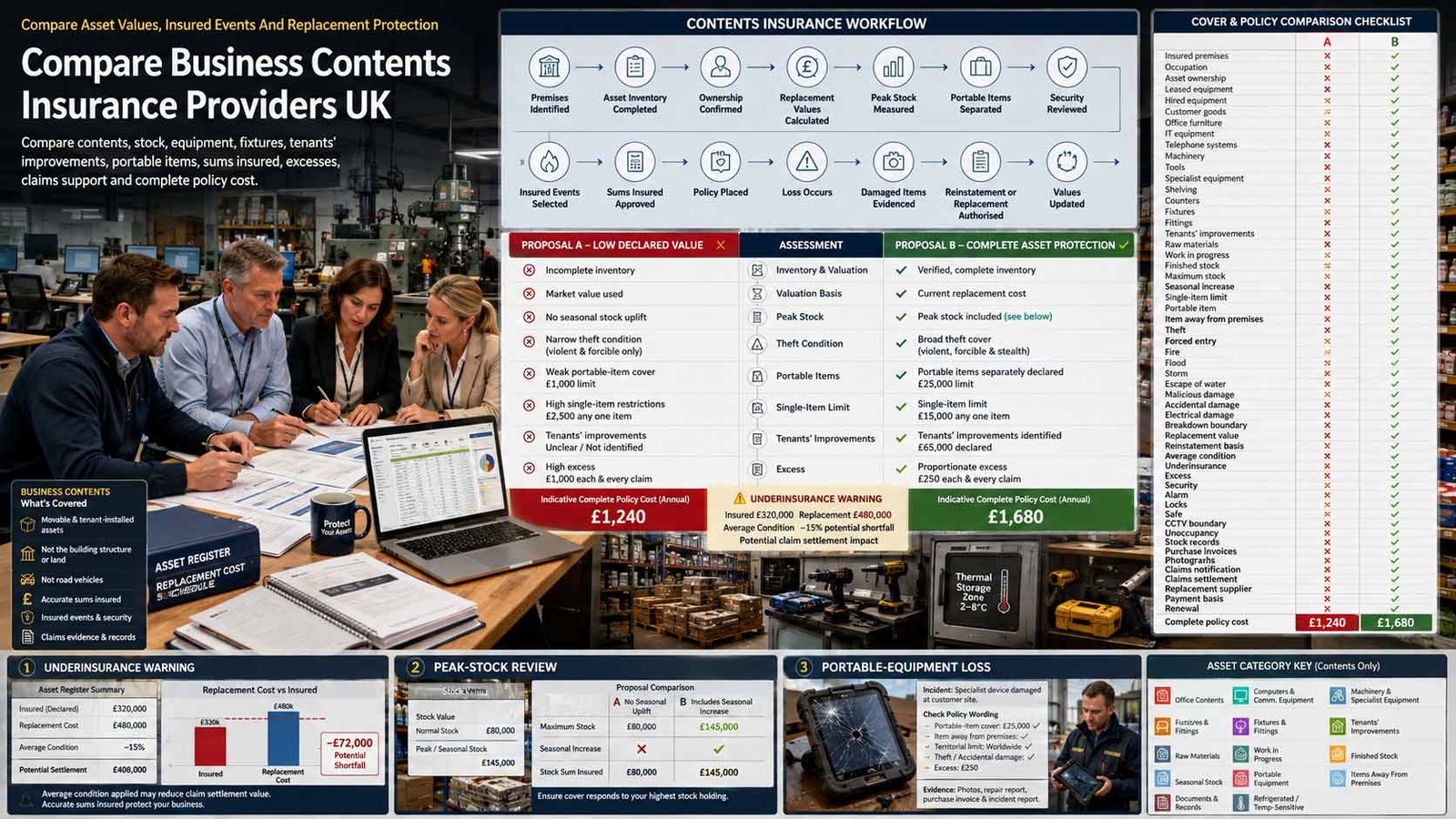
Protect The Physical Assets The Business Owns Or Is Responsible For
Business contents insurance is designed to repair or replace insured stock, equipment, furniture, fixtures and other movable or tenant-installed assets after covered loss or damage.
- Create a complete inventory using current replacement costs
- Insure stock at cost price and include seasonal maximum levels
- Separate premises contents from portable or temporarily removed equipment
- Test theft, security, unoccupancy and claims-evidence conditions
Business contents insurance can cover the cost of repairing or replacing insured physical assets after events such as fire, flood, escape of water, storm, malicious damage, theft or accidental damage, depending on the policy. Typical assets include computers, furniture, machinery, specialist equipment, shelving, counters, tenant-installed fixtures and stock.
The policy does not automatically insure every item used by the business. Assets can be restricted by location, ownership, single-item value, stock type, security, storage, occupancy and whether they are taken away from the premises. The sum insured must reflect the selected settlement basis and the highest value exposed, not an outdated balance-sheet figure.
This page remains within business contents insurance. It does not insure the permanent structure of the premises or road-going assets. Those risks require separate assessment and are intentionally outside this comparison.
Choose The Right Business Contents Insurance Route
Match the buying route to premises, asset type, stock, portability, security, occupancy and the complexity of the replacement values.
| Buying Model | What It Usually Includes | Best-Fit Question |
|---|---|---|
| Direct Online Small-Business Contents Policy | Digital quotation, standard insured events, selected sums insured and online documents for eligible offices, shops, salons and lower-complexity risks. | Can the online journey capture all stock, specialist equipment, fixtures, locations and security conditions accurately? |
| Broker Commercial Contents And Stock Placement | A broker discusses assets, stock, occupancy, security, valuations and special extensions before approaching one or more insurers. | Which insurers were considered and what advice, fees, claims support and underinsurance checks are included? |
| Office Contents And Equipment Cover | Protection for office furniture, computers, servers, telephones, printers, specialist devices, documents and portable technology where selected. | Are high-value electronics, equipment away from the premises and data-reconstruction costs separately defined? |
| Retail, Hospitality And Stock Policy | Contents and stock arranged around fixtures, point-of-sale systems, shelving, kitchen or service equipment, seasonal inventory and theft exposure. | Does the policy reflect maximum stock, refrigerated or high-risk stock, glass, signage and overnight security? |
| Home-Based Business Contents Cover | Commercial protection for business-owned equipment, furniture, stock and materials stored or used at a residential address. | Does the insurer accept the business activity, storage, visitors and separation from personal possessions? |
| Portable Equipment And Temporary Removal Extension | Cover for laptops, phones, cameras, projectors, specialist tools and other insured property taken to client sites, events or temporary locations. | Which countries, unattended-vehicle situations, theft conditions, single-item limits and excesses apply? |
| Machinery, Equipment Breakdown And Stock Deterioration | Additional protection for insured machinery or equipment breakdown and resulting damage to stock, subject to technical conditions and maintenance. | Is breakdown included, which equipment qualifies and how is spoiled or temperature-sensitive stock valued? |
| Multi-Site Or Commercial Package | Contents and stock insured across several sites or within a wider commercial policy with shared administration and claims handling. | Are sums insured, locations, limits and excesses separately stated rather than combined into one unclear total? |
Eight Areas That Determine Business Contents Policy Fit
Use the same premises, asset inventory, replacement values, maximum stock, security and claims history for every provider.
Comparison Criterion
Insured Contents, Equipment And Fixtures
Compare the policy definition with the real inventory: office furniture, IT, machinery, specialist tools, telephone systems, shelving, counters, display equipment, tenant-installed fixtures, decorations, documents and other assets. Confirm ownership, hired or leased equipment, employee property and customer goods separately.
Comparison Criterion
Sum Insured And Valuation Basis
Establish whether claims settle on reinstatement, replacement-as-new, indemnity or another basis. Use current purchase, delivery, installation and professional setup costs rather than depreciated accounts values. Check single-item limits, declarations, day-one uplift, index linking and the consequences of underinsurance or an average clause.
Comparison Criterion
Stock, Work In Progress And Seasonal Peaks
Insure stock at cost price rather than sale price unless the wording states otherwise. Include raw materials, work in progress, finished goods, consumables and seasonal maximums. Review high-risk stock, refrigerated goods, precious items, tobacco, alcohol, pharmaceuticals, customers’ goods and stock temporarily stored elsewhere.
Comparison Criterion
Insured Events And Accidental Damage
Compare fire, lightning, explosion, storm, flood, escape of water, impact, malicious damage, theft and accidental damage. Determine whether cover is named-perils or broader accidental-damage wording, and review exclusions for wear, gradual deterioration, faulty workmanship, vermin, contamination, cyber events and unexplained disappearance.
Comparison Criterion
Premises, Security And Unoccupancy
Confirm every insured location, construction, occupancy, neighbouring trade, fire protection, alarms, locks, shutters, safes and opening hours. Review theft evidence, forced-entry requirements, key security, stock storage, overnight cash or attractive items, inspection duties and restrictions when premises are vacant or closed for an extended period.
Comparison Criterion
Portable Equipment And Property Away
Standard premises cover can stop at the insured address. Compare laptops, phones, cameras, projectors, tools and specialist equipment used at client sites, events, employees’ homes or temporary storage. Check worldwide territory, unattended vehicles, overnight storage, single-item limits, proof of ownership and excesses.
Comparison Criterion
Breakdown, Deterioration And Supporting Extensions
Review equipment breakdown, power surge, electrical or mechanical failure, data reinstatement, replacement locks, debris removal, trace and access, temporary removal, exhibitions and deterioration of stock. These extensions vary and can contain maintenance, age, inspection, temperature-monitoring and service-contract conditions.
Comparison Criterion
Claims, Provider Status, Pricing And Exit
Compare notification, emergency mitigation, loss adjusters, replacement suppliers, reinstatement evidence, settlement time, excesses, insurer identity, broker role, FCA status, annual premium, Insurance Premium Tax, instalment charges, fees, changes, renewal, cancellation and access to records after the policy ends.
Measures To Define Before Selecting A Business Contents Provider
Translate broad property claims into written inventory, valuation, security, stock, extension, claims and commercial evidence.
| Measure | What It Should Define | Evidence To Request | Common Weakness |
|---|---|---|---|
| Asset inventory | Every item, category, ownership status, location and current replacement cost | Asset register, invoices, serial numbers, photographs, lease documents and valuation notes | The quote uses one rounded figure without item-level evidence |
| Settlement basis | Whether damaged property is replaced as new or settled after depreciation | Policy wording, schedule, valuation method, index linking and insurer confirmation | The buyer assumes new replacement when the wording uses indemnity value |
| Maximum stock value | The highest cost value at risk, including seasonal and promotional peaks | Inventory records, purchase invoices, monthly peaks, raw materials and work in progress | Average stock is insured while peak stock is materially higher |
| Premises and occupancy | Every site, use, construction, opening hours and period of unoccupancy | Address schedule, lease, occupancy plan, neighbouring trades and closure procedures | Temporary storage or a second site is omitted |
| Security conditions | The locks, alarms, shutters, safes, fire controls and evidence required for theft claims | Security survey, alarm certificate, maintenance, key control and photographs | The policy contains a warranty the premises cannot meet |
| Portable property | Which items are covered away from the insured premises and under what conditions | Portable asset list, countries, storage, employee use, unattended-vehicle and single-item limits | Laptops are assumed covered worldwide under premises-only contents |
| Tenants’ improvements | Which counters, partitions, flooring, lighting and fitted items are the tenant’s responsibility | Lease, fit-out invoices, landlord schedule, photographs and reinstatement estimate | Improvements are omitted because they appear fixed to the premises |
| Breakdown and deterioration | How mechanical or electrical failure and resulting stock spoilage are treated | Equipment list, age, maintenance, refrigeration monitoring and extension wording | Fire and theft cover is mistaken for mechanical breakdown protection |
| Claims evidence | How ownership, value, damage, theft, mitigation and replacement will be proved | Off-site inventory backup, invoices, images, police reference, repair reports and claim procedure | All records are lost in the same incident as the contents |
| Provider verification and cost | The insurer, intermediary, claims handler and complete annual commercial position | FCA Firm Checker, policy documents, premium, IPT, finance, fees and service terms | The buyer compares monthly instalments without insurer or annual-total verification |
Business Contents Insurance Providers UK Businesses Can Consider
Shortlist providers whose asset appetite, valuation basis, security conditions, stock cover, claims model, regulated role and complete cost fit the business. Confirm current written terms before purchase.
Provider Profile
Allianz Insurance
Allianz offers commercial contents and stock protection through business products and broker distribution. Include it where a business wants established commercial underwriting, UK-based claims service and contents arranged within a broader commercial programme. Confirm the selected product, insured property, stock, replacement basis, locations, security conditions, excesses, extensions, claims process, broker fees and complete annual cost.
Review official Allianz business contents informationProvider Profile
AXA Business Insurance
AXA provides direct business contents, stock and equipment options for eligible shops, offices, workshops and other SMEs. Its published material includes contents, stock, tenants’ improvements, shop fronts and selected high-risk stock depending on the product. Confirm occupation eligibility, sums insured, accidental damage, portable items, security, single-item limits, excesses, claims route and payment total.
Review official AXA business contents informationProvider Profile
Direct Line For Business
Direct Line for Business offers contents and stock cover as part of a tailored business policy, with options for specialist items and equipment used away from the premises. Published information states that equipment breakdown is included with its contents and stock cover for eligible items. Confirm the exact insured events, sum insured, breakdown terms, stock deterioration, portable property, excess, claims service, fees and renewal.
Review official Direct Line for Business contents informationProvider Profile
Hiscox
Hiscox offers business contents cover for equipment, stock and documents kept at a workplace, subject to the selected policy. Include it where an office, professional, retail or home-based business wants configurable contents within a direct commercial policy. Confirm premises, accidental damage, theft, water damage, portable items, replacement basis, single-item limits, security conditions, claims support and total cost.
Review official Hiscox business contents informationProvider Profile
Markel Direct
Markel Direct provides office and business-equipment insurance for eligible microbusinesses, consultants, contractors and self-employed professionals. Published material includes office contents and equipment used inside and outside the office, with a stated £250 excess on its office policies and selected pricing from £5 per month. Confirm stock eligibility, portability, insured events, item limits, first payment, complete annual premium and package conditions.
Review official Markel Direct office and equipment informationProvider Profile
PolicyBee
PolicyBee is a specialist online business-insurance broker offering business contents cover for office furniture, equipment, fixtures and fittings, with separate routes for stock and portable equipment. Include it where the buyer wants a guided digital broker and needs help separating premises contents from portable or trading stock. Confirm insurer panel, underlying insurer, advice basis, sums insured, extensions, fees, claims route and renewal.
Review official PolicyBee business contents informationProvider Profile
Premierline
Premierline is a commercial insurance broker arranging business contents and stock policies across offices, retail, hospitality, trades, care and other sectors. Published guidance covers machinery, IT hardware, fixtures, stock, customer goods and seasonal values. Include it where varied assets or higher stock require adviser review. Confirm insurers approached, valuation basis, underinsurance, security, extensions, claims support, fees and cancellation.
Review official Premierline contents and stock informationProvider Profile
Simply Business
Simply Business is a broker and comparison service presenting business contents quotations from several insurer brands for eligible SMEs. Its current guidance describes repair and replacement cover for office furniture and business equipment and stresses that insurer definitions differ. Include it where the buyer wants multiple routes through one application. Confirm underlying insurer, insured property, limits, excesses, stock, portable equipment, fees and claims contact.
Review official Simply Business contents informationWhat Changes Business Contents Insurance Cost UK 2026
Compare the complete cost of adequate replacement values and workable conditions—not the lowest advertised monthly figure.
| Cost Driver | Why It Changes Premium | What A Comparable Quote Should Show |
|---|---|---|
| Business activity and asset type | Restaurants, workshops, retailers, manufacturers and specialist-equipment users can face higher fire, theft, water or breakdown exposure | Occupation, processes, equipment, heat, chemicals, refrigeration and asset categories |
| Total contents replacement value | Higher replacement cost increases the insurer’s maximum material-damage exposure | Current replacement values including delivery, installation and setup |
| Maximum stock value | Seasonal peaks, attractive stock and fragile or perishable goods change frequency and severity | Cost-price maximum, monthly peaks, stock type, storage and high-risk categories |
| Premises location and construction | Flood, crime, fire spread, shared premises and construction can change loss probability | Full addresses, construction, floor, neighbouring trades and flood history |
| Security and fire protection | Locks, alarms, shutters, CCTV, safes, sprinklers and fire detection can reduce or condition risk | Security specifications, certificates, monitoring and maintenance |
| Occupancy and unoccupancy | Night-time operation, long closures and temporary vacancy affect theft, water and fire detection | Opening hours, inspections, closure periods and seasonal shutdown procedures |
| Portable equipment and temporary locations | Property away from the premises faces different theft, loss and transit conditions | Portable item values, territories, storage, employees and unattended-vehicle use |
| Claims and loss history | Previous theft, escape of water, fire or accidental damage can indicate future exposure | Five-year or requested history, circumstances, values and corrective action |
| Settlement basis and excess | Replacement-as-new, indemnity, accidental damage and lower excesses can increase premium | Chosen basis, average clause, item limits and excess by event |
| Payment method and fees | Monthly finance, broker charges and administration can increase total payable | Annual premium, IPT, deposit, instalment total, broker and change fees |
| Indicative Commercial Model | Typical Position | What Must Be Confirmed |
|---|---|---|
| Annual Direct Policy | The full annual premium is paid for selected contents and stock protection | Sums insured, insured events, excesses, annual total, IPT, fees and cancellation |
| Monthly Instalment Plan | The annual premium is financed or collected through instalments | Deposit, APR or finance charge, total payable and missed-payment consequences |
| Broker-Placed Policy | An intermediary arranges cover with an insurer and may charge fees or receive commission | Insurer, advice basis, market approach, fees, claims role, changes and renewal |
| Commercial Package | Contents and stock are purchased with selected additional business sections | Separate sums insured, dependencies, duplicated cover, exclusions and whole-policy cost |
Match The Provider To The Contents, Stock And Operating Environment
The right shortlist depends on assets, stock volatility, portability, security, premises use, specialist equipment and claims complexity.
Office Or Professional Services Business
Prioritise computers, servers, telephones, furniture, specialist devices, documents, portable laptops, data reinstatement, accidental damage, replacement-as-new wording, item limits, employee use, homeworking and a claims route that can replace essential technology quickly.
Retail, Hospitality Or Customer-Facing Premises
Prioritise stock at maximum cost value, fixtures, counters, shelving, kitchen or service equipment, refrigeration, theft, glass-related interfaces, seasonal peaks, high-risk goods, security warranties, water damage and rapid access to replacement suppliers.
Home-Based Or Mobile Business
Prioritise separation from personal possessions, commercial acceptance at the residential address, stock storage, visitors, equipment away from the premises, worldwide territory, unattended-vehicle restrictions, single-item limits, proof of ownership and employee devices.
Workshop, Manufacturer Or Specialist Equipment User
Prioritise machinery, plant, tools, raw materials, work in progress, customer goods, power surge, equipment breakdown, deterioration, maintenance, fire protection, hazardous processes, replacement lead times, valuations and broker-led wording review.
How To Compare Business Contents Insurance Proposals
Issue one property-risk pack containing every legal entity, insured address, occupation, opening hours, construction, neighbouring trades, security, fire protection, unoccupancy, full asset inventory, current replacement costs, single high-value items, tenants’ improvements, hired equipment, customer goods, portable property, maximum stock by category, seasonal peaks, refrigeration, maintenance, prior losses, preferred excess and payment method. Require the provider to return a completed asset, wording, condition and commercial schedule rather than a premium-only summary.
- Every provider prices the same inventory and maximum stock values
- Replacement, indemnity and average-clause treatment is explicit
- Portable property, improvements and special stock are demonstrated
- Security, theft and unoccupancy conditions are returned before purchase
- Insurer, intermediary and claims handler are identified
- Annual and monthly totals include IPT, finance and fees
Compare The Same Loss End To End
Ask each provider how the policy would respond if escape of water damages office equipment and stock, a laptop is stolen away from the premises, seasonal inventory exceeds the declared value and replacement takes several weeks.
A low premium is not a strong result when the sum insured is inadequate, the theft condition cannot be met or the key equipment sits outside the insured location.
Six Questions To Put To Every Business Contents Provider
The answers expose valuation gaps, missing stock, unworkable security conditions, restricted portable property and incomplete annual costs.
Which Assets And Stock Categories Are Covered?
Request the exact definition for furniture, IT, machinery, tools, fixtures, improvements, hired equipment, documents, raw materials, work in progress, finished stock and customer goods.
How Should We Calculate Each Sum Insured?
Confirm replacement or indemnity basis, delivery and installation, VAT, index linking, single-item limits, stock cost price, seasonal increases, declarations and any average clause.
Which Insured Events And Exclusions Apply?
Obtain fire, flood, escape of water, storm, theft, malicious damage and accidental-damage wording plus wear, gradual damage, unexplained loss, cyber and contamination exclusions.
What Security And Occupancy Conditions Must We Meet?
Ask about locks, alarms, shutters, CCTV, safes, fire protection, key control, forced entry, inspections, night-time stock and restrictions during temporary closure or vacancy.
How Are Portable Equipment, Breakdown And Stock Deterioration Handled?
Request territories, unattended-vehicle conditions, temporary locations, item limits, maintenance, equipment age, temperature monitoring, excesses and claims evidence.
What Is The Complete Annual Cost And Exit Position?
Obtain premium, IPT, deposit, instalment total, finance, broker and administration fees, mid-term asset changes, cancellation, renewal, claim support and document access.
A Seven-Stage Business Contents Provider Evaluation
Move from verified inventory and security data to tested wording and claims operation rather than selecting a policy from price alone.
- Create a verified asset baseline covering locations, equipment, fixtures, improvements, stock, portable property, ownership, replacement values, security, occupancy and prior losses.
- Define the settlement standard and sums insured, including replacement or indemnity basis, stock cost price, seasonal maximums, single items, delivery, installation and VAT treatment.
- Prepare a prioritised requirement catalogue covering insured events, accidental damage, theft, portable items, improvements, breakdown, deterioration, excesses, conditions, claims and complete cost.
- Issue one quotation brief and scripted loss set using the same inventory, stock peaks, security, locations, occupancy, claims history, inception date and payment assumptions.
- Shortlist providers by asset and stock appetite, wording, valuation basis, security requirements, claims capability, regulated status, adviser support and complete cost.
- Complete due diligence and document review. Check FCA status, insurer identity, IPID, wording, schedule, statement of fact, sums insured, endorsements, fees and claims instructions.
- Purchase only after correcting inaccuracies. Store an off-site inventory, maintain security, update asset and stock values, record changes and repeat the comparison before renewal.
Business Contents Insurance Comparison Checklist
Use this table before purchasing, changing or renewing business contents cover.
| No. | Requirement | Evidence To Obtain Before Purchase | Confirmed |
|---|---|---|---|
| 01 | Business contents service boundary retained | The comparison remains focused on business-owned contents, stock, equipment and tenant-installed assets | |
| 02 | Every insured location declared | Main premises, secondary sites, storage, temporary locations and home-business address | |
| 03 | Complete asset inventory prepared | Description, ownership, serial number, location, age, invoice and replacement cost | |
| 04 | Settlement basis approved | Replacement-as-new, reinstatement, indemnity, VAT, delivery and installation | |
| 05 | Maximum stock value verified | Raw materials, work in progress, finished goods, consumables and seasonal peaks at cost | |
| 06 | High-value and special stock declared | Attractive, fragile, refrigerated, precious, hazardous or customer-owned goods | |
| 07 | Tenants’ improvements identified | Counters, partitions, flooring, lighting, fitted units and lease responsibilities | |
| 08 | Portable equipment separately controlled | Laptops, phones, cameras, tools, territories, storage and unattended-vehicle conditions | |
| 09 | Insured events and accidental damage accepted | Fire, flood, escape of water, storm, theft, malicious damage and exclusions | |
| 10 | Security conditions achievable | Locks, alarms, shutters, safes, fire protection, key control and maintenance | |
| 11 | Unoccupancy conditions understood | Closure limits, inspections, heating, water, alarms and insurer notification | |
| 12 | Breakdown and deterioration assessed | Eligible equipment, maintenance, temperature monitoring, spoilage and excesses | |
| 13 | Claims evidence stored off-site | Invoices, photographs, serial numbers, valuations, backups and emergency contacts | |
| 14 | Provider and insurer verified | FCA status, insurer, intermediary, claims handler and terms of business | |
| 15 | Three-year cost and exit complete | Premium, IPT, finance, fees, changes, renewal, cancellation and durable document access |
Common Business Contents Insurance Buying Mistakes
Most avoidable problems begin with weak inventories, incorrect valuation, missing stock peaks, untested conditions or price-led selection.
| Mistake | Why It Creates Risk | Better Control |
|---|---|---|
| Using depreciated accounts values as the sum insured | The claim may not fund current replacement, delivery and installation | Value assets using the policy’s settlement basis |
| Insuring average stock instead of the seasonal maximum | Peak inventory can be underinsured during the period of greatest exposure | Use cost-price maximums and seasonal declarations |
| Assuming every item inside the premises is covered | Ownership, stock type, single-item limits and exclusions can remove assets | Create an itemised inventory and obtain written confirmation |
| Ignoring tenants’ improvements | Counters, flooring, partitions and lighting may be the tenant’s responsibility | Review the lease and include the current reinstatement value |
| Treating premises cover as portable-equipment cover | Laptops and tools can be uninsured when taken to clients or temporary locations | Add the correct away-from-premises extension |
| Accepting security warranties without testing them | A theft claim can be affected when locks, alarms or closure procedures are not met | Complete a security survey and evidence maintenance |
| Leaving unoccupancy unreported | Cover can reduce or stop during extended closure or vacancy | Notify the insurer and follow inspection and utility conditions |
| Assuming fire and theft cover includes equipment breakdown | Mechanical or electrical failure may require a separate extension | Compare breakdown and deterioration wording explicitly |
| Keeping all inventory evidence at the premises | The same incident can destroy the proof needed for the claim | Store secure off-site copies of records and images |
| Comparing monthly prices without sums insured and fees | The insurer, valuation basis, excess, finance and annual total can differ | Compare complete documents and total payable |
Frequently Asked Questions
Answers to common questions from UK businesses comparing contents, stock, equipment, valuation, portable property, underinsurance, claims and pricing.
What Is Business Contents Insurance?
Business contents insurance can pay to repair or replace insured stock, equipment, furniture, fixtures and other business-owned or responsible-for assets after covered loss or damage. Exact protection depends on the property definition, insured events, location, sums insured, excesses and policy conditions.
Is Business Contents Insurance Legally Required In The UK?
Business contents insurance is generally not compulsory under UK law. A lease, lender, franchise, customer contract or other agreement can require specified protection. Without suitable cover, the business must fund replacement of damaged or stolen assets and stock itself.
What Does Business Contents Insurance Cover?
Policies can cover office furniture, computers, telephones, printers, machinery, specialist equipment, fixtures, tenant-installed improvements, documents and stock. Cover can apply after fire, flood, escape of water, storm, theft, malicious damage or accidental damage, subject to the selected wording.
How Should A Business Calculate Its Contents Sum Insured?
Use the policy’s required settlement basis and calculate the current cost of replacing all insured items, including delivery, installation and setup. Do not rely only on depreciated accounts values. Include high-value items, fixtures, improvements, hired property and every insured location.
How Should Stock Be Valued For Business Contents Insurance?
Stock is commonly insured at cost price rather than retail sale price. Use the maximum value exposed, including seasonal peaks, raw materials, work in progress and finished goods. Special categories such as refrigerated, high-risk or customer-owned stock may require separate limits or extensions.
Does Business Contents Insurance Cover Laptops And Equipment Away From The Premises?
Standard contents cover can be limited to the insured address. Portable-equipment or temporary-removal cover may be required for laptops, phones, cameras, projectors and tools used at client sites or other locations. Check territory, unattended-vehicle conditions, item limits and excesses.
Does Business Contents Insurance Cover Accidental Damage?
Accidental damage may be included, optional or excluded depending on the policy. Compare it separately from named events such as fire, flood and theft. Review exclusions for wear and tear, gradual damage, faulty workmanship, breakdown and unexplained disappearance.
What Is Underinsurance And An Average Clause?
Underinsurance occurs when the sum insured is lower than the value at risk. Some policies apply an average clause, reducing a claim in proportion to the underinsurance. Accurate inventories, current replacement costs and maximum stock values reduce this risk.
Does Business Contents Insurance Cover Equipment Breakdown Or Spoiled Stock?
Some policies include or offer equipment-breakdown and deterioration-of-stock extensions, while standard fire and theft cover may not respond to mechanical or electrical failure. Check eligible equipment, maintenance, age, monitoring, temperature change, excesses and sublimits.
How Should UK Businesses Compare Business Contents Insurance Providers?
Give every insurer or broker the same premises, asset inventory, replacement values, maximum stock, security, occupancy, portable property, claims history and payment assumptions. Compare insured events, settlement basis, exclusions, excesses, conditions, claims support, annual total, fees, renewal and cancellation.
Official Guidance And Provider Resources
Reviewed by Bhav Giva, Founder & Lead Analyst at CompareServices.co.uk, on 5 August 2026.
Use current ABI, FCA, GOV.UK and provider documentation to verify contents and stock definitions, valuation basis, maximum values, insured events, accidental damage, portable property, security, unoccupancy, breakdown, deterioration, claims procedures, insurer and intermediary status, pricing examples, Insurance Premium Tax, fees and policy terms. Insurance appetite, premiums and wording can change. Obtain valuation, risk-management or appropriately authorised insurance advice where assets, stock, specialist equipment or policy conditions are complex.
- Association of British Insurers — Commercial Property Insurance
- Association of British Insurers — Insurance For Small Businesses Guide
- FCA — FCA Firm Checker
- FCA — Financial Services Register
- GOV.UK — Insurance Premium Tax
- Allianz — Business Contents Information
- AXA — Business Contents Insurance
- Direct Line For Business — Business Contents Insurance
- Hiscox — Business Contents Insurance
- Markel Direct — Office And Business Equipment Insurance
- PolicyBee — Business Contents Insurance
- Premierline — Business Contents And Stock Insurance
- Simply Business — Business Contents Insurance