
Compare Commercial Vehicle Insurance Providers UK
Compare Vehicle Use, Cover Level, Driver Eligibility, Market-Value Settlement, Courtesy Vehicles, Electric-Vehicle Features, Claims Support, Pricing And Complete Policy Cost
Compare commercial vehicle insurance UK providers by vehicle type, registration, ownership, market value, weight, modifications, electric or hybrid components, business activity, class of use, carriage of own goods, carriage of goods for hire and reward, courier or delivery work, annual mileage, overnight parking, security, named drivers, driver age, licence type, convictions, claims, no-claims history, comprehensive, third-party fire and theft or third-party-only cover, accidental damage, fire, theft, glass, keys, trailers, foreign use, legal expenses, approved repairs, replacement vehicles, total-loss settlement, excesses, uninsured-driver protection, claims service, insurer identity, FCA status, annual premium, Insurance Premium Tax, instalment costs, fees, renewal, cancellation and complete policy documents. Give every provider the same vehicles, drivers, use, mileage, values, claims history and payment assumptions before comparing proposals.
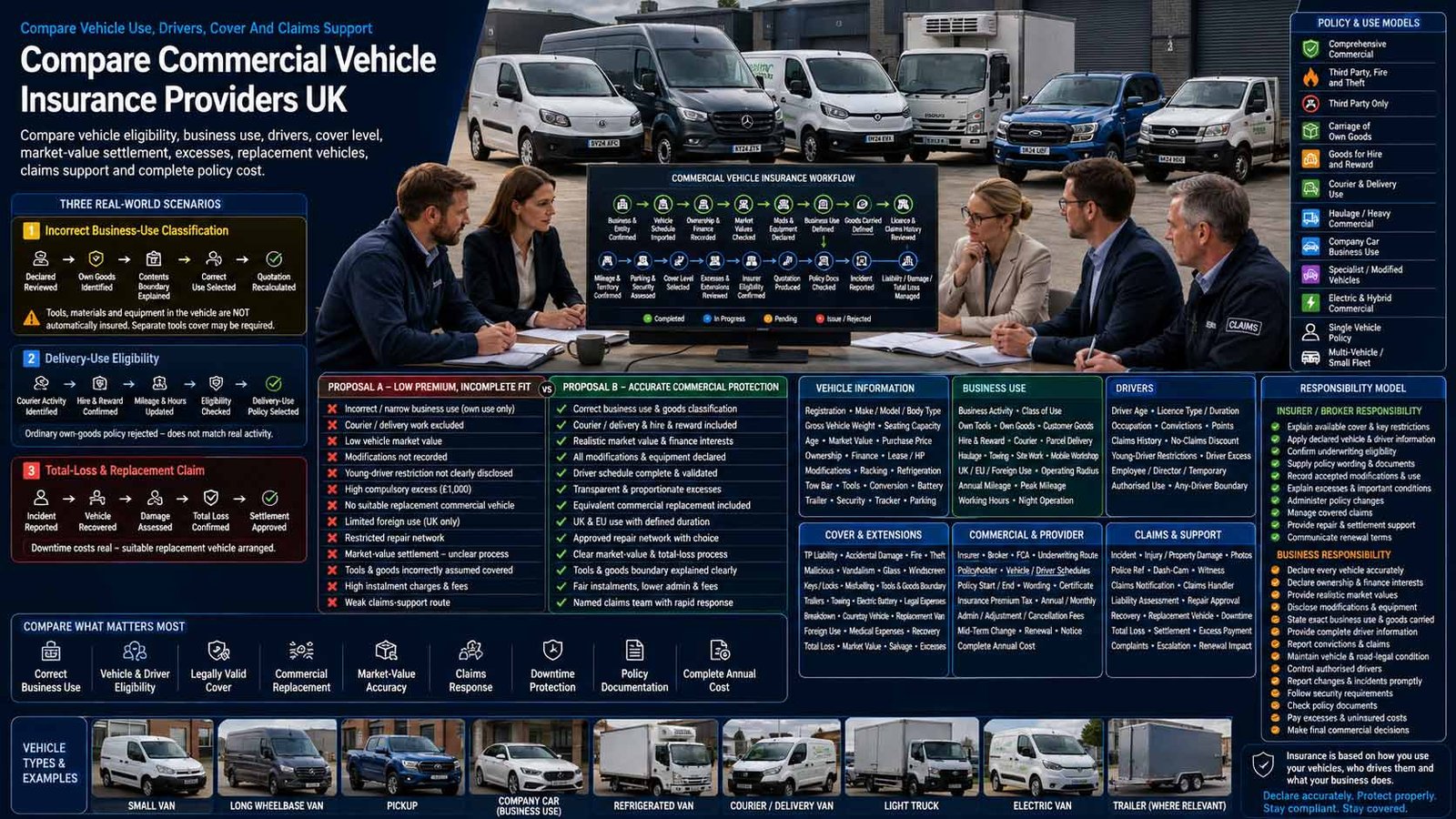
Insure The Vehicle, Driver And Business Use Correctly
Commercial vehicle insurance protects vehicles used for business and provides the legally required liability cover when they are driven on roads or in public places.
- Use at least third-party insurance for every road-going vehicle and permitted driver
- Declare the exact business use, goods carried, mileage and operating territory
- Match the vehicle value, driver restrictions and excess to the real exposure
- Check replacement transport, repairs and claims notification before purchase
It is illegal to drive a vehicle on a road or in a public place without at least third-party motor insurance. A vehicle that is not being used must normally remain insured unless it is kept off the road and has a valid Statutory Off Road Notification. The driver must also be correctly insured; a live policy against the registration does not prove that the use or driver is permitted.
Commercial vehicle insurance can cover legal liability to other road users and, depending on the selected level, damage to the insured vehicle caused by accident, fire, theft, attempted theft, vandalism or other insured events. The policy must reflect whether the vehicle carries the business’s own tools or goods, carries customers’ goods for payment, performs deliveries, tows a trailer, travels abroad or has specialist modifications.
This page focuses only on motor insurance protection for vehicles used by UK businesses. It does not assess operational transport systems or payment products.
Choose The Right Commercial Vehicle Insurance Route
Match the policy to vehicle type, ownership, use, drivers, goods carried, mileage and the operational consequence of a vehicle being unavailable.
| Policy Model | What It Usually Includes | Best-Fit Question |
|---|---|---|
| Comprehensive Commercial Vehicle Cover | Third-party liability plus accidental damage, fire, theft and attempted theft affecting the insured vehicle, subject to excesses and exclusions. | Does the repair, market-value and replacement-vehicle position protect the business after a serious incident? |
| Third Party, Fire And Theft | Legal liability to other people plus fire, theft and attempted-theft protection for the insured vehicle, without general accidental-damage cover. | Can the business fund damage to its own vehicle after an at-fault collision? |
| Third Party Only | The minimum level covering liability for injury or damage caused to other people, vehicles or property. | Is the premium saving proportionate to the uninsured value and downtime exposure? |
| Own-Goods Business Use | Cover for a van or pickup carrying the policyholder’s tools, equipment or goods between jobs and business locations. | Are the goods and tools themselves covered, or only the vehicle and motor liability? |
| Courier Or Delivery Use | Specialist use for repeated deliveries or carriage of other people’s goods for payment, subject to routes, vehicle type and driver criteria. | Does the wording match the exact delivery activity, parcel type, platforms and working hours? |
| Haulage And Heavy Commercial Vehicle Cover | Motor protection for lorries, trucks and heavier goods vehicles, often arranged through specialist insurers or brokers. | Are vehicle weight, operator activity, territories, trailers and goods categories accepted? |
| Company Car Business Use | Cover for company-owned or business-used cars where employees travel to clients, sites or several workplaces. | Are every driver, class of business use and personal-use permission stated correctly? |
| Specialist Or Modified Vehicle Cover | Underwriting for electric vans, refrigerated vehicles, tippers, mobile workshops, catering vehicles, minibuses, pickups and other specialist bodies or equipment. | Are batteries, charging cables, fixed equipment, modifications and replacement arrangements included? |
Eight Areas That Determine Commercial Vehicle Policy Fit
Use the same vehicles, drivers, use, mileage, values, security and claims history for every provider.
Comparison Criterion
Vehicle Eligibility, Ownership And Value
Compare registration, make, model, body type, gross vehicle weight, seating, age, market value, purchase method, company or sole-trader ownership, leasing and finance interest. Declare conversions, racking, refrigeration, signage, lifting equipment, tow bars, security devices and every modification. Confirm new-vehicle replacement and total-loss valuation rules.
Comparison Criterion
Business Use And Goods Carried
Define social use, commuting, carriage of own goods, commercial travelling, courier work, delivery, hire and reward, haulage, passenger transport and voluntary use. State the actual goods, tools, samples or equipment carried. An incorrect class of use can leave a vehicle shown as insured but not insured for the journey being made.
Comparison Criterion
Drivers, Licences And Restrictions
Compare named-driver, specified-driver and broader driver options. Record age, occupation, licence type, licence length, residency, convictions, disqualifications, claims, medical restrictions and expected frequency of use. Check young-driver, inexperienced-driver, foreign-licence and employee-permission restrictions.
Comparison Criterion
Cover Level, Excess And Settlement
Compare comprehensive, third-party fire and theft and third-party-only protection. Review compulsory and voluntary excesses, windscreen excess, theft excess, young-driver excess, market-value settlement, new-vehicle replacement, finance shortfall, salvage, write-off categories and whether VAT affects the payment.
Comparison Criterion
Repairs, Courtesy Vehicle And Downtime
Assess approved-repairer networks, repair guarantees, parts policy, roadside recovery after an accident, replacement transport, courtesy-vehicle type, duration and availability after theft or total loss. A small car may not replace a working van, pickup, refrigerated body or specialist commercial vehicle.
Comparison Criterion
Tools, Goods, Trailers And Accessories
Motor cover may exclude business goods, samples, stock and tools unless a specific section or separate policy applies. Compare fixed and removable accessories, tools, keys, personal belongings, trailers, attached equipment, charging cables and goods in transit. Check forced-entry, overnight and single-item conditions.
Comparison Criterion
Territory, Mileage, Parking And Security
Confirm annual mileage, peak mileage, postcode, overnight location, locked compound, garage, street parking, alarms, immobilisers, trackers, key control, EU or worldwide travel and green-card requirements. Review territorial time limits, unattended-vehicle conditions, trailer use and what must be reported when circumstances change.
Comparison Criterion
Claims, Provider Status, Pricing And Exit
Compare accident reporting, 24-hour claims access, approved repairers, uninsured-driver protection, no-claims discount, legal expenses, complaints, insurer identity, intermediary role, FCA status, annual premium, Insurance Premium Tax, instalment charges, fees, policy changes, renewal, cancellation and proof that the vehicle appears on the central insurance record.
Measures To Define Before Selecting A Commercial Vehicle Provider
Translate marketing claims into written vehicle, use, driver, repair, claims and commercial evidence.
| Measure | What It Should Define | Evidence To Request | Common Weakness |
|---|---|---|---|
| Vehicle schedule | Every registration, vehicle type, ownership, value, weight and modification | V5C or lease record, purchase invoice, finance interest, photographs and modification details | A quotation is based on the wrong body type, value or registration |
| Class of use | The exact work journeys, goods carried and whether payment is received for carriage | Business description, contracts, route pattern, goods categories and insurer confirmation | Own-goods cover is used for paid delivery work |
| Driver eligibility | Who may drive and the licence, age, conviction and claims conditions | Driver list, licence checks, claims history, occupation and permission records | An employee is allowed to drive without being within the certificate terms |
| Cover and settlement | The insured events, excesses and basis of repair or total-loss payment | Schedule, policy wording, vehicle value, new-replacement condition and excess table | The buyer assumes invoice value when the policy pays market value |
| Downtime support | How the business travels or works while the vehicle is repaired, stolen or written off | Courtesy or replacement-vehicle wording, duration, vehicle class and availability | A small courtesy car cannot perform the insured vehicle’s work |
| Goods and equipment | What happens to tools, stock, samples, customer goods, trailers and accessories | Separate limits, forced-entry conditions, item list and relevant additional cover | The motor policy is assumed to insure all contents automatically |
| Security and parking | The overnight location, anti-theft controls and theft-claim conditions | Parking declaration, alarm, immobiliser, key control, photographs and certificates | The vehicle is routinely parked somewhere different from the quote |
| Mileage and territory | The annual distance, countries, travel duration and permitted use abroad | Mileage records, journeys, green-card need and territorial wording | Mileage or foreign use exceeds the declared allowance |
| Claims operation | How incidents, recovery, repairs, third parties and evidence are handled | Claims guide, contact route, repair network, app or portal and escalation | Drivers do not know how or when to report an accident |
| Provider verification and cost | The insurer, intermediary, total annual cost and renewal position | FCA Firm Checker, policy documents, premium, IPT, finance and fees | A monthly instalment is compared without insurer or annual-total checks |
Commercial Vehicle Insurance Providers UK Businesses Can Consider
Shortlist providers whose vehicle, use and driver appetite, repair support, claims model, regulated role and complete cost fit the business. Confirm current written terms before purchase.
Provider Profile
Allianz Insurance
Allianz provides motor insurance designed for company cars, vans and goods vehicles through brokers and partners. Include it where a business wants commercial underwriting, mixed vehicle types or adviser-led placement. Confirm the exact Allianz or group insurer, vehicle and driver eligibility, use, cover level, excesses, repair network, replacement transport, foreign use, claims service, broker fees and complete annual cost.
Review official Allianz business vehicle insurance informationProvider Profile
Aviva
Aviva offers direct Business Vehicle and Van Insurance for sole traders and companies, with comprehensive or third-party fire and theft options. Published benefits can include a 24-hour accident line, uninsured-driver promise, approved repairs, optional courtesy vehicles and selected tool cover, subject to terms. Confirm use, drivers, business goods exclusions, excesses, replacement vehicle and optional-cover cost.
Review official Aviva business vehicle insurance informationProvider Profile
AXA
AXA provides direct van insurance for business, own-goods, courier and selected specialist uses, with comprehensive and reduced cover options. Include it where the vehicle and drivers meet its online eligibility and the business wants configurable legal, breakdown, trailer or no-claims options. Confirm age criteria, use, annual mileage, overnight parking, vehicle value, excess, claim service, optional costs and total payable.
Review official AXA van insurance informationProvider Profile
Direct Line For Business
Direct Line for Business offers commercial van and pickup insurance directly rather than through general comparison sites. Its published material distinguishes commercial business use from personal commuting and offers comprehensive or third-party fire and theft protection. Confirm vehicle type, own-goods or other use, drivers, tools, electric components, repair and replacement support, excesses, no-claims treatment, claims route and renewal terms.
Review official Direct Line for Business van insurance informationProvider Profile
Admiral
Admiral offers commercial van insurance for vehicles up to 3.5 tonnes and publishes comprehensive, third-party fire and theft and third-party-only choices. Its classes include carriage of own goods and carriage of goods for hire and reward. Include it where the van, use and drivers fit its direct model. Confirm contents add-ons, modifications, electric components, excesses, replacement vehicle, claims service and total cost.
Review official Admiral commercial van insurance informationProvider Profile
Churchill Business
Churchill Business offers van insurance for business or leisure use, including carrying the policyholder’s goods, tools or equipment between work locations. The product is arranged and administered by Brightside Insurance Services and underwritten as stated in the policy documents. Confirm the regulated roles, class of use, drivers, repair network, courtesy vehicle, excesses, claims process, fees, renewal and cancellation.
Review official Churchill Business van insurance informationProvider Profile
NFU Mutual
NFU Mutual offers commercial vehicle routes covering vans, pickups, trucks and specialist business vehicles through local agency support. Its van material publishes comprehensive features including approved repairs, selected new-vehicle replacement, windscreen cover, courtesy transport and limited tools cover, subject to terms. Confirm market-value settlement, driver and vehicle acceptance, use, tools conditions, excesses, claims access and policy changes.
Review official NFU Mutual commercial vehicle insurance informationProvider Profile
Markerstudy
Markerstudy provides broker-distributed commercial vehicle products, including working-vehicle cover targeted at vehicles primarily used for the policyholder’s business. Include it where standard direct products do not fit a specialist vehicle, driver or use. Confirm the distributing broker, underwriting insurer, current policy wording, accepted vehicle, business use, drivers, excesses, repair arrangements, claims contact, broker fees and renewal.
Review official Markerstudy commercial vehicle informationWhat Changes Commercial Vehicle Insurance Cost UK 2026
Compare the complete annual cost of correctly classified cover—not the lowest advertised starting price.
| Cost Driver | Why It Changes Premium | What A Comparable Quote Should Show |
|---|---|---|
| Vehicle type, weight and value | Larger, heavier, specialist, high-performance or high-value vehicles can create higher repair and liability exposure | Registration, make, model, body, gross weight, value and replacement lead time |
| Business use and goods carried | Courier, delivery, haulage and high-mileage work can increase road time and claim frequency | Exact class of use, goods, routes, customer work and payment received |
| Driver age and experience | Younger, inexperienced or restricted-licence drivers can attract higher premiums or excesses | All drivers, licence length, residency, occupation and vehicle access |
| Claims and convictions | Prior accidents, thefts, offences and disqualifications affect expected loss and insurer appetite | Full requested history, fault status, points, bans and no-claims evidence |
| Annual mileage and operating area | More miles, urban routes, night driving and wider territories can increase exposure | Annual and peak mileage, postcodes, times, countries and overnight stops |
| Parking and security | Street parking, theft hotspots and weak key control increase loss probability | Overnight location, alarm, immobiliser, tracker, keys and secure compound |
| Cover level and excess | Comprehensive protection, lower excesses and extra benefits increase insurer exposure | Cover level, compulsory and voluntary excess, glass and young-driver excess |
| Modifications and fixed equipment | Racking, refrigeration, lifting gear, conversions and electric components change value and repair complexity | Every modification, fitted equipment, battery, cable and specialist body |
| Replacement transport and legal extras | A suitable replacement commercial vehicle, legal costs and breakdown support add value and cost | Vehicle class, duration, theft and write-off cover, exclusions and add-on price |
| Payment method and fees | Monthly finance, broker charges and administration can increase total payable | Annual premium, IPT, deposit, APR, instalment total, changes and cancellation fees |
| Commercial Model | Typical Position | What Must Be Confirmed |
|---|---|---|
| Annual Direct Policy | The annual premium is paid for a single vehicle or direct multi-vehicle arrangement | Vehicle, drivers, use, cover, excess, annual total, IPT, fees and cancellation |
| Monthly Instalment Plan | The annual motor premium is financed or collected through instalments | Deposit, APR or finance cost, total payable and cancellation after missed payments |
| Broker-Placed Policy | An intermediary arranges cover with an insurer and may charge fees or receive commission | Insurer, advice basis, market approach, fees, claims role, changes and renewal |
| Specialist Commercial Vehicle Placement | A broker or specialist underwriter places unusual vehicles, uses or driver profiles | Accepted use, endorsements, excesses, insurer, repair process and complete cost |
Match The Provider To The Vehicle And Commercial Use
The right shortlist depends on vehicle type, goods carried, drivers, routes, mileage, security, replacement needs and claims complexity.
Tradesperson Carrying Own Tools And Materials
Prioritise carriage-of-own-goods use, van or pickup eligibility, tools and contents limits, forced-entry conditions, racking and modifications, overnight parking, young or additional drivers, windscreen cover and a suitable replacement vehicle after a claim.
Courier, Delivery Or Paid Goods Transport
Prioritise the correct paid-carriage class, goods type, delivery frequency, annual mileage, night work, multiple drivers, vehicle weight, territorial use, proof-of-delivery equipment, claims reporting and specialist underwriting where standard own-goods cover is unsuitable.
Company Car Or Service Vehicle
Prioritise business journeys to clients and several workplaces, named or broader driver permissions, personal use, passenger cover, mileage, market value, electric components, legal expenses, uninsured-driver protection and straightforward administration when employees change.
Truck, Specialist Body Or Modified Commercial Vehicle
Prioritise gross weight, body type, fixed machinery, refrigeration, lifting gear, towing, specialist repairers, long replacement times, driver licence classes, overseas journeys, high excesses, agreed endorsements and broker access to appropriate insurers.
How To Compare Commercial Vehicle Insurance Proposals
Issue one motor-risk pack containing every legal entity, vehicle registration, ownership, finance interest, value, weight, modification, fixed equipment, business activity, exact class of use, goods carried, annual and peak mileage, operating territories, overnight parking, security, named drivers, licence and conviction details, claims, no-claims evidence, desired cover level, excess preference, replacement-vehicle requirement and payment method. Require the provider to return a completed vehicle, driver, use, wording and commercial schedule rather than a premium-only summary.
- Every provider prices the same vehicles, drivers and business use
- Cover levels, excesses and market-value rules are directly comparable
- Tools, goods, trailers, modifications and electric components are explicit
- Replacement transport and claims processes are demonstrated
- Insurer, intermediary and repair network are identified
- Annual and monthly totals include IPT, finance and fees
Compare The Same Incident End To End
Ask each provider how the policy would respond if a driver causes a collision, the vehicle cannot be repaired, business tools are inside, a suitable replacement van is needed and the third party disputes responsibility.
A low premium is not a strong result when the driver, journey, goods or modification falls outside the declared use.
Six Questions To Put To Every Commercial Vehicle Provider
The answers expose incorrect business use, driver restrictions, unsuitable settlement, weak replacement support and incomplete annual costs.
Which Vehicles, Modifications And Uses Are Accepted?
Request registration, body, weight, value, fixed equipment, electric components, own-goods, paid delivery, towing, territories and every excluded activity in writing.
Who Is Permitted To Drive And Under What Conditions?
Confirm named or broader driver terms, age, licence, experience, convictions, employee permission, personal use, commuting, additional drivers and excesses.
How Will Repairs Or A Total Loss Be Settled?
Obtain approved-repairer, parts, guarantee, market-value, new-vehicle replacement, finance, salvage, VAT, windscreen and excess terms.
What Replacement Transport Is Available?
Ask what vehicle class is supplied, when it is available, how long it lasts and whether theft, write-off, specialist bodies or business use are included.
How Are Tools, Goods, Trailers And Foreign Journeys Treated?
Request item limits, theft conditions, exclusions, trailers, accessories, charging cables, territorial duration, green-card requirements and separate cover needs.
What Is The Complete Annual Cost And Exit Position?
Obtain premium, IPT, deposit, finance, instalment total, broker and administration fees, driver or vehicle changes, cancellation, renewal and claims contacts.
A Seven-Stage Commercial Vehicle Provider Evaluation
Move from verified vehicles and use to tested cover and claims operation rather than selecting a policy from price alone.
- Create a verified motor baseline covering legal entities, vehicles, ownership, values, modifications, uses, goods, drivers, mileage, parking, security, claims and existing policies.
- Define the required class of use and cover level for every vehicle, including own goods, paid carriage, passenger use, towing, foreign travel and specialist work.
- Prepare a prioritised requirement catalogue covering drivers, accidental damage, fire, theft, repairs, total loss, replacement transport, tools, trailers, legal expenses, claims and complete cost.
- Issue one quotation brief and scripted accident set using the same vehicles, drivers, mileage, security, history, inception date and payment assumptions.
- Shortlist providers by vehicle and use appetite, wording, excesses, claims capability, repair support, regulated status, adviser access and complete cost.
- Complete due diligence and document review. Check FCA status, insurer identity, IPID, policy wording, schedule, certificate, statement of fact, endorsements, fees and claims instructions.
- Purchase only after correcting inaccuracies. Verify the central insurance record, brief every driver, report changes promptly, retain evidence and compare again before renewal.
Commercial Vehicle Insurance Comparison Checklist
Use this table before purchasing, changing or renewing commercial vehicle cover.
| No. | Requirement | Evidence To Obtain Before Purchase | Confirmed |
|---|---|---|---|
| 01 | Commercial vehicle insurance service boundary retained | The comparison remains focused on motor cover for business vehicles and permitted drivers | |
| 02 | Every vehicle identified | Registration, make, model, body, weight, value, ownership and finance interest | |
| 03 | Every modification declared | Racking, refrigeration, lifting gear, signage, towing, batteries and specialist bodies | |
| 04 | Business use classified correctly | Own goods, commercial travelling, delivery, paid carriage, haulage, passenger and personal use | |
| 05 | Every driver approved | Age, licence, experience, occupation, convictions, claims and permission | |
| 06 | Mileage and operating territory verified | Annual mileage, peak use, routes, countries and overnight stops | |
| 07 | Cover level approved | Comprehensive, third-party fire and theft or third-party-only protection | |
| 08 | Excesses affordable | Compulsory, voluntary, theft, glass, young-driver and special excesses | |
| 09 | Settlement basis understood | Market value, new-vehicle replacement, finance, VAT and salvage | |
| 10 | Replacement transport suitable | Vehicle type, timing, duration, theft, write-off and specialist use | |
| 11 | Tools, goods and trailers controlled | Separate limits, theft conditions, item evidence and additional cover | |
| 12 | Parking and security conditions achievable | Overnight address, compound, alarm, immobiliser, tracker and key control | |
| 13 | Claims process tested | Accident reporting, recovery, repairs, evidence, third parties and escalation | |
| 14 | Provider and insurer verified | FCA status, insurer, intermediary, claims handler and terms of business | |
| 15 | Three-year cost and exit complete | Premium, IPT, finance, fees, changes, renewal, cancellation and records |
Common Commercial Vehicle Insurance Buying Mistakes
Most avoidable problems begin with incorrect use, missing drivers, unsuitable replacement support or price-led selection.
| Mistake | Why It Creates Risk | Better Control |
|---|---|---|
| Using personal or commuting cover for commercial journeys | The driver can be uninsured for the actual use even when a policy exists | Declare the exact business use and goods carried |
| Selecting own-goods cover for paid deliveries | Carriage for payment can require different underwriting | Describe contracts, customers and payment accurately |
| Omitting a driver or licence restriction | The person behind the wheel may fall outside the certificate | Maintain an approved driver register and licence checks |
| Understating vehicle value or modifications | Total-loss payment and insurer acceptance can be affected | Use current market value and declare every change |
| Assuming tools and goods are automatically covered | Motor policies often limit or exclude business contents | Compare separate limits and theft conditions |
| Choosing a courtesy car when the business needs a van | The replacement cannot perform the insured vehicle’s work | Specify the required vehicle type and duration |
| Ignoring overnight parking and key security | Theft conditions and premium depend on the real location and controls | Record parking, keys, alarms and any address changes |
| Failing to report changes in drivers or use | A new employee, route or service can alter the risk materially | Use a documented mid-term change process |
| Waiting to report an accident | Delay can impair recovery, repair and third-party handling | Give every driver a clear incident reporting procedure |
| Comparing monthly prices without annual finance and fees | The insurer, cover, excess and total payable can differ | Compare complete documents and annual total |
Frequently Asked Questions
Answers to common questions from UK businesses comparing legal requirements, classes of use, drivers, cover levels, tools, settlement, electric vehicles and pricing.
What Is Commercial Vehicle Insurance?
Commercial vehicle insurance is motor cover for vans, pickups, trucks, company cars and other vehicles used for business. It provides the legally required third-party liability and can also cover fire, theft and accidental damage to the insured vehicle, depending on the level selected.
Is Commercial Vehicle Insurance Legally Required In The UK?
At least third-party insurance is required before a vehicle is driven on a road or in a public place. A vehicle that is not being used must normally remain insured unless it is kept off the road and has a valid Statutory Off Road Notification. The driver and the journey must both fall within the policy terms.
What Is The Difference Between Business Use And Commercial Van Use?
Business use can include travelling to clients or work locations and carrying the policyholder’s own goods, tools or equipment. Carriage of other people’s goods for payment, courier work, haulage or passenger use can require a different class. The exact activity must be declared.
What Levels Of Commercial Vehicle Insurance Are Available?
Common levels are comprehensive, third party fire and theft, and third party only. Comprehensive generally includes accidental damage to the insured vehicle as well as third-party, fire and theft protection. The reduced levels leave more damage to the business’s own vehicle uninsured.
Does Commercial Vehicle Insurance Cover Tools Or Goods In The Vehicle?
Not automatically. Some policies include limited tools or personal-belongings cover, while business goods, stock and customers’ goods can be excluded. Check item limits, forced-entry conditions, overnight restrictions, excesses and whether separate protection is required.
How Is A Commercial Vehicle Valued After A Total Loss?
Many policies settle at market value immediately before the loss, subject to the schedule and wording. Selected policies can replace a recently purchased new vehicle when conditions are met. Check finance interest, VAT, salvage, modifications and whether an invoice or agreed value applies.
Can Several Employees Drive The Same Commercial Vehicle?
Yes where the certificate and schedule allow them. Policies may use named drivers, specified categories or broader driver wording with age and licence restrictions. Employers should verify licences, convictions, claims, permission and the permitted use before allowing a person to drive.
Does Commercial Vehicle Insurance Cover Electric Vans?
Many providers can cover electric vans, but battery, leased battery, charging cable, wallbox, recovery after loss of charge and specialist repair arrangements vary. Declare modifications and charging equipment and compare excesses, replacement cost and foreign-use terms.
How Much Does Commercial Vehicle Insurance Cost UK 2026?
Premiums depend on vehicle type and value, business use, goods carried, driver age and history, annual mileage, parking, security, claims, cover level, excesses and payment method. Published starting prices use selected customers and should not replace comparable quotations.
How Should UK Businesses Compare Commercial Vehicle Insurance Providers?
Give every insurer or broker the same vehicles, drivers, use, goods, mileage, parking, security, claims history, cover level and payment assumptions. Compare exclusions, excesses, market-value settlement, replacement transport, claims service, insurer identity, annual total, fees, renewal and cancellation.
Official Guidance And Provider Resources
Reviewed by Bhav Giva, Founder & Lead Analyst at CompareServices.co.uk, on 5 August 2026.
Use current GOV.UK, MIB, FCA and provider documentation to verify legal insurance status, class of use, drivers, vehicle eligibility, cover level, settlement, replacement transport, tools and goods, territorial cover, claims procedures, insurer and intermediary status, pricing examples, Insurance Premium Tax, fees and contract terms. Motor insurance appetite, premiums and wording can change. Obtain appropriately authorised insurance or legal advice where vehicle use, paid carriage, specialist bodies, drivers or cross-border work is complex.
- GOV.UK — Driving Without Insurance
- GOV.UK — Uninsured Vehicles And Continuous Insurance Enforcement
- GOV.UK — Driving A Van
- Motor Insurers’ Bureau — Check Your Vehicle Insurance Status
- FCA — FCA Firm Checker
- FCA — Financial Services Register
- GOV.UK — Insurance Premium Tax
- Allianz — Business Vehicle Insurance
- Aviva — Business Vehicle And Van Insurance
- AXA — Van Insurance
- Direct Line For Business — Van Insurance
- Admiral — Commercial Van Insurance
- Churchill Business — Van Insurance
- NFU Mutual — Commercial Vehicle Insurance
- Markerstudy — Working Vehicle Insurance