
Compare Commercial Combined Insurance Providers UK
Compare Property, Liability, Business Interruption, Stock, Equipment, Goods In Transit, Money, Legal Expenses, Shared Definitions, Claims Support, Pricing And Complete Package Cost
Compare commercial combined insurance UK providers by legal entities, premises, buildings where selected, contents, stock, machinery, equipment, business interruption, gross profit or revenue basis, indemnity period, public and products liability, employers’ liability, work away, goods in transit, money, legal expenses, deterioration, breakdown, crime or financial-lines modules where offered, shared definitions, sublimits, excesses, aggregation, claims coordination, risk-management conditions, sums insured, declared values, turnover, payroll, contract requirements, insurer identity, broker role, FCA status, annual premium, Insurance Premium Tax, instalment costs, fees, renewal, cancellation and package changes. Give every provider the same business description, sites, assets, stock, revenue, payroll, activities, contracts, claims history, selected modules and payment assumptions before comparing proposals.
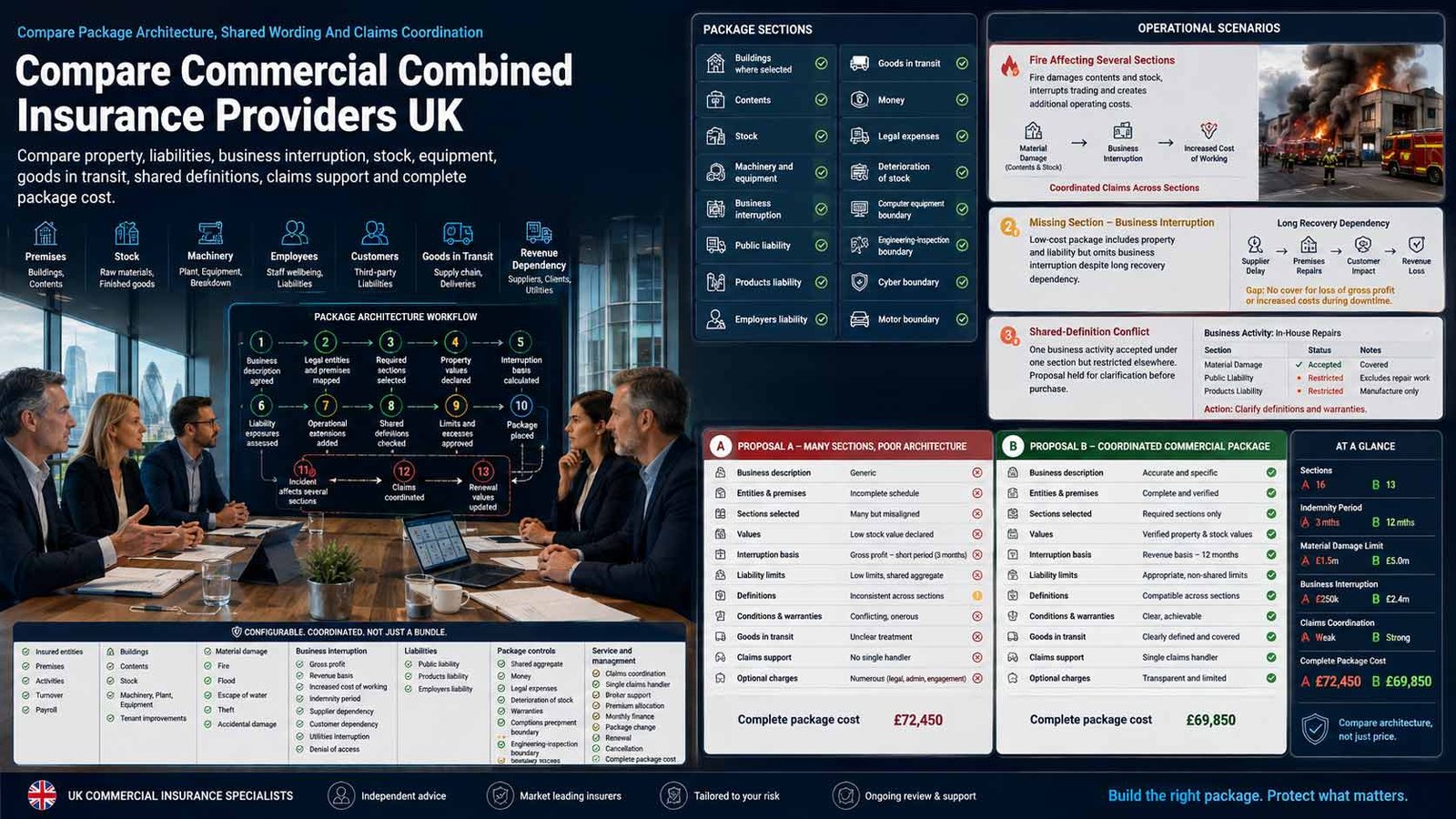
Build One Coordinated Policy Around The Whole Operating Risk
Commercial combined insurance brings selected property, interruption, liability and operational modules together under one policy, schedule, premium and renewal date.
- Define the complete risk before selecting individual modules
- Align property values, revenue, payroll and contract requirements
- Check how shared definitions, exclusions and claims interact
- Remove gaps and duplication without assuming every risk is included
Commercial combined insurance is a configurable multi-section business policy rather than one fixed cover. A package can include material damage, business interruption, public and products liability, employers’ liability, money, goods in transit, legal expenses, equipment breakdown, terrorism and other modules offered by the provider.
The value lies in coordination, not the number of sections. One schedule can simplify administration and claims, but a combined policy can still contain different limits, excesses, conditions, exclusions, declared values and indemnity periods for each module. Some sections may be mandatory within a product, while others are optional or unavailable for the trade.
This page compares the architecture and provider fit of a multi-cover commercial package. It does not replace the detailed assessment required for a single specialist policy and does not cover personal insurance.
Choose The Right Commercial Combined Insurance Route
Match the route to turnover, premises, assets, interruption dependency, liability exposure, sector complexity and the level of broker support required.
| Package Model | What It Usually Includes | Best-Fit Question |
|---|---|---|
| E-Traded SME Combined Policy | Digitally quoted property, interruption and liability modules for eligible smaller businesses with defined trade, turnover, values and claims thresholds. | Does the e-trade question set capture the real processes, stock, work away, products and interruption dependency? |
| Broker-Advised Commercial Combined | A broker structures a package, approaches one or more insurers and supports wording, placement, changes, claims and renewal. | Which insurers and package structures were considered, and what advice, fees and claims support are included? |
| Property-Led Combined Policy | Material damage is the core section, with interruption, liability, money, goods in transit and other modules added around premises and assets. | Are rebuilding, contents, stock and interruption values complete before the liability modules are attached? |
| Liability-Led Combined Package | Employers, public and products liability are central, with selected property, tools, stock, work away or legal-expenses sections added. | Does the business have sufficient premises and revenue protection, or has the package been designed around liability alone? |
| Manufacturing, Wholesale Or Distribution Package | Property, stock, machinery, products liability, interruption, goods in transit, breakdown and supply-chain extensions tailored to operational processes. | Are raw materials, work in progress, product exposure, machinery dependencies and supplier bottlenecks mapped? |
| Retail, Hospitality Or Premises Package | Contents, stock, customer-facing liability, employers’ liability, interruption, money, deterioration, glass or licence-related extensions where available. | Do footfall, seasonal stock, refrigeration, opening hours, security and dependency on the premises match the selected modules? |
| Mid-Market Manually Underwritten Combined | A flexible package for larger values, complex processes, multiple premises, higher limits, overseas exposure and bespoke endorsements. | Can the insurer coordinate specialist property, casualty and financial modules without forcing unsuitable standard wording? |
| Sector-Specific Combined Programme | A package designed around a defined trade such as engineering, printing, warehousing, technology, food, leisure or contracting. | Are sector exclusions, risk controls and extensions more suitable than a generic combined product? |
Eight Areas That Determine Commercial Combined Policy Fit
Use the same business description, modules, values, revenue, payroll, activities, contracts and claims history for every provider.
Comparison Criterion
Package Scope And Section Map
List every selected section, insured entity, premises, activity, product, asset class and operational dependency. Confirm which modules are mandatory, optional, unavailable or separately insured. A combined policy should show a clear boundary between property, interruption, liability, transit, money, legal, engineering and specialist sections.
Comparison Criterion
Property Values And Settlement Basis
Compare buildings where selected, tenants’ improvements, contents, machinery, computers, stock, customers’ goods and portable or temporarily removed property. Use current reinstatement or replacement values, include delivery and installation, review average clauses and index linking, and confirm how one event affects several property sections.
Comparison Criterion
Business Interruption Basis And Indemnity Period
Define gross profit, revenue, gross income or another insured basis correctly. Model the time to rebuild, replace machinery, recover customers and restore suppliers—not only the physical repair period. Check indemnity period, trends, payroll, increased cost of working, denial of access, utilities and dependency extensions.
Comparison Criterion
Liability Limits And Interactions
Compare employers’ liability, public liability and products liability limits, legal costs, work away, exports, pollution, subcontractors and contractual requirements. Confirm whether public and products liability share a combined aggregate and how claims arising from one event or product batch are grouped.
Comparison Criterion
Operational Extensions And Sublimits
Review goods in transit, money, glass, book debts, deterioration, equipment or machinery breakdown, crime, legal expenses, personal accident, directors’ liability or other modules offered. Identify sublimits, excesses, territorial restrictions, maintenance conditions and whether the extension duplicates another policy.
Comparison Criterion
Shared Definitions, Exclusions And Conditions
A combined wording can apply one definition or condition across several sections. Check business description, insured events, cyber and contamination exclusions, reasonable precautions, security, unoccupancy, hot work, waste, maintenance, notification, fraud and change-in-risk provisions at both general and section level.
Comparison Criterion
Claims Coordination And Recovery
Test a loss affecting property, interruption and liability at the same time. Confirm one claims contact, loss adjuster coordination, emergency payments, mitigation, forensic accounting, damaged stock, supplier evidence, legal defence, recoveries, complaints and how multiple excesses apply to the same incident.
Comparison Criterion
Provider Status, Governance And Complete Cost
Compare insurer identity, broker role, financial strength, FCA status, underwriting route, service contacts, annual premium, Insurance Premium Tax, instalment charges, broker fees, policy changes, renewal, cancellation, claims history portability and the cost of sections still purchased separately.
Measures To Define Before Selecting A Commercial Combined Provider
Translate package claims into written section, valuation, interruption, liability, condition, claims and commercial evidence.
| Measure | What It Should Define | Evidence To Request | Common Weakness |
|---|---|---|---|
| Package architecture | Every selected section, legal entity, premises and business activity | Section map, schedule, proposal, statement of fact and separate-policy register | A summary says combined cover without identifying missing modules |
| Property declared values | Rebuild, replacement, stock and equipment values by location and category | Valuations, asset register, stock records, lease responsibilities and index basis | One property total combines values that settle differently |
| Interruption exposure | Insured financial basis, dependencies and realistic recovery duration | Accounts, forecasts, recovery plan, machinery lead times, supplier and customer concentration | A 12-month indemnity period is selected without recovery modelling |
| Liability exposure | Payroll, turnover, work away, products, territories, subcontractors and contracts | Wage and turnover splits, product and export data, contracts and limit requirements | Public and products liability aggregation is not understood |
| Operational extensions | The purpose, limit, excess and conditions of each optional module | Extension wording, sublimit schedule, asset or transit data and overlap analysis | Several low sublimits create an appearance of broad cover |
| General conditions | The duties that can affect more than one section | Warranties, security, hot-work, maintenance, unoccupancy, notification and change controls | A general condition is reviewed only within the property section |
| Claims response | How one event is coordinated across damage, interruption and liability | Claims protocol, contacts, adjuster model, interim-payment process and sample reports | Separate handlers create inconsistent facts and delayed settlement |
| Gaps and duplication | Which risks remain outside the package or appear in more than one policy | Insurance register, policy comparison matrix, exclusions and responsibility owner | The buyer assumes one policy means every business risk is insured |
| Provider governance | Insurer, intermediary, underwriting route, claims handler and decision authority | FCA Firm Checker, Financial Services Register, terms of business and policy documents | The buyer cannot identify who underwrites or controls claims |
| Complete cost | Package premium and the total cost of finance, fees and retained separate covers | Annual premium, IPT, deposit, instalment total, fees and three-year cost model | Savings are claimed without including excluded or duplicated policies |
Commercial Combined Insurance Providers UK Businesses Can Consider
Shortlist providers whose package architecture, underwriting appetite, interruption expertise, liability capacity, claims model, regulated role and complete cost fit the business. Confirm current written terms before purchase.
Provider Profile
Allianz Insurance
Allianz offers broker-distributed Commercial Select for businesses with substantial turnover and Complete Business for eligible SMEs across manufacturing, wholesale, distribution and service trades. Include Allianz where the buyer needs a broad property-and-casualty package, specialist underwriting and coordinated claims. Confirm the selected product, mandatory modules, values, interruption basis, liability limits, endorsements, broker role, claims service and complete cost.
Review official Allianz Commercial Select informationProvider Profile
Zurich
Zurich’s SME Commercial Combined product combines up to 15 business covers in one policy, while its mid-market proposition supports larger and more complex organisations. Include it where a broker needs flexible e-traded or manually underwritten sections and risk-management support. Confirm turnover and trade eligibility, property values, interruption basis, liability modules, extensions, sublimits, claims route, fees and renewal.
Review official Zurich SME Commercial Combined informationProvider Profile
QBE
QBE Commercial Combined offers property, liability and financial options for SME and mid-market businesses, including material damage, interruption, equipment, machinery breakdown, terrorism, liability and selected financial lines. Include it where the buyer wants modular specialist underwriting across several risk classes. Confirm selected modules, policy version, aggregation, sublimits, territories, broker route, claims service and complete annual cost.
Review official QBE Commercial Combined informationProvider Profile
Intact Insurance
Intact Insurance provides Commercial Combined and Business Combined routes through brokers, with property damage as a core element and optional interruption, liability, transit, money, legal and computer sections depending on the product. Include it where an SME or mid-market buyer needs broker-led package placement. Confirm the exact Intact product, included modules, underwriting criteria, claims contact, insurer documents, fees and renewal.
Review official Intact Commercial Combined informationProvider Profile
AXA Business Insurance
AXA allows eligible SMEs to assemble business insurance around premises, contents, stock, liability and interruption requirements through its direct and broker channels. Include it where the business fits AXA’s occupation and value appetite and wants configurable cover rather than a manually underwritten mid-market programme. Confirm every selected section, declared value, interruption assumption, limit, exclusion, claims process, payment total and document set.
Review official AXA Business Insurance informationProvider Profile
Premierline
Premierline is a commercial insurance broker arranging combined packages for manufacturers, wholesalers, engineers, printers, warehouses and other SMEs. Its commercial combined route can bring property, contents, equipment, liability, interruption and legal-expenses covers together. Include it where the buyer wants adviser-led insurer comparison. Confirm panel scope, recommendation, insurer, broker fees, claims support, package changes and cancellation.
Review official Premierline Commercial Combined informationProvider Profile
Everywhen
Everywhen, formerly Towergate, arranges tailored commercial combined insurance for manufacturers, distributors, wholesalers, service and repair businesses, importers, exporters, retailers and other commercial enterprises. Include it where the business requires a broker to assemble liability, property damage, interruption, machinery, stock, work away and transit modules. Confirm insurers approached, advice, fees, claims route and annual cost.
Review official Everywhen Commercial Combined informationProvider Profile
Romero Insurance Brokers
Romero offers an SME commercial combined route designed to place several essential business protections within one tailored package. Include it where a smaller business wants an independent broker to assess property, liability, interruption and other relevant sections together. Confirm insurer panel, advice and service model, exact modules, values, sublimits, claims support, broker charges, policy changes and renewal.
Review official Romero SME insurance informationWhat Changes Commercial Combined Insurance Cost UK 2026
There is no meaningful universal package price because modules, values, sectors and recovery assumptions differ. Compare the total cost of the same package design.
| Cost Driver | Why It Changes Premium | What A Comparable Quote Should Show |
|---|---|---|
| Trade, processes and products | Manufacturing, heat, machinery, hazardous goods, food, chemicals and product exposure can increase several sections at once | Full activity description, process flow, materials, products, work away and exports |
| Premises and construction | Location, flood, construction, fire separation, neighbouring trades and occupancy affect property and interruption exposure | Addresses, construction, use, fire protection, security, utilities and loss history |
| Buildings, contents and stock values | Higher reinstatement and replacement values increase material-damage capacity | Professional valuations, asset register, stock maximums and tenant responsibilities |
| Revenue and indemnity period | Greater income dependency and longer recovery increase interruption exposure | Accounts, forecast, insured basis, recovery plan and indemnity period |
| Payroll and liability exposure | Employee numbers, manual work, public interaction, products and territories affect casualty pricing | Payroll and turnover splits, employee roles, visitors, products and exports |
| Machinery and supply-chain dependency | Specialist equipment, long lead times and concentrated suppliers can extend downtime | Machinery schedule, service contracts, replacement lead times and dependency map |
| Claims history and risk controls | Property, interruption and liability losses indicate future frequency and severity | Five-year or requested claims data, corrective action, surveys and control evidence |
| Selected extensions and sublimits | Transit, money, crime, legal, breakdown and other modules add insured exposure | Module schedule, limits, territories, assets, transactions and overlap review |
| Excesses and self-insured retention | Higher deductibles transfer more cost to the business and can reduce premium | Excess by section and event, affordability and multiple-excess treatment |
| Payment method and broker fees | Finance, intermediary charges and policy administration can change the total payable | Annual premium, IPT, deposit, instalment total, fees and cancellation costs |
| Commercial Model | Typical Position | What Must Be Confirmed |
|---|---|---|
| E-Traded SME Package | Standardised online or platform underwriting for eligible trades and values | Referral thresholds, mandatory modules, limits, exclusions, fees and changes |
| Broker-Placed Annual Package | A broker approaches insurers and arranges one 12-month combined policy | Insurers considered, advice basis, commission or fees, claims role and renewal |
| Manually Underwritten Mid-Market Policy | Underwriters assess complex values, processes, claims, limits and bespoke wording | Survey requirements, warranties, minimum premium, service contacts and governance |
| Layered Package Plus Separate Specialist Covers | The combined policy handles core risks while specialist policies remain separate | Responsibility map, gaps, overlap, claims coordination and total insurance spend |
Match The Provider To The Package Complexity And Operating Model
The right shortlist depends on premises, processes, assets, recovery time, liability exposure, products, territories and internal insurance capability.
Office, Service Or Lower-Complexity SME
Prioritise a clear section map, contents, interruption, public and employers’ liability, simple values, online documents, straightforward changes and a claims route that coordinates damage and loss of income without unnecessary specialist modules.
Retail, Hospitality Or Customer-Facing Premises
Prioritise stock peaks, fixtures, equipment, refrigeration, money, customer and employee liabilities, interruption, denial of access, utilities, security, unoccupancy, licences where relevant and a recovery period that reflects rebuilding customer demand.
Manufacturer, Wholesaler Or Distributor
Prioritise machinery, raw materials, work in progress, finished stock, products liability, goods in transit, supplier and customer dependencies, breakdown, fire controls, exports, batch exposure, long replacement lead times and broker-led wording review.
Multi-Site Or Mid-Market Business
Prioritise location-specific values, group entities, shared limits, business interruption by site, catastrophe exposure, higher liability capacity, risk engineering, bespoke extensions, financial strength, coordinated claims governance and specialist covers outside the core package.
How To Compare Commercial Combined Insurance Proposals
Issue one risk pack containing every legal entity, trading activity, site, construction, fire and security control, building and tenant responsibility, contents, stock, machinery, portable property, transit, annual revenue, insured interruption basis, indemnity period, payroll, public interaction, products, exports, subcontractors, contracts, claims history, risk surveys, required limits, preferred excesses, specialist policies retained outside the package and payment method. Require the provider to return a completed section map, values schedule, interruption schedule, liability schedule, endorsements, exclusions and commercial summary rather than a premium-only proposal.
- Every provider prices the same modules, entities, locations and values
- Interruption basis and indemnity period are supported by recovery evidence
- Liability limits, aggregates, products and work-away assumptions align
- General and section-specific conditions are returned before purchase
- Gaps, duplication and specialist policies outside the package are listed
- Annual and monthly totals include IPT, finance and fees
Compare One Complex Loss Across The Entire Package
Ask each provider how the policy would respond if a fire damages machinery and stock, stops trading, affects a customer order, creates employee and third-party allegations, and requires temporary premises and urgent replacement equipment.
A low premium is not a strong result when the property value is understated, the indemnity period is too short or claims are fragmented across incompatible sections.
Six Questions To Put To Every Commercial Combined Provider
The answers expose missing modules, unsuitable values, weak interruption design, shared exclusions and incomplete annual costs.
Which Sections, Entities And Premises Are Included?
Request a complete section map showing mandatory, selected, declined, unavailable and separately insured modules for every company, site, activity, product and territory.
How Have Property Values And Stock Been Calculated?
Obtain rebuilding and replacement basis, stock maximums, machinery installation, index linking, day-one uplift, average clauses, single-item limits and location splits.
How Does Business Interruption Match Our Recovery Plan?
Confirm insured basis, indemnity period, trends, payroll, increased cost of working, machinery lead times, supplier and customer dependencies, utilities and denial-of-access extensions.
How Do Liability Limits And Aggregates Interact?
Ask about employers, public and products liability, work away, exports, pollution, subcontractors, contractual liability, legal costs, one-event aggregation and products aggregates.
Which General Conditions Affect Several Sections?
Request cyber, contamination, security, unoccupancy, hot-work, maintenance, waste, alarm, notification, change-in-risk and reasonable-precaution conditions at policy and section level.
What Is The Complete Annual Cost And Claims Model?
Obtain section premiums, IPT, deposit, instalment total, finance, broker and administration fees, claims contacts, adjuster model, interim payments, changes, cancellation and renewal.
A Seven-Stage Commercial Combined Provider Evaluation
Move from a verified enterprise risk map to coordinated wording and claims operation rather than selecting a package from price or section count alone.
- Create a verified risk baseline covering legal entities, activities, premises, property, stock, machinery, revenue, payroll, products, contracts, dependencies, claims and current policies.
- Build a package architecture showing core combined sections, optional modules, specialist policies retained separately, required limits, sums insured and internal ownership.
- Validate property values and business interruption using current valuations, accounts, forecasts, recovery times, supplier and customer dependencies and realistic indemnity periods.
- Issue one quotation brief and scripted multi-section loss using the same modules, values, revenue, payroll, activities, history, inception date and payment assumptions.
- Shortlist providers by sector appetite, property and casualty expertise, wording, limits, claims coordination, financial strength, regulated status, risk support and complete cost.
- Complete due diligence and document review. Check FCA status, insurer identity, IPID, wording, schedule, statement of fact, values, interruption schedule, endorsements, fees and claims instructions.
- Purchase only after correcting inaccuracies. Assign section owners, store records, complete risk actions, update values and exposures, test claims escalation and compare again before renewal.
Commercial Combined Insurance Comparison Checklist
Use this table before purchasing, restructuring or renewing a commercial combined package.
| No. | Requirement | Evidence To Obtain Before Purchase | Confirmed |
|---|---|---|---|
| 01 | Commercial combined service boundary retained | The page and proposal remain focused on a multi-section commercial package rather than personal or one-cover-only insurance | |
| 02 | Every legal entity and activity declared | Companies, trading names, products, processes, work away, exports and acquisitions | |
| 03 | Package section map complete | Included, declined, unavailable and separately insured modules are recorded | |
| 04 | Every premises and property value verified | Buildings where selected, improvements, contents, machinery, stock and installation costs | |
| 05 | Business interruption basis approved | Gross profit, revenue or income calculation, trends, payroll and dependencies | |
| 06 | Indemnity period recovery-tested | Rebuild, planning, equipment lead time, recruitment, suppliers and customer return | |
| 07 | Liability exposure aligned | Payroll, turnover, public interaction, products, exports, subcontractors and contracts | |
| 08 | Limits, aggregates and legal costs understood | Employers, public and products liability plus event and annual aggregation | |
| 09 | Operational extensions justified | Transit, money, legal, breakdown, deterioration, crime and other selected modules | |
| 10 | Gaps and duplication documented | Specialist policies, exclusions, overlapping covers and ownership of each risk | |
| 11 | General conditions achievable | Security, unoccupancy, hot work, alarms, maintenance, notification and change controls | |
| 12 | Claims coordination tested | One incident across property, interruption, liability and specialist sections | |
| 13 | Provider and insurer verified | FCA status, insurer, broker, underwriting route, claims handler and terms of business | |
| 14 | Three-year commercial model complete | Premium, IPT, finance, fees, risk actions, retained covers and expected changes | |
| 15 | Renewal and change governance assigned | Values, turnover, payroll, sites, products, acquisitions, closures and document access |
Common Commercial Combined Insurance Buying Mistakes
Most avoidable problems begin with incomplete package design, weak values, short interruption periods, hidden sublimits or price-led selection.
| Mistake | Why It Creates Risk | Better Control |
|---|---|---|
| Assuming combined means comprehensive | A policy can still omit critical modules, locations, activities or limits | Use a written section and gap map |
| Selecting modules before mapping the business | The package can reflect familiar covers rather than the actual operating risk | Start with entities, sites, assets, revenue, people, products and dependencies |
| Using outdated property values | Underinsurance can affect material-damage and interruption recovery | Obtain current reinstatement and replacement values |
| Choosing a short indemnity period | Physical repair can finish before turnover, customers and supply chains recover | Model the full recovery path and add contingency |
| Treating public and products liability as identical | Products claims can aggregate differently and involve wider territories or batches | Compare limits, aggregates, exports and product wording |
| Adding extensions without testing sublimits | A package can appear broad while key modules carry low caps or restrictive conditions | Record purpose, limit, excess and scenario for every extension |
| Ignoring shared policy conditions | A general warranty or exclusion can affect several sections simultaneously | Review general and section wording together |
| Leaving specialist policies outside the map | Gaps, duplication and inconsistent claims facts can remain across separate contracts | Maintain one complete insurance and responsibility register |
| Comparing premiums with different modules | The cheaper proposal may exclude interruption, products, transit or higher values | Normalise the section schedule before comparing cost |
| Managing renewal as one administrative date only | Values, turnover, payroll, products and risk controls can change throughout the year | Use mid-term change and annual exposure governance |
Frequently Asked Questions
Answers to common questions from UK businesses comparing combined modules, values, interruption, liabilities, claims coordination and pricing.
What Is Commercial Combined Insurance?
Commercial combined insurance is a configurable policy that brings several business-insurance sections together under one contract, schedule, premium and renewal date. Depending on the product, sections can include property damage, business interruption, employers’ liability, public and products liability, money, goods in transit, legal expenses, breakdown and other selected covers.
Is Commercial Combined Insurance Legally Required In The UK?
The combined package itself is not generally compulsory. Certain sections can be legally required in specific circumstances, such as employers’ liability for most employers. Contracts, leases, lenders, customers, regulators or professional bodies can also require particular modules, limits and evidence.
Which Businesses Use Commercial Combined Insurance?
It is commonly used by SMEs and mid-market businesses with premises, stock, machinery, employees, customer or product liability and a need for interruption protection. Manufacturers, wholesalers, distributors, warehouses, engineers, printers, retailers, hospitality businesses and service companies can use tailored combined packages.
What Can A Commercial Combined Policy Include?
Available modules vary by insurer. A package can include buildings, contents, stock, machinery, business interruption, employers’ liability, public and products liability, goods in transit, money, legal expenses, deterioration, equipment breakdown, terrorism and selected financial or crime-related covers.
Is Commercial Combined Insurance Better Than Separate Policies?
A combined policy can simplify administration, renewal and claims and can reduce gaps when sections share consistent definitions. Separate policies may remain appropriate for specialist risks or different markets. Compare coverage, limits, conditions, claims coordination and total cost rather than assuming one structure is always better.
How Should A Business Calculate Commercial Combined Sums Insured?
Use current rebuilding and replacement values for property, maximum stock values, accurate machinery and installation costs, and the insurer’s required financial basis for business interruption. Payroll, turnover, products, exports and contract limits must also be declared consistently for liability sections.
How Long Should The Business Interruption Indemnity Period Be?
The period should cover the realistic time needed to rebuild or relocate, replace machinery, restore suppliers, recruit or retrain staff and recover customers and turnover. Twelve months can be too short for businesses with planning, specialist-equipment or supply-chain delays.
Can Commercial Combined Insurance Include Product And Public Liability?
Many combined products can include both public and products liability, but the limits, aggregate basis, territories, exclusions and contract requirements vary. Businesses should confirm how one event or batch of products is treated and whether exports or work away are accepted.
How Much Does Commercial Combined Insurance Cost UK 2026?
There is no reliable universal price because the package can combine different modules, values, turnover, payroll, processes, locations, limits and claims histories. Compare current proposals using the same package specification and include Insurance Premium Tax, instalment finance, broker fees and covers retained separately.
How Should UK Businesses Compare Commercial Combined Providers?
Give every insurer or broker the same legal entities, activities, premises, modules, property values, stock, revenue, indemnity period, payroll, products, contracts, claims history, required limits and payment assumptions. Compare wording, sublimits, conditions, claims coordination, gaps, complete annual cost, fees, renewal and cancellation.
Official Guidance And Provider Resources
Reviewed by Bhav Giva, Founder & Lead Analyst at CompareServices.co.uk, on 5 August 2026.
Use current ABI, FCA, GOV.UK, insurer and broker documentation to verify package sections, property values, business interruption, liability limits, optional modules, exclusions, conditions, claims procedures, insurer and intermediary status, Insurance Premium Tax, fees and contract terms. Product appetite, modules, premiums and wording can change. Obtain valuation, legal, business-continuity or appropriately authorised insurance advice where the package, property, liabilities or recovery assumptions are complex.
- Association of British Insurers — Business Insurance
- Association of British Insurers — Commercial Property Insurance
- Association of British Insurers — Business Interruption Insurance
- FCA — FCA Firm Checker
- FCA — Financial Services Register
- GOV.UK — Insurance Premium Tax
- Allianz — Commercial Select
- Allianz — Complete Business
- Zurich — SME Commercial Combined
- QBE — Commercial Combined
- Intact Insurance — Commercial Combined
- AXA — Business Insurance
- Premierline — Commercial Combined Insurance
- Everywhen — Commercial Combined Insurance
- Romero Insurance Brokers — SME Insurance