
Compare Office / Commercial Buildings Insurance Providers UK
Compare Reinstatement Value, Building Fabric, Fixtures, Professional Fees, Debris Removal, Flood, Subsidence, Escape Of Water, Unoccupancy, Claims Support, Pricing And Complete Policy Cost
Compare commercial building insurance UK providers by insured legal entities, ownership and lease responsibilities, owner-occupied offices, shops, surgeries, workshops, warehouses, factories, hospitality premises, community buildings and commercially let premises, construction, age, floor area, extensions, outbuildings, walls, roofs, foundations, permanent fixtures, fitted services, lifts, gates, fences, car parks, underground pipes and cables, rebuilding cost, declared value, Day One uplift, index linking, professional fees, demolition, debris removal, site clearance, statutory-authority requirements, fire, explosion, storm, flood, escape of water, impact, malicious damage, theft-related damage, subsidence, accidental damage, glass, terrorism, trace and access, alternative premises, loss of rent or business interruption where selected, unoccupancy, security, fire protection, maintenance, listed or heritage features, hazardous processes, excesses, insurer identity, FCA status, annual premium, Insurance Premium Tax, finance, broker fees, policy changes, renewal and cancellation. Give every provider the same property schedule, construction, occupation, reinstatement assessment, loss history, risk controls, required extensions and payment assumptions before comparing proposals.
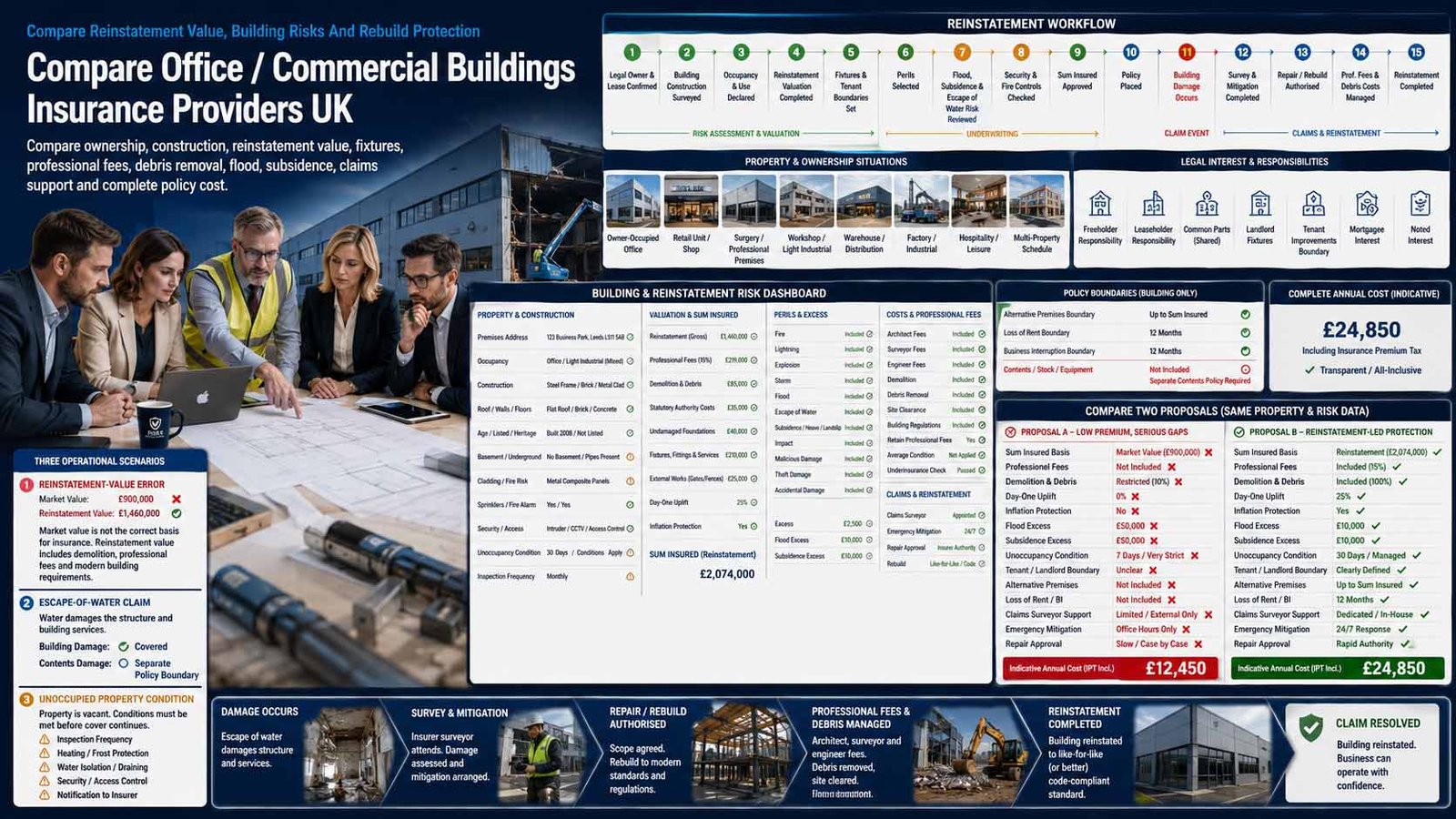
Insure The Building For Reinstatement, Not Its Sale Price
Commercial buildings insurance is designed to fund repair or rebuilding when insured physical damage affects offices and other business premises.
- Confirm who is responsible for insuring the structure under the title, lease or finance agreement
- Use a current professional reinstatement assessment rather than market value
- Include professional fees, demolition, debris removal and statutory requirements
- Disclose construction, occupancy, unoccupancy and risk-control changes promptly
Commercial property insurance can cover the cost of repairing or rebuilding business premises after insured events such as fire, storm, flood, escape of water, malicious damage and other selected risks. The insured building can include its structure, permanent fixtures, fitted services, walls, gates, fences, car parks and underground pipes or cables when stated in the wording.
The building sum insured should reflect the cost of reinstating the premises, not the purchase price, market value, mortgage balance or expected sale value. A serious loss can involve demolition, debris removal, architects, surveyors, engineers, planning requirements, building regulations, access constraints, inflation and specialist materials as well as ordinary labour and construction costs.
This comparison covers offices and commercial buildings, including owner-occupied premises and commercial property risks. It does not cover home, domestic buy-to-let or residential landlord insurance.
Choose The Right Office Or Commercial Buildings Insurance Route
Match the route to ownership, construction, occupancy, reinstatement value, number of premises, hazardous features, heritage status and the level of professional advice required.
| Buying Model | What It Usually Includes | Best-Fit Question |
|---|---|---|
| Direct Online Owner-Occupied SME Cover | Digital quotation for eligible offices, shops, surgeries, salons and lower-complexity commercial premises with standard construction and values. | Can the online questions capture construction, extensions, tenants’ improvements, flood, subsidence, unoccupancy and specialist features accurately? |
| Office Insurance Package With Buildings Section | Commercial building protection combined with selected contents, interruption, glass, legal or liability sections for an office-based business. | Is the structural reinstatement value independently verified rather than inferred from contents or package limits? |
| Broker-Placed SME Commercial Property | A broker presents the premises, occupation, values, loss history and risk controls to one or more commercial insurers. | Which insurers were considered, what advice was given and what claims, survey and renewal support are included? |
| Industrial, Workshop Or Warehouse Buildings Policy | Manually reviewed property cover for machinery, heat, hazardous materials, storage, composite panels, loading areas and operational processes. | Do the insurer’s construction, fire-protection and occupation assumptions match how the building is actually used? |
| Commercial Property Owner Or Portfolio Policy | One policy covering one or several commercial premises, with building damage, loss of rent and property-owner extensions where selected. | Are every premises, tenant trade, lease responsibility, rent exposure and unoccupied period separately declared? |
| Listed, Heritage Or Non-Standard Construction Cover | Specialist wording and valuation for listed status, traditional materials, conservation requirements, unusual roofs, timber frames or difficult access. | Can the insurer reinstate using required methods and materials rather than applying ordinary modern-building assumptions? |
| Vacant, Partially Occupied Or Redevelopment Cover | Restricted or specialist cover for premises that are empty, between tenants, awaiting sale, undergoing refurbishment or changing use. | Which perils remain insured and what inspection, water, heating, security and works conditions apply? |
| Mid-Market, Multi-Site Or International Property Programme | Primary and excess property capacity, risk engineering, multinational coordination and bespoke claims governance for larger values and complex sites. | Can the provider coordinate location values, catastrophe exposure, local policies, engineering surveys and large-loss response? |
Eight Areas That Determine Commercial Buildings Policy Fit
Use the same property schedule, construction, occupation, reinstatement values, insured perils, risk controls, loss history and payment assumptions for every provider.
Comparison Criterion
Ownership, Lease And Insurable Interest
Confirm the legal owner, mortgagee, freeholder, leaseholder and every entity requiring an interest noted. Read leases and finance agreements to determine responsibility for the structure, common parts, glass, tenant-installed fixtures, alterations and service charges. Avoid duplicate insurance or an uninsured responsibility between owner and occupier.
Comparison Criterion
Reinstatement Cost And Declared Value
Use a current professional assessment of the complete rebuilding cost. Include demolition, debris removal, professional fees, access, site constraints, materials, labour, statutory requirements and VAT where applicable. Compare declared value, sum insured, Day One uplift, index linking, average clauses and how inflation is handled during the policy and reconstruction period.
Comparison Criterion
Building Definition And Permanent Property
Compare the structure, foundations, roofs, walls, floors, permanent fixtures, fitted services, lifts, boilers, solar installations, gates, fences, yards, car parks, roads, landscaping, signs and underground pipes or cables. Confirm tenants’ improvements, landlord’s fixtures, outbuildings, mezzanines and recent extensions rather than relying on a generic building description.
Comparison Criterion
Insured Perils And Accidental Damage
Review fire, lightning, explosion, earthquake, storm, flood, escape of water, impact, malicious damage, riot, theft-related damage, subsidence, ground heave, landslip, sprinkler leakage, accidental damage and glass. Check exclusions, excesses, geographic flood information, drainage, flat roofs, ageing services and whether gradual deterioration, wear and tear or poor maintenance remains outside cover.
Comparison Criterion
Unoccupancy, Security And Change Of Use
Policies can restrict cover after a defined period of unoccupancy or when occupation changes. Compare notification deadlines, inspections, water isolation, heating, mail removal, alarm activation, locks, boarding, waste removal and record keeping. Confirm partial occupancy, working hours, subletting, refurbishment and temporary closure before relying on standard wording.
Comparison Criterion
Specialist Extensions And Catastrophe Risks
Assess terrorism, trace and access, loss of metered water, alternative premises, architects’ fees, public-authority requirements, landscaped areas, fly-tipping, illegal cultivation, debris removal and emergency access where relevant. Flood, subsidence, listed status, combustible construction and high-value plant can require special underwriting, limits or risk improvements.
Comparison Criterion
Risk Engineering, Maintenance And Claims Response
Compare fire and electrical surveys, alarms, sprinklers, compartmentation, roof and drainage maintenance, water-leak controls, security, hot-work permits, contractor management and business-continuity support. Test emergency assistance, loss adjuster access, interim payments, reinstatement decisions, alternative premises, cash settlement and large-loss governance.
Comparison Criterion
Provider Status, Contract Terms And Complete Cost
Identify the insurer, broker, underwriting platform, surveyor and claims handler. Verify FCA status, financial strength, policy period, excesses, warranties, risk-improvement deadlines, premium, Insurance Premium Tax, finance charges, broker fees, mid-term changes, cancellation, renewal, index adjustments and document access after switching provider.
Measures To Define Before Selecting A Commercial Buildings Provider
Translate broad property descriptions into written ownership, valuation, construction, occupation, peril, condition, claims and commercial evidence.
| Measure | What It Should Define | Evidence To Request | Common Weakness |
|---|---|---|---|
| Insurable interest | Who owns, occupies, finances or must insure each part of the premises | Title, lease, mortgage conditions, service-charge documents and entity structure | Owner and occupier assume the other party insures the same structure |
| Reinstatement value | The complete cost of rebuilding after a total loss | Professional reinstatement assessment, measurements, construction data and valuation date | Market value or mortgage balance is used instead |
| Declared value and uplift | The value at policy inception and the inflation allowance during the policy period | Schedule, Day One percentage, index basis, review date and average wording | An uplift is treated as a substitute for an accurate base value |
| Building composition | Walls, roof, floors, cladding, insulation, frame, services and permanent fixtures | Survey, plans, photographs, fire assessment, asbestos information and alteration records | Composite panels, flat roofs or extensions are omitted |
| Occupation and processes | How each area is used, including tenants, storage, heat, machinery and hazardous goods | Site plan, occupancy schedule, process description, opening hours and licences | The proposal describes an office although workshops or storage occupy part of the site |
| Peril exposure | Flood, storm, subsidence, escape of water, fire, theft and malicious-damage conditions | Flood mapping, drainage, claims history, ground reports, maintenance and insurer terms | A standard excess is assumed across all perils |
| Unoccupancy | When restrictions begin and which controls preserve cover | Inspection log, alarm records, water and heating controls, security plan and notification | Temporary closure passes the policy threshold without disclosure |
| Risk controls | The protective systems, inspections and maintenance required by the insurer | Fire, electrical, sprinkler, alarm, roof, water-leak and contractor records | A warranty is accepted without assigning an owner or evidence process |
| Claims service | How emergency action, mitigation, valuation and reinstatement are coordinated | Claims protocol, contacts, adjuster model, interim-payment process and sample reporting | The provider cannot explain how a large building loss will be managed |
| Provider verification and cost | The insurer, intermediary, claims handler and complete annual commercial position | FCA Firm Checker, Register, wording, premium, IPT, finance, fees and renewal terms | The comparison uses premium alone and ignores risk work or finance costs |
Office And Commercial Buildings Insurance Providers UK Businesses Can Consider
Shortlist providers whose property appetite, valuation approach, construction acceptance, insured perils, risk engineering, claims expertise, regulated role and complete cost fit the premises. Confirm current written terms before purchase.
Provider Profile
Allianz Insurance
Allianz provides business buildings and contents cover for eligible commercial customers and broker-distributed property products for larger or portfolio risks. Its published material covers events including fire, storm and flood, while specialist property routes add risk and claims expertise. Include Allianz where a business wants an established commercial insurer. Confirm the exact product, rebuilding values, perils, surveys, excesses, claims route and complete cost.
Review official Allianz buildings and contents informationProvider Profile
AXA Business Insurance
AXA’s commercial property insurance supports eligible shops, offices, surgeries and other premises, with buildings, permanent fixtures and selected extensions. Published cover can include gates, fences, car parks and underground services, with optional subsidence and other property features. Include AXA where an SME wants a direct online route. Confirm building ownership, declared value, construction, flood, unoccupancy, excesses and annual total.
Review official AXA commercial property informationProvider Profile
Hiscox
Hiscox offers commercial property and office insurance for small businesses that own the premises from which they operate. Its buildings proposition addresses fire, flood and storm damage and can be combined with selected business covers. Include Hiscox where an owner-occupier wants a direct or advised route and UK claims support. Confirm premises eligibility, rebuilding basis, accidental damage, subsidence, unoccupancy, excesses and policy changes.
Review official Hiscox commercial property informationProvider Profile
Direct Line For Business
Direct Line for Business offers building cover through several business policies, with published insured-event examples including fire, explosion, storm, flood, escape of water, malicious damage and accidental damage, subject to exclusions and selected options. Include it where an eligible SME wants a direct digital quotation. Confirm whether buildings are standard or optional, the exact policy, rebuilding value, terrorism option, excesses and claims route.
Review official Direct Line business buildings informationProvider Profile
NFU Mutual
NFU Mutual’s commercial property cover can protect buildings, contents and stock against selected physical damage, supported by local agency advice. Commercial Select allows businesses to assemble relevant property and interruption sections, while specialist routes serve property owners and complex risks. Include NFU Mutual where site understanding and adviser support matter. Confirm occupation, values, insured events, surveys, claims service and annual cost.
Review official NFU Mutual commercial property informationProvider Profile
Aviva
Aviva offers buildings and contents protection through broker-distributed business insurance and provides extensive commercial property risk-management resources. Its current specialist-partner service includes professional reinstatement cost assessments that consider labour, materials, access and debris removal. Include Aviva where a broker-led placement, valuation support and property risk controls are important. Confirm insurer product, values, risk actions, claims governance, fees and renewal.
Review official Aviva business insurance informationProvider Profile
Zurich
Zurich provides broker-distributed property insurance for SME, mid-market and larger organisations. Its mid-market proposition protects against financial impacts from damage to premises, machinery and stock and can address associated loss of gross profit or revenue. Include Zurich where a multi-site or higher-value business needs risk engineering and coordinated property claims. Confirm location values, catastrophe exposure, surveys, limits, local policies and service team.
Review official Zurich mid-market property informationProvider Profile
QBE
QBE’s property insurance supports risks ranging from single-site businesses to multinational organisations, with flexible commercial property and machinery protection. Its SME route includes offices, retail, wholesale, distribution and light manufacturing, while real-estate products address physical damage and loss of rental income. Include QBE for specialist, industrial, portfolio or complex property risks. Confirm capacity, construction, perils, engineering, claims expertise and programme structure.
Review official QBE property insurance informationWhat Changes Commercial Building Insurance Cost UK 2026
There is no reliable universal property premium because buildings, values, construction, occupations, locations and controls differ. Compare the complete annual cost of the same premises specification.
| Cost Driver | Why It Changes Premium | What A Comparable Quote Should Show |
|---|---|---|
| Reinstatement and declared value | Higher rebuilding costs increase the maximum property loss the insurer may face | Professional assessment, valuation date, declared value, uplift and sum insured |
| Construction and building age | Combustible panels, timber, flat roofs, heritage materials and ageing services can increase severity | Walls, roof, frame, insulation, services, extensions and survey evidence |
| Occupation and processes | Heat, machinery, storage, public access, food preparation and hazardous materials change fire and damage exposure | Use by area, processes, tenants, opening hours and stored materials |
| Location and catastrophe exposure | Flood, storm, subsidence, crime and access conditions differ by site | Full address, flood information, ground history, claims and surrounding risks |
| Fire, security and water controls | Alarms, sprinklers, compartmentation, electrical maintenance and leak detection can reduce frequency or severity | Inspection records, certificates, maintenance contracts and response procedures |
| Occupancy and unoccupied periods | Empty or partially used premises can face greater theft, fire, water and malicious-damage risk | Occupancy schedule, closure periods, inspections, water, heating and security |
| Selected perils and extensions | Subsidence, accidental damage, terrorism, glass, trace and access and landscaping add exposure | Required extensions, limits, excesses, exclusions and loss scenarios |
| Claims history and risk improvements | Previous fire, water, flood, theft or subsidence losses affect underwriting and required controls | Five-year or requested claims data, corrective action and survey completion |
| Excess and self-insured retention | Higher deductibles transfer more loss to the business and can reduce premium | Excess by peril and premises, affordability and aggregate treatment |
| Finance, broker fees and surveys | Instalments, professional valuations, intermediary charges and risk work change total cost | Premium, IPT, deposit, instalment total, fees, surveys and required improvements |
| Commercial Model | Typical Position | What Must Be Confirmed |
|---|---|---|
| Direct Online SME Buildings Policy | Digital quotation for eligible, lower-complexity commercial premises | Building definition, declared value, perils, excesses, optional covers and annual total |
| Broker-Placed Commercial Property | A broker presents the premises and approaches suitable commercial insurers | Insurers considered, advice basis, commission or fees, surveys, claims role and renewal |
| Manually Underwritten Industrial Or Specialist Property | Underwriters and engineers assess construction, processes, values and controls | Risk improvements, warranties, primary and excess capacity, service team and review timetable |
| Multi-Site Or Portfolio Programme | Several locations are insured under one coordinated property contract | Location values, catastrophe aggregation, unoccupancy, acquired sites, claims allocation and total cost |
Match The Provider To The Premises, Construction And Loss Severity
The right shortlist depends on who owns the property, how it is built and occupied, the complete reinstatement cost, catastrophe exposure and the support required after a major loss.
Owner-Occupied Office Or Professional Premises
Prioritise correct structural responsibility, fitted services, glass, accidental damage, escape of water, alternative premises, straightforward digital documents, accurate valuation, easy policy changes and claims support that can coordinate repairs without confusing building and contents responsibilities.
Retail, Hospitality Or Customer-Facing Building
Prioritise fire, flood, glass, theft-related damage, public areas, signs, external fixtures, kitchens, refrigeration plant, seasonal closure, security, water damage, licence implications, alternative premises and rapid emergency support to restore safe customer access.
Workshop, Warehouse, Factory Or Mixed-Use Site
Prioritise construction, composite panels, heat and machinery, hazardous storage, compartmentation, sprinklers, loading areas, roof and drainage maintenance, electrical inspections, high rebuilding values, specialist surveys, business-continuity coordination and claims experts familiar with industrial reinstatement.
Multi-Site, Portfolio, Heritage Or Complex Premises
Prioritise professional location schedules, listed or non-standard materials, catastrophe aggregation, unoccupied sites, acquisitions, disposals, loss-of-rent or interruption interfaces, primary and excess capacity, risk engineering, insurer financial strength and large-loss governance.
How To Compare Commercial Buildings Insurance Proposals
Issue one property-risk pack containing every legal entity, owner and occupier, title and lease responsibility, full address, use by area, tenant trade, opening hours, construction, age, floor area, roof, frame, cladding, insulation, extensions, outbuildings, listed status, permanent fixtures, services, solar or engineering installations, current reinstatement assessment, declared value, Day One uplift, professional fees, debris removal, VAT treatment, flood and subsidence information, claims history, fire and security systems, electrical and sprinkler records, water controls, maintenance, unoccupied periods, required extensions, excess tolerance, finance method and planned alterations. Require the provider to return completed valuation, building, peril, condition, claims and commercial schedules rather than a premium-only quote.
- Every provider assesses the same buildings, values, construction and occupation
- Declared value, Day One uplift, index linking and average are directly comparable
- Flood, subsidence, escape of water, accidental damage and terrorism are explicit
- Unoccupancy, security, maintenance and survey conditions are returned before purchase
- Insurer, intermediary, claims handler and loss-adjuster arrangements are identified
- Annual and monthly totals include IPT, finance, fees, valuations and risk improvements
Compare The Same Major Building Loss End To End
Ask each provider how the policy would respond if a fire causes structural damage, requires demolition and debris removal, triggers modern building-regulation work, closes the premises for an extended period and reveals that specialist machinery and tenant improvements complicate reinstatement.
A low premium is not a strong result when the declared value is wrong, professional fees are omitted, the premises breach an unoccupancy condition or the business cannot fund required risk improvements.
Six Questions To Put To Every Commercial Buildings Provider
The answers expose incorrect values, omitted structures, restricted perils, unachievable conditions, weak claims support and incomplete annual costs.
What Exactly Is Included In The Building Definition?
Request the structure, foundations, permanent fixtures, fitted services, walls, gates, fences, yards, car parks, signs, landscaping, outbuildings, extensions, tenant improvements and underground services.
How Should The Declared Value And Sum Insured Be Set?
Confirm the valuation date, reinstatement basis, professional fees, demolition, debris removal, access, statutory requirements, VAT, Day One uplift, index linking and average-clause treatment.
Which Perils, Excesses And Restrictions Apply?
Ask about fire, storm, flood, escape of water, subsidence, malicious damage, impact, accidental damage, glass, terrorism, flat roofs, water systems and location-specific excesses.
What Happens When The Premises Is Empty Or Changes Use?
Obtain the unoccupancy threshold, notification duty, inspections, water, heating, alarm, security and waste controls and the process for tenants, refurbishment, closure or altered occupation.
Which Surveys, Warranties And Risk Improvements Are Required?
Request fire, electrical, sprinkler, alarm, roof, drainage, flood, water-leak and security requirements, completion deadlines, evidence standards and consequences of non-compliance.
What Is The Complete Annual Cost And Claims Model?
Obtain premium, IPT, deposit, finance, broker and administration fees, valuation and survey costs, claims contacts, adjuster model, interim payments, policy changes, cancellation and renewal.
A Seven-Stage Commercial Buildings Provider Evaluation
Move from verified property responsibility and reinstatement values to tested peril, condition and claims wording rather than selecting a policy from price alone.
- Create a verified property baseline covering entities, ownership, leases, premises, use, construction, permanent fixtures, services, values, claims, occupancy and planned alterations.
- Obtain or update professional reinstatement assessments and define declared values, Day One uplift, professional fees, debris removal, VAT position and catastrophe concentration.
- Prepare a prioritised requirement catalogue covering building definition, insured perils, excesses, extensions, unoccupancy, security, maintenance, surveys, claims and complete cost.
- Issue one quotation brief and scripted major-loss scenario using the same property schedule, values, controls, claims history, inception date, excess and payment assumptions.
- Shortlist providers by property appetite, valuation approach, construction acceptance, risk engineering, wording, claims expertise, financial strength, regulated status and complete cost.
- Complete due diligence and document review. Check FCA status, insurer identity, IPID, wording, schedule, statement of fact, valuation data, endorsements, risk actions, fees and claims instructions.
- Purchase only after correcting inaccuracies. Complete required improvements, retain inspections and valuations, notify changes promptly, test emergency contacts and compare again before renewal.
Commercial Buildings Insurance Comparison Checklist
Use this table before purchasing, changing or renewing office and commercial building cover.
| No. | Requirement | Evidence To Obtain Before Purchase | Confirmed |
|---|---|---|---|
| 01 | Commercial-buildings service boundary retained | The comparison covers offices and commercial premises and excludes home and residential landlord insurance | |
| 02 | Every legal entity and insurable interest declared | Owner, occupier, mortgagee, freeholder, leaseholder and noted interests | |
| 03 | Every premises and structure listed | Main building, extensions, outbuildings, yards, gates, services and permanent fixtures | |
| 04 | Professional reinstatement assessment current | Valuation date, methodology, measurements, construction and complete rebuild cost | |
| 05 | Declared value and Day One basis approved | Base value, uplift, index linking, sum insured, average and inflation review | |
| 06 | Professional fees and debris costs included | Architects, surveyors, engineers, demolition, clearance, access and statutory work | |
| 07 | Construction and occupation accurate | Walls, roof, frame, insulation, cladding, use, tenants, heat, machinery and storage | |
| 08 | Insured perils and excesses mapped | Fire, flood, storm, escape of water, subsidence, malicious and accidental damage | |
| 09 | Unoccupancy controls achievable | Notification, inspection, water, heating, alarm, security, waste and records | |
| 10 | Fire, water and security controls evidenced | Risk assessments, inspections, alarms, sprinklers, electrics, roofs and leak controls | |
| 11 | Specialist features disclosed | Listed status, unusual materials, flat roofs, solar, asbestos, flood and ground history | |
| 12 | Extensions and interfaces confirmed | Terrorism, glass, trace and access, alternative premises, rent or interruption | |
| 13 | Claims protocol tested | Emergency mitigation, adjuster, experts, interim payments, reinstatement and complaints | |
| 14 | Provider and insurer verified | FCA status, insurer, intermediary, underwriting route and financial strength | |
| 15 | Three-year cost and change governance complete | Premium, IPT, finance, fees, valuations, risk work, alterations, renewal and cancellation |
Common Commercial Buildings Insurance Buying Mistakes
Most avoidable problems begin with market-value assumptions, outdated valuations, incomplete building schedules, undeclared changes or unoccupancy conditions discovered after a loss.
| Mistake | Why It Creates Risk | Better Control |
|---|---|---|
| Using market value as the building sum insured | Sale price does not represent demolition, professional fees and complete reconstruction | Use a professional reinstatement assessment |
| Treating Day One uplift as a replacement for valuation | Inflation protection cannot correct an inaccurate starting value | Set the base declared value correctly first |
| Omitting permanent fixtures and external property | Gates, car parks, services, solar equipment or extensions can remain uninsured | Use a complete building and site schedule |
| Describing mixed premises as office-only | Storage, workshops, kitchens, tenants and processes can change underwriting materially | Declare use by area and entity |
| Assuming every cause of damage is standard | Flood, subsidence, accidental damage and terrorism can carry exclusions or separate terms | Compare each required peril and excess |
| Ignoring unoccupancy thresholds | Cover can narrow after temporary closure or between tenants | Notify the insurer and maintain required controls |
| Accepting warranties without an evidence owner | Failure to maintain alarms, inspections or fire controls can affect claims | Assign, calendar and retain compliance evidence |
| Failing to update after alterations or change of use | Extensions, refurbishment, new tenants and processes change values and risk | Use formal mid-term change control |
| Comparing premiums with different declared values | The cheapest quote may rely on lower values, fewer perils or larger excesses | Normalise every proposal before scoring |
| Leaving claims planning until after a loss | Emergency action, evidence and reinstatement decisions become slower and less controlled | Test contacts, records and authority in advance |
Frequently Asked Questions
Answers to common questions from UK businesses comparing reinstatement values, insured perils, ownership, leases, unoccupancy, risk conditions, claims and pricing.
What Is Commercial Buildings Insurance?
Commercial buildings insurance can cover the cost of repairing or rebuilding offices and other business premises after insured physical damage. Depending on the wording, the building can include its structure, permanent fixtures, fitted services, walls, gates, car parks and underground pipes or cables.
Is Commercial Building Insurance Legally Required In The UK?
Commercial buildings insurance is not generally compulsory by statute. A commercial mortgage provider, freeholder, lease, investor or contract may require specified cover and noted interests. Owners should protect the full reinstatement exposure even where there is no legal obligation.
Should A Commercial Building Be Insured For Market Value?
No. The building should normally be insured using its reinstatement cost rather than purchase price or market value. Reinstatement can include demolition, debris removal, labour, materials, professional fees, access, building regulations and specialist reconstruction requirements.
What Is A Day One Declared Value?
The declared value is generally the estimated rebuilding cost at the start of the policy period, before the selected Day One inflation uplift. The uplift helps address cost increases during the policy and reconstruction period but does not replace an accurate professional starting valuation.
What Does Commercial Building Insurance Usually Cover?
Selected cover can include fire, explosion, storm, flood, escape of water, impact, malicious damage, theft-related damage, subsidence and accidental damage. Exact perils, excesses and exclusions vary, and wear, gradual deterioration and poor maintenance are commonly excluded.
Does Commercial Buildings Insurance Cover Empty Premises?
Cover may continue for a limited period, but policies commonly restrict insured perils or impose inspection, water, heating, alarm, security and waste-removal conditions after a defined unoccupancy threshold. Temporary closure, refurbishment and tenant changes should be disclosed promptly.
Who Insures A Commercial Building When The Business Rents It?
Responsibility depends on the lease. The freeholder or landlord may insure the structure and recover the cost, while the tenant may remain responsible for glass, alterations, tenant-installed fixtures or other parts. The parties should check the lease and confirm responsibilities in writing.
Does Commercial Buildings Insurance Include Business Interruption?
Not automatically. Building damage and business interruption are separate sections even when purchased together. A business should separately verify the insured financial basis, indemnity period, alternative premises and dependencies rather than assuming the building policy replaces lost income.
How Often Should A Commercial Reinstatement Value Be Reviewed?
The value should be reviewed whenever the building is acquired, extended, altered or changes use and at suitable intervals thereafter. Construction inflation, access, regulations and specialist materials can change quickly, so businesses should use current professional advice rather than relying only on index linking.
How Should UK Businesses Compare Commercial Buildings Providers?
Give every insurer or broker the same ownership, premises, construction, occupation, reinstatement assessment, declared value, Day One uplift, claims history, insured perils, risk controls, unoccupancy and payment assumptions. Compare wording, excesses, surveys, claims support and complete annual cost.
Official Guidance And Provider Resources
Reviewed by Bhav Giva, Founder & Lead Analyst at CompareServices.co.uk, on 5 August 2026.
Use current ABI, FCA, GOV.UK, insurer, broker, valuation and risk-engineering documentation to verify rebuilding values, declared-value and Day One treatment, building definitions, insured perils, excesses, unoccupancy, risk conditions, claims procedures, insurer and intermediary status, Insurance Premium Tax, fees and policy terms. Property appetite, premiums, inflation, construction costs and wording can change. Obtain professional reinstatement, surveying, legal or appropriately authorised insurance advice where ownership, construction, lease responsibility, heritage status, values or catastrophe exposure are complex.
- Association Of British Insurers — Commercial Property Insurance
- Association Of British Insurers — Insurance For Small Businesses
- FCA — FCA Firm Checker
- FCA — Financial Services Register
- GOV.UK — Insurance Premium Tax
- Allianz — Buildings And Contents Insurance For Business
- Allianz — Commercial Property Guidance Notes
- AXA — Commercial Property Insurance
- Hiscox — Commercial Property Insurance
- Direct Line For Business — Business Buildings Insurance
- NFU Mutual — Commercial Property Insurance
- Aviva — Business Insurance
- Aviva — Reinstatement Cost Assessments
- Zurich — Mid-Market Property Insurance
- QBE — Property Insurance